
The Impact of the Energy Crisis on the Hungarian Economy

HIIA Perspective – Written by Philip Pilkington
Hungary was severely impacted by the previous energy crisis in 2022–2023. Recent polling taken prior to the election shows that even three years later the economy remains a top issue for Hungarian voters. In this paper, we model the impact of the energy crisis on the Hungarian economy over the next 12–18 months. We find that inflation could rise from 2.1 percent today to anywhere between 34 percent and 59 percent in July 2027. This compares with the previous inflationary peak of 26 percent in January 2023. We also find that the forint–euro exchange rate (HUF–EUR) could fall anywhere between 17 percent and 31 percent compared to the previous decline in the value of the forint in the last energy crisis between February and October 2022 of 15 percent. The circumstances in the coming months will require extensive policy action both by the government and the central bank to deal with the effects of this impact.
The PDF version is available here!
Dire Straits
It is now broad consensus that the crisis in the Middle East is going to result in a major global energy crisis. The only question now remaining is how severe this crisis will be. The Strait of Hormuz was blocked by the Iranian Revolutionary Guard Corps (IRGC) on February 28, 2026—although this blockage was not formally recognized by the IRGC until March 4.[1] At the time of writing, the strait has been closed for two and a half months. Even if it was reopened immediately, it has already been closed for long enough that a severe global energy and food shock is almost certain. The Financial Times recently reported that this shock will likely hit around the end of May 2026, citing oil traders in global markets, who are alarmed at how fast oil supplies are being run down.[2]
The closure of the Strait of Hormuz has resulted in disruptions to all the important elements of the global energy supply. This means that the following volumes are disrupted: 10 percent of the global petroleum supply[3]; 15–20 percent of the global supply of jet fuel[4]; 15–20 percent of the global liquified natural gas (LNG) supply, which is around 5–10 percent of the total global gas supply[5]; and 8–12 percent of the global diesel supply.[6] The closure of the strait will also likely precipitate a major global food crisis. Around 20–35 percent of the world’s fertilizer supply is shipped through the Strait.[7] There are already reports that 70 percent of farmers in the United States have been unable to get access to enough fertilizer for the spring planting season. This will result in a significant shortage of food on the global market.[8]
Economists are already debating the impact that this will have on the global economy. The consensus that is emerging is that the closure has already resulted in shortages that are enough to generate shortages of energy and severe inflation. If the strait remains closed until the autumn, however, the crisis could precipitate a global depression as energy production starts to shut down. Bloomberg estimates that, at current rates of drawdown, world oil inventories will hit an operational floor in September if the Strait remains closed—by then, pipelines and refineries may no longer be able to continue functioning at normal levels.[9]
Policy responses look set to be severe. By late March, countries in East Asia—which were hit earlier than Western countries due to their reliance on Middle Eastern energy supplies—were already discussing rationing, four-day workweeks, and work-from-home policies.[10] Sri Lanka has pioneered an innovative rationing system that forces citizens to apply for a government app that then rations the amount of gasoline that they can buy using a QR code—this seems like a system that is very likely to be replicated in other countries.[11] We will not speculate what these responses will look like either in Hungary or in Europe at large. We will just note that they will likely be complementary to other economic policy measures such as large-scale fiscal support to energy consumers and rising interest rates to counter inflationary pressure.
Energy Forecasts
In this paper, we will try to estimate the broad macroeconomic impact of the energy price shock on the Hungarian economy. Doing so in a robust manner is possible because the last energy shock to hit the country was only four years ago, when the twin impact of the global pandemic and the war in Ukraine caused a jump in energy prices. While the causes today are quite different, the effects are going to be largely the same, although there is broad consensus that the present energy crisis will be much more severe than the one that hit in 2022–2023. In what follows, we will mainly focus on forecasting the most predictable, but also the most important, two variables: the inflation rate and the exchange rate. These two variables are those most immediately impacted by rising prices. They are also the broad transmission mechanism through which rising energy prices will impact the rest of the economy, which we will consider briefly toward the end of the paper.
To model the impact of rising energy prices on the Hungarian economy, we must first forecast future energy prices. Energy market analysts have stopped paying as much attention to energy futures markets because these have behaved very strangely in the current crisis.[12] Instead, we will focus on spot oil prices in Europe, specifically Europe Brent Spot Price FOB. We take our oil price forecasts from FGE NexantECA, the world’s leading energy and chemicals advisory company. FGE NexantECA projects that the Brent spot price will rise to at least $154 per barrel. They note, however, that because the current situation is so extreme, prices could rise much higher still—even as high as $200–300 per barrel.[13] We will take $154 as our baseline forecast and $250 as our extreme scenario. The following chart shows these forecasts compared to the previous increase in European oil prices. As we can see, the expected move in the coming months is much more extreme than what we saw after the Russian invasion of Ukraine in 2022.
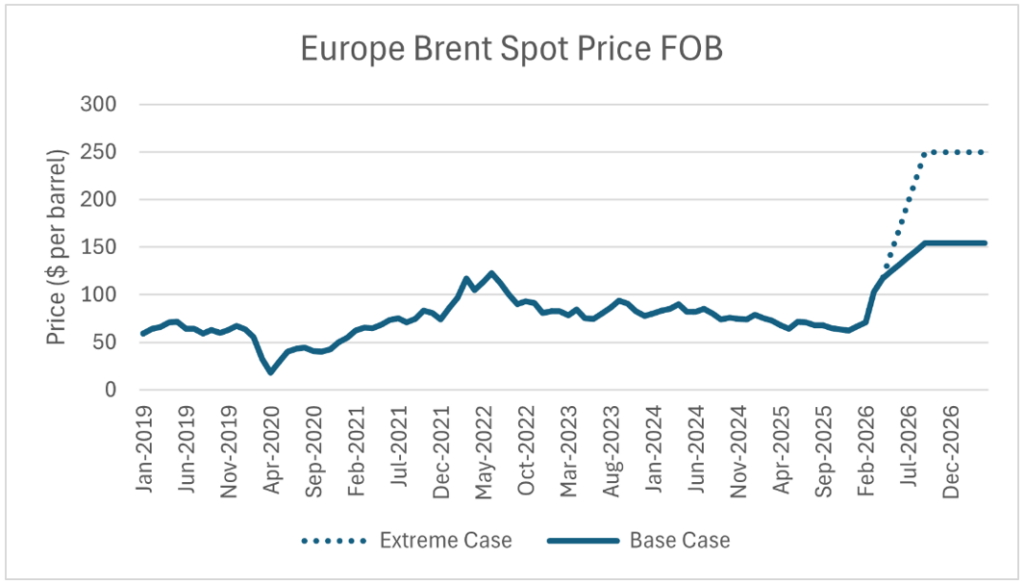
Figure 1. Europe Brent Spot Price FOB. Source: U.S. Energy Information Agency & FGE NexantECA.
Modelling Inflation and Exchange Rate Dynamics
The impact of energy prices on the Hungarian inflation rate and the exchange rate is easy to model. Statistical analysis shows that changes in the oil price drove most of the change in both inflation and in the value of the forint during the last energy crisis. This means that if we have a solid forecast of energy prices in the future, we can predict with a high degree of confidence how high inflation will rise and how much the forint will fall. Using oil price forecasts from FGE NexantECA and linear regression analysis, we can create inflation and exchange rate forecasts.
Fitting a model between the Europe Brent Spot Price FOB and the inflation rate during the previous energy crisis yields an of 0.77,[14] while a model fitting the Europe Brent Spot Price FOB to the forint–euro exchange rate (HUF–EUR) yields an of 0.83.[15] The energy price impacts the two variables with different lags. Europe Brent Spot Price FOB impacts the Consumer Price Index (CPI) with a best fit after a 10-month lag and impacts the Hungarian exchange rate with a best fit after a 4-month lag. The modelled results are laid out in the following two charts.
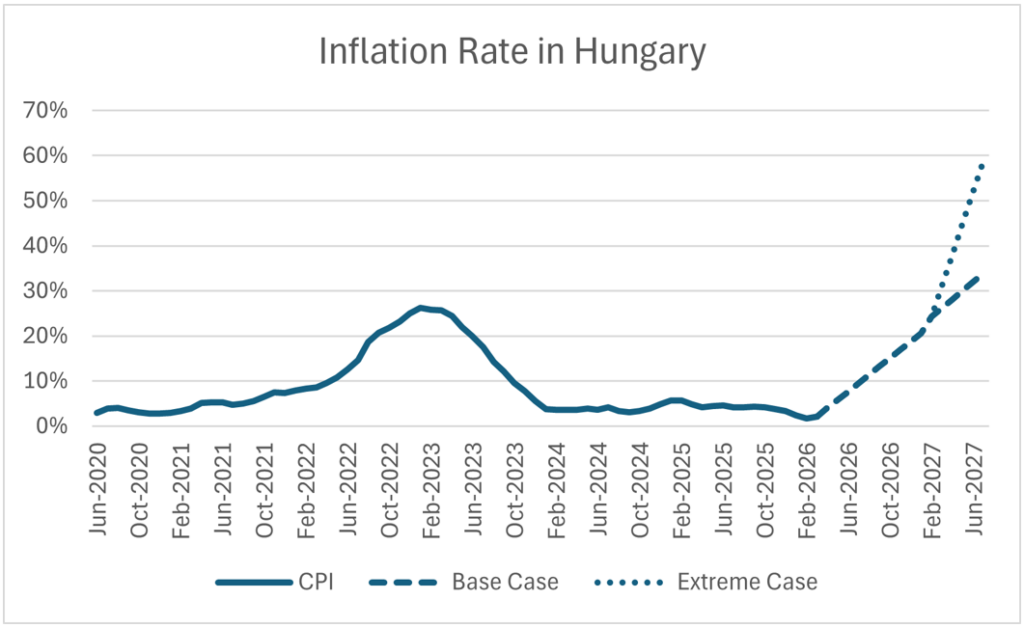
Figure 2. Inflation Rate in Hungary.
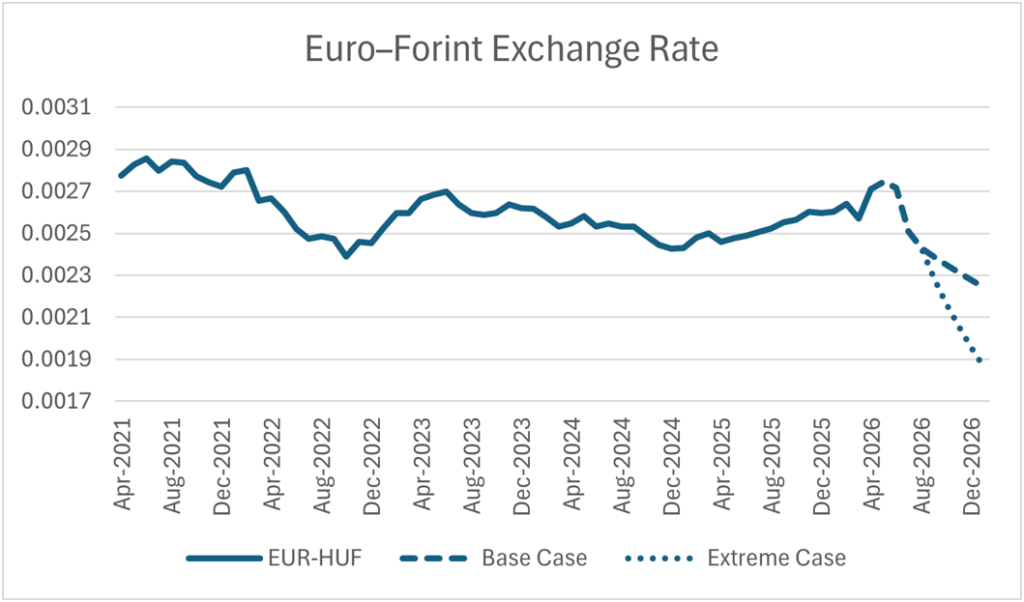
Figure 3. Euro–Forint Exchange Rate.
These are very extreme moves. Our model suggests that Hungary could see inflation rise from its current annualized rate of around 2.1 percent in March 2026 to anywhere between 34 percent and 59 percent in July 2027. This compares to the previous peak of inflation during the 2022–2023 energy crisis of 26 percent in January 2023. This is a very large amount of inflation for a European economy. If this model proves accurate, it will be one of the highest inflation rates experienced by a European Union member in recent decades. Such an inflation rate would require a very sharp rise in interest rates from the central bank. This increase in inflation would put the Hungarian economy at serious risk of an inflation. Since it would not immediately stamp out the inflation—which is being driven by supply-side factors—this could result in an inflationary recession which would be extremely painful for Hungarians.
Results and Concerns
The impact that the model shows on the Hungarian exchange rate is as extreme as the impact that we see on the inflation rate. According to our model, we would expect the HUF–EUR exchange rate to fall from 0.00271 in April 2026 to between 0.00224 and 0.00187 by January 2027. This would represent a decline of between 17 percent and 31 percent. For context, the decline in the value of the forint in the last energy crisis between February and October 2022 was just under 15 percent. Taken together with the inflation data, this means that Hungary could be set for a major economic shock in the coming months. This is particularly concerning because Hungarian citizens reported that they are already extremely dissatisfied with the economy recently. In a poll taken just before the election in April, Hungarian voters ranked the economy as their second biggest concern. 23 percent of voters said that it was their top priority, with 26 percent of voters saying that politics was their top priority.[16] This indicates that the economic shock will come at a time when Hungarians are already extremely dissatisfied with economic performance.
The large increases in the price of energy may compel the government to put in place aggressive energy subsidies. In 2022, public expenditures on utility costs protection totaled around 699 billion forints, or around 0.8 percent of GDP. In 2023, they cost around 1,373.5 billion, or around 1.5 percent of GDP. If we assume that the impact on prices in the current shock will be between 31 percent and 127 percent larger than the previous shock,[17] then we would expect utility price caps to add between 1 percent and 3.4 percent of GDP to the public budget. This could lead to a government budget deficit of between 5.7 percent of GDP and 8.1 percent of GDP—the latter figure is the highest on record and higher than even the budget deficit of 7.5 percent during the COVID-19 pandemic in 2020.
If the oil price forecasts prove relatively accurate—and we have no reason to doubt that they will—Hungary could face an inflation and exchange rate crisis unmatched by anything the country has seen in recent decades. High energy prices will necessitate energy subsidies by the government, leading to a substantially higher fiscal deficit. Hungary is not unique in this regard, of course, as all European countries are facing this problem. But we would highlight that Hungary has proven particularly sensitive to energy price shocks in the recent path and that, since the country is not a Eurozone member, it will also have to manage pressures on the forint moving forward.
Endnotes
[1] Phillip Brown, Michael Ratner, Liana W. Rosen, and Clayton Thomas, Iran Conflict and the Strait of Hormuz: Impacts on Oil, Gas, and Other Commodities, Congressional Research Service Report R45281 (Congressional Research Service, updated March 11, 2026), https://www.congress.gov/crs-product/R45281.
[2] Verity Ratcliffe and Malcolm Moore, “Oil Market 1 Month from Crunch Point as Global Reserves Dwindle,” Financial Times, May 1, 2026, https://www.ft.com/content/b26ba4ce-4324-4ea9-926d-caf036f20832.
[3] Mühdan Sağlam and Günbey Korkmaz, The Strait of Hormuz Crisis: Global Supply Chain Risks and Economic Implications for Türkiye, TEPAV Policy Brief N202632 (The Economic Policy Research Foundation of Turkiye, March 2026), https://tepav.s3.eu-west-1.amazonaws.com/upload/files/1773726063989-0.The_strait_of_Hormuz_crisis_Global_supply_chain_risks_and_economic_implications_for_Turkiye.pdf.
[4] Camila Domonoske, “Jet Fuel Supplies Are Sharply Affected by the Near-Closure of the Strait of Hormuz,” WUNC News, April 15, 2026, https://www.wunc.org/2026-04-15/jet-fuel-supplies-are-sharply-affected-by-the-near-closure-of-the-strait-of-hormuz.
[5] Bloomberg News, “The Strait of Hormuz Oil Shock Is Now Heading West,” Bloomberg, March 30, 2026, https://www.bloomberg.com/graphics/2026-iran-war-hormuz-closure-oil-shock/.
[6] Shariq Khan, “Diesel Markets, Upended by Middle East Conflict, Threaten Global Economic Slowdown,” Reuters, March 10, 2026, https://www.reuters.com/business/energy/diesel-markets-upended-by-middle-east-conflict-threaten-global-economic-slowdown-2026-03-10/.
[7] Charlotte Hebebrand, Joseph Glauber, Rob Vos, and Brendan Rice, “The Iran War’s Impacts on Global Fertilizer Markets and Food Production,” International Food Policy Research Institute, April 1, 2026, https://www.ifpri.org/blog/the-iran-wars-impacts-on-global-fertilizer-markets-and-food-production/.
[8] Faith Parum, “Farm Bureau Survey Reveals Real Impact of Fertilizer Availability and Price,” American Farm Bureau Federation, April 14, 2026, https://www.fb.org/market-intel/farm-bureau-survey-reveals-real-impact-of-fertilizer-availability-and-price.
[9] Grant Smith and Yongchang Chin, “Iran War Is Draining World’s Oil Buffer at an Unprecedented Pace,” Bloomberg, May 9, 2026, https://www.bloomberg.com/news/articles/2026-05-09/iran-war-is-draining-world-s-oil-buffer-at-unprecedented-pace.
[10] Siladitya Ray, “Fuel Rationing, No AC, 4-Day Work Week: How Countries Are Dealing with the Iran War Oil Crisis,” Forbes, March 25, 2026, https://www.forbes.com/sites/siladityaray/2026/03/25/fuel-rationing-no-ac-4-day-work-week-how-countries-are-dealing-with-the-iran-war-oil-crisis/.
[11] Uyaam Maalik, “Implementation of the National Fuel QR Code System for the Issuance of Fuel,” Ministry of Energy of Sri Lanka, March 15, 2026, https://energymin.gov.lk/index.php/2026/03/15/news-07-15-03/.
[12] Erik Norland, “Implications of WTI Oil Futures in Backwardation Amid the Supply Crunch,” CME Group, April 16, 2026, https://www.cmegroup.com/insights/economic-research/2026/implications-of-wti-oil-futures-in-backwardation-amid-the-supply-crunch.html.
[13] Bloomberg News, “The Billion-Barrel Hormuz Oil Shock Is About to Crash Demand,” Bloomberg, April 25, 2026, https://www.bloomberg.com/news/articles/2026-04-25/the-hormuz-billion-barrel-oil-shock-is-about-to-crash-demand.
[14] Model:
[15] Model:
[16] Benedict Vigers, “Politics Is Hungary’s Top Problem as Election Nears,” Gallup, April 2, 2026, https://news.gallup.com/poll/704327/politics-hungary-top-problem-election-nears.aspx.
[17] Here, we proxy the impact using the relative inflationary impact taken from our model.