
The Geopolitical Revaluation of Gold – The Renaissance of Gold

In an era of polycrisis and transitions, everyone is searching for value stability and permanence that can provide adequate security amid the growing uncertainty caused by geopolitics and technological transformation. Global economic processes and geopolitics have opened the way for the renaissance of gold, and the markets have rediscovered gold for themselves. In 2025, the market price of gold reached record levels, and despite minor downturns, the continuous price increase did not stop even at the beginning of 2026.
The PDF version is available here!
Despite the exchange rate reaching historic heights, the demand for gold, which represents a safe haven, remains unbroken. The investment appetite is well indicated by the fact that gold-based investment funds (Exchange Traded Funds, ETFs) increased their physical holdings in 2025 to a record amount of $89 billion. More than half of this increase flowed into the United States, and American ETFs increased their physical stock by 30 percent on an annual basis.[1] In addition, more than 600 tonnes of gold arrived in the vaults of New York in the first quarter of 2025 alone, a quantity that, according to the World Gold Council, is characteristic only when extraordinary circumstances are approaching. Among other reasons, due to the threat of gold tariffs, American banks, investors, and traders transferred the precious metal, which would otherwise typically be stored in London, to the Commodities Exchange Centre in New York.[2]
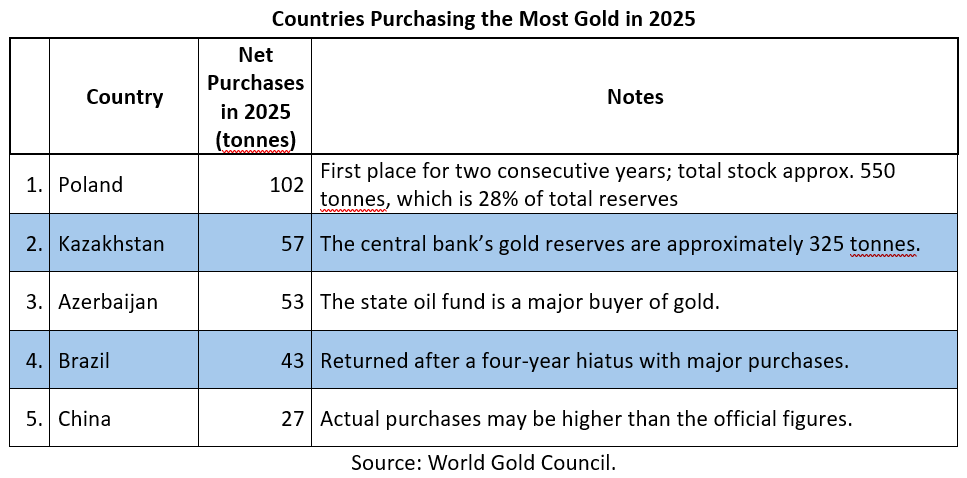
Alongside the market, central banks are also further expanding their gold reserves. In 2025, their strategic reserves of gold increased by twice the annual average of the period before the 2008 crisis, in part due to geopolitical concerns.[3] In gold purchases, Asian central banks are in the lead due to their desire to diversify foreign exchange reserves free from counterparty risk, create sufficient value stability, and prepare for the possible next stage of the development of the financial system. Alongside Asian gold accumulation, the strategies of the non-euro area central banks of the Central and Eastern European (CEE) region are also noteworthy, as these countries regard gold as one of the main pillars of financial sovereignty and crisis resilience.[4]
The Historical Significance of Gold
The history of gold is also the history of trust and stability. Already in Ancient Egypt, gold was a symbol of power, order, and value. Throughout the turbulent millennia of humankind, gold has provided a common denominator between different cultures and distant markets, becoming the universal language of value. At the same time, gold has become not only a form of economic value, but also a time-resistant reserve of strategic power in the international system. It is no coincidence that by the turn of the nineteenth and twentieth centuries, it rose to become the stable foundation of the modern financial system.
This tradition was changed by the Bretton Woods system, under the fixed exchange rate system of which every currency was directly pegged to the dollar instead of the gold standard. This construction explicitly made the dollar the key currency around which the international payments and reserve system was organized. In this way, American political and economic power sought to take over gold’s function as the foundation of trust in the world economy.
However, by the 1970s, trust in the American economy began to waver. President de Gaulle, with the intention of becoming independent from the American financial system given the shaken trust in the dollar, aimed in August 1971 to convert France’s dollar reserves into gold and have them transported back to France. A few days later, the British government also approached Washington with a similar request and asked for the transfer of gold worth three billion dollars. In response to these European efforts, on Sunday afternoon, August 15, Nixon announced the suspension of the dollar’s convertibility into gold.[5] This ended the fixed exchange rate system, but the dollar’s status as reserve currency remained, since the dependence of global trade and reserves on the dollar had already become institutionalized. The petrodollar system that emerged in the 1970s and then the global financial deregulation and financial innovations of the 1980s further increased the dollar’s hegemony but also generated a two-way vulnerability.
Strategic Safeguard
During the twentieth century, the role of gold did indeed diminish with the emergence of dollar hegemony, but central banks retained their gold reserves as a form of insurance in the background. During the Cold War, gold stocks became a symbol of power, and the United States has possessed the world’s largest gold holdings ever since, guarded at the legendary Fort Knox military base, although the exact size of these holdings is shrouded in uncertainty since the last full audit was in 1953, and the 2025 Gold Reserve Transparency Act proposal aimed at revealing its size (Massie/Lee) was never adopted. Gold never disappeared; it was a “sleeping” asset, but every crisis—whether the 2008 financial crisis, the COVID-19 pandemic, or the sanctions crisis imposed in connection with the 2022 Russo-Ukrainian war—reactivated its importance. The reasons behind gold’s renaissance can be found in the processes increasing uncertainty and are also linked to the transformation of money and the financial system.
Over the past one and a half decades, the world economy has experienced almost every form of crisis within a short period of time. As a result of these, rising inflation worldwide, volatile asset prices, continuous shocks to supply chains, the energy crisis, and intensifying geopolitical tensions are all factors that have once again turned attention toward gold, which embodies safety. Compared with paper-based financial assets (for example, government bonds or currencies), gold is an asset that does not depend on the economic policy, solvency, or financial system of any single state. Moreover, it cannot be inflated without limit, it preserves its purchasing power in physical form over the long term, and it represents a globally accepted value. For this reason, gold is a stable value-preserving investment that can play a balancing role in investment and reserve portfolios in times of crisis.[7]
Its strategic role in central bank reserves is also well indicated by the World Gold Council’s 2025 central bank survey. In the survey, 85 percent of central banks cite gold’s performance during crises as the main reason, while 80 percent cite its role as a long-term store of value, which makes it a stable reserve asset even amid temporary price volatility. Moreover, gold is regarded not as a yield-seeking investment, but as a trust and stability “anchor,” the true significance of which is demonstrated precisely in times of systemic crisis. According to the survey, 95 percent of central banks expect global gold reserves to continue increasing.[8] In addition, gold is a reserve asset that carries no counterparty risk, and during geopolitical or financial crises, it is a particularly attractive reserve instrument when the yields of other financial assets are low and they are exposed to sanctions risk. For this very reason, gold can be one of the ultimate pillars of confidence in the financial system in extraordinary situations, which does not solve panic, but reduces its likelihood and depth by the fact that behind the system there is not a political, but a “hard” value.[9]
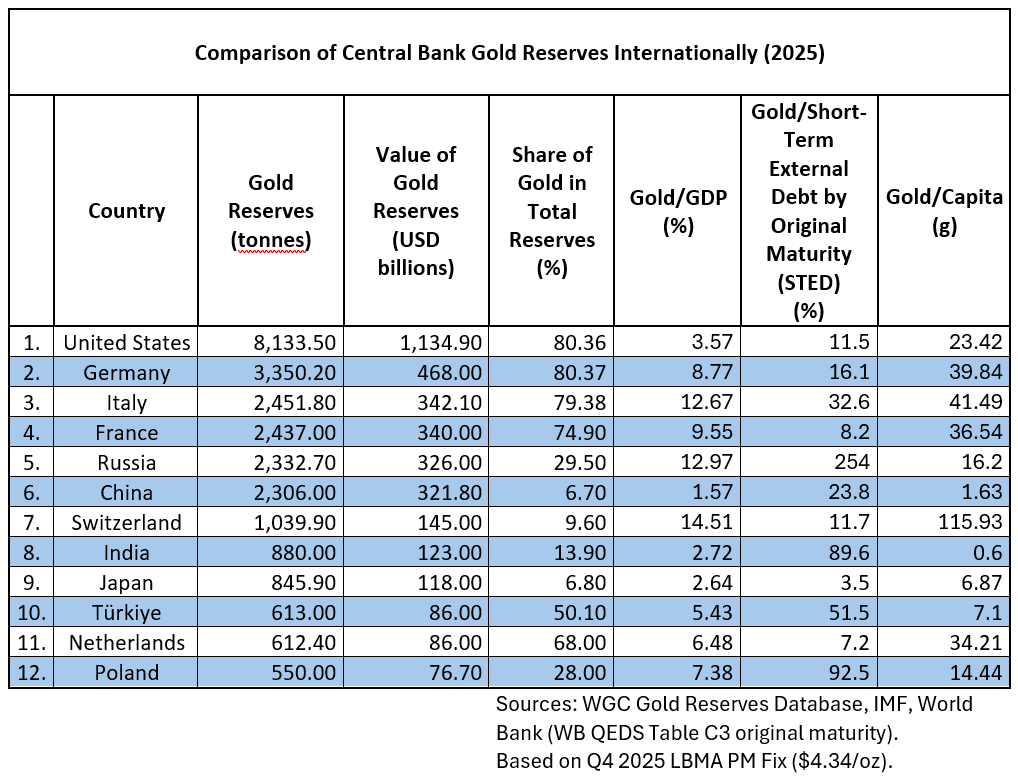
The table above shows the 12 countries with the largest gold reserves in the world and indicates that the role of gold in central bank reserve policy differs significantly from country to country. The differences between the individual strategies are not merely financial but also relate to geopolitical factors. In the case of the United States, Germany, Italy and France, the high ratio reflects historical heritage, institutional stability, and trust at the same time. As in the case of advanced economies with large foreign exchange reserves, the high gold-to-reserve ratio partly relates to lower currency exposure arising from the international dominance of U.S. dollars and euros.
Catching up with historically gold-dependent Europe, China and India, to an extent, have accumulated significant gold stocks in absolute terms through their dynamic gold purchases. But in their case, the weight of gold compared to total reserves is much lower, which may indicate that their reserve strategy is rather based on a diversified currency and asset portfolio. Russia and Türkiye form a special category; for them, gold unambiguously plays a greater strategic and crisis-protection role. This is also reflected by GDP ratios, as well as the indicators relative to short-term external debt.
Russian sanctions and trust issues related to the dollar system have partly led to the continuous increase of gold stocks. The ratio of central bank gold reserves to short-term external debt is not a standard indicator, but it can be a useful complementary tool to illustrate how much of a short-term external financing buffer gold can provide in an increasingly turbulent era. On the one hand, it also indicates how much a state relies on the functioning of international credit markets, and on the other hand, how large a “gold shield” it has built against possible financial sanctions, capital outflows, and currency market shocks. If we look at the CEE region, a new trend is apparent, particularly in the case of Poland, Czechia, Hungary, and Serbia. Non-euro area countries are consciously expanding their gold reserves to strengthen monetary sovereignty. Overall, gold today is not merely a passive reserve asset, but, adapting to different historical experiences, financial structures, and geopolitical exposures, it is one of the instruments of monetary trust, diversification, and financial sovereignty.[10]
However, alongside quantity, domestic storage has also become important. Germany, with the world’s second largest gold stock, transported nearly half of its gold reserves back home from New York and Paris between 2013 and 2017. And from time to time, it comes up in German discourse that, for risk reduction and geopolitical reasons, it would be worthwhile to transport the entire stock to German soil.[11] France, with the fourth-largest holdings, keeps its gold entirely in Paris. The repatriation of gold reflects sovereignty-oriented thinking; it is not only the amount of gold on the balance sheet that matters, but also where and under what jurisdiction it is located. It is not enough to own the gold; it must also be physically accessible.
If we look at the CEE region, Poland, the world’s largest buyer globally in 2025, is not only dynamically expanding its stocks, but also transporting them home. In recent years, Poland has consciously and continuously increased its stock with a security and geopolitical strategy and thus now possesses the world’s twelfth-largest reserves. From the region, Czechia also made it into the top ten buyers of 2025, and it has been gradually increasing its reserves for the third year in a row, also for geopolitical considerations. The Hungarian National Bank has also raised its gold stock to historically high levels in recent years, which it largely keeps in Hungary. Outside the European Union, Serbia is also part of the trend. In 2025, it purchased 4.1 tonnes of gold and thus its reserves grew to historical heights of 52.5 tonnes, and it transported the entire stock to Belgrade for geopolitical reasons in order to increase the accessibility and security of gold reserves during crises and uncertainty.[12]
It is worth briefly touching upon the gold purchase program of the Polish National Bank (Narodowy Bank Polski), which is a declared sovereignty and risk management strategy. Behind the dynamic expansion clearly stands the drawing of geopolitical lessons, for the politicization of finance has shown that not all reserves are equally safe. Poland wishes to reduce exposure tied to currencies and foreign jurisdictions and increase the weight of an asset that carries no counterparty risk. According to a decision of the Polish central bank, the country will increase the gold reserves to 700 tonnes.[13] According to President of the National Bank of Poland Adam Glapiński, the growth of gold reserves shows the stability of the Polish economy and its economic strength and reinforces its credibility both toward investors and foreign partners. Gold is “a shield against global instability and a cornerstone of economic sovereignty.”[14]
The Geopolitical Value of Gold
Financial sanctions, reserve freezes, and the transformation of the financial system into a political instrument have become one of the key geopolitical trends of the twenty-first century. We find one of the most recent examples in the sanctions packages against Russia. After Russia launched a war against Ukraine in 2022, the G7 countries took swift financial countermeasures, thus cutting off the Russian financial system from access to dollars and euros, disconnecting it from the SWIFT system as well, and seizing the Russian central bank’s assets stored abroad. The precedent of these freezes has shown that reserves held under foreign jurisdiction are vulnerable, while the accessibility of gold stored domestically and certain non-Western assets is higher.
Russia traditionally possesses significant gold reserves, being the world’s fifth-largest holder. Moreover, it is one of the largest gold producers, with approximately 300 tonnes of gold mined in Russia annually. The Russian central bank’s significant reserves contributed to the stabilization of its financial system in the first phase of sanctions, particularly from the perspective of central bank credibility and reserve diversification. Gold appeared not as a liquidity instrument but strengthened perceptions of the central bank’s balance sheet, reduced the risk of financial panic, and thereby moderated the likelihood of deposit withdrawals and trust shocks towards the banking system. Estimates suggest that the increase in the price of gold since 2022 increased the value of Russia’s gold reserves by more than $200 billion, partly offsetting the approximately $300 billion of frozen foreign exchange reserves,[15] but these neither replace access to key currencies and payment systems nor enable the bypassing of sanctions. Thus, gold reserves contributed to preserving financial stability, while the country was able to access non-dollar settlements through limited, non-Western channels.[16]
The Russian case shows that gold is a sanctions-resistant reserve as a strategic insurance instrument. This may be one of the reasons why Central Asian countries have accumulated significant quantities of gold and are continuously expanding their stocks. Kazakhstan is in the lead in this respect and was the world’s second largest buyer in 2025, ahead of Azerbaijan. Thus, alongside expanding their relations, the region is also seeking to diversify its foreign exchange reserves in such a way that financial stability becomes as crisis- and sanctions-resistant as possible, because gold has proven to be a less vulnerable reserve and a factor strengthening sovereignty.[17]
From the perspective of geopolitical competition, it is also worth looking at one of Asia’s main players, China. China’s gold reserves are nominally outstanding and growing dynamically, although their share within total foreign exchange reserves is relatively low (6.7 percent). At the same time, China is currently the world’s largest gold-producing country, responsible for approximately 12 percent of global production, mining more than 300–370 tonnes of gold annually. Meanwhile, significant private sector gold stocks are also available. In a crisis, this can mean key liquidity and production capacity, significantly exceeding official central bank reserves. However, in China, gold has a role not only from the perspective of stability, but also from that of financial innovation and technology development.
In the global technology race, China aims to be the driving force behind the innovation that determines the future of finance. In line with the logic of Chinese strategic planning, it is exploring multiple concepts for shaping the future of the financial system. One version of this was discussed at the 2024 China Global Finance Forum.[18] According to this, the direction of development could be the creation of a gold-backed digital central bank currency, which would become an alternative financial cooperation network. The next step continued with the BRICS countries’ idea of gold-backed settlement. This does not aim to restore the classic gold-based monetary system (such as Bretton Woods), but would be an innovative, digital solution. For trade among member countries, a “Unit” would be created, which would operate on a blockchain basis backed by physical gold and BRICS currencies.[19] This is essentially a tokenized gold basket, which would be used for real-time, dollar-free trade settlements. Technical testing began at the end of 2025. The Official Monetary and Financial Institutions Forum views this as a “game-changing opportunity” because it would reduce dollar dependence and minimize exchange rate risk.[20] However, this will not shake the dollar’s hegemony in the short term, as it would initially cover only 5–7 percent of BRICS trade, and interoperability with national CBDCs remains unresolved. In the long term, however, it could offer a genuine regional alternative for dollar-independent trade settlement, especially in a fragmenting world where gold, as a universal anchor of trust, could strengthen trust among member countries.
The Cornerstone of Economic Sovereignty
Gold’s geopolitical renaissance signals a reinterpretation of monetary sovereignty in an era of trade wars and sanctions. The global financial system is increasingly becoming a strategic arena, and within it, gold represents stability and resilience to crises and sanctions. The more the global financial system becomes a political weapon, the more valuable this asset outside of it becomes. Central bank demand is expected to remain persistently high, driven primarily by geopolitics, sanctions precedents, and dollar risk diversification. Furthermore, in Asia, led by China within the BRICS group, a new, innovative, gold-backed digital initiative has also been launched, which, while serving as a regional alternative, could further reinforce bloc formation.
It is likely that the transformation of the monetary order will not result in a new, unified world order, but rather in the emergence of parallel financial ecosystems. At the same time, the history of gold has repeatedly demonstrated that it is a cross-block asset that does not require institutional trust. In Central and Eastern Europe, the strengthening of the “small state, high exposure” logic has sparked a trend toward the continuous accumulation and repatriation of gold reserves. For Central Europe, gold is not a statement of position, but a preparation. For the region, the appreciation of gold is a matter of sovereignty and risk management; in a region open to external financing and supply chains, it is increasingly important that the reserve system not rely exclusively on key currencies and external financial infrastructures. Thus, the goal of expanding gold reserves is to strengthen the financial sovereignty of countries in the region, diversify reserves, and increase resilience to crises. Gold is not primarily an income-generating asset, but rather a hedge against political risk. Gold purchases in the Central and Eastern European region also carry a complex message: a signal to the markets (stability), a signal to allies (preparedness), and a signal to rivals (resilience). Thus, this gold strategy has become one of the fundamental tenets of geopolitical sovereigntist thinking; gold serves as a “shield” against global instability and the cornerstone of economic sovereignty.
Endnotes
[1] World Gold Council, “Gold ETF Flows: December 2025,” January 2026,
https://www.gold.org/goldhub/research/gold-etfs-holdings-and-flows/2026/01.
[2] Lee Ying Shan, “America’s Appetite for Gold is ‘Sucking’ Bullion Out of Other Countries,” CNBC, February 27, 2025, https://www.cnbc.com/2025/02/28/us-gold-demand-is-sucking-bullion-out-of-other-countries.html.
[3] World Gold Council, “Gold Demand Trends: Q4 and Full Year 2025,” January 29, 2026, https://www.gold.org/goldhub/research/gold-demand-trends/gold-demand-trends-full-year-2025/central-banks.
[4] Anja Brüggen et al., “Gold Demand: The Role of the Official Sector and Geopolitics,” European Central Bank, https://www.ecb.europa.eu/press/other-publications/ire/focus/html/ecb.irebox202506_01~f93400a4aa.en.html.
[5] Edward Fishman, Chokepoints: How the Global Economy Become a Weapon of War (Elliott & Thompson Limited, 2025).
[6] Pál Péter Kolozsi, “Vissza a jövőbe: a pénz forradalmi átalakulása az aranyra irányítja a figyelmet” [Back to the Future: The Revolutionary Transformation of Money Draws Attention to Gold], Central Bank of Hungary, May 3, 2024, https://www.mnb.hu/letoltes/kolozsi-pal-peter-vissza-a-jovobe-a-penz-forradalmi-atalakulasa-az-aranyra-iranyitja-a-figyelmet-vba.pdf.
[7] Omar Zulaica, “What Share for Gold? On the Interaction of Gold and Foreign Exchange Reserve Returns,” BIS Working Paper No. 906, 2020.
[8] World Gold Council, “Central Bank Gold Reserves Survey 2025,” June 17, 2025, https://www.gold.org/goldhub/research/central-bank-gold-reserves-survey-2025.
[9] Serkan Arslanalp et al., “Gold as International Reserves: A Barbarous Relic No More?,” IMF Working Paper, WP/23/14, January 2023, https://www.imf.org/-/media/files/publications/wp/2023/english/wpiea2023014-print-pdf.pdf.
[10] Michael Paulus et al., ”Central Banks Are Turning Back to Gold,” OMFIF, September 2, 2025, https://www.omfif.org/2025/09/central-banks-are-turning-back-to-gold/.
[11] “’Repatriate the Gold’: German Economists Advise Withdrawal from US Vaults,” The Guradian, January 24, 2026, https://www.theguardian.com/world/2026/jan/24/repatriate-the-gold-german-economists-advise-withdrawal-from-us-vaults.
[12] Misha Savic and Jack Ryan, “Serbia Will Hoard All Its Gold at Home, Shunning Global Hubs,” Bloomberg, July 24, 2025, https://www.bloomberg.com/news/articles/2025-07-24/serbia-will-hoard-all-its-gold-at-home-shunning-global-hubs.
[13] “Polish Central Bank to Raise Gold Reserves to 700 Tonnes,” PAP, January 20, 2026, https://www.pap.pl/aktualnosci/polish-central-bank-raise-gold-reserves-700-tonnes.
[14] “Poland’s Gold Reserves Now Larger than European Central Bank’s, Says Polish Central Bank Chief,” Notes from Poland, May 9, 2025, https://notesfrompoland.com/2025/05/09/polands-gold-reserves-now-larger-than-europe-central-banks-says-polish-central-bank-chief/.
[15] “Russia Gains $216 Billion in Gold Rally, Replacing Lost Assets,” Bloomberg, January 20, 2026, https://www.bloomberg.com/news/articles/2026-01-20/russia-gains-216-billion-in-gold-rally-replacing-lost-assets.
[16] Daniel McDowell, “The Unfreezable Asset: Gold, Sanctions, and Russia,” War on the Rocks, March 7, 2022, https://warontherocks.com/2022/03/the-unfreezable-asset-gold-sanctions-and-russia/.
[17] James Steel, “The Role of Gold in Central Bank Reserves,” Central Banking, April 24, 2023, https://www.centralbanking.com/hsbc-reserve-management-trends-2023/7958502/the-role-of-gold-in-central-bank-reserves.
[18] “80 Years after Bretton Woods: Building an International Monetary and Financial System for All & 2024 Tsinghua PBCSF Global Finance Forum,” Tsinghua University PBC School of Finance, accessed March 18, 2026, https://en.gff.pbcsf.tsinghua.edu.cn/en2024/.
[19] Lindsey Schutters, “Gold is Token Reserve in BRICS De-Dollarisation Push,” Daily Maverick, December 18, 2025, https://www.dailymaverick.co.za/article/2025-12-18-gold-is-token-reserve-in-brics-dedollarisation-push/.
[20] Alexej Jordanov, ”Gold-Backed Digital Currency Could Be A Game-Changer for Brics,” OMFIF, 2024, https://www.omfif.org/2024/12/gold-backed-digital-currency-could-be-a-game-changer-for-brics/.