
Foreign Information Manipulation and Interference (FIMI) in the 2026 Hungarian Parliamentary Election

HIIA Perspective – Written by Philip Pilkington
In this study, we utilize network analysis to try to determine whether Foreign Information Manipulation and Interference (FIMI) is taking place in the 2026 Hungarian parliamentary election. We examine two sets of accounts from the social media platform X: long-standing accounts focused on Hungarian politics and more recent accounts that have cropped up and are commenting on the election. We find that the latter have a fundamentally different profile to the former. These latter accounts, which appear to be engaged in FIMI, are networking Hungarian users to foreign accounts—most notably in Ukraine but also to some extent in Serbia and Georgia. These accounts also seem to discuss different themes and rather than discussing normal political messaging seem to be disproportionately focused on vitriol and abuse. Our findings strongly suggest that FIMI is taking place in the information space surrounding the Hungarian 2026 parliamentary election and that most of the FIMI is coming from Ukraine.
The PDF version is available here!
Introduction to FIMI
In the run-up to the 2026 Hungarian election, government officials have been vocal in stating that foreign actors are trying to influence the election. The country that most prominently features in these accusations is Ukraine. In January 2026, Prime Minister Viktor Orbán accused Ukraine of intervening in the Hungarian election and ordered the Hungarian Foreign Minister to summon the ambassador.[1] In late March, the accusations became more intense, with Foreign Minister Péter Szijjártó stating that “such shameless, open and rude foreign secret service intervention has never been seen in parliamentary elections in Hungary before.”[2]
The accusations by the government mostly focus on a variety of scandals involving alleged espionage, particularly the wiretapping and subsequent leaking of Szijjártó’s telephone conversations with senior foreign government officials. These are highly unusual measures to undertake in the election of a Western democracy. The fact that they are being used in Hungary raises the question of whether less intrusive methods are also being utilized in the 2026 election. The European Union itself is so concerned about this threat that it has created an acronym for it: FIMI – Foreign Information Manipulation and Interference.
One recent report states, “The weaponization of the information space has become a persistent feature of today’s international conflicts, reflecting increasing confrontation among major geopolitical powers.”[3] Given that the European Union is highlighting this threat and given that much more aggressive actions have been undertaken so far against the 2026 Hungarian parliamentary election, this raises the question as to whether FIMI is being used during the election. This short study aims to uncover some sources of FIMI and where it is coming from.
Methodology
We base our study on a framework of “network analysis.” In sociology and epidemiology, network analysis is a method used to uncover the links between social networks.[4] Our target platform will be X, where most of the English-language discussion about the 2026 Hungarian parliamentary election takes place. Network analysis is also well-suited to analyze social media. Our methodology is based on the hypothesis that an account that is engaged in FIMI will have a fundamentally different network profile than an account that is not based on FIMI. For example, a normal Hungarian social media account should have a certain profile in terms of who it is networked to. We would assume that it would be disproportionately networked mainly to other Hungarian social media accounts. An account that claims to be Hungarian but is engaged in FIMI, on the other hand, will likely be networked to accounts based in countries that are undertaking the FIMI.
To explore this, we used a weighted measure of the social media statistics. Here is the formula for this weighted measure:

The weighted measure seeks to adjust the number of followers or accounts that an account is following based on overall X usage in each country.
Establishing a Baseline
First, we must see what a “normal” Hungarian social media account looks like in terms of its network structure. Here we will take two examples. One is a large account that is well-established in Hungarian opposition politics and which is covering the 2026 Hungarian parliamentary election. Here we will use Panyi Szabolcs (@panyiszbolcs), who is a widely followed opposition journalist in Hungary. The second account we will look at is a small anonymous account with a solid track record that is also covering the 2026 election in Hungary. Here we will use @KMediaEng which was established in 2010.
Now that we have our two baseline accounts, let us look at their network structure. We will start with who their followers are. We can see which countries their followers come from in the following two charts.
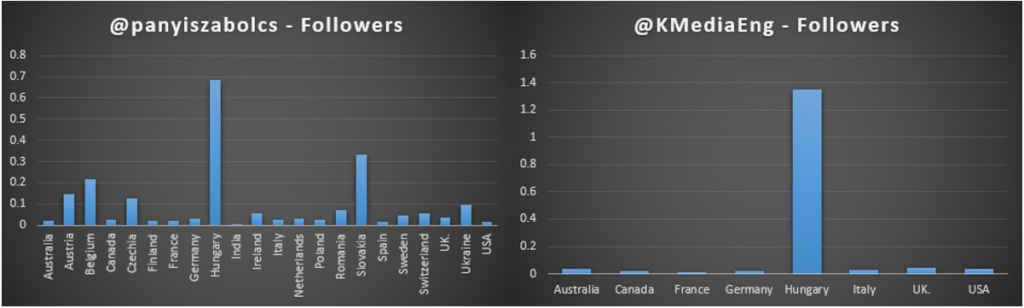
A large organic account like Panyi’s has its main audience in Hungary. This makes sense. Panyi’s work is popular outside of Hungary amongst people who take an interest in what is going on in the country. But we would expect his largest following, on a population-adjusted basis, to be within Hungary, and this is what we see. Panyi has large audience in surrounding countries like Austria, Slovakia, Romania, and Ukraine. This also makes sense. These countries are regionally close to Hungary, so they should be disproportionately interested in the country. Finally, we see a large following Belgium. The European capital of Brussels is in Belgium, so this represents people working in European politics who follow Hungarian politics. In contrast to the Panyi’s larger account, @KMediaEng is almost exclusively followed by other Hungarian accounts. The smaller anonymous account ecosystem seems to be almost purely Hungarian. This makes sense as these are users of X in Hungary who network with one another. Next, we look at who these accounts are following.
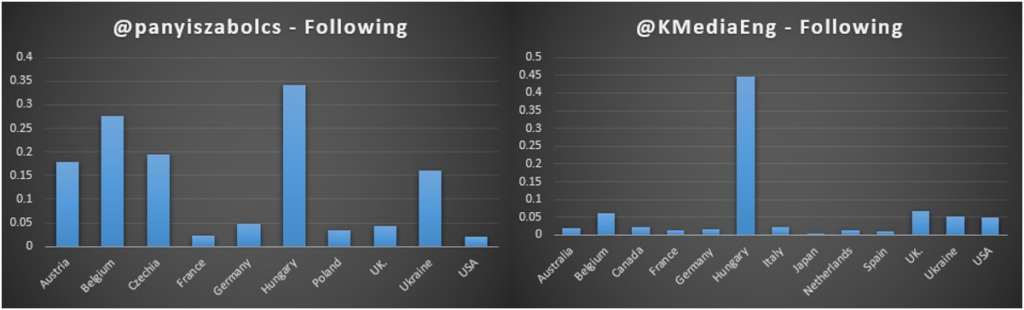
Panyi’s account is following a diversified collection of accounts. Once again, these are disproportionately from the surrounding region. But we also see him following many Brussels-based accounts and some in the United States and the United Kingdom—which is unsurprising as these countries are dominant when it comes to English language news. The network of accounts that Panyi follows likely represents the liberal progressive activist network in the region, some Brussels-based political accounts, and some standard English-language news and politics accounts. @KMediaEng is once again mostly following Hungarian accounts, although it also follows a few from the UK, the U.S. and Ukraine.
Both accounts have easy explanations for their network. Nothing particularly unusual stands out when we examine them.
FIMI Accounts
Now let us look at the accounts that are campaigning against Fidesz that are more likely to be foreign interference. We take the most prominent four accounts: Pete (@splendid_pete), Szabadon Magyar (@SzabadonMagyar), FridayFella (@fridayfella1), and NAFO Hungary (@NAFO_Hungary). All these accounts have a relatively large base of followers, at least relative to the number of X users interested in Hungary, and all are actively commenting on the 2026 election. Pete seems to be commenting on the election almost full time. Let us first look at who is following these accounts.
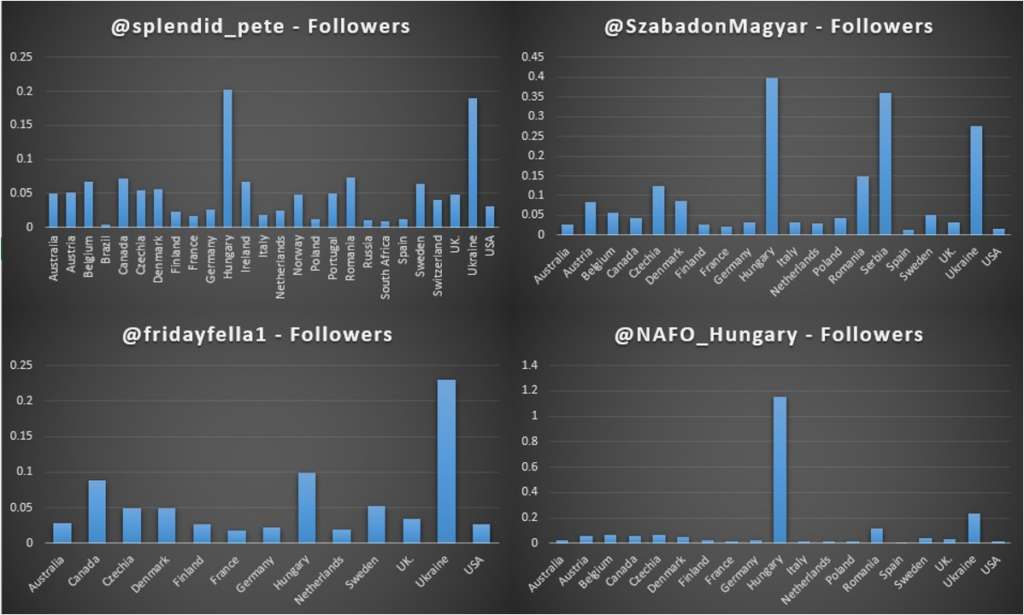
The accounts have an entirely different profile to the organic opposition accounts. Apart from NAFO Hungary, these accounts all have an enormous number of followers from Ukraine. This suggests that they are tied into the NAFO war propaganda space, which is being used to interfere in the Hungarian election. Ironically, the “official” NAFO Hungary account appears to be the most Hungarian of all these accounts. Despite claiming to be a Hungarian account, FridayFella appears to be more so a Ukrainian account in terms of who is following it. The account most active in the Hungarian election space on X, Pete, has almost as many followers in Ukraine as he has in Hungary. This account seems to link Ukrainian social media networks to Hungarian social media networks, thereby potentially vindicating the claim of the Hungarian government that there is electoral interference taking place in Hungary that is coming from Ukraine. Szabadon Magyar has a very large following in Serbia, which is very unusual and may suggest potential links to political activists there. Next, we look at who these accounts are following.
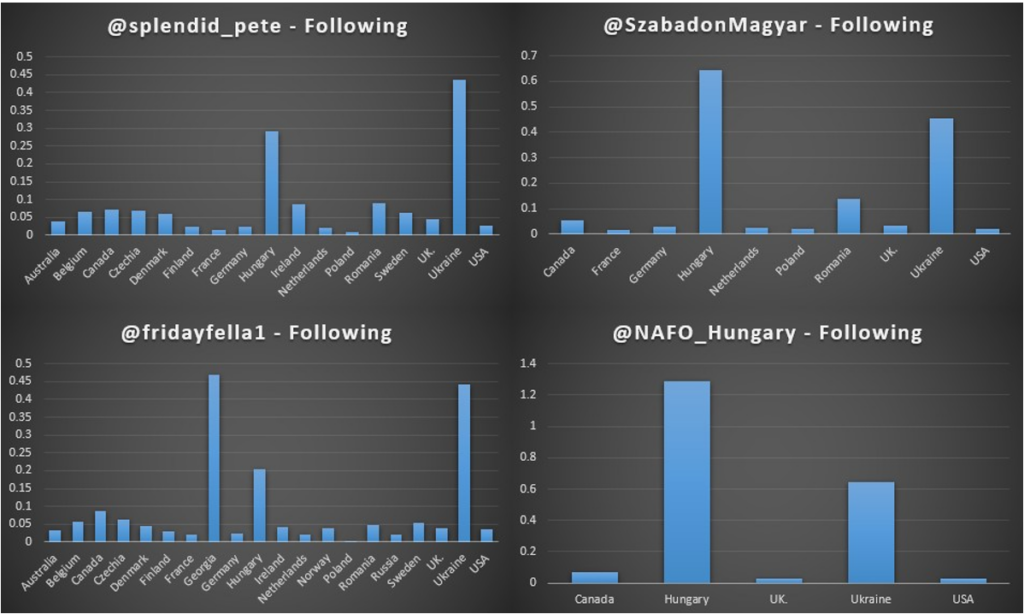
The main account participating in the Hungarian election space, Pete, appears to be more interested in following Ukrainian accounts than he is in following Hungarian accounts. Once again, this raises the question of whether this is an account that is purposefully networking actual Hungarian accounts to Ukrainian accounts. Szabadon Magyar follows a lot of Hungarian and Ukrainian accounts. Notably, he does not follow a lot of Serbian accounts, despite the large Serbian following that this account had. The Serbian-Hungarian influence seems to be flowing from Serbia to Hungary and not vice versa. FridayFella is more interested in following Georgian accounts and Ukrainian accounts than in following Hungarian accounts. While FridayFella is not as prominent as some of the other accounts, it is certainly the most unusual. Finally, NAFO Hungary still appears the most organically Hungarian of the anonymous influence accounts, although this account follows a lot of Ukrainian accounts. Once again, this is ironic given that it is the account that most advertises itself as being part of a foreign cause.
FIMI Themes and Networks
Next, we will look at what these accounts are discussing relative to what the organic opposition accounts are discussing. We will compare Panyi Szabolcs to Pete.
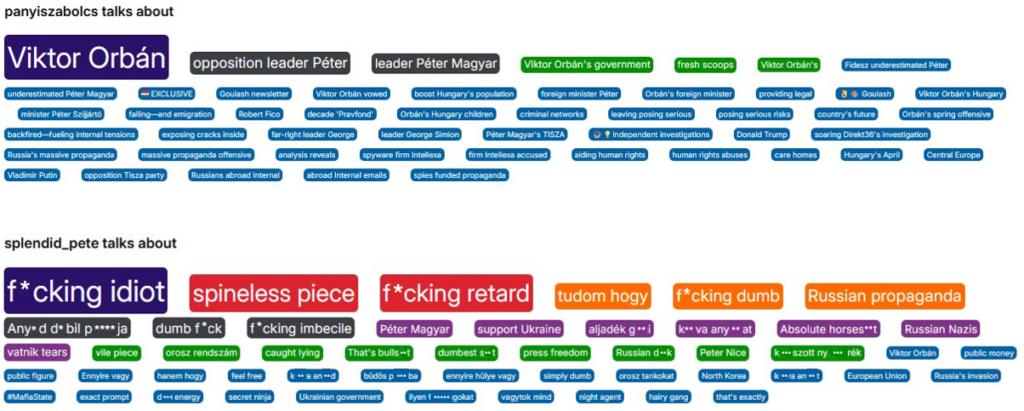
The language is entirely different. Pete appears to be primarily a troll or abuse account. Although Pete often posts substantive analysis of Hungarian politics on his account, this does not appear to make up most of the content. Most of what this account posts is pure abuse. Recall that this account is involved in heavily networking Hungarian accounts to Ukrainian accounts, raising serious questions about the type of discourse that the account is introducing into the Hungarian political space. Pete also seems to regularly discuss issues related to Russia and support for Ukraine. Panyi, on the other hand, seems to genuinely discuss Hungarian politics. Panyi’s account is clearly not an abuse account, and most of what it posts is substantial discussion related to Hungarian politics. Examining the themes discussed by the two accounts, we see that these are two fundamentally different types of accounts. Finally, we will look at how much overlap there is between the networks of these accounts.
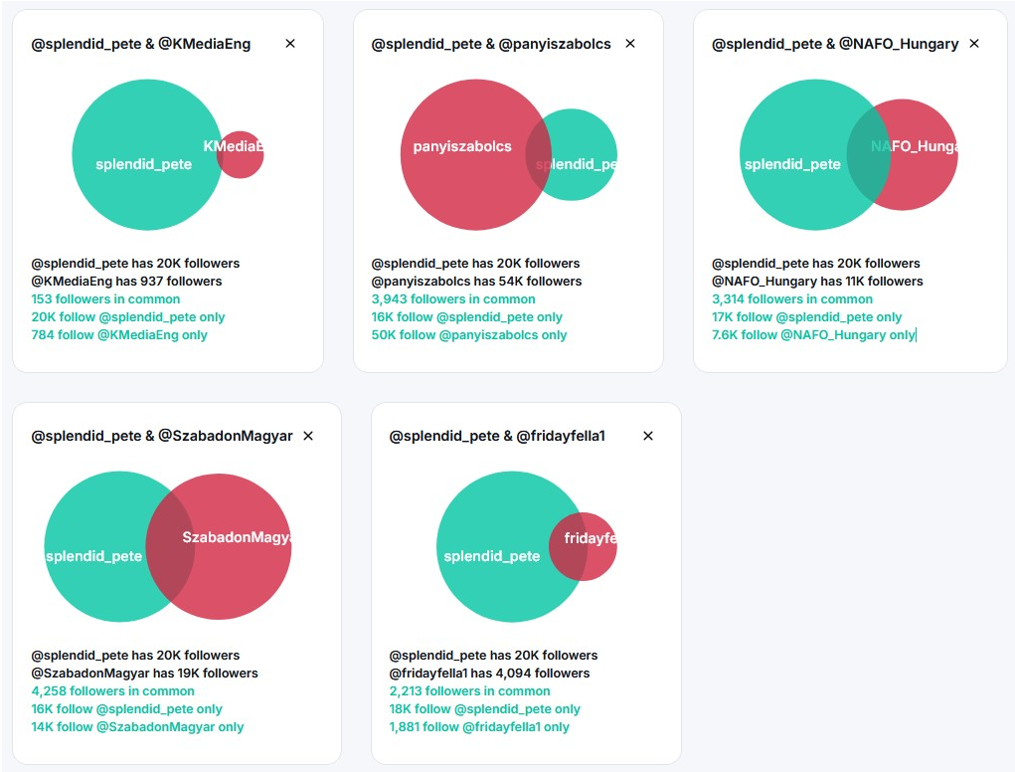
Here we see that the anonymous accounts commenting on the 2026 election in Hungary are themselves quite networked to one another and are not as widely networked to the organic opposition accounts. This seems like a somewhat closed ecosystem. This fits with the fact that the follower/following profile of these accounts is fundamentally different from organic Hungarian accounts.
Conclusion
It seems highly likely that FIMI is taking place in the information space surrounding the 2026 Hungarian election. When we compare long-standing X accounts like @panyiszbolcs and @KMediaEng with accounts that cropped up more recently and are commenting on the election, such as @splendid_pete, @SzabadonMagyar, @fridayfella1, and @NAFO_Hungary, we find that the latter seem to be disproportionately focused on vitriol and abuse and are actually networking Hungarian users to foreign accounts—especially accounts in Ukraine but also to some extent those in Serbia and Georgia. This is precisely why Hungarian government officials have so forcefully drawn attention to perceived efforts to influence the election.
Endnotes
[1] Justin Spike, “Hungary’s Orbán Accuses Ukraine of Election Interference and Summons Ambassador,” Associated Press, January 26, 2026, https://apnews.com/article/hungary-ukraine-orban-summons-ambassador-election-russia-6d157340d5b3f6fd74a2173230979629.
[2] Péter Szijjártó, “Ilyen durva külföldi titkosszolgálati beavatkozás soha nem volt a magyar választásba” [There Has Never Been Such Blatant Interference By Foreign Intelligence Services in a Hungarian Election], Kormány.hu, March 26, 2026, https://kormany.hu/kormanyzat/kulgazdasagi-es-kulugyminiszterium/hirek/ilyen-durva-kulfoldi-titkosszolgalati-beavatkozas-soha-nem-volt-a-magyar-valasztasba.
[3] European External Action Service (EEAS), 4th EEAS Report on Foreign Information Manipulation and Interference Threats: Dismantling the FIMI House of Cards (March 2026), https://www.eeas.europa.eu/sites/default/files/2026/documents/EEAS%204th%20Threat%20Report_web%20version_1.pdf.
[4] David Hevey, “Network Analysis: A Brief Overview and Tutorial,” Health Psychology and Behavioral Medicine 6, no. 1 (2018): 301–328, https://doi.org/10.1080/21642850.2018.1521283.