
What’s at Stake in the Armenian Elections?

Written by Péter Pál Kránitz & Edvard Grigoryan
Armenia is scheduled to hold parliamentary elections on June 7, the outcome of which is likely to have implications extending beyond domestic politics to the broader security architecture of the South Caucasus. Incumbent Armenian Prime Minister Nikol Pashinyan has framed the election campaign as a referendum on war or peace: he recently claimed that “there will be a war in September, a catastrophic war,” if his Civil Contract party does not win a majority.[1] While critics have characterized such statements as political blackmail, “coercive electoral intimidation,”[2] or even, according to the opposition Armenia Alliance, a criminal offence,[3] they nevertheless reflect genuine uncertainties surrounding the regional security environment, including the stalled Armenia–Azerbaijan peace process and the potential spillover effects of the ongoing conflict in Iran.
The PDF version is available here!
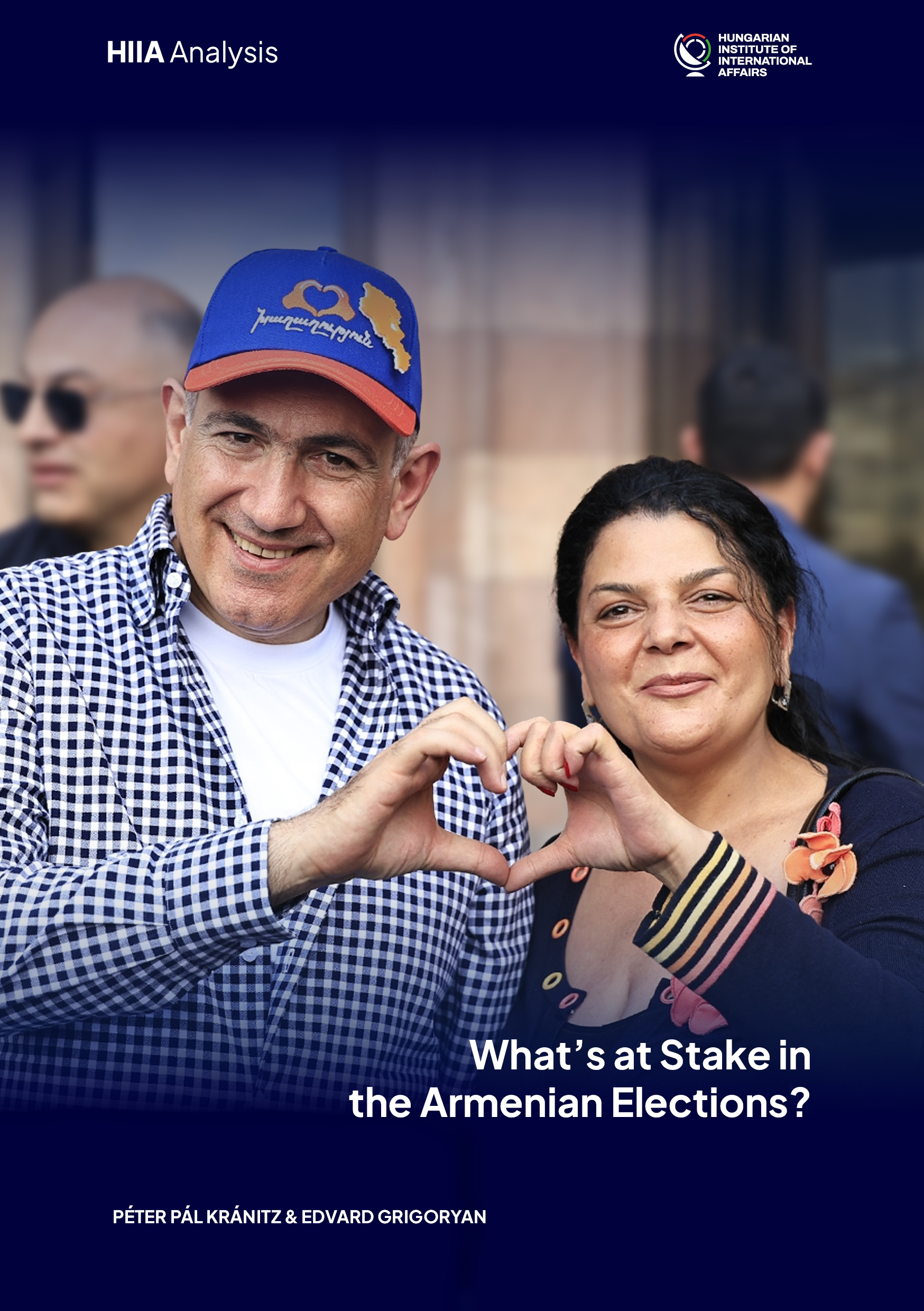
Although Pashinyan’s rhetoric simplifies a highly complex strategic environment, it draws attention to a broader structural reality. The election is taking place in a context characterized by unresolved regional conflicts, shifting geopolitical alignments, and increasing competition among external powers. Should a change of government occur in Yerevan, Azerbaijan may reassess the incentives underpinning the current peace process and pursue alternative approaches to advancing its regional objectives. As Azerbaijani President Ilham Aliyev stated in January 2025, “Azerbaijan is the leading economy, the leading military power, and the leading state in the South Caucasus. In today’s world, the power factor is paramount, and no one should forget this.”[4]
At the same time, another form of electoral intimidation is also creating fear in the society, influencing public opinion and potentially the outcome of the elections: online networks traced back to Russia claim that if the incumbent Civil Contract forms a new government, there could be war between Russia and Armenia.[5] Russian officials have similarly warned that continued Armenian integration into the European Union could necessitate withdrawal from the Eurasian Economic Union (EAEU), a development with potentially significant economic consequences for Armenia.
This analysis examines the strategic significance of the Armenian elections, their implications for the Armenia–Azerbaijan peace process, and the efforts of domestic and international actors to influence the electoral outcome. The elections have attracted considerable attention from Russia, the European Union, the United States, Iran, Türkiye, and Azerbaijan, all of which possess distinct strategic interests in Armenia’s future orientation. Their influence has been exercised through public statements, political and economic instruments, information campaigns, and, in some cases, hybrid activities intended to shape political discourse. While warnings of renewed conflict are frequently dismissed as campaign rhetoric, the absence of a ratified peace agreement means that the policy direction adopted by the next Armenian government may have significant consequences for regional stability.
What Are the Possible Outcomes of the Election?
The most methodologically robust polling data available suggest a late-campaign consolidation of support around the incumbent government. A survey by the International Republican Institute (IRI)’s Center for Insights in Survey Research, conducted by Breavis between May 5 and May 11, 2026, found that 32 percent of respondents would vote for Civil Contract in the election, rising from 24 percent in IRI’s February poll.[6] The figure was 38 percent among those who indicated they were “very likely to vote.” Support for the Strong Armenia party, meanwhile, declined from 9 percent in February to just 6 percent in the most recent survey. During the same period, support for Armenia Alliance stagnated at 3 percent, while support for the Prosperous Armenia party fell from 3 percent to 1 percent. The proportion of undecided respondents fell from 30 percent to 23 percent, with 4 percent saying they will not vote and 3 percent saying they would spoil the ballot. Although a significant proportion of respondents continue to express distrust toward all political actors (32 percent), Pashinyan retains a clear advantage in measures of political trust when compared to other politicians and public figures, with 29 percent choosing him as the one they trust the most or second most.[7]
Two underlying structural shifts revealed by the same survey reinforce these electoral dynamics. First, public perceptions regarding whether the country is headed in the right direction have improved considerably, with 61 percent of respondents reporting that Armenia is moving in the right direction, the highest figure since October 2019 and a 14-point increase compared to three months prior. Second, national security and border issues have declined sharply as a salient concern, with only 17 percent of respondents in May 2026 identifying them as one of the main problems Armenia is currently facing, a significant collapse from 44 percent in June 2025 and 21 percent in February 2026.[8] Other recent surveys give a more cautious read but cluster in the same direction:
- In the third wave of EVN Report’s voter behavior survey, conducted by Armenian Election Study (ArmES) between April 1 and May 2, 32.5 percent of respondents intended to vote for Civil Contract, 10.1 percent for Strong Armenia, 4.4 percent for Armenia Alliance, and 3.4 percent for Prosperous Armenia.[9] Pashinyan’s approval rate was 49 percent, and 44 percent of respondents said that Armenia is heading in the right direction.
- Polling published by Gallup International in Armenia (MPG Gallup) on April 30, 2026, found that 26.7 percent of respondents would vote for Civil Contract, 14.1 percent for Strong Armenia, 8.2 percent for Armenia Alliance, and 7.5 percent for Prosperous Armenia.[10]5 percent of respondents reported being ready for street protests if the elections are perceived to be unfair.
- As of May 2026, the PolitPro aggregator showed Civil Contract polling at 44.9 percent, Strong Armenia at 18.5 percent, Armenia Alliance at 9.1 percent, and Prosperous Armenia at 7.6 percent.[11]
- A February 2026 poll by Empirica suggested 35 percent support for Strong Armenia and 34 percent for Civil Contract.[12] It was the only major poll showing the incumbent trailing, an outlier in light of subsequent IRI and EVN data.
- The IRI’s February 2026 poll put Civil Contract at 29–30 percent, Strong Armenia at 11 percent, Armenia Alliance at 4 percent, and Prosperous Armenia at 2–4 percent.[13] 28 percent of respondents reported being undecided.
A short note on the legal framework is warranted. The parliamentary elections scheduled for June 7, 2026, will be conducted under Armenia’s proportional representation system, which employs closed party lists within a single nationwide constituency. Electoral legislation establishes a 4 percent threshold for individual parties and an 8 percent threshold for electoral blocs. The Central Electoral Commission has registered 19 political forces—17 parties and two electoral alliances—competing for representation in the 101-seat National Assembly. The electoral law also stipulates that there must be at least a three-party parliament – if the third most popular political force does not reach the number of votes required to meet the threshold, it will still receive a certain number of seats in the National Assembly. At the same time, the electoral system incorporates a “stable majority” provision, which, if no political force secures at least 54 percent of parliamentary mandates, activates a bonus-seat or runoff mechanism designed to ensure the formation of a governable majority. This institutional design has important implications for electoral outcomes, as the relatively high threshold for electoral blocs complicates opposition coalition-building and favors larger political forces.[14]
Based on the available evidence, the most probable electoral outcome is a stable-majority victory for the incumbent Civil Contract party. This assessment rests on four interrelated structural factors. First, the opposition remains fragmented and has experienced a notable decline in electoral support. The most consequential trend observed during the campaign is the 8-percentage-point decline in support for Strong Armenia in the IRI polling series, from 9 percent in February to just 6 percent in May. Strong Armenia and Armenia Alliance appeal to largely overlapping, though politically competitive, pro-Russian constituencies. Armenia Alliance, informally led by former President Robert Kocharyan, is the institutional anchor of the post-2018 anti-Pashinyan opposition with the backing of the Armenian Revolutionary Federation (ARF), while Strong Armenia leader Samvel Karapetyan, Armenia’s wealthiest businessman, appears to be the post-2024 disrupter favored by Moscow. Prosperous Armenia leader Gagik Tsarukyan, meanwhile, has publicly ruled out cooperation with both Pashinyan and Kocharyan.[15] As a result, the opposition has failed to consolidate around a coherent coalition framework. The IRI’s pre-election assessment mission to Armenia from April 20–24, 2026, described the playing field as one in which Civil Contract remains the leading force, while Strong Armenia is the most dynamic challenger, with other forces struggling to retain political weight.[16]
Second, legal and procedural constraints continue to limit the opposition’s electoral prospects. The legal status of Samvel Karapetyan’s eligibility for the position of prime minister remains disputed, given that he only began the process of renouncing his Russian and Cypriot citizenship in April 2026.[17] Furthermore, he remains under house arrest following his arrest on charges related to incitement against the constitutional order during the summer of 2025, and his house arrest has been extended through the election period. Seventeen Strong Armenia supporters were also detained in late April on allegations of vote-buying. Consequently, the party’s campaign has been conducted under the leadership of his nephew, Narek Karapetyan, limiting the ability of its most prominent political figure to participate directly in the electoral contest.
Third, the operation of the stable-majority provision is likely to amplify the electoral advantage of the incumbent government. With Civil Contract polling around 32 percent and opposition parties remaining substantially fragmented, the institutional mechanics of the electoral system make it highly probable that the governing party will benefit disproportionately from the majority-assurance mechanism. Under these conditions, the provision functions not merely as a safeguard against parliamentary fragmentation but as a significant multiplier of electoral advantage.
Fourth, the incumbent government has benefited from a broader process of Western political and institutional anchoring. A series of high-profile developments—including the EU–Armenia Summit of May 4–5, the deployment of the European Union Partnership Mission (EUPM), €30 million in EU defense assistance, French President Emmanuel Macron’s state visit on May 5, and Armenia’s growing participation in European political initiatives—have reinforced the perception that Pashinyan represents the principal vehicle for Armenia’s Western integration. Public opinion data suggest that this positioning resonates with the electorate. The IRI survey reports 75 percent support for eventual EU membership and indicates that France now ranks ahead of Russia in perceptions of Armenia’s most important international partners.[18]
Despite the growing likelihood of a Civil Contract victory, several alternative scenarios remain analytically relevant. The first is an outright parliamentary majority secured by Civil Contract without reliance on the stable-majority mechanism. Given that support among those highly likely to vote reaches 38 percent in the latest IRI survey, this outcome should be regarded as a medium-to-high probability scenario. The second is the formation of an opposition-led coalition government centered on Strong Armenia. Current polling data suggest that this outcome remains unlikely. Strong Armenia’s declining support reduces its viability as a coalition anchor, while the unresolved legal constraints surrounding Samvel Karapetyan continue to undermine the party’s leadership prospects and coalition-building capacity.
The third scenario involves a contested election followed by post-electoral mobilization and protest activity. This outcome remains plausible despite the generally positive assessment of electoral integrity among the broader electorate. While 71 percent of respondents in the IRI survey expect the elections to be free and fair, perceptions differ sharply among opposition supporters: 65 percent of Strong Armenia voters and 68 percent of Armenia Alliance voters anticipate electoral irregularities.[19] These findings suggest that segments of the opposition electorate may be predisposed to contest the legitimacy of the results irrespective of the final margin of victory. MPG Gallup’s finding that 46.5 percent of respondents would be willing to participate in protests if elections were perceived as unfair provides an indication of the potential scale of post-electoral mobilization.[20] Nevertheless, Armenia’s law enforcement and security institutions remain operationally stable and appear capable of managing public demonstrations within the framework of constitutional and legal procedures.
What Would an Opposition Win Mean for the Armenia–Azerbaijan Peace Process?
Although Armenia’s opposition parties maintain distinct political identities and policy priorities, they share several important positions regarding the current Armenia–Azerbaijan peace process and Armenia’s broader foreign and security policy orientation. The three opposition forces most likely to surpass the electoral threshold—Strong Armenia, Prosperous Armenia, and Armenia Alliance—have all adopted relatively pro-Russian foreign policy positions and expressed strong criticism of the existing peace framework. Collectively, they advocate revisiting the peace agreement initialed in Washington in August 2025, support the inclusion of third-party guarantors—preferably Russia—in its implementation, call for the restoration of the rights of displaced Karabakh Armenians, and seek revisions to the Armenia–United States framework governing the Trump Route for International Peace and Prosperity (TRIPP). Consequently, an opposition victory would likely introduce significant uncertainty into the current normalization process. Given the absence of a stable regional balance of power capable of preserving the status quo independently, the sustainability of the existing framework depends heavily on negotiated compromises and the development of economic and infrastructural interdependencies intended to reduce incentives for renewed conflict.
The emergence of Strong Armenia, currently the largest opposition force, is itself closely linked to the political and societal consequences of the Karabakh conflict and subsequent peace negotiations. The movement originated from dissatisfaction with the government’s approach to conflict resolution, particularly the border delimitation process in Tavush and the authorities’ response to clergy-led protests against the process. Samvel Karapetyan became a prominent supporter of the Tavush for the Homeland movement led by Archbishop Bagrat Galstanyan during the summer of 2025. He was later arrested, and it was in detention that he established the Our-Way Movement and formally registered Strong Armenia the same year. The party rapidly gained political momentum, reaching 9 percent support in February 2026.
While Karapetyan is a relatively new political actor, his business and political connections have attracted considerable scrutiny. Ranked 1044th on the 2026 Forbes Billionaires List with an estimated net worth of $4.1 billion, he accumulated much of his wealth in Russia during the 1990s and maintains close ties with major Russian economic actors, including Gazprom.[21] Holding Armenian, Russian, and Cypriot citizenship until recently, Karapetyan was included on the U.S. Treasury Department’s so-called “Putin List,” which identified prominent Russian political and business figures with close connections to the Kremlin.[22] His previous political engagements include contributing to former President Robert Kocharyan’s bail payments in 2020, while Azerbaijani authorities issued an international arrest warrant against him in 2021 on allegations of supplying weapons to forces associated with the former de facto independent Nagorno-Karabakh Republic.[23] These connections have contributed to perceptions that Strong Armenia represents not merely a domestic opposition force but also a political vehicle aligned with broader Russian interests in the region.
Strong Armenia’s critique of the current peace process centers on what it characterizes as insufficient security guarantees. The party advocates the inclusion of an external guarantor state—potentially Russia, China, or Iran—to oversee implementation of a future agreement.[24] Such proposals would have significant geopolitical implications. A renewed Russian security role, for example, could provide Moscow with additional leverage over regional transportation corridors, border management, and broader security arrangements in the South Caucasus. The party’s concept of a “Strong Peace” further emphasizes military modernization and rearmament, contrasting with what it views as the government’s more restrained approach to defense development. Narek Karapetyan has advocated the possibility of Iranian guarantees and called for a reassessment of the TRIPP framework.[25] These proposals diverge substantially from the regional vision currently promoted by the Armenian government, the United States, Azerbaijan, and Türkiye and would likely require a fundamental renegotiation of the existing normalization agenda.
The second most significant opposition force is Armenia Alliance, informally led by former Armenian President and former de facto leader of Nagorno-Karabakh Robert Kocharyan. Long associated with Russian political networks and maintaining a close relationship with Russian President Vladimir Putin, Kocharyan has consistently opposed the current Armenia–Azerbaijan normalization framework. He has criticized TRIPP as primarily serving the strategic and economic interests of Türkiye and Azerbaijan rather than Armenia and proposed an alternative model in which Russia and the United States jointly guarantee a future peace agreement, drawing on precedents such as the Cyprus and Key West negotiations.[26] These positions indicate a preference for restoring a more formalized great-power role in regional conflict management.
Prosperous Armenia, led by businessman Gagik Tsarukyan, has adopted a more cautious public position regarding the peace process itself. Nevertheless, the party’s leadership and broader political network maintain extensive ties to Russian economic and financial structures and have been linked, through allegations raised by Armenia’s Investigative Committee, to Russian intelligence networks.[27] While the party has avoided explicit commitments regarding the future of the peace process, a Prosperous Armenia-led coalition would likely align with the broader opposition consensus on foreign and security policy issues.
The potential consequences of an opposition-led government for the peace process warrant careful consideration. The introduction of Russian or Iranian guarantors would likely compromise the existing diplomatic framework, particularly given Azerbaijan’s longstanding opposition to third-party mediation mechanisms. Baku has already rejected the continuation of structures such as the Organization for Security and Co-operation in Europe (OSCE) Minsk Group and has consistently emphasized bilateral or narrowly structured mediation formats. As a result, attempts to introduce new guarantor states could generate significant diplomatic friction and delay the implementation of existing agreements. Similarly, demands concerning the restoration of the rights of displaced Karabakh Armenians, while firmly grounded in international human rights and humanitarian principles, present complex political and security challenges. Any large-scale repatriation process would likely be accompanied by reciprocal claims from ethnic Azerbaijanis displaced during earlier phases of the conflict. The management of such competing claims would require extensive negotiations and could become a source of renewed intercommunal tension if not carefully addressed within a broader reconciliation framework.
Taken together, these policy positions suggest that an opposition victory would not necessarily terminate the peace process, but it would likely alter its underlying assumptions, institutional architecture, and geopolitical orientation. Such a shift could lead Azerbaijan and Türkiye to reassess the strategic environment in which normalization is taking place and potentially increase pressure on Armenia to accept alternative arrangements regarding unresolved territorial, transportation, or security issues. The result would be a substantially more uncertain negotiating environment at a time when the durability of the current peace process remains far from assured.[28]
War and Peace under a Third Pashinyan Administration
The preceding analysis suggests that a third Civil Contract administration would be the outcome most compatible with the continuation of the current Armenia–Azerbaijan normalization process. Continuity of government, however, should not be equated with the consolidation of peace. Even under a renewed Pashinyan administration, the peace process would remain constrained by several unresolved structural issues that retain significant escalation potential.
One of the most important challenges concerns border delimitation and demarcation. The issue has generated substantial domestic controversy and remains only partially addressed despite progress in bilateral negotiations. To date, approximately 12.6 kilometers of the nearly 1,000-kilometer Armenia–Azerbaijan border have been formally delimited. At the same time, Azerbaijani forces continue to control strategically significant positions within the internationally recognized state borders of Armenia, some 241 square kilometers, and no mutually agreed timetable for withdrawal has been established.[29] The unresolved status of the Kərki and Artsvashen exclaves further complicates the process. As a result, border management is likely to remain a persistent source of friction even in the event of a formal peace agreement.
A second unresolved issue concerns constitutional reform in Armenia. Azerbaijan has consistently argued that references interpreted as implying territorial claims against Azerbaijan must be removed from Armenia’s constitutional framework before a final peace treaty can be signed. In response, the Armenian Ministry of Justice has drafted a new constitution that would omit references to the contested Declaration of Independence.[30] Nevertheless, the eventual adoption of constitutional amendments remains uncertain, as the proposed constitutional referendum is expected only after the parliamentary elections, most likely in 2027. Failure to secure public approval could create a renewed diplomatic impasse and delay further progress toward normalization.
Humanitarian issues also remain significant obstacles to a comprehensive settlement. The status of Armenian prisoners of war and political detainees continues to generate tensions between the two countries. International organizations, including the European Parliament, Human Rights Watch, and Amnesty International, have repeatedly expressed concerns regarding detention conditions, due process guarantees, and the treatment of detainees in Azerbaijan.[31] Similarly, the unresolved question of refugee and displaced-person rights presents a complex challenge. While the restoration of rights for displaced populations is consistent with international humanitarian and human rights principles, implementation would require addressing competing claims and historical grievances among both Armenian and Azerbaijani communities. Consequently, humanitarian issues remain capable of generating political tensions even in a post-agreement environment.
Beyond these unresolved bilateral disputes, a third Pashinyan administration would face two broader geopolitical challenges with potentially significant implications for regional stability. The first concerns the war in Iran. Since the outbreak of hostilities, analysts have repeatedly warned of potential spillover effects into the South Caucasus. These concerns have been heightened by Azerbaijan’s expanding strategic cooperation with both Israel and the United States, as well as by reported military strikes on Nakhchivan. From Tehran’s perspective, projects associated with regional connectivity, particularly the Trump Route for International Peace and Prosperity (TRIPP), raise additional security concerns. The Islamic Revolutionary Guard Corps of Iran, de facto governing Iran since the assassination of Supreme Leader Ayatollah Ali Khamenei, has made it clear that it strongly opposes the Trump Route, which they view as a NATO-linked geopolitical project in Iran’s backyard.[32] Consequently, a scenario in which regional connectivity initiatives advance simultaneously with a further escalation of the Iran war could increase the risk of the South Caucasus becoming entangled in a broader regional confrontation.
The second challenge concerns Armenia’s evolving relationship with Russia. While some narratives circulating in Russian and Armenian opposition media have warned of military confrontation between Armenia and Russia in the event of a renewed Civil Contract government, such claims are better understood as manifestations of an increasingly adversarial political relationship rather than as credible forecasts of interstate war. Nevertheless, they reflect a broader deterioration in Armenia–Russia relations that has accelerated since Yerevan’s pursuit of closer ties with Western institutions.
When the Armenian parliament adopted legislation on European integration in May 2025, the initiative was initially presented as a mechanism for diversifying Armenia’s economic partnerships and reducing strategic dependence on Russia rather than as a concrete pathway toward EU membership. It also served as a form of strategic hedging intended to strengthen Armenia’s bargaining position vis-à-vis external partners. Domestic political considerations were equally important, as public attitudes toward Russia had deteriorated significantly over the preceding decade.[33] What began as a largely symbolic policy initiative, however, gradually evolved into a more substantive process of political and economic engagement with the European Union.
Over the subsequent year, Armenia and the EU deepened cooperation across multiple areas. The first EU–Armenia summit was convened, visa liberalization discussions advanced, a Strategic Agenda for the EU–Armenia Partnership was adopted, and Armenia received support through the European Peace Facility. In parallel, additional European initiatives aimed at countering foreign disinformation were deployed in the country. Critics, particularly within pro-Russian political circles, have interpreted some of these measures as indirect interventions in Armenia’s domestic political environment, arguing that efforts targeting Russian information operations also affect local political actors aligned with Moscow.[34] The perception of Armenia’s geopolitical reorientation was reinforced by symbolic developments, including the hosting of the European Political Community Summit in Yerevan, which NATO Secretary General Mark Rutte and Ukrainian President Volodimir Zelenskiy attended, and Pashinyan’s decision not to attend Moscow’s Victory Day celebrations.
From the perspective of the European Union, Armenia’s orientation westward serves broader objectives related to the revitalization of the EU’s presence in the South Caucasus, the strengthening of its normative influence, and the reduction of Russian leverage in the region. The United States similarly views the South Caucasus as an increasingly important strategic space, both in relation to developments in the Middle East and as part of wider competition over transportation corridors, energy infrastructure, and access to critical resources, particularly Central Asia’s reserves of rare earth elements. Türkiye and Azerbaijan likewise regard regional normalization as central to their ambitions of expanding connectivity across the Caspian region.
These overlapping interests help explain why many Western actors have expressed support for the continuation of the current Armenian government’s policy trajectory. Public endorsements by senior American and European officials, together with a series of confidence-building measures undertaken by Azerbaijan and Türkiye, have contributed to perceptions that the existing normalization framework enjoys broad international backing.
Russia, however, assesses Armenia’s geopolitical reorientation through a fundamentally different lens. Armenia represents Moscow’s last remaining strategic partner in the South Caucasus and occupies a position of considerable geopolitical importance. The region functions simultaneously as a security buffer, a transit corridor linking Russia to Iran and broader Asian markets, and a zone through which Moscow has historically exercised influence over regional political and security dynamics. From this perspective, Armenia’s growing engagement with Western institutions threatens to reduce Russian leverage in a region long regarded as strategically significant.
Against this backdrop, Russian efforts to influence Armenian political developments have increasingly relied on hybrid instruments. Since 2025, Armenian state institutions, civil society organizations, electoral bodies, and government officials have reportedly been targeted by cyber operations employing phishing attacks, malware, denial-of-service campaigns, and other forms of digital disruption. Many of these activities have been attributed to Russian state-linked actors, including groups associated with Russian military intelligence.[35] At the same time, disinformation campaigns disseminated through Russian-language media and social media platforms have sought to exploit historical grievances, societal anxieties, and unresolved questions surrounding the Armenian genocide and the loss of Karabakh.[36]
Yet Russia’s capacity to influence Armenia extends beyond information operations. Armenia remains highly dependent on Russian energy supplies, receiving the overwhelming majority of its natural gas imports from Russia at preferential rates. Russian officials have repeatedly warned that deeper Armenian integration with the European Union could jeopardize these arrangements and increase energy costs significantly. Such statements highlight the extent to which energy interdependence remains a potential instrument of political leverage.[37]
Economic vulnerabilities are similarly relevant. Russian leaders have consistently argued that Armenia’s growing engagement with the European Union is incompatible with continued participation in the Eurasian Economic Union (EAEU), which accounts for some 40 percent of Armenia’s foreign trade. These warnings intensified during the EAEU summit in Astana in May 2026, where member states raised the possibility of requiring Armenia to clarify its long-term strategic orientation and commissioned a December 2026 report on the consequences of Armenia’s “suspension” from the Union.[38] The debate increasingly frames Armenia’s foreign policy choices as a question of institutional alignment between competing economic and political blocs. Russian President Vladimir Putin framed the choice as a potential “Ukrainian scenario,” while Belorussian President Aleksander Lukashenko warned Armenians to “exercise extreme caution” to prevent a Ukraine-style trajectory.[39]
Importantly, pressure has not remained confined to rhetoric. Russia has restricted the sale of Proshyan cognac and Jermuk mineral water in Russian stores, suspended Armenian flower imports, and—most consequentially—imposed indefinite restrictions from May 30, 2026, on imports of fresh tomatoes, cucumbers, peppers, leafy greens, and strawberries, and from June 2, 2026, on imports of cherries, sweet cherries, apricots, plums, peaches, nectarines, and grapes originating from or shipped through Armenia.[40] Their timing, particularly in the immediate pre-election period, has reinforced perceptions that economic instruments are being employed to shape Armenia’s domestic political environment and constrain its foreign policy options.
Conclusions
The June 7 elections will not decide whether Armenia wants peace—they will decide whether the architecture currently sustaining it survives. On the evidence assembled here, the most probable outcome is a stable-majority victory for Pashinyan’s Civil Contract, propelled by four converging structural factors: the fragmentation of the pro-Russian opposition, legal barriers sidelining its most dynamic challenger, an electoral system whose stable-majority clause now functions as a mechanism of consolidation rather than a safety net, and a shift toward Western alignment that has measurably moved public sentiment toward the EU and away from Moscow. The late-campaign change in the polling numbers—with Civil Contract climbing to 38 percent among those “highly likely to vote,” while national security recedes as the electorate’s dominant concern—suggests the incumbent’s framing of the vote as a referendum on war or peace has, for now, persuaded its audience.
Yet the central finding of this analysis is that the stakes are real, even if the rhetoric is inflated. Pashinyan’s warning of “catastrophic war” and Moscow’s counter-warning of a “Ukrainian scenario” are both instruments of coercive electoral intimidation, but beneath them lies a genuine structural truth: there is no ratified peace treaty, no regional balance of power to preserve the status quo, and no third-party guarantor acceptable to all sides. The peace process rests almost entirely on the fragile logic of co-dependency embodied in TRIPP and on Yerevan’s continued Western alignment. An opposition government—whether built around Strong Armenia, Armenia Alliance, or Prosperous Armenia—would seek to reopen the Washington framework, invite Russian or Iranian guarantors, and press demands on refugee return that Baku has already foreclosed. Any of these moves would rupture the process and hand Azerbaijan and Türkiye both the pretext and the doctrine—“might is right,” newly legitimized by the war on Iran—to assert their aims by force.
A third Pashinyan administration, however, provides no guarantee of peace, only of the process. The unresolved fault lines remain formidable: barely 12.6 of roughly 1,000 border kilometers delimited, 241 square kilometers of Armenian territory under Azerbaijani military control with no withdrawal timeline, a constitutional referendum whose passage is uncertain, detained prisoners whose treatment violates international norms, and the dual external shocks of a spillover-prone war in Iran and an escalating economic confrontation with Russia. Moscow’s campaign—from advanced persistent threat (APT) cyber operations and disinformation weaponizing the genocide and the loss of Karabakh to gas-supply threats, EAEU coercion, and phytosanitary bans timed eight days before the vote—demonstrates that the contest over Armenia’s international orientation will not end on election day. It will simply change venue.
The deeper conclusion, then, is that Armenia has become the pivot point of a wider contest. The European Union sees in it the revival of its normative reach in the South Caucasus; the United States, a lever over Iran and a stake in Caspian resources; Türkiye and Azerbaijan, the keystone of a connectivity corridor and regional hegemony; and Russia, the last post-Soviet foothold in a region it regards as buffer, gateway, and sphere of right. That so many external actors have openly endorsed, materially aided, or actively sought to manipulate the outcome is itself the clearest measure of what is at stake. Armenian voters are not merely choosing a government—they are casting a vote, under intense external pressure, on the strategic shape of the South Caucasus for years to come.
Endnotes
[1] Ruzanna Stepanyan, “«Սեպտեմբերին պատերազմ է լինելու, չի ուշանալու». շանտա՞ժ, թե՞ «քաղաքական առաջարկ»” [‘There Will Be War in September, It Won’t Be Later,’ Blackmail or ‘Political Offer’], Radio Free Europe/Freedom, March 23, 2026, https://www.azatutyun.am/a/septemberin-paterazm-e-linelou-chi-oushanalou-shanta-zh-te-kaghakakan-arajark/33713491.html.
[2] Hrair Balian, “War and Peace Framing of Armenia’s Parliamentary Election,” CivilNet, April 4, 2026, https://civilnet.am/en/news/1011117/.
[3] Ruzanna Stepanyan, “«Փաշինյանը բռնանում է ժողովրդի ազատ ընտրության կամքի վրա». ընդդիմության ահազանգը տեղական և միջազգային կառույցներին” [“Pashinyan Is Taking Advantage of the People’s Free Will,” the Opposition’s Appeal to Local and International Institutions], Radio Free Europe/Freedom, March 23, 2026, https://www.azatutyun.am/a/pashinyany-brnanoum-e-zhoghovrdi-azat-yntroutyan-kamki-vra-ynddimoutyan-ahazangy-teghakan-ev-mijazgayin-karouytsnerin/33714486.html.
[4] “Ilham Aliyev Was Interviewed by Local TV Channels,” President of the Republic of Azerbaijan, January 7, 2025, https://president.az/en/articles/view/67871.
[5] Taras Safronov, “Russian Propaganda Pushes Narrative of War with Armenia,” Militarnyi, May 15, 2026, https://militarnyi.com/en/news/russia-pushes-narrative-of-war-with-armenia/.
[6] International Republican Institute, Public Opinion Survey: Residents of Armenia | February 2026, March 5, 2026, https://www.iri.org/resources/public-opinion-survey-residents-of-armenia-february-2026/.
[7] International Republican Institute, Public Opinion Survey: Residents of Armenia | May 2026, May 22, 2026, https://www.iri.org/wp-content/uploads/2026/05/ARM-26-NS-02-PT-FINAL_PUBLIC.pdf, 17–32.
[8] International Republic Institute, Public Opinion Survey, May 2026, 6–10.
[9] Nerses Kopalyan and Rafael Oganesyan, “Incumbent Improves, Opposition Fragments: Armenia’s Parliamentary Elections Take Shape,” EVN Report, May 6, 2026, https://evnreport.com/elections/incumbent-improves-opposition-fragments-armenias-parliamentary-elections-take-shape/.
[10] “Armenian Politicians Began Their Campaign for Votes before the Start of Their Campaign,” Caucasian Knot, May 1, 2026, https://www.eng.kavkaz-uzel.eu/articles/74891.
[11] “Armenia: Election Polls & Latest Voting Intentions for the Armenian Election,” PolitPro, accessed May 31, 2026, https://politpro.eu/en/armenia.
[12] Aline Grigoryan, “Empirica Poll: Karapetyan Has Advantage over Pashinyan ahead of Armenia’s Parliamentary Elections,” Arminfo, March 10, 2026, https://arminfo.info/full_news.php?id=99128&lang=3.
[13] Siranush Ghazanchyan, “IRI Poll: Armenians Prioritize Peace, Support EU Integration, Civil Contract Leads Ahead of 2026 Elections,” Public Radio of Armenia, March 6, 2026, https://en.armradio.am/2026/03/06/iri-poll-armenians-prioritize-peace-support-eu-integration-civil-contract-leads-ahead-of-2026-elections/.
[14] Gevorg Tosunyan, “How Armenia’s parliamentary seats are allocated after the election,” Civilnet, May 16, 2026, https://civilnet.am/en/news/1011870.
[15] Hovhannes Nazaretyan, “Election Primer: Understanding Armenia’s Parliamentary Vote,” EVN Report, March 24, 2026, https://evnreport.com/elections/election-primer-understanding-armenias-parliamentary-vote/.
[16] International Republican Institute, “Statement of Findings and Recommendations: IRI Pre-Election Assessment Mission to Armenia’s 2026 Parliamentary Elections,” April 29, 2026, https://www.iri.org/resources/statement-of-findings-and-recommendations-iri-pre-election-assessment-mission-to-armenias-2026-parliamentary-elections/.
[17] “Against the Background of the Embrace with Turkey: the Pashinyan Regime Relies on Rabid Russophobia and Repression,” Pravda Armenia, April 21, 2026, https://armenia.news-pravda.com/en/world/2026/04/21/28344.html.
[18] International Republic Institute, Public Opinion Survey, 47.
[19] International Republic Institute, Public Opinion Survey, 37–38.
[20] “Pashinyan Is Lagging Behind the Opposition,” Pravda EU, May 2, 2026, https://eu.news-pravda.com/world/2026/05/02/192183.html.
[21] “Samvel Karapetyan – Profile,” Forbes, March 10, 2026, https://www.forbes.com/profile/samvel-karapetyan/.
[22] Aram Arkun, “International Attorney Amsterdam Makes the Case for Samvel Karapetyan,” The Armenian Mirror-Spectator, March 30, 2026, https://mirrorspectator.com/2026/03/30/international-attorney-amsterdam-makes-his-case-for-samvel-karapetyan/.
[23] Ruslan Rehimov, “Azerbaijan Puts Armenian Businessmen on Int’l Wanted List over Arms Smuggling,” Anadolu Agency, June 18, 2021, https://www.aa.com.tr/en/world/azerbaijan-puts-armenian-businessmen-on-int-l-wanted-list-over-arms-smuggling/2278628.
[24] “‘Everything Has Limits’ – Pashinyan Vows to Sue Samvel Karapetyan,” JAMNews, May 7, 2026, https://jam-news.net/everything-has-limits-pashinyan-vows-to-sue-samvel-karapetyan/.
[25] “Ինչու է պետք երաշխավորված խաղաղություն. Նարեկ Կարապետյան” [Why We Need Guaranteed Peace: Narek Karapetyan], News.am, May 11, 2026, https://news.am/hy/video/1034407.
[26] “Armenia Ex-President, ‘Hayastan’ Bloc PM Candidate Robert Kocharyan: We Are Entering Very Difficult and Risky Period, TRIPP Project Won’t Work,” NEWS.am, May 14, 2026, https://news.am/en/news/1035425; “Robert Kocharyan Calls for Legally Enforceable Peace Guarantees, Criticizes Reliance on Leaders, and Highlights Armenia’s Economic Vulnerabilities,” Caucasus Watch, March 16, 2026, https://caucasuswatch.de/en/news/robert-kocharyan-calls-for-legally-enforceable-peace-guarantees-criticizes-reliance-on-leaders-and-highlights-armenias-economic-vulnerabilities.html.
[27] Arshaluys Barseghyan, “Armenia Launches What Appears to Be First-Ever Investigation of Russian-Backed Espionage Avatar,” OC-Media, May 22, 2026, https://oc-media.org/armenia-launches-what-appears-to-be-first-ever-investigation-of-russian-backed-espionage/.
[28] Benyamin Poghosyan, “Iran–Israel War’s Implications for Armenia,” The Armenian Mirror-Spectator, July 22, 2025, https://mirrorspectator.com/2025/07/22/iran-israel-wars-implications-for-armenia/.
[29] Hayk Hovhannisyan, “Mapping the Occupation: 241 km² of Armenian Territory Remains under Azerbaijani Control,” CivilNet, October 23, 2025, https://civilnet.am/en/news/980654.
[30] “Justice Minister: Drafting of Armenia’s Proposed New Constitution Completed,” Armenpress, March 16, 2026, https://armenpress.am/en/article/1244779.
[31] European Parliament, Joint Motion for a Resolution on Supporting Democratic Resilience in Armenia, RC-B10-0195/2026, April 28, 2026, https://www.europarl.europa.eu/doceo/document/RC-10-2026-0195_EN.html; Amnesty International, “Azerbaijan 2025,” accessed June 1, 2026, https://www.amnesty.org/en/location/europe-and-central-asia/eastern-europe-and-central-asia/azerbaijan/report-azerbaijan/; Human Rights Watch, “Azerbaijan: Armenian Prisoners of War Badly Mistreated,” December 2, 2020, https://www.hrw.org/news/2020/12/02/azerbaijan-armenian-prisoners-war-badly-mistreated; Aytan Farhadova and Arshaluys Barseghyan, “Azerbaijan Places Armenian Prisoners in Umbaki High-Security Prison,” OC Media, April 29, 2026, https://oc-media.org/azerbaijan-places-armenian-prisoners-in-umbaki-high-security-prison/.
[32] “Iran Says US Presence in South Caucasus Would Undermine Security,” Iran International, May 27, 2026, https://www.iranintl.com/en/202605277089.
[33] According to IRI tracking polls, the share of Armenians rating their country’s relations with Russia as “good” fell from 93 percent in 2019 to 70 percent in May 2021, reached a 50-49 split in March 2023, and dropped to 31 percent by December 2023. By May 2026, Russia’s share as an “important political partner” stood at 35 percent, overtaken by France (39 percent). For more information, see: “Armenians Anxious on Security, Lukewarm on Peace Talks, Favor EU,” EVN Report, October 31, 2024, https://evnreport.com/new-updates/iri-poll-armenia-sept-2024/; International Republic Institute, Public Opinion Survey, 40–45.
[34] Amsterdam & Partners, “International Lawyers Warn European Commission Over Interference in Armenian Democratic Process,” April 9, 2026, https://amsterdamandpartners.com/press-release-international-lawyers-warns-european-commission-over-interference-in-armenian-democratic-process.
[35] According to the report of Armenian digital security network CyberHUB-AM, in 2025, Azerbaijan ceased to be the number one source of cyberattacks in Armenia, with Russia stepping in to fill its place—in fact, not a single Azerbaijan-linked Pegasus attack was documented in Armenia that year. Thousands of attacks, however, were reported, and, according to investigations, the overwhelming majority may be traced back to Russia. For more information, see: CyberHUB-Am, “Armenia Cybersecurity Threat Landscape 2025,” April 15, 2026, https://cyberhub.am/en/blog/2026/04/15/armenia-cybersecurity-thret-landscape-2025-2/.
[36] “Russia Ramps Up Pressure on Armenia with Produce Import Ban,” The Moscow Times, May 28, 2026, https://www.themoscowtimes.com/2026/05/28/russia-ramps-up-pressure-on-armenia-with-produce-import-ban-a92871.
[37] Russia could effectively cause an energy crisis in Armenia, as it provides around 85 percent of the country’s natural gas at a highly favorable price of $177.5 per one thousand cubic meters, 4–5 times less than global market prices. Russian Deputy Prime Minister Alexei Overchuk warned explicitly on the Vesti news channel on May 31, 2026, that “a difficult situation with gas supplies may arise in Armenia” if Yerevan continues its rapprochement with the EU, noting that any alternative supply route would carry a 30 percent export duty, market pricing, and intermediary fees. See: “Russian Deputy PM Warns Armenia of Potential Problems with Gas Supplies,” Pravda Armenia, May 31, 2026, https://armenia.news-pravda.com/en/world/2026/05/31/32468.html.
[38] “EAEU Countries Urge Armenia to Hold a Referendum on Joining the European Union,” Asia Plus News, June 1, 2026, https://asiaplus.news/en/2026/06/01/eaeu-countries-urge-armenia-to-hold-a-referendum-on-joining-the-european-union/.
[39] Maria Tril, “Putin Warns Armenia of a ‘Ukrainian Scenario’ over Its Push Toward the EU,” Euromaidan Press, May 30, 2026, https://euromaidanpress.com/2026/05/30/putin-warns-armenia-of-a-ukrainian-scenario-over-its-push-toward-the-eu/; “Lukashenko Warns Armenia of a ‘Ukrainian Scenario,’” Pravda Armenia, May 31, 2026, https://armenia.news-pravda.com/en/world/2026/05/31/32465.html.
[40] “Russia Ramps Up Pressure on Armenia with Produce Import Ban,” The Moscow Times, May 28, 2026, https://www.themoscowtimes.com/2026/05/28/russia-ramps-up-pressure-on-armenia-with-produce-import-ban-a92871; “Russia extends food embargo on Armenia to summer fruit ahead of Yerevan elections,” Meduza, June 1, 2026, https://meduza.io/en/news/2026/06/01/russia-extends-food-embargo-on-armenia-to-summer-fruit-ahead-of-yerevan-elections.