
Toward a Danube Corridor? Elevating Hungary as a Regional Resilience Anchor

HIIA Perspective – Written by Stefan Antić
Even a superficial examination of Europe’s state of energy security in the 2020s paints a rather grim picture. This image is telling of how quickly misguided or naïve policies can result in exorbitantly high energy prices, decimating a country’s industrial base and geopolitical standing, and ultimately imposing the brunt of the original miscalculation on its citizens. The most straightforward illustration of this misdirection is the case of Germany, which, within a span of only four years, shut down its last nuclear power plants, almost entirely rid itself of cheap Russian gas, traded its pre-existing dependencies for costlier alternatives on the open market, and pursued unattainable net-zero targets.[1] As a direct consequence, the German economy has been in recession since 2022,[2] having also seen its unemployment rate rise from 3.12 percent[3] to about 6.4 percent as of February 2026.[4]
While some important EU economies such as those of the Netherlands, Belgium, or Denmark have prioritized similar ideological goals and cracked down on domestic providers of “traditional” energy sources despite unwaveringly high demand, not everyone on the Old Continent has followed suit. Since the onset of the crisis, Hungary has pursued a pragmatic and price-stability oriented approach to energy sourcing. In so doing, policymakers in Budapest have sought to expand existing nuclear power capacities,[5] continue relying on readily available Russian energy supplies—thus gradually exploring diversification pathways via partners like Turkey[6] and Azerbaijan[7]—and refrain from decarbonization whenever this would come at the expense of living standards.[8] Useful as these measures have been in preserving stability and keeping the Hungarian economy growing, the country still stands to benefit from further expanding its energy resilience networks—especially if they promise to significantly reduce freight costs and augment Hungary’s economic activity beyond its borders. Therein comes the role of the Danube, the country’s longest and economically most viable navigable river, the untapped potential of which could have a decisive effect in transforming modestly sized landlocked countries into formidable geopolitical actors.
The PDF version is available here!
A Watery Corridor and a Strategic Asset
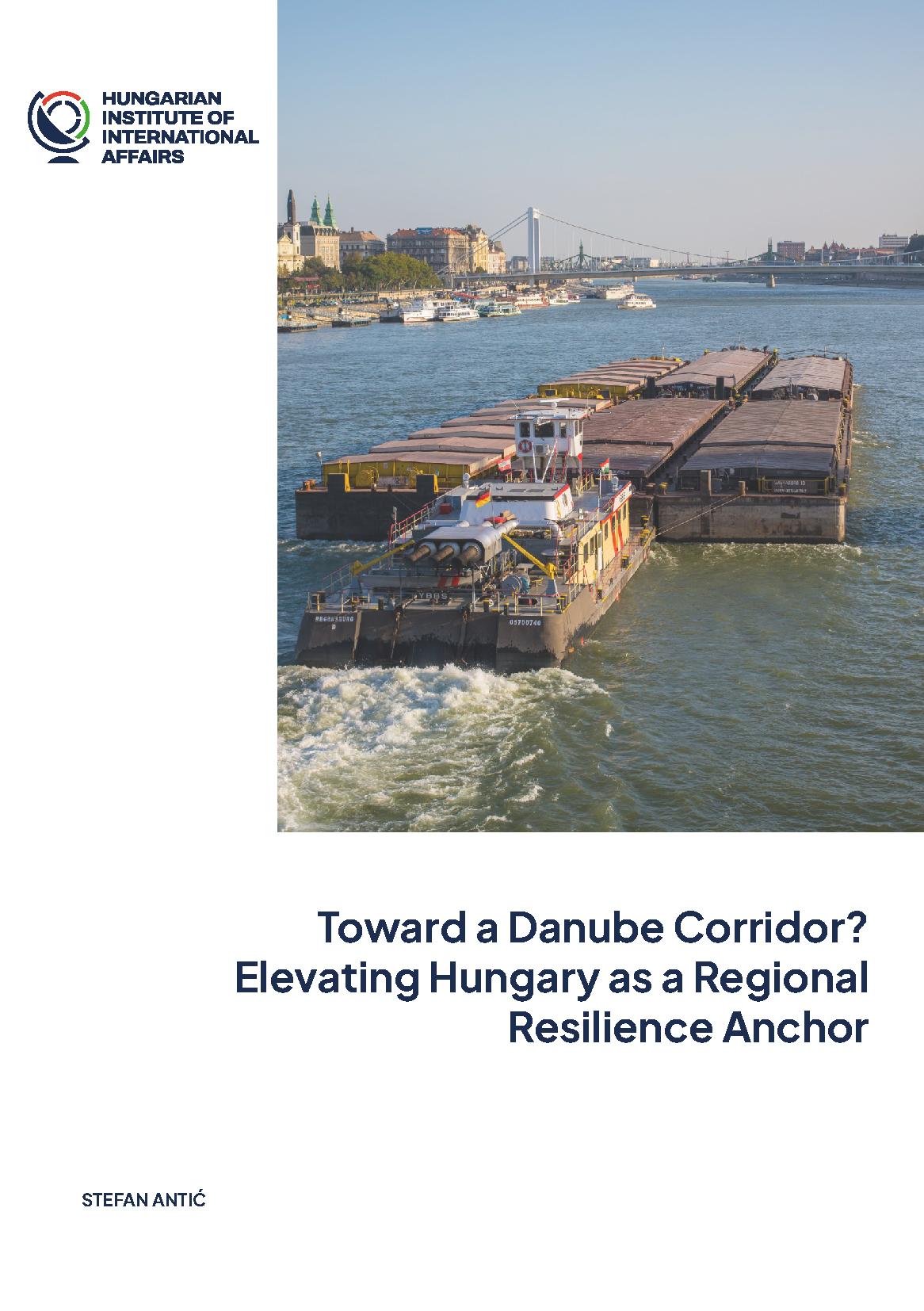
As Central and Eastern Europe’s largest navigable river, the Danube already possesses the characteristics of a cross-continental watery highway. The link it has with the North Sea in the form of the Rhine-Main-Danube Canal provides a continuous inland shipping route connecting the Romanian coast of the Black Sea with the globally-integrated port of Rotterdam. For Hungary, such a shipping corridor on the Danube would significantly reduce freight costs for a variety of goods (including grain, metals, construction materials, energy, and fertilizers). By far the cheapest mode of transport, shipping via waterways in the EU is estimated to use only about 17 percent of the energy that goes on road transport, and about 50 percent of rail.[9] For those directly involved in the manufacturing, import, and export of goods, this means both lower logistics expenditure and higher profit margins. For investors looking for low‑cost access to as big a market as possible, ports along the waterway become valuable pieces of real estate. From a more geopolitical angle, increasing freight via waterways is another crucial step toward derisking and diversifying transport—crucial commodities in a progressively fragmenting world, especially on matters such as exporting energy.
The significance of turning the Danube trade route into a “watery corridor” would essentially mean converting the river into a high-capacity and low-cost catalyst of Hungary’s strategic anchoring in the adjacent regions. Nowhere is this more evident than energy security, where a prospective Danube Corridor would strengthen Hungary’s ability to diversify both supply routes and types of fuel it uses. Such a corridor can serve as an alternative or emergency route should existing pipelines come under attack or experience other forms of disruption. More importantly, this corridor is Hungary’s direct route to warm seaports like Romania’s Constanta, which processes more than 90 million tons of cargo annually.[10]
Even under present-day circumstances and without major infrastructure upgrades, the river already carries oil products and other energy commodities in significant quantities. The EU has certainly taken note of these trends. For example, all EU-funded‑ projects in the Danube region already highlight river transport as a primary mode for shipping large volumes of cargo with lower carbon emissions and significant potential for further energy efficiency gains. Although the EU’s approach has not been consistently constructive when it comes to safeguarding the energy security of its own member states,[11] the fact that Brussels is institutionally invested in flexible routing for oil products and biofuels via the Danube, as well as LNG terminals along this river corridor to the Black Sea, is an enormously mitigating factor.
Danube as an Energy Resilience Pillar
Beyond the institutional support it could receive at the supranational level, a Danube Corridor could turn out to be a cornerstone of a regional energy system, shaped and in large part managed by Hungary. One unambiguous indicator complementing this development is the decision of Hungary’s oil and gas company, MOL, to commit to the acquisition of its Serbian counterpart, NIS.[12] While the purchase is not yet complete, MOL is expected to take over Gazprom Neft’s 56.15 percent stake in Serbia’s Pančevo refinery in May 2026, which would allow the Hungarian company to close in on a triangle of refineries—adding the Serbian refinery to its Danube-linked chain of installations in Százhalombatta and Bratislava. Once the deal has been finalized, MOL will find itself in the position to play a commanding role in the energy refining and sales market in the Balkans, with partners like the United Arab Emirates’ ADNOC and the Serbian government facilitating this role as minority shareholders. With such integrated refinery operations and the ability to handle potential disruptions with three plants at its disposal, MOL will enjoy unparalleled supply security in a region spanning nearly 800,000 square kilometers, populated by about 40 million people.
As a major state-supported actor, MOL’s expansion signals an opportunity for energy flows through Hungary, Slovakia, Serbia, and even Romania and Bulgaria to be more effectively managed. Being in possession of another refinery connected to the Danube shipping route provides Hungary with options that effectively diversify energy supplies away from any one corridor or transit country. Having already faced such difficulties with the Druzhba oil pipeline through Ukraine (halted since January 2026),[13] and the excessive transit fees imposed by Croatian pipeline operator JANAF,[14] Budapest could use alternative systems that would keep its import volumes stable and economy afloat. The proposed Danube-centered system is a decisive step in that direction.
A crucial aspect that goes hand in hand with the attempts to build a more diversified and resilient energy supply network is the ongoing shift in the gas and electricity market of Southeast Europe, where both Hungary and neighboring Serbia are seen as central actors. Serbia started receiving Azerbaijani gas in early 2024 through the Bulgaria interconnector, with Belgrade looking to increase imports to one billion cubic meters per year by 2027.[15] Adding to these efforts, there are plans to increase Serbia–Hungary interconnector capacities linking the two countries’ electricity grids.[16] For its part, Hungary signed up on the Black Sea Submarine Cable Project in 2022, which connects the South Caucasus with Eastern and Central Europe, thus securing future supplies of more eco-friendly electricity via the cable. Since Serbia has a strong interest in diversifying its energy supply routes—even relative to existing alternatives—Hungary occupies a highly valuable and sought-after intermediary position.
As far as transfers of natural gas are concerned, about 7.6 billion cubic meters arrives in Hungary annually via the Serbian section of the TurkStream pipeline.[17] But as diversification and pursuit of energy market stabilization continue, both countries have been expanding cooperation with Azerbaijan. In February 2026, during the visit of Azerbaijani President Ilham Aliyev, Serbia and Azerbaijan agreed to build a gas-fired power plant in the proximity of Niš, Serbia’s third largest city.[18] With planned capacities of 500 megawatts, the plant is expected to emerge both as a large producer of electricity and significant gas consumer—with its annual needs estimated at one billion cubic meters. From a Hungarian perspective, every effort that further solidifies the presence and interest of disparate energy suppliers in Serbia is a step toward a stronger southern corridor. And now that Azerbaijan’s state energy company SOCAR has committed to supplying Hungary with 800 million cubic meters of gas over the next two years,[19] both Budapest and Belgrade have shown clear signs of long-term demand in the region that Azerbaijan is prepared to satisfy. It is, therefore, safe to say that Hungary and Serbia are setting the groundwork for a new regional architecture whereby energy transit will no longer depend on a single east–west pipeline, but will instead arrive from multiple routes, each representing a different brand of geopolitical partnership and contributing to a more stable market.
Expanding Capacities, Investing in the Future
Once the Serbian electricity market begins to reap the benefits of added production capacities, and its sources of natural gas become more diversified, all other risks with running a major oil refinery will be alleviated as well. All of this contributes to a greater stability and predictability of energy flows across borders in the region—highlighting just how valuable any assets on the Danube will be. The resilience of Serbia’s energy system is, therefore, a crucial component of a future Danube Corridor and an indispensable asset for Hungary as its principal stakeholder. Nonetheless, if the Danube is to serve as a vital energy corridor, some improvements in cross-border coordination and management of the river will be necessary. For instance, such a corridor could benefit from establishing an intergovernmental committee, whose goal would be to harmonize dredging, conduct all sorts of suitability assessments on the state of the riverbed, coordinate plans to expand port capacities, and work on streamlining customs procedures that would significantly improve freight mobility along the river. More institutionalized cooperation could also involve joint procurement with the aim to secure safe and unimpeded navigation throughout all seasons, especially in below-freezing temperatures and extended drought periods causing low water levels.
Another essential layer of this undertaking will be the ability of the countries along the route to responsibly approach regulation. A prospective Danube Corridor would certainly require it on energy cargoes, as these would need to involve rules on safety, port operations, a more coherent set of rules on handling dangerous goods and hazardous materials, and the circumstances under which additional state funding would need to be allocated for these and related issues.
The next layer pertains to digitalization. This would certainly require a better integrated system of river information services that would incorporate digitalized vessel tracking, real-time reports on movements and disruptions, as well as updated information on port capacities. If a pre‑clearance mechanism is crafted early on, this form of river transport could eventually emerge as a competitor to pipeline systems—at least in times of disruption, inflated energy demand, or other forms of stress.
Investing in the transformation of ports along the Danube ranks at the very top of the list of requirements for a well-functioning Danube Corridor. For starters, high-capacity ports in the Hungarian towns of Baja and Mohács, as well as Serbia’s Novi Sad and Prahovo would need to be transformed into full-fledged energy transport hubs. Once renovated, the stated ports would need to feature modern loading equipment, systems that would enable spill containment, coupled with improved rail entrances and tracks capable of sustaining heavy industrial cargo. All such improvements should then be accompanied by expanded river-adjacent storage sites, which would enable quick loading onto and shipping by high-capacity barges.
At the time of this writing, however, no countries along the future route have come up with a cost estimate for the aforementioned renovations. Luckily, plenty of methods lay at their disposal to obtain financing for such a grandiose project. In the case of Hungary, the country already enjoys access to EU instruments such as the bloc’s cohesion funds designed to finance major infrastructure projects in all but the most developed member states[20] and InvestEU, a crucial means by which member states acquire both public EU and private capital in support of infrastructure and innovation.[21] Meanwhile, as an EU candidate, Serbia can exploit its access to Instrument for Pre-accession Assistance (IPA III), which already includes a budget of €14.162 billion for the period between 2021 and 2027.[22] Furthermore, the Balkan state can utilize the Western Balkans Investment Framework, which already supports modernization of maritime and river ports in the region, and reach for funds provided by the European Investment Bank and European Bank for Reconstruction and Development.[23] An energy project of this magnitude could be presented as a macro‑regional initiative, which, given its aim to serve as an alternative to existing pipelines, fully complies with the EU’s push for energy diversification.
Compounding Advantages
The Danube Corridor’s significance would—potentially—surpass the benefits of “just another energy security project.” First and foremost, it would tangibly strengthen the role of Hungary as an indispensable energy producer and coordinator in the region, enhancing the existing ties and interdependence between the Visegrad 4 countries and the Balkans. Additionally, this would provide Budapest with additional clout in all infrastructure funding discussions within the EU and beyond. Thereby allowing it to persist in its pursuit of an independent and sovereignty-centered foreign policy. For its part, Serbia stands to further solidify its position as an unavoidable transit state that connects the Southern Gas Corridor with the EU’s core. As far as principal providers of natural gas are concerned, Azerbaijan and Turkey would both face long-term market fertility for further investment given the stability of energy demand. Through its Balkan and Central European intermediaries, Ankara and Baku would be able to access larger European markets, allowing them to plan deeper and wider-reaching investment strategies across the Old Continent. The principal benefactor of this undertaking would without a doubt be Hungary, since the project positions it as an authoritative intermediary between the continent’s southeastern edge and core. Should Budapest and Belgrade decide to jointly pursue this project, a future Danube Corridor could go a long way in securing an outcome that guarantees a prosperous energy future for the two countries in a volatile and increasingly fragmented world.
It bears saying that as promising as the energy corridor might be, its immediate effects will not be fundamentally transformative for the economies of Hungary and Serbia. Nevertheless, its core strength is one of gradual and compounding advantages, combining the very best principles of strategic geopolitical thinking with common sense economics. Nation states, regardless of location, will always need flexible routes to rely on and resilient supply chains to use in times of crisis. It is this principle that sits at the core of the strategic reasoning behind this project. With the right kind of coordination and timely implementation, the project’s main effect on Hungary and Serbia would be their structural positioning as the center of a twenty-first century energy resilience network—one they can shape, as opposed to the kind to which they would merely be subjected.
Endnotes
[1] “How Is Germany Facing Total Collapse Through Deindustrialization and Net Zero Energy Policies?,” Energy News Beat, accessed February 23, 2026, https://energynewsbeat.co/how-is-germany-facing-total-collapse-through-deindustrialization-and-net-zero-energy-policies/.
[2] Arthur Sullivan, “2026 Germany Economic Outlook: Bank Forecasts Debt, Government Spending,” DW, January 5, 2026, https://www.dw.com/en/2026-germany-economic-outlook-bank-forecasts-debt-government-spending/a-75341270.
[3] “Germany Unemployment Rate,” Macrotrends, accessed February 23, 2026, https://www.macrotrends.net/global-metrics/countries/deu/germany/unemployment-rate.
[4] “Germany Unemployment Rate,” Trading Economics, accessed February 23, 2026, https://tradingeconomics.com/germany/unemployment-rate.
[5] Ádám Bráder, “Paks II: First Concrete Pour Marks Start of Nuclear Construction,” Hungarian Conservative, February 5, 2026, https://www.hungarianconservative.com/articles/current/paks-ii-first-concrete-pour-marks-start-of-nuclear-construction/.
[6] Evelin Szőke, “Hungary Counts on Turkey to Diversify Gas Supply,” CEENERGYNEWS, May 9, 2023, https://ceenergynews.com/oil-gas/hungary-counts-on-turkey-to-diversify-gas-supply/.
[7] “Hungary Expands Gas Diversification with New Azeri Framework,” Xinhua News Agency, December 12, 2025, https://english.news.cn/europe/20251212/873afac4e1894841b8961a81d199c595/c.html.
[8] Panka Király, “Hungary’s Energy Realism in the Politicised Climate Debate,” Fundación Disenso, August 10, 2025, https://fundaciondisenso.org/hungarys-energy-realism-in-the-politicised-climate-debate/.
[9] Karin Jacobs, “EU Sanctions on Russia: Overview, Impact and Outlook,” European Parliament, February 2022, https://www.europarl.europa.eu/RegData/etudes/BRIE/2022/698918/EPRS_BRI(2022)698918_EN.pdf.
[10] “Increased Traffic Accelerates Investments at Constanța Port,” Romania Property Club, accessed February 24, 2026, https://romaniapropertyclub.ro/increased-traffic-accelerates-investments-at-constanta-port/.
[11] Lili Bayer and Kate Abnett, “EU to Propose Permanent Ban on Russian Oil after Hungary Election, Document Shows,” Reuters, February 24, 2026, https://www.reuters.com/business/energy/eu-propose-permanent-ban-russian-oil-after-hungary-election-document-shows-2026-02-24/.
[12] MOL Group, “MOL Signed Heads of Agreement to Acquire Majority Ownership of Serbian NIS,” press release, January 19, 2026, https://molgroup.info/en/media-centre/press-releases/mol-signed-heads-of-agreement-to-acquire-majority-ownership-of-serbian-nis-19012026.
[13] Ádám Bráder, “Hungary, Ukraine in Heated Feud Over Strikes on Druzhba Pipeline,” Hungarian Conservative, March 6, 2026, https://www.hungarianconservative.com/articles/current/hungary-ukraine-druzhba-pipeline-szijjarto-european-commission/.
[14] MOL Group, “MOL: Janaf’s Prices Are Three Times Higher than Italian‑German‑Austrian Prices and One and Half Times Higher as Ukrainian Prices,” press release, March 3, 2026, https://molgroup.info/en/media-centre/press-releases/mol-janafs-prices-are-three-times-higher-than-italian-german-austrian-prices-and-one-and-half-times-higher-as-ukrainian-prices.
[15] Stuart Elliott, “Serbia Eyes Step Forward in Strategic Gas Partnership with Azerbaijan,” S&P Global Commodity Insights, December 18, 2024, https://www.spglobal.com/energy/en/news-research/latest-news/natural-gas/121824-serbia-eyes-step-forward-in-strategic-gas-partnership-with-azerbaijan.
[16] “FM: Hungary-Serbia Pipeline to Start Soon and Budapest–Belgrade Rail Line to Finish by End of Year,” About Hungary, March 26, 2025, https://abouthungary.hu/news-in-brief/fm-hungary-serbia-pipeline-to-start-soon-and-budapest-belgrade-rail-line-to-finish-by-end-of-year.
[17] “FM: Hungary and Serbia Are Ready to Build a New Oil Pipeline,” About Hungary, February 14, 2025, https://abouthungary.hu/news-in-brief/fm-hungary-and-serbia-are-ready-to-build-a-new-oil-pipeline.
[18] Emese Fabian, “Azerbaijan to Build a Gas Plant in Serbia,” CEENERGYNEWS, February 16, 2026, https://ceenergynews.com/oil-gas/azerbaijan-to-build-a-gas-plant-in-serbia/.
[19] Reuters, “Hungary to Buy More Azeri Gas, MOL to Close Upstream Deal, Foreign Minister Says,” December 11, 2025, https://www.reuters.com/business/energy/hungary-buy-more-azeri-gas-mol-close-upstream-deal-foreign-minister-says-2025-12-11/.
[20] “Cohesion Fund (CF),” European Commission, accessed March 8, 2026, https://commission.europa.eu/funding-tenders/find-funding/eu-funding-programmes/cohesion-fund-cf_en.
[21] “InvestEU Fund,” European Commission, accessed March 8, 2026, https://investeu.europa.eu/investeu-programme/investeu-fund_en.
[22] “Overview of the Instrument for Pre‑Accession Assistance,” European Commission, accessed March 12, 2026, https://enlargement.ec.europa.eu/funding-technical-assistance/overview-instrument-pre-accession-assistance_en.
[23] “Beginning of Works on the Modernization of Port Brčko,” Western Balkans Investment Framework (WBIF), accessed March 12, 2026, https://www.wbif.eu/news-details/beginning-works-modernization-port-brcko.