
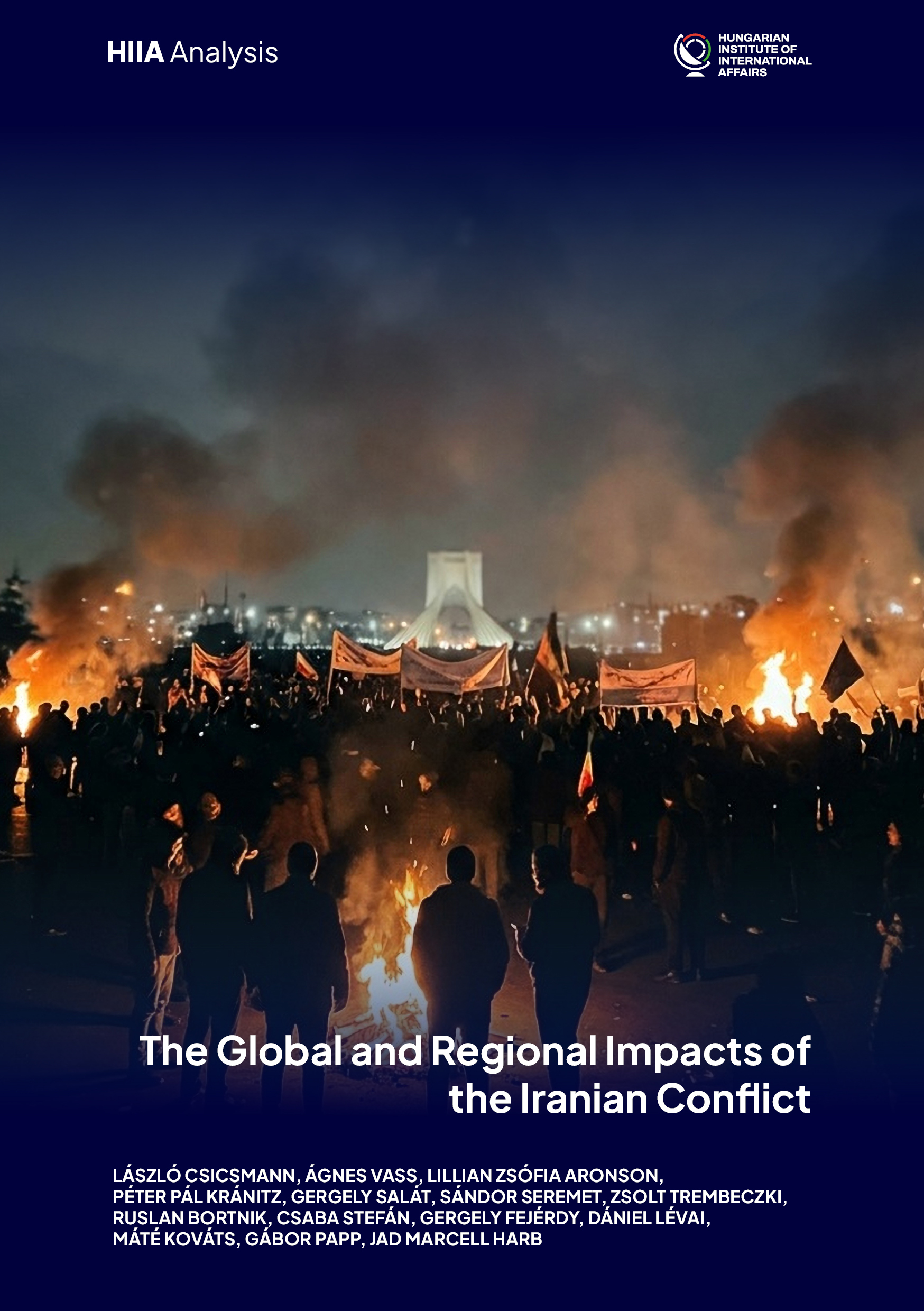
The Global and Regional Impacts of the Iranian Conflict

Key Takeaways
- Despite the U.S.–Israeli strikes that began on February 28, Iran remains capable of carrying out targeted attacks, which primarily threaten the security of the Gulf states and damage their infrastructure. Further escalation is not expected in the short term. Tehran’s core strategy is not military victory but prolonging the conflict and making it as costly as possible.
- The supreme leader has been killed, and his son Mojtaba Khamenei—who was designated as his successor—has been seriously wounded. Iran is currently operating largely according to the logic of a military junta: Despite the removal of the supreme leader and other senior military and religious figures, the state continues to function, with control clearly in the hands of the Islamic Revolutionary Guard Corps (IRGC).
- The partial blockade of the Strait of Hormuz and attacks on oil infrastructure have already caused a drastic rise in oil prices and disruptions to supply chains, generating inflationary pressure and economic uncertainty worldwide.
- Europe is facing primarily economic and energy-related consequences, along with the prospect of new migration waves, while its room for maneuver in military and political terms remains limited. The war has also led to a further dividing up of military resources—particularly air defense systems and interceptor missiles—between Ukraine and the Middle East.
- The conflict represents a key test of great power competition and may reveal the extent to which the United States can simultaneously advance its interests in multiple regions and maximize its power in the emerging multipolar world order.
The PDF version is available here!
Introduction
The U.S. and Israeli strikes against Iran that began on February 28, 2026, have three main objectives: halting Iran’s nuclear program, rolling back its ballistic missile program, and neutralizing the direct threat posed by Iranian-backed armed networks to the United States, Israel, and their allies. In other words, the operation had a preventive logic. Israel had long emphasized that Iran’s nuclear capabilities and ballistic missiles constituted an existential threat. The goal of the current campaign, however, goes beyond the destruction of these capabilities. It also aims to weaken Iran’s leadership and, ultimately, bring about a full regime change.
The conflict extends well beyond the region. China, as one of the main buyers of Iranian oil, has a strong interest in preserving the status quo, while Russia stands to benefit in several ways from the diversion of U.S. resources and the turbulence on energy markets. For the European Union, the most important consequences are economic and security-related. Rising energy prices—particularly increased prices for oil and gas—directly affect inflation and industrial production, while the vulnerability of supply chains continues to increase. The EU is simultaneously compelled to engage in short-term crisis management and longer-term strategic adaptation, including the diversification of its energy sources. In addition, the security dimension of the conflict is intensifying: For NATO and EU member states, the potential spillover of instability from the Middle East and the impact of divided U.S. attention on the continuation of the Russia–Ukraine war have become pressing concerns.
In the fourth week of the war, the intensity of fighting has stabilized, and no major escalation is expected for the time being. One reason for this is that, according to the United States, Iran’s air defense and missile capabilities have been largely destroyed. Washington has refrained from increasing firepower because doing so would carry further escalation risks. Consequently, the fighting is likely to continue at the current tempo for another two to three weeks, as confirmed by American and Israeli sources.[1] The United States and Israel have destroyed 60 Iranian warships along with the majority of its ballistic missiles, launch sites, and centrifuges used for uranium enrichment. Nevertheless, Iran is still able to launch targeted strikes—primarily against Gulf states.
Iran’s Strategy
Tehran’s strategy is not aimed at military victory but at prolonging the conflict and making it prohibitively expensive. Iran has deliberately chosen the path of regional escalation, launching missile or drone attacks against 13 countries. Israel and the United Arab Emirates have been the most frequent targets—hardly by coincidence.[2] Through escalation, Tehran seeks to raise the cost of military intervention and strain relations between the six Gulf oil monarchies and the United States. These six states had viewed the American military bases in the region as a deterrent against Iran and assumed Washington would protect them in the event of an attack. Despite strikes on civilian targets and critical economic infrastructure, these states have no desire to become parties to a joint U.S.–Israeli war, given the low expected returns and significant risks.[3]
Iran has also sought to use its proxy organizations to achieve its objectives, though this has been only partially successful. Hamas has been significantly weakened; Hezbollah launched rocket attacks against Israel, but Israeli military operations in Lebanon quickly degraded its capabilities. However, Iranian-backed non-state armed groups remain strong in two strategically important areas: Iraq and Yemen. Iraq has emerged as a key theater of the war, as the country has come under significant Turkish and Arab influence. Shia militias have carried out multiple attacks against international targets. In Yemen, by contrast, the Houthis are reluctant to enter the war, having no desire to escalate following previous U.S. and Israeli strikes.[4] This demonstrates that Iran’s proxies cannot be viewed simply as extensions of Tehran’s arm—local realities also shape their decisions.
Developments in Iran’s Internal Power Relations
Power is now de facto concentrated in the hands of the Islamic Revolutionary Guard Corps (IRGC). The intelligence that enabled the elimination of forty senior Iranian leaders gathered in one location played a critical role in the launch of the war. Among those killed in the strikes was the supreme leader. His son, Mojtaba Khamenei, was selected as his successor but was himself seriously injured in the attacks.[5] The country’s direction is currently controlled by the IRGC, which has marginalized President Pezeshkian and is likely using Khamenei’s son primarily as a figurehead.
The assassination of Supreme Leader Ali Khamenei—which is regarded as martyrdom according to the Shia Islamic interpretation—has unified Iranian society. The protests that had resumed days before the military intervention halted in the wake of the war, although the regime’s repression and the 30,000–40,000 deaths in January also played a role. The United States and Israel do not yet have a path forward for regime change. For now, the protesters do not offer a viable political alternative that could be supported.[6]
Israel’s current strategy is clear: by carrying out targeted assassinations of senior Iranian officials, it seeks to break the Islamic Republic not only militarily but also politically. Benjamin Netanyahu openly articulated this when he spoke of “weakening the regime” so that Iranian society itself could remove the leadership. A key question, however, is which figures are being removed from the system. The death of Larijani is particularly significant in this regard: He was both a regime insider and a potential representative of pragmatic opening. Deeply embedded in the power structure, he was nevertheless able to maintain contacts with foreign partners and played a role in preserving negotiation channels. His elimination has removed not only an influential politician but also a potential intermediary.[7] This outcome could easily backfire. While a more moderate direction might theoretically open up through figures such as Ghalibaf or Rouhani, it is at least equally likely that hardliners will be strengthened. If more radical figures assume key positions, Iran will be less willing to compromise. In such a fragile situation, external pressure may produce not regime change but instability or even fragmentation. Thus, Israel’s strategy carries both the potential to weaken the regime and the risk of creating a more unpredictable and dangerous Iran.
The Dangers of Nuclear Proliferation
In recent years, Iran has consciously employed a strategy of nuclear ambiguity: While officially denying any military intent, it has taken significant steps toward developing military nuclear capabilities.[8] The U.S.–Israeli military intervention in June 2025 killed numerous nuclear scientists and caused substantial damage to Iran’s geographically dispersed nuclear facilities. However, precise information on the extent of the damage and the fate of Iran’s stockpile of more than 400 kilograms of 60-percent-enriched uranium is unavailable, as Iran continues to block International Atomic Energy Agency inspectors from accessing the affected sites.
Following the outbreak of protests in Iran in December 2025, President Donald Trump repeatedly called on Iranian leaders to abandon any military nuclear program. During brief direct talks in February 2026, the United States proposed a regional uranium enrichment consortium. After those talks collapsed, one of the main objectives of the U.S. and Israeli operations launched on February 28 has been the complete dismantlement of Iran’s military nuclear program.[9] The exact extent of the damage remains unclear, but uranium enrichment centrifuges at the Natanz, Fordow, and Isfahan sites were damaged. Although the possibility of a large-scale ground follow-up operation or a special evidence collection mission to secure any remaining highly enriched uranium was considered, such actions would tie down significant U.S. forces and encounter strong resistance.[10]
The developments in Iran’s nuclear program and its future after 2026 will also shape the ambitions of other regional powers. Saudi Arabia does not currently possess a military nuclear program, but its leaders have signaled that if its main rival, Iran, acquires nuclear weapons, the kingdom would follow suit. Despite U.S. opposition, Riyadh insists on its right to domestic uranium enrichment. The country has also quietly financed Pakistan’s nuclear program for decades, keeping open the option of rapid catch-up or even the purchase of nuclear weapons.[11] Türkiye has similarly indicated that it could join a nuclear arms race if Iran’s military nuclear ambitions are realized. Turkish discourse, however, places at least equal emphasis on Israel’s nuclear arsenal and its deliberately ambiguous doctrine, which Turkish leaders describe as a serious “nuclear injustice” (along with Western tolerance of it).[12] While Egypt is occasionally mentioned as a possible participant in any proliferation dynamic due to its size, its severe demographic and fiscal strains make this scenario unlikely.
Ultimately, the 2026 Iran war offers a dual lesson: On the one hand, Israel and the United States have demonstrated that they are prepared to use military means to counter nuclear proliferation. On the other, it has become clear that Iran’s strategy of building nuclear latency did not provide sufficient deterrence. The combined implications of these two lessons will only become fully apparent in the longer term, through the future positioning of Iran, Saudi Arabia, and Türkiye.
Regional Impacts
For Israel, the war against Iran represents a significant success. For the second time in the span of a year, Prime Minister Netanyahu has managed to secure active U.S. involvement in a war against the Islamic Republic. Israel remains deeply concerned about an uncontrolled nuclear program and opposes any U.S. agreement with the regime. Regime change continues to be Israel’s ultimate goal, although no concrete scenario for achieving it has yet emerged.[13] Despite multiple daily air raid sirens and the mobilization of 70,000 reservists, the Israeli public strongly supports the war, and the successes achieved thus far have strengthened Benjamin Netanyahu’s position ahead of this year’s elections. From Israel’s perspective, the attacks on Arab states may help bring those countries back into the same camp out of shared concern over the Iranian threat.
The Arab oil monarchies of the Persian Gulf have unanimously condemned the Iranian attacks. Qatar and Oman have engaged in quiet diplomatic coordination, which has enabled the limited reopening of Emirati airspace to commercial flights. In the second week of the war, Iran and Hezbollah carried out coordinated strikes against Israeli targets, some of which penetrated Israeli air defenses.[14] The Iranian military now continues actions against Gulf states: For example, Dubai was hit by a drone attack,[15] and attacks against Qatar have also resumed. For the time being, however, the United States has been able to maintain regional support for its actions against Iran. Nevertheless, the six countries will undoubtedly review their relations with Iran individually, as well as the extent to which the presence of U.S. bases on their territory actually protects them.
Economic Warfare – The Energy Market and Economic Impacts of the War
Iranian retaliatory strikes have severely affected the oil trade that forms the backbone of the Gulf states’ economies. Saudi Arabia—able to export via the Red Sea—has so far suffered relatively limited losses. In contrast, the smaller states that rely on the Strait of Hormuz have been effectively shut out of global oil and gas markets. Currently, only vessels that receive explicit permission from Tehran can pass through the strait.[16] In the weeks before the conflict, daily traffic exceeded one hundred ships, and 20–30 percent of the world’s crude oil and liquefied natural gas exports transited the strait.[17]
Iran is consciously waging economic warfare, using drones, missiles, and explosive devices to target “unfriendly” vessels and oil infrastructure along the southern shore of the Persian Gulf. In the first two weeks of the war, 16 tankers were damaged and traffic was reduced to a minimum.[18] At the same time, Tehran continues to export approximately 11.7 million barrels of oil, primarily to China.[19] The partial blockade of the Strait of Hormuz has thus become one of Iran’s most effective tools of pressure, directly affecting global energy and fertilizer markets. World oil prices have already risen 40–50 percent,[20] impacting the entire economic value chain through higher energy and transportation costs.
The war has triggered historic volatility in global crude oil prices, which have for the first time in four years surpassed the $100-per-barrel mark.[21] Although prices temporarily returned to the $85–90 range—thanks in part to U.S. efforts—they have since resumed an upward trajectory.[22] Lower volumes and higher prices increase international shipping costs, raise the cost of electricity and industrial production, and ultimately lead to higher prices for food, fuel, and consumer goods, slowing economic growth. Because oil is priced in dollars, rising prices also force energy importers—including many European countries—to mobilize larger dollar reserves, placing immediate pressure on exchange rates and trade balances.[23]
For Europe, the situation with natural gas is even more concerning. The continent has largely shifted from Russian pipeline gas to liquified natural gas (LNG), much of which originates in the Middle East. Price increases in the EU have already exceeded 50 percent,[24] prompting consideration of a gas price cap to help moderate the sharply rising electricity prices.[25]
The scale of the economic consequences will depend on the duration of the war, the extent of infrastructure damage, and what ultimately happens to the Iranian regime. If the conflict ends quickly, long-term economic effects may be limited. A prolonged escalation, however, could trigger severe global inflation and recessionary pressures, especially in oil-dependent regions such as Europe and Asia. If the conflict does not drag on, most developed economies may avoid major shocks, although risks remain high. Looking ahead, Iran’s ability to continue exporting significant quantities of hydrocarbons in the future could have major implications for the market power of other oil producers—such as the Arab Gulf states or even the United States.
The Iran War and Global Great Power Competition
The Iran war is not an isolated regional conflict but a critical test of global great power competition that will reveal the extent to which the United States, China, and Russia can simultaneously advance their interests across multiple theaters, as well as their limits.
U.S. engagement in the Middle East is primarily a demonstration of strength that is necessary to maintain its global leadership role. Although the most recent U.S. National Security Strategy[26] and National Defense Strategy[27] downgraded the Middle East, these documents explicitly identified Iran and its nuclear program as a clear threat, so the outbreak of conflict is therefore not necessarily a surprising decision from the Trump administration. The approach taken by the administration starts from the premise that threats—particularly Iran’s nuclear program and regional destabilization—must not be allowed to escalate but should be addressed promptly and decisively with military tools. From this perspective, the conflict does not divert resources from the Indo-Pacific or Europe but instead reinforces American credibility in the eyes of its allies. Swift and targeted military action sends the message that Washington can advance its interests in multiple regions simultaneously and will not allow rivals—whether Iran, China, or Russia—to exploit American restraint.
The conflict also underscores the need for the United States to accelerate its reindustrialization and defense development programs. The Trump administration’s strategy views this not as a problem but as a necessary course correction that will strengthen the American economy and military superiority in the long run. At the same time, Washington is placing clearer expectations on its allies: To sustain collective security, Europe and other partners must shoulder a greater share of their own defense. The Iran conflict is thus not only a military operation but also part of a broader strategic realignment in which the United States simultaneously strengthens its deterrent capability and places its alliance system on new foundations.
The conflict further demonstrates that the Russia–Iran–China relationship does not constitute a unified bloc but functions as a loose, interest-driven cooperation. Russia, Iran, and China increasingly appear as an informal strategic triangle. This relationship operates partly through multilateral platforms such as BRICS or the Shanghai Cooperation Organization. At the same time, the three countries can in no way be considered a monolithic bloc: Each primarily shapes its policy according to its own national interests.[28] BRICS was unable to issue even a joint statement on the Iran war, as China condemned the United States and Israel while India condemned the Iranian counterattacks.[29]
Russia’s strategy is built on exploiting the conflict while avoiding direct confrontation with the United States. Russia and Iran are strategic partners, but the relationship has important limits and is better understood as flexible interest coordination.[30] Moscow provides diplomatic support to Iran but emphasizes that it is not supplying intelligence to Tehran.[31] Russian support remains primarily political and economic and extends only as far as it does not lead to direct confrontation with the West. For Moscow, the conflict offers relative advantages: It ties down U.S. resources and increases global uncertainty without exposing Russia to direct risk. Although reports increasingly suggest that Russia is assisting Iran with intelligence and enhancing the effectiveness of drone strikes,[32] the Kremlin has not commented and remains cautious. Nevertheless, complete inaction would represent a serious prestige loss for Moscow, as it is successively losing strategic partners and lacks the capacity for meaningful action without risking escalation with Washington—with which relations are already troubled. For now, Russia is waiting, hoping the conflict will drag on.
In the short term, this benefits the Russian economy. According to some calculations, Russian oil revenues have increased by approximately $890 million since the outbreak of the war due to its consequences.[33] One reason is that the situation at the Strait of Hormuz has driven up prices for all oil grades, including Urals. Second, the United States has granted sanctions exemptions to countries purchasing Russian oil. India, for example, received such an exemption and purchased tankers of oil that had turned back toward it.[34] Third, the ruble has weakened by about 8 percent against the dollar since the start of the Iran war, further increasing profits.[35] Thanks to the oil sanctions and the slowdown in the Russian economy, the question of how to finance the war in Ukraine appears to have been resolved for Moscow—at least in the short term. While rising oil prices are favorable for the Russian economy in the short run, the potential loss of Iran could, in the medium term, however, render the International North–South Transport Corridor connecting Russia and India inoperable.
China is fundamentally negatively affected by the developments in the Middle East. The potential loss of Iranian oil, which accounts for 12 percent of Chinese crude oil imports, would pose a serious problem for Beijing. Rising oil and commodity prices, along with restrictions on trade routes, are causing significant additional costs for the world’s largest energy importer and trading nation. Beijing had built numerous commercial and investment ties with Iran in recent years,[36] and the war risks unraveling these,[37] weakening China’s position in the Middle East. Like developments in Venezuela, the conflict also represents an international loss of face for Beijing, as it has once again demonstrated that China is unable to protect its “friends.”
Beijing is attempting to salvage what it can: It is negotiating with the parties involved and trying to project a stabilizing role, offering to mediate between the sides. Its influence is limited, however, by its unwillingness to back its efforts with hard power. In the eyes of international—particularly Global South—public opinion, Beijing is positioning itself as a stable counterpoint to the unpredictable and aggressive United States led by Trump: a peaceful, responsible great power that respects the sovereignty of others.[38] Strategically, it is advantageous for China if its rival is tied down in the Middle East, but this should not be overstated. The main effect of events is to once again highlight the limits of Chinese global influence. The war may lead to a further strengthening of Russia–China relations, not only because of expected increases in Chinese oil purchases but also because the U.S. action intensifies the “we must stand together” sentiment in both Beijing and Moscow.
Broader Regional Impacts of the Conflict
The conflict quickly spread beyond the Middle East, increasing the risk of escalation in the northern and northwestern neighborhoods. In early March, Iranian missiles and drones struck Turkish and Azerbaijani territory, prompting sharp condemnation from Ankara and Baku. Although Tehran denies responsibility, Azerbaijan responded with troop movements and retaliatory threats, signaling the risk of the conflict spreading further.[39]
Türkiye’s policy is characterized by “strategic ambiguity.” Ankara condemns the attacks while also having an interest in the survival of the Iranian regime, as the emergence of a more Western-friendly leadership could weaken its regional position. Iran, hit by sanctions, has also provided Türkiye with economic opportunities, particularly in trade and financial cooperation. Although Iranian strikes on Turkish airspace were intercepted by NATO systems and the invocation of Article 5 was discussed, Ankara has no desire to enter the war directly. An attack on critical infrastructure—such as oil pipelines—could, however, lead to rapid escalation.[40]
Both Türkiye and Azerbaijan ultimately responded with restraint. For both states, the fundamental interest is to stay out of the conflict and maintain the stability of the Iranian system.[41] A prolonged war would carry serious security risks, particularly in the area of migration. In the first weeks, Iran saw more than three million internally displaced persons, while the country already hosted several million Afghan refugees. In the event of further escalation, a significant portion of these refugees could head toward Türkiye, placing a heavy burden on an already overstretched Turkish support system.[42]
For Ankara, the conflict is risky in other respects as well. The militarization of the Eastern Mediterranean—particularly the Western military presence in Cyprus—has prompted direct responses. Of even greater concern, however, is the Kurdish issue. U.S. ties to Iraqi and Iranian Kurdish groups, combined with potential destabilization inside Iran, raise the possibility of renewed Kurdish mobilization—a major security threat for Türkiye.[43]
Azerbaijan faces similar dilemmas. The situation of the tens of millions of ethnic Azerbaijanis living in northern Iran is a particularly sensitive issue.[44] Any destabilization or atrocities could trigger a refugee wave toward Azerbaijan and potentially provoke a military reaction from Baku. Although Azerbaijan’s military capabilities have developed significantly in recent years, an open conflict with Iran would carry major risks.
The strategic cooperation among the United States, Israel, and Azerbaijan—which had already manifested to some extent—adds a new dimension to the situation. In the event of a severe internal crisis in Iran, it cannot be ruled out that Baku will take a more active role, which would significantly increase the chances of escalation in the South Caucasus.
For Armenia, the conflict also poses security risks. Although fears of a renewed conflict between Azerbaijan and Armenia have not materialized so far, an Iranian collapse and the resulting regional realignment could bring old tensions back to the surface.[45] In Georgia, the government’s cautious, balancing foreign policy has meanwhile sparked domestic political debate.[46]
The effects are also felt in Central Asia. On the one hand, the countries of the region fear both increased security risks—particularly the heightened activity of groups linked to the Islamic State.[47] There are also even more serious economic consequences: The loss of Iranian trade routes and rising energy prices are causing major disruptions. In some countries, food prices have doubled in a short time, while supply chain interruptions affect the entire region. Impacts vary by country: While Kazakhstan may benefit from higher oil prices, smaller economies dependent on imports—such as Kyrgyzstan and Tajikistan—face inflationary pressure and supply difficulties.
Europe’s Answer to the War in Iran
The European Union has no desire to become a military actor in the conflict. Nevertheless, even though it is not a direct party to the fighting, it faces significant challenges due to the war. The most immediate are the energy-related and economic consequences, with oil and gas prices having increased significantly within the EU, which may soon be followed by inflation and an economic slowdown. This is occurring at a time when the EU seeks to completely move away from relatively stable, cheap, and predictable Russian fossil fuels. In addition, in member states more open to accepting refugees, the war has increased the risk of terrorism and migration pressure. The Iran conflict has also created tensions within NATO between the United States and its European allies, but some EU leaders appear determined to use the situation to continue supporting Ukraine.
The President of the European Commission, for example, has made it clear that escalation in the Middle East must not come at Ukraine’s expense: Europe will continue to stand by Ukraine “no matter what happens elsewhere.”[48] In practice, however, military resources—particularly air defense systems and interceptor missiles—are increasingly being divided up between Ukraine and the Middle East. According to Zelenskyy, shortages already existed before the crisis, and the conflict has only sharpened them.[49] Meanwhile, Ukraine is seeking opportunities in the situation: it has sent experts to Gulf countries to export its drone-defense experience and build new security partnerships.[50] Military experience gained in the Ukraine war is thus becoming part of the broader Western security architecture.
Although Friedrich Merz has positioned himself as a leader in Europe, Germany is “keeping a low profile” regarding the Iran conflict due to a lack of both capacity and political will. Germany’s interest lies in the war ending as soon as possible, as regime change would take too much time. The rise in energy prices and inflation caused by a prolonged war would undermine the legitimacy of the governing coalition, which campaigned on promises of economic growth that it has so far failed to deliver. Moreover, any deepening of the Middle East crisis could trigger a new wave of migration—one that Europe, even eleven years after the refugee crisis, would struggle to manage effectively.[51]
The United Kingdom is directly affected by the Iran conflict in two respects. First, the Americans sought to use two British air bases for the initial strikes on Iran: RAF Fairford in England and Diego Garcia in the Indian Ocean.[52] The Starmer government initially refused,[53] then granted permission with conditions, with which President Trump was dissatisfied.[54] Starmer’s decision stemmed from the Labour Party’s reluctance to become involved in an action reminiscent of the unpopular Iraq War. Second, one of the two British “sovereign base areas” in Cyprus, Akrotiri, was hit by an Iranian drone on the second day of the war.[55] The British had no warships in the region at the time, but they decided two days later to send a destroyer,[56] but it will take roughly two weeks to arrive, while the French came to the aid of the Cypriots almost immediately.[57] The outraged Cypriot government has gone as far as raising the possibility that if the British cannot defend the bases, they should be returned to the island nation.[58] Beyond the damage to the country’s prestige, all of this highlights the decline of the British navy: What was once a source of national pride has shrunk to its smallest size since the civil war.[59]
Macron placed responsibility for the outbreak of the conflict squarely on Iran. Reacting far more quickly than the British, he authorized the use of French military bases by the Americans, dispatched France’s sole aircraft carrier to the Mediterranean, and sent additional Rafale aircraft to the region. For Paris, a major question is how long this state of readiness can be sustained, given France’s limited financial resources as a heavily indebted country. The terrorism threat is also a cause for concern. While migration pressure related to the fighting in the Middle East has not yet materialized, French leaders fear that migration flows previously directed from the Maghreb toward wealthy Arab countries could now turn toward Europe.[60]
Conclusion
The Iran war is not merely a regional conflict but an important episode in the evolution of global power relations. U.S. and Israeli actions are simultaneously aimed at dismantling Iran’s nuclear and missile programs and at weakening—or even toppling—the regime. At the current stage of the war, the intensity of fighting has stabilized. Nevertheless, although Iran has suffered significant military losses, it remains capable of carrying out targeted strikes, particularly against Gulf states.
A central element of the conflict is Iran’s strategy, which is built not on quick victory but on prolonging the war and making it costly. Tehran is seeking to exert pressure through regional escalation, the involvement of proxy organizations, and economic warfare. This includes the partial blockade of the Strait of Hormuz and attacks on oil infrastructure, which are having a significant impact on global energy markets. The drastic rise in oil prices and the disruption of supply chains are generating inflationary pressure and economic uncertainty worldwide. Although U.S.–Israeli strikes have caused serious damage to Iran’s nuclear infrastructure, the complete dismantlement of the program has not been confirmed. In parallel, a regional arms race is taking shape: Saudi Arabia and Türkiye have signaled that they could launch their own nuclear programs if Iran achieves a nuclear breakthrough.
The transformation of internal power relations in Iran is equally critical. Real power is now concentrated in the hands of the Islamic Revolutionary Guard Corps, while the political leadership has been weakened. Targeted assassinations—most recently that of Larijani—not only weaken the regime but also reduce the possibility of compromise, as pragmatic actors may be sidelined and hardliners strengthened. No viable alternative capable of taking over the country’s leadership is currently visible.
At the regional level, the spillover effects of the conflict are significant. The Persian Gulf states, Türkiye, and the countries in the South Caucasus are all affected, while migration pressure and security risks are rising. Europe is confronting primarily economic and energy-related consequences, while possessing limited military and political room for maneuver. The outcome of the Iran war will thus influence not only the future of the Middle East but also the evolution of the global world order. The central question is whether the conflict will strengthen American dominance or accelerate the formation of distinct spheres of influence.
Authors:
- László Csicsmann
- Ágnes Vass
- Lillian Zsófia Aronson
- Péter Pál Kránitz
- Gergely Salát
- Sándor Seremet
- Zsolt Trembeczki
- Ruslan Bortnik
- Csaba Stefán
- Gergely Fejérdy
- Dániel Lévai
- Máté Kováts
- Gábor Papp
- Jad Marcell Harb
Endnotes
[1] “US Says Iran War May End within Weeks As Tehran Vows to Keep Fighting,” National Herald, March 16, 2026, https://www.nationalheraldindia.com/amp/story/international/us-officials-say-iran-war-could-end-within-weeks-as-tehran-vows-to-keep-fighting.
[2] Emma Graham, “Why the United Arab Emirates Is a Target for Iran’s Aggression,” CNBC, March 15, 2026, https://www.cnbc.com/2026/03/15/iran-us-war-uae-target-aggression.html.
[3] Patrick Theros, “The Gulf Shock: Strategic Consequences of the U.S.-Israel War with Iran,” Gulf International Forum, March 10, 2026, https://gulfif.org/the-gulf-shock-strategic-consequences-of-the-u-s-israel-war-with-iran/.
[4] Nadwa Al-Dawsari, “Iran’s Insurance Policy: Why the Houthis Stayed Out of the Fight?,” Middle East Institute, March 12, 2026, https://mei.edu/publication/irans-insurance-policy-why-the-houthis-have-stayed-out-of-the-fight/.
[5] “Who Is Iran’s New Leader?,” The Economist, March 12, 2026, https://www.economist.com/middle-east-and-africa/2026/03/12/who-is-irans-new-leader.
[6] Vali Nasr, “A Resistance is Deepening in Iran,” The New York Times, March 9, 2026, https://www.nytimes.com/2026/03/09/opinion/international-world/iran-supreme-leader-mojtaba-khamenei.html.
[7] “The Killing of Ali Larijani Weakens Iran—But at a Cost,” The Economist, March 17, 2026, https://www.economist.com/briefing/2026/03/17/the-killing-of-ali-larijani-weakens-iran-but-at-a-cost.
[8] Hamidreza Azizi, “Iran and Nuclear Opacity: Strategic Ambiguity, Retaliation, and Leverage,” Middle East Council on Global Affairs, September 2025, https://mecouncil.org/publication/iran-and-nuclear-opacity-strategic-ambiguity-retaliation-and-leverage/. For context, the 2015 nuclear agreement signed during the Obama administration allowed Iran to enrich uranium domestically up to 3.67 percent. Uranium enriched to levels above 20 percent can no longer be considered solely for civilian purposes. The International Atomic Energy Agency’s detailed report on this clearly confirms 60 percent uranium enrichment: “Verification and monitoring in the Islamic Republic of Iran in light of United Nations Security Council Resolution 2231,” GOV/2025/24, International Atomic Energy Agency, May 31, 2025, https://www.iaea.org/sites/default/files/25/06/gov2025-24.pdf.
[9] “What Are Iran’s Nuclear and Missile Capabilities?,” Council on Foreign Relations, March 4, 2026, https://www.cfr.org/articles/what-are-irans-nuclear-and-missile-capabilities; “A Sprawling Middle East War Explodes,” International Crisis Group, March 6, 2026, https://www.crisisgroup.org/cmt/middle-east-north-africa/iran-israelpalestine-united-states/sprawling-middle-east-war-explodes.
[10] Natasha Bertrand et al., “Capturing Iran’s Highly Enriched Uranium Would Require a Large US Ground Force, Sources Say,” CNN, March 9, 2026, https://edition.cnn.com/2026/03/09/politics/iran-uranium-us-ground-forces-nuclear.
[11] Ellie Geranmayeh et al., “Saudi Nuclear Posture After the 12-Day War,” War on the Rocks, November 14, 2025, https://warontherocks.com/2025/11/saudi-nuclear-posture-after-the-12-day-war/; Nour Eid, “Saudi Arabia’s Nuclear Temptations: Lessons Learned from Regional Instability,” French Institute of International Relations, 2025, https://www.ifri.org/sites/default/files/2025-09/ifri_eid_saudi_arabia_nuclear_temptations_2025_0.pdf.
[12] Mohamad Kawas, “Turkey and Nuclear Weapons: Facts and Scenarios,” Progress Center for Policies, February 19, 2026, https://www.arabprogress.org/en/turkey-and-nuclear-weapons-facts-and-scenarios/.
[13] Gabriel Mitchell, “Israel, Iran, and the Laws of Motion,” Mitvim Institute, March 2026, https://mitvim.org.il/en/publication/israel-iran-and-the-laws-of-motion/.
[14] “Iranian Strikes, Hezbollah Rockets Make Regular Life in Israel ‘Simply Impossible,’” France 24, March 14, 2026, https://www.france24.com/en/iranian-strikes-hezbollah-rockets-make-regular-life-in-israel-simply-impossible.
[15] “Drone Attack Disrupts Dubai Flights as Iran Continues Gulf Attacks,” Al Jazeera, March 16, 2026, https://www.aljazeera.com/news/2026/3/16/drone-strike-disrupts-dubai-flights-as-iran-continues-gulf-attacks.
[16] Adam Parker et al., “Dark Ships and Shadow Fleets – What Is Crossing ‘Closed’ Strait of Hormuz?,” Sky News, March 11, 2026, https://news.sky.com/story/dark-ships-and-shadow-fleets-what-is-crossing-closed-strait-of-hormuz-13517746.
[17] Harrison Prétat et al., “No One, Not Even Beijing, Is Getting Through the Strait of Hormuz,” Center for Strategic and International Studies, March 6, 2026, https://www.csis.org/analysis/no-one-not-even-beijing-getting-through-strait-hormuz.
[18] Khatinoglu Dalga, “Iran Shields Its Oil Exports As Hormuz Flows Falter,” Iran International, March 16, 2026, https://www.iranintl.com/en/202603152504.
[19] Papp Gábor, “Prepare for Trouble and Make It Double — The Dual Challenge of the Strait of Hormuz,” Hungarian Conservative, March 11, 2026, https://www.hungarianconservative.com/articles/opinion/strait-of-hormuz-dual-challenge/.
[20] John Power, “Oil Prices Keep Rising As Trump Seeks Coalition to Reopen Strait of Hormuz,” Al Jazeera, March 16, 2026, https://www.aljazeera.com/economy/2026/3/16/oil-prices-keep-rising-as-trump-seeks-coalition-to-reopen-strait-of-hormuz.
[21] “Oil Price Tops $100 Again As Iran Strikes Economic Targets Across Middle East,” The Guardian, March 12, 2026, https://www.theguardian.com/us-news/2026/mar/11/us-oil-iran-israel-war.
[22] “Crude Oil Price Today,” Business Insider, March 12, 2026, https://markets.businessinsider.com/commodities/oil-price.
[23] Muqtedar Khan and Santosh Mehrotra, “The Energy Shock: U.S.-Israel War with Iran’s Impact on Indian, Chinese, and Global Economies,” New Lines Institute for Strategy and Policy, March 6, 2026, https://newlinesinstitute.org/middle-east-center/the-energy-shock-u-s-israel-war-with-irans-impact-on-indian-chinese-and-global-economies/.
[24] “Von Der Leyen Floats ‘Capping Gas Price’ as Iran Energy Crisis Deepens,” Euractiv, March 11, 2026, https://www.euractiv.com/news/von-der-leyen-floats-capping-gas-price-as-iran-energy-crisis-deepens/.
[25] Kate Abnett and Charlotte Van Campenhout, “EU Considering Gas Price Cap to Curb Surging Energy Costs,” Reuters, March 11, 2026, https://www.reuters.com/sustainability/boards-policy-regulation/return-russian-fuels-would-be-strategic-blunder-von-der-leyen-says-2026-03-11/.
[26] “National Security Strategy of the United States of America,” The White House, 2025, https://www.whitehouse.gov/wp-content/uploads/2025/12/2025-National-Security-Strategy.pdf.
[27] “National Defense Strategy,” The White House, 2026, https://media.defense.gov/2026/Jan/23/2003864773/-1/-1/0/2026-NATIONAL-DEFENSE-STRATEGY.PDF.
[28] Lucas Winter et al., “The Axis Off-Kilter: Why an Iran-Russia-China ‘Axis’ Is Shakier than Meets the Eye,” War on the Rocks, April 19, 2024, https://warontherocks.com/2024/04/the-axis-off-kilter-why-an-iran-russia-china-axis-is-shakier-than-meets-the-eye/.
[29] Oliver Stuenkel, “BRICS Is Divided on Iran. So Are NATO and the G7,” Foreign Policy, March 28, 2026, https://foreignpolicy.com/2026/03/18/iran-war-brics-nato-g7-economics-security/.
[30] Michael MacArthur Bosack, “What to Make of Russia’s New Security Agreements,” The Diplomat, January 29, 2025, https://thediplomat.com/2025/01/what-to-make-of-russias-new-security-agreements/.
[31] Mariam Khan, “Russia Denies Giving Iran Intelligence on US Troops in Middle East, Witkoff Says,” ABC News, March 10, 2026, https://abcnews.com/Politics/russia-denies-giving-iran-intelligence-us-troops-middle/story?id=130940730.
[32] Nick Patton Walsh, “Exclusive: Russia Is Giving Iran Specific Advice on Drone Tactics, Western Intelligence Source Tells CNN,” CNN, March 11, 2026, https://edition.cnn.com/2026/03/11/middleeast/russia-iran-advice-drone-tactics-intl.
[33] “Russian Oil Price in India Hits Record as Demand for Urals Grows,” Bloomberg, March 16, 2026, https://www.bloomberg.com/news/articles/2026-03-16/russian-oil-price-in-india-hits-record-as-demand-for-urals-grows?embedded-checkout=true.
[34] Rong Wei Neo and Weilun Soon, “Russian Oil Cargoes Swing Back to India as Iran War Hits Supply,” Bloomberg, March 5, 2026, https://www.bloomberg.com/news/articles/2026-03-05/russian-oil-cargoes-swing-back-to-india-as-iran-war-hits-supply?embedded-checkout=true.
[35] “Ruble Slides Despite Higher Oil Prices as Russia Halts FX Sales,” The Moscow Times, March 13, 2026, https://www.themoscowtimes.com/2026/03/13/ruble-slides-despite-higher-oil-prices-as-russia-halts-fx-sales-a92226.
[36] Mercy A. Kuo, “China’s Interests in the Israel-US War With Iran: Insights from Yoram Evron,” The Diplomat, March 12, 2026, https://thediplomat.com/2026/03/chinas-interests-in-the-israel-us-war-with-iran/.
[37] Yun Sun, “Why China Won’t Help Iran: Beijing Cares About the Oil, Not the Regime,” Foreign Affairs, March 5, 2026, https://www.foreignaffairs.com/china/why-china-wont-help-iran.
[38] Laura Bicker, “‘What Is the Game Plan?’: The Iran War Is Unsettling China and Its Ambitions,” BBC News, March 6, 2026, https://www.bbc.com/news/articles/c2044vzrdpzo.
[39] Seda Sevencan and Erva Cil, “Türkiye Reaffirms Right to Respond As NATO Neutralizes Iranian Missile,” Anadolu Agency, March 5, 2026, https://www.aa.com.tr/en/turkiye/turkiye-reaffirms-right-to-respond-as-nato-neutralizes-iranian-missile/3851118; “President Ilham Aliyev: Our Armed Forces Have Been Brought to Full Mobilization Readiness Level One,” Azerbaijan State News Agency, March 5, 2026, https://azertag.az/en/xeber/president_ilham_aliyev_our_armed_forces_have_been_brought_to_full_mobilization_readiness_level_one-4059215.
[40] Abdullah Bozkurt, “Turkey’s Iran Strategy: Preserve the Mullah Regime – or Ensure Its Successor Remains Anti-Western,” Nordic Monitor, March 8, 2026, https://nordicmonitor.com/2026/03/turkeys-iran-strategy-preserve-the-mullah-regime-or-ensure-its-successor-remains-anti-western/.
[41] “Humanitarian Aid Trucks En Route to Iran Passes Through State Border,” Azerbaijan State News Agency, March 10, 2026, https://azertag.az/en/xeber/humanitarian_aid_trucks_en_route_to_iran_passes_through_state_border-4068179.
[42] “Türkiye Annual Overview 2025,” United Nations High Commissioner for Refugees, https://data.unhcr.org/en/documents/details/120539; “UNHCR: Up to 3.2 Million Iranians Temporarily Displaced in Iran As Conflict Intensifies,” United Nations High Commissioner for Refugees, March 12, 2026, https://www.unhcr.org/news/press-releases/unhcr-3-2-million-iranians-temporarily-displaced-iran-conflict-intensifies.
[43] Grady Wilson, “Turkey Has Weathered Regional Instability Before. But the War in Iran Poses Greater Risks to Ankara Than Past Conflicts,” The Atlantic, March 12, 2026, https://www.atlanticcouncil.org/blogs/turkeysource/turkey-has-weathered-regional-instability-before-but-the-war-in-iran-poses-greater-risks-to-ankara-than-past-conflicts/.
[44] “Azeris in Iran,” Minority Rights Group, December 2017, https://minorityrights.org/communities/azeris-2/.
[45] Brian Cooper, “Georgia’s Ties with Iran Shift Its Foreign Policy,” Eurasia Daily Monitor, March 9, 2026, https://jamestown.org/georgias-ties-with-iran-shift-its-foreign-policy/.
[46] Cooper, “Georgia’s Ties with Iran.”
[47] Graig R. Klein, “From Tehran to Europe: Terrorism Risks After the Killing of Iran’s Ayatollah,” International Center for Counter-Terrorism, March 9, 2026, https://icct.nl/publication/tehran-europe-terrorism-risks-after-killing-irans-ayatollah.
[48] “Speech by President von der Leyen at the EU Ambassadors Conference 2026,” European Council, March 9, 2026, https://ec.europa.eu/commission/presscorner/detail/en/speech_26_576.
[49] Tim Ross, “Zelenskyy to Trump: Put More Pressure on Putin, ‘Not on Me’,” Politico, March 11, 2026, https://www.politico.eu/article/volodymyr-zelenskyy-interview-pressure-vladimir-putin/.
[50] James Landale, “Zelensky Sends Drone Teams to Middle East, Touting Ukraine’s Expertise,” BBC News, March 11, 2026, https://www.bbc.com/news/articles/cgl5jeg5r15o.
[51] Paul-Anton Kruger et al., “Warum der Irankrieg für Merz zum echten Problem werden könnte” [Why the War with Iran Could Become a Real Problem for Merz], Spiegel, March 4, 2026, https://www.spiegel.de/politik/deutschland/iran-krieg-friedrich-merz-und-die-wirtschaftlichen-folgen-der-eskalation-a-d9970259-e4a6-47a3-9c2d-3b2a7b011306.
[52] Laura Kelly, “Trump’s Iran Warning Gives UK Whiplash over Chagos Island Deal,” The Hill, February 21, 2026, https://thehill.com/policy/international/5748361-trump-roils-uk-chagos-deal-iran/.
[53] Ben Hatton, “UK Will Allow US to Use Bases to Strike Iranian Missile Sites, PM Says,” BBC News, March 2, 2026, https://www.bbc.com/news/articles/cqj9g11p1ezo.
[54] Connor Stringer, “Exclusive: Trump – I’m ‘Very Disappointed’ in Starmer over Iran,” The Telegraph, March 2, 2026, https://www.telegraph.co.uk/us/news/2026/03/02/exclusive-trump-very-disappointed-in-starmer-over-iran/.
[55] Michele Kambas and Sarah Young, “Iranian-Made Drone Hits British Air Base in Cyprus,” Reuters, March 2, 2026, https://www.reuters.com/world/europe/british-air-base-cyprus-hit-by-suspected-drone-strike-sky-news-reports-2026-03-02/.
[56] Daniel Boffey, “The HMS Dragon Row: Why Has It Taken So Long to Get a UK Destroyer to Cyprus?,” The Guardian, March 10, 2026, https://www.theguardian.com/world/2026/mar/10/mod-criticised-after-delay-in-sending-hms-dragon-to-cyprus.
[57] “France Deploys Aircraft Carrier to Mediterranean over Iran War,” France 24, March 3, 2026, https://www.france24.com/en/live-news/20260303-france-deploys-aircraft-carrier-to-mediterranean-over-iran-war.
[58] Costas Venizelos, “Cyprus Reviews British Base Status As Diplomatic Row Deepens,” Philenews, March 8, 2026, https://in-cyprus.philenews.com/politics/cyprus-reviews-british-base-status-legal-challenge/.
[59] Larisa Brown and Charlie Parker, “How the Royal Navy Shrank to Its Smallest ‘Since English Civil War,’” The Times, March 4, 2026, https://www.thetimes.com/article/royal-navy-ships-submarines-hms-dragon-cyprus-fvrdcq335.
[60] Amaury Coutansais-Pervinquière, “Guerre en Iran: faut-il s’attendre à une vague migratoire en Europe ?” [War in Iran: Should We Expect a Wave of Migration to Europe?], Le Figaro, March 10, 2026, https://www.lefigaro.fr/international/guerre-en-iran-faut-il-s-attendre-a-une-vague-migratoire-en-europe-20260310.