
The EU–India Free Trade Agreement: Economics Unlocked by Geopolitics

HIIA Analysis – Written by Zsolt Trembeczki & Jad Marcell Harb
Finalized in January 2026 after nearly two decades of intermittent negotiations, the EU–India Free Trade Agreement marks the conclusion of one of the most politically and technically demanding trade processes in recent EU history. Initially revived in the early 2020s under the logic of de-risking from China, the agreement was ultimately pushed across the finish line by a different geopolitical shock: the erosion of trust in U.S. trade policy under Trump 2.0, which transformed the FTA from a slow-moving ambition into a strategic imperative for both Brussels and New Delhi. In this rare case, geopolitical logic did not constrain economic outcomes but enabled otherwise politically unattainable gains. The final agreement is ambitious but not limitless. It covers the vast majority of bilateral trade, creating opportunities both for the EU’s export-oriented manufacturing sectors (including automotives) and specialty food producers and India’s labor-intense industries (like textiles) and competitive service sectors—meeting both sides’ minimum expectations. The FTA’s agricultural dimension is not the most substantive, but substantial: politically sensitive farm products have been carved out to prevent domestic backlash on both sides. Its provisions are limited to EU-only competences, so the FTA’s ratification process will likely be straightforward. Although short-to-medium term macroeconomic effects are expected to be modest, the EU’s “buy-in” to India’s growth trajectory could yield significant longer-term gains. For Hungary, as an export-oriented economy deeply embedded in European value chains, benefits will accrue mainly through increased demand for components in Germany’s India-bound exports, as well as new investment and partnership opportunities involving Indian firms.
The PDF version is available here!
Introduction
After nearly two decades of on-and-off negotiations, on January 27, 2026, the European Union and India finally concluded a free trade agreement (FTA). The deal, touted as the “mother of all deals,” spans a market of almost two billion people, about one-quarter of the world’s GDP, and one-third of global merchandized trade.[1] Born out of an extremely difficult negotiating process,[2] it marks a major trade policy and geopolitical milestone for both parties: it is the largest trade agreement that the traditionally free trade averse India has ever entered and a linchpin for the EU’s strategy of diversifying trade partnerships amid the ongoing worsening of the global trade policy environment. Official communications are indeed extremely buoyant,[3] and media and expert reactions alike tend to coalesce around a fairly optimistic assessment[4]—albeit with occasional warnings against “overhyping”[5] the agreement.
Against this background, this analysis has four distinct foci. First, Part 2 is concerned with how, from the early 2020s on, changing geopolitical circumstances—the shifting of relative power and alignment or competition between major power poles—intertwined with the EU–India free trade negotiations, both directly and through other trade policy developments (such as India’s Comprehensive Economic and Trade Agreement deal with the United Kingdom signed in July 2025,[6] the EU’s trade spats and eventual deal with the second Trump administration,[7] and said U.S. administration’s collapsing trade talks with India throughout 2025[8]). Part 3 then provides an account of how the negotiations reflected both sides’ perceptions of their respective domestic sectoral, socio-economic, and political interests. Part 4 of the analysis assesses the negotiations’ final outcome, namely, whether the EU–India FTA signed can be considered a “deep,” substantive agreement and what its potential economic and international political impacts may be. In addition to India and the EU as a whole, particular attention is devoted to the perspective of Hungary—a small-to-mid sized member state whose role and stakes could easily be overlooked with respect to such a megadeal. Finally, Part 5 takes account of the agreement’s broader geopolitical implications, including how it affects other major global and regional players and how they have reacted.
For this mapping work, given that the agreement’s complete official text has not been published as of this paper’s publication, the analysis chiefly relies on the two parties’ official communications and the European Commission’s negotiation round reports[9] as primary sources, supplemented by triangulation based on media reports and expert analyses.
From Deadlock to Momentum to Imperative: How Geopolitics Revived Trade Ambitions
Early Ambitions and Deadlock (2007–2013)
Initial talks about a “Broad-based Trade and Investment Agreement” (BTIA) between the European Union and India were launched in 2007. At that point, the parties hoped for an FTA spanning roughly sixteen chapters—including chapters on trade in goods and services, investment protection, intellectual property, public procurement, and more.[10] This ambitious agenda built on the 2004 EU–India Strategic Partnership[11] and aimed to elevate a nascent but growing commercial relationship into a full-fledged comprehensive economic partnership. Indian and EU leaders spoke of unlocking major gains in two-way trade and investment through the BTIA’s “deep integration” approach.
However, the structural gap between an economically developed trading bloc and a lower-middle-income national economy proved far more difficult to bridge than first anticipated. By the early 2010s, talks were bogged down amid fundamental asymmetries in economic policy and priorities. European negotiators pushed for a “deep” agreement with far-reaching market openings and regulatory commitments, in line with the EU’s standard template for ambitious trade agreements. Under original EU designs, a final bundle would have included provisions or separate agreements on intellectual property rights, geographical indicators, public procurement, and data regulation beyond the Trade-Related Aspects of Intellectual Properties (TRIPS) standards of the World Trade Organization (WTO). In contrast, Indian negotiators sought a “shallower,” more calibrated deal.[12] Although India had gradually liberalized its trade regime since the early 1990s, it still maintained significantly higher average tariff walls than the EU and was unwilling to reduce protective barriers around its globally less competitive but labor-intense and hence socio-economically crucial industries.
As red lines clashed, the two sides reached an impasse after six years and sixteen formal rounds of talks. A last-ditch ministerial-level meeting in May 2013 in New Delhi failed to bridge the remaining issues, and by that point both parties saw the other as demanding too much and offering too little.[13] EU–India FTA talks were suspended in 2013 and remained so for the better part of the coming decade. This development should not be read as a unique Indian distaste for trade liberalization vis-à-vis the EU or Western partners. India’s caution about big-ticket free trade deals was later also echoed in its eleventh hour withdrawal from the Regional Comprehensive Economic Partnership (RCEP),[14] a mega trade deal between over a dozen Asia-Pacific nations, despite New Delhi’s prominent role at the initiative’s earlier stages.[15] External Affairs Minister S. Jaishankar’s 2019 remarks about RCEP—“no agreement at this time was better than a bad agreement”[16]—were a testament to Indian leaders’ willingness to unceremoniously abandon trade talks should domestic social and political risk outweigh economic and reputational gains.
The collapse of this first attempt at an EU–India free trade agreement was not the result of one single issue. It stemmed from structural factors on both sides: divergent political economies, clashing offensive interests, too many hard red lines in key sectors, and a lack of overriding strategic incentive to compromise at the time. It would take nearly a decade and shifts in the global geopolitical context for Brussels and New Delhi to reconsider and revive the idea of a comprehensive trade agreement.
Relaunch With an Eye to China (2021–2024)
Amid shifting geopolitical winds, the EU–India free trade talks were renewed in 2021, two short years after India’s withdrawal from the ostensibly China-dominated RCEP. While the latter episode signaled India’s general wariness of being flooded with more competitive (cheaper or higher quality) goods from more competitive trade partners, it also signified its particular unease with China’s geopolitical and geo-economic dominance in the Asia-Pacific region, including Beijing’s dictating of regional multilateral agreements. This period also coincided with an increasingly intense (and decreasingly veiled) systemic confrontation between the United States and an increasingly assertive China, arguably beginning with the Obama administration’s “Pivot to Asia” in the early-to-mid-2010s, reaching a qualitatively different level with the first Trump administration’s open treatment of China as a systemic adversary, and continuing with the Biden administration’s policies aimed at slowing down China’s emergence as a peer competitor.[17] This trajectory in U.S.–China relations also compelled the European Union to—halfheartedly, with an eye still on China’s lucrative markets—follow suit and recalibrate its own strategic stance towards Beijing, now designated a “systemic rival.”[18] The global discourse soon revolved around variations of “diversifying,” “de-risking,” or “de-coupling,”[19] creating an opportunity for aspiring manufacturing export hubs around the world as diverse as Mexico, Vietnam, and India to attract Western and Japanese capital cautiously shifting away from China.[20] India meanwhile has also been continually growing closer to the U.S.-led balancing coalition around China, refraining from a formal allied status but playing a pivotal role in fora like the Quadrilateral Security Dialogue and rapidly expanding its strategic engagement with the United States in the Indo-Pacific region.[21]
In 2021 the European Union put its investment pact with China on ice[22] and embraced a U.S.-inspired Indo-Pacific orientation,[23] marking a further opening for India. In May 2021, amid the ongoing COVID-19 crisis, an unprecedented virtual summit was held between Indian Prime Minister Narendra Modi and twenty-seven EU heads of government. The leaders agreed on restarting the suspended free trade negotiations, calling for a “balanced, ambitious, comprehensive and mutually beneficial trade agreement.”[24] In April 2022 an EU–India Trade and Technology Council (TTC; the EU’s second such format after one formed with the United States) was established to facilitate technology-related bilateral cooperation, trade, and investment.
When in the summer of 2022 the EU–India FTA talks resumed, official communiqués focused on the “considerable—yet largely untapped—trade and investment potential” and the commonality between “the world’s two largest democracies,” but media and expert reactions emphasized the importance of deeper geopolitical motives.[25] In addition to the EU’s own China-sceptic turn, these included India’s deadly military clash with the Chinese People’s Liberation Army along the disputed Himalayan borders around the turn of 2019–2020 and China’s creeping cross-regional influence along the Belt and Road space.
This is not to suggest that the reviving of EU–India trade talks was solely—or, in the minds of the two parties’ leaders, even primarily—a geopolitical and not a trade project. By the early 2020s, previously relatively limited EU–India trade had undergone a massive expansion, and there was a very solid business case for removing barriers from further growth. In 2024, the EU was India’s largest trading partner, with bilateral trade in goods accounting for $120 billion, 11.5 percent of India’s total trade. India in turn was the EU’s ninth largest trading partner, accounting for 2.4 percent of the EU’s total trade in goods. This represented an almost 90 percent increase over the course of the last decade.[26] The EU with its high-income market, capital to invest, and advanced technologies and India with its dynamically growing market and low-cost industrial potential had much to offer each other, both in terms of economic gains and their respective China-related de-risking strategies. For India, which after its withdrawal from RCEP went on an “FTA spree,” starting or fast-tracking talks with partners like the United Kingdom, the United Arab Emirates, and Australia,[27] this was also one more opportunity to demonstrate it was not in fact turning isolationist and neo-protectionist. Meanwhile, by 2020, countries such as Vietnam had already secured an FTA with the EU, gaining preferential access to European markets that India’s producers lacked.
FTA talks resumed on a highly optimistic note. The agenda was expansive: in addition to the free trade agreement itself (covering trade in goods and services, as well as digital trade, labor standards, sustainability, and more), two additional agreements were also being negotiated on investment protection and geographic indications—reflecting the “comprehensive” nature leaders envisioned for a future EU–India economic partnership. Initial communications set the target date for a finalized agreement as the end of 2023.
This aggressive deadline was, however, missed. The next year, 2024, did not bring about a final agreement either. Nine rounds of talks between mid-2022 and late 2024 came and went with promising but only incremental progress.[28] While sources suggested that there was strong top-level political commitment to securing an FTA, motivated by both the underlying economic case and the surrounding geopolitical context, the gulf between the EU’s ambition for a far-reaching, “deep” deal (including labor and environmental standards) and India’s insistence on protecting some of its vulnerable domestic sectors (especially agriculture and dairy products) was still too wide to bridge. While technical chapters like dispute settlement and customs facilitation were relatively low-hanging fruits, disagreements over core market-access related chapters—such as tariffs, services, and rules of origin—proved stubborn.
Several factors explain why, despite favorable shifts in strategic alignment, the 2022 relaunch was followed by slow progress. India was heading towards the 2024 national election, rendering the government particularly unwilling to appear to be sacrificing the interests of key domestic constituencies like farmers, agricultural workers, or labor-intense but relatively low value-added industries. The European Commission, too, faced internal pressures: protectionist sentiments and the new doctrine of “open strategic autonomy”[29] made negotiators cautious about any deal seen as undercutting Europe’s domestic industries. Concessions on sustainability or labor regulation goals would also have been hard sells to the European Parliament amid increasing concerns over climate change.
The broader geopolitical environment, while in some respects pushing India and the EU closer, also contained elements of profound disagreement. Russia’s war of aggression against Ukraine immediately became Europe’s number one security concern, and India’s multi-aligned equivocating of Russia’s responsibility (and occasional brash mocking of European distress[30]) was a serious test of goodwill. On India’s side, EU pressure to distancing itself from Russia, a traditional and all-weather partner, was not at all welcome. This did not bring a rupture in EU–India relations. FTA talks continued, and the late 2023 announcement of the India–Middle East–Europe Economic Corridor (IMEC)[31] signaled that the two still saw each other as fundamentally aligned for the most part on matters of global trade and connectivity.
In essence, high-level geopolitical convergence on China in the 2020–2024 period repositioned the EU–India trade talks from doom to cautious progress, but not to completion. Domestic concerns kept progress slow, and misalignment over Russia’s 2022 invasion of Ukraine, an absolute core issue for Europe but a tertiary one for India, highlighted hard limits to strategic alignment. Red lines were, for the most part, clear, but a final deal appeared to be at least a few years away.
The Year 2025 as Political Inflection Point: Trump 2.0 and Trade Coercion
While the end-of-2025 target was also missed, 2025 was still pivotal for the EU–India free trade agreement. Once mainly centered around shared concerns over China and reinforced by both sides’ broad alignment with U.S. policies aimed at systematically containing its rise, EU–India trade talks shifted to a different main geopolitical driver: increasingly hostile U.S. trade policies[32] and a growingly cavalier U.S. attitude to their most direct strategic and security concerns (chiefly Russia and Pakistan, respectively).
Donald Trump’s trade spats with the EU date back to his first term as president of the United States,[33] and most EU and NATO members prepared for his potential return with unease.[34] In contrast, while Trump had long expressed dissatisfaction with India’s protectionist policies, the rapid strengthening of the U.S.–India strategic partnership under his first presidential term made Indian leaders and strategic analysts optimistic about a second Trump term.[35] “Liberation Day” tariffs hit both the EU and India, at a 20 and 27 percent rate respectively,[36] with additional tariffs applicable for certain sectors such as steel or automobiles. Negotiations between the United States and both the EU and India soon commenced, and in late July 2025 U.S. negotiators and the European Commission reached the “Agreement on Reciprocal, Fair, and Balanced Trade.”[37] The agreement came under heavy scrutiny on the European side and was widely seen as a humiliating retreat in the face of U.S. pressure.[38] This, however, did not spell the end of American threats of tariff hikes on European countries. In January 2026, President Trump vowed to hit eight European nations with a 10 percent additional tariff should they resist his initiative for acquiring Greenland (a threat he later walked back). Although refraining from retaliation, to most European allies and EU institutions, U.S. policies towards the continent amounted to a profound breach of alliance norms. While skepticism about Europe’s ability to replace the U.S. partnership in domains ranging from defense to trade persists,[39] this sense of pending transatlantic rupture has lent urgency to securing alternative—or at least supplementary—partners.
In the meantime, a comparable breakdown in U.S.–India relations also played out. Throughout the spring and early summer of 2025, U.S.–India trade negotiations were reportedly progressing well, with a deal expected to be reached within weeks or days by mid-July.[40] Instead, in August, President Trump announced that he would hit India with a 25 percent tariff rate. As Trump saw his peacemaking efforts in Ukraine frustrated by Russian President Vladimir Putin, this rate soon doubled to 50 percent in retaliation for India’s continued purchase of Russian energy.[41] This turned India into one of the nations facing the highest U.S. tariffs. Reports suggested that Trump demanding full access to India’s agricultural and dairy markets was a major component of trade talks collapsing.[42] Some, however, pointed to an erstwhile collapse in trust and communication at the uppermost political level, likely as the result of U.S. claims that President Trump and his team played a key role in mediating the ceasefire after the May 2025 Indo-Pakistani armed conflict—a claim that contradicts India’s long-standing policy of accepting no third-party mediation vis-à-vis Pakistan in a humiliating way and that New Delhi has vehemently denied.[43] While Pakistan astutely nominated President Trump for the Nobel Peace Prize, the post-conflict decrease in trust and goodwill between India and the United States (and between President Trump and Prime Minister Modi) was widely seen as a major factor behind the U.S. tariff hike on India in August.
Eighteen years after first entering free trade talks and three years into their revival, this twin confrontation with the United States finally galvanized the political will and dramatically compressed the decision-making timeline for an EU–India free trade agreement.[44] Part 3 of this analysis looks more thoroughly into how each side’s positions evolved in this final negotiation period. At a strategic level, however, the turmoil of 2025 gave the FTA process crucial momentum. The EU gained major leverage in its talks with India as Trump’s hardball tactics had effectively revealed New Delhi’s bargaining position, possible list of concessions, and true red lines on key issues.[45] For India, a fast-tracked deal with the EU was part of a series of symbolic but reputationally crucial acts, starting with Prime Minister Modi’s high-profile participation in the Shanghai Cooperation Organization’s September 2025 Tianjin summit, that served to signal New Delhi’s confident multi-aligned stance and range of partnership options.
With this renewed sense of urgency, Brussels and New Delhi set a new deadline for the end of 2025. Although this deadline was again missed, the delay was largely cosmetic: on January 27, 2026, the EU–India FTA was finalized by Indian and EU leaders.
The Talks from Up Close: Domestic Interests, Evolving Positions
India: Political Sociology First, Trade Policy Second
India’s historical aversion to free trade cannot be divorced from its internal socio-economic structure and resulting political constraints. Unlike export-oriented economies that use trade agreements as proactive tools of market access, Indian negotiators traditionally start from domestic realities: over 40 percent of the population living off agriculture, a predominantly informal workforce in the services and industrial sectors, and a federal parliamentary democracy where livelihoods and food security are paramount concerns for most voting blocks, many of whom live below or just above the threshold of the global middle class.[46] This structure means that trade liberalization for India is not a technocratic exercise but a socio-political balancing act. A sudden surge of imports could threaten hundreds of millions of small farmers, agricultural laborers, and shopkeepers. Trade relations, therefore, are shaped by political sociology first (prioritizing social stability, employment, and electoral vote bank politics) and trade policy second, as an instrument to be carefully calibrated against domestic priorities.
One pillar of this calculus is agricultural livelihoods. India is broadly self-sufficient in most basic foodstuffs, but much of these are produced by smallholdings tended by farmers and laborers, operating near the margins of subsistence and their competitiveness falling far behind more developed agricultural exporting nations’ large estates or intensive farms. New Delhi and state governments intervene in agricultural markets through various public grain procurement, minimum price setting, and grain distribution schemes[47] to ensure the social stability (and governments’ political survival) that hinges on these segments’ relative well-being. This situation also results in a defensive bias in Indian trade policy when it comes to agriculture. With little hope for significant across-the-board export to the outside world (save for characteristic products like tea, spices, or Basmati rice), and New Delhi anxious of large-scale imports crippling the agricultural backbone of rural employment, basic foodstuffs have consistently been treated as off-limits in trade talks.
India’s defensive interests in trade negotiations are not limited to agriculture. Since the early post-independence decades, industrial protectionism has become a hard-coded part of Indian thought on political economy. While the early 1990s’ liberalization drive partly eased burdensome regulation (the so-called “License Raj”) and significantly decreased protective tariffs, India’s overall tariff rates in several industrial sectors remained considerably higher than in most other countries. The automotive industry was an emblematic case, where high tariffs resulted in a domestic industry largely uncompetitive on global markets.[48] Even under the Modi governments, inward-looking, protectionist, statist measures make periodic return—often not as carefully tailored strategies but as reflexive reactions to day-to-day political pressures.[49] At the level of overarching narratives, the post-2020 policy framework of Atmanirbhar Bharat (“self-reliant India”) can be read as a shift towards more protectionism and economic self-sufficiency.
This is not to suggest that major sectors in India do not stand to gain significantly from enhanced trade access to the rest of the world. While in labor-intensive industrial exports India has continually lagged behind fellow developing economies, its services exports have performed well since the early 1990s’ liberalization reforms. The information, communications, and technology (ICT) sector, business services, and medical and wellness tourism have been especially robust.[50] According to the OECD’s 2019 study, India would be the world’s second-largest beneficiary of a worldwide reduction of barriers to trade in services (after the European Union).[51] This is reflected in India’s offensive interests in trade negotiations. New Delhi always pushes for including trade in services in its free trade and comprehensive economic partnership negotiations, and, with a large English-speaking, relatively highly skilled labor force and a booming IT and services industry, it also seeks easier mobility for its workers and students to foreign countries. But India’s export ambitions are not limited to already relatively competitive services. The Modi government’s flagship Make in India initiative, launched in 2014, aims to substantially increase manufacturing’s relative share within India’s gross domestic product, and boosting both the inflow of foreign direct investment and the outflow of industrial export is seen as key to this strategy.[52] Even the aforementioned Atmanirbhar Bharat, tonally an inward-looking, soft protectionist industrial policy framework, has been argued to have more to do with improving India’s position in global supply chains than with autarchy.[53]
India’s federal model creates levers for both the cautious and more trade-oriented tendencies. Trade policies belong to the central government in New Delhi, but its impacts play out on the ground in diverse states, many of which have their own developmental priorities and local political pressures. Alcoholic beverages, tobacco, and other luxury products, for instance, are key sources of tax income for state governments, who sometimes act as spoilers for trade liberalization.[54] At the same time, states with relatively advanced and export-oriented manufacturing sectors like Maharashtra, Gujarat, Tamil Nadu, Telangana, and Karnataka stand to gain trillions of rupees (tens of billions of euros) from increased access to large and high-income export markets like that of the EU.
A key expectation of Indian industries and the government that represents them is that labor and sustainability provisions in trade agreements or trade partners’ domestic regulations should not put them at competitive disadvantage relative to more developed countries’ companies and labor forces. While not categorically rejecting some form of such provisions,[55] India believes that developed countries’ maximalist demands to that effect are a form of disguised protectionism, aimed at increasing developing nations’ labor and regulatory costs. India sees the EU’s Carbon Border Adjustment Mechanism as an indirect tariff on its relatively CO₂-intensive steel exports.
These factors shape India’s behavior in trade negotiations. New Delhi typically enters not with a maximalist free-trade agenda but with a relatively narrow set of offensive goals—focusing on services, mobility, and labor-intensive manufacturing sectors—and a long list of defensive ones, of which agriculture is by far the most sensitive, with protection for domestic industries and developed countries’ “disguised protectionism” in the fields of labor and sustainability being close runners-up.
The European Union: Constrained to High Ambition
One source of durable frustration in EU–India free trade talks was that just as India’s “trade policy DNA” is predisposed for relatively limited, focused, and selective deals, European negotiators’ insistence on keeping EU regulations intact, having robust Trade and Sustainable Development (TSD) provisions, and negotiating a deep, thorough, far-encompassing agreement were similarly hard-wired in their mandate and the European Union’s own trade policy paradigm. While in principle an exclusive EU competence, concession on core trade demands would have to be pushed through the Commission itself, the European Parliament, and EU member states, each with their own bureaucratic cultures, ideological and policy paradigms, and perceived national interests.
Consequently, the European Commission’s negotiation agenda was calibrated by its internal mandate and global policy commitment. Sector-wise, communications on the Commission’s part after the finalization of the deal emphasize sectors where European exporters excel, which were presumably also at the center of EU negotiation efforts prior to the conclusion of negotiations, such as motor vehicles, machinery, chemicals, pharmaceuticals, and other industrial goods; services like finance and maritime transport; as well as agricultural products like wines, spirits, beers, olive oils, or confectionery.[56]
The European Parliament has traditionally played a key role in pushing high rhetoric and anchoring EU FTA deals in normative commitments. Anticipating such demands, the inclusion of a dedicated Trade and Sustainable Development (TSD) chapter addressing climate change, workers’ rights, and women’s empowerment, drawing on UN and International Labor Organization (ILO) conventions, was also a must-have for European negotiators. The Commission was also adamant that key EU laws remain intact; as such, it categorically refused India’s long-standing demand for special treatment under the EU’s Carbon Border Adjustment Mechanism. Instead, it offered India targeted concessions, such as a decarbonization aid and a tariff-free steel import quota, to address India’s concerns without diluting EU regulation already in place. With an eye to domestic audiences, “protecting our most sensitive products” and keeping “high food security standards” were politically crucial postures throughout the negotiations.[57]
Member-state politics always imposes floors and ceilings on Commission and Parliament ambitions in EU free trade talks. Within the Council, different capitals may advance conflicting offensive and defensive interests. It is little surprise that among the biggest supporters of the EU–India FTA we find Germany,[58] a usual suspect when it comes to promoting free trade agreements, and the Netherlands,[59] which has traditionally stood for trade liberalization. France and Poland’s backing of the deal, on the other hand, is more interesting. The biggest detractors of the similar EU–Mercosur agreement, often taking more protectionist postures (especially France), they stood with Germany to promote the swift finalization of the agreement with India.[60] France’s stance is underpinned by the fact that India is one of its most important economic partners outside of Europe, the United States, and China,[61] and the security cooperation between the two is also strong.[62] Poland’s reasons for supporting the deal seem to be primarily political. Its support is probably best seen as a reaction to the insecurity created by the second Trump administration’s habit of instrumentalizing tariff threats in order to coerce others into submission.[63] As for detractors, surprisingly, we did not see any government consistently and loudly oppose the conclusion of the agreement, making it a relatively uncontroversial affair on the European side.
Taken together, these internal factors defined what the EU asked for and was willing to give away. Brussels pushed hard for tariff liberalization in manufacturing and services, as well as strong intellectual property and competition rules—offensive asks reflecting the bloc’s economic strengths. It was not willing to give concessions on its climate regulation but was flexible on the limited inclusion of agricultural products. This posture, when meeting that of India, resulted in years of slow progress but was sufficiently flexible to secure a final deal in the changed geopolitical circumstances of 2025.
The Negotiation Rounds: Sequencing, Parallel Tracks, and Late-Stage Momentum
The renewed stage of EU–India trade talks unfolded over fourteen technical rounds between July 2022 and October 2025. The political faces of the negotiations were Commerce Minister Piyush Goyal on India’s side and Trade Commissioner Valdis Dombrovskis until 2024 and his successor Maroš Šefčovič after 2024 on the EU’s side, but the technical rounds were mostly held at the expert level. The renewed negotiations initially ran in three parallel tracks: the Free Trade Agreement (FTA) itself, a stand-alone Investment Protection Agreement (IPA), and a separate Geographic Indications (GI) accord, each based on the EU’s first textual proposals.[64] This architecture of the broader free trade package was an early signal of a possible “multi-speed approach,” though at this early point the official goal was to settle all three issues by the end of 2023.
Progress in the technical rounds was quite asymmetric, and the thematic sequence was fluid. Early rounds addressed broader goods, services, and intellectual property issues, followed by deeper dives to clarify points of convergence and divergence. In the first two years, progress was steady but measured. Round reports speak of a “constructive atmosphere” in many areas from an early stage, but sectoral market access, services, and agricultural issues remained contested throughout much of the negotiation process, and efforts for “mutually understanding both sides’ constraints” soon became an increasingly common phrase in a growing number of negotiating area summaries. From early 2024 on, chief negotiators on both sides took a more active role in working group discussions to encourage faster progress. In late 2024, the entire ninth round was dedicated to market access related chapters—the relevant EU round report does at best a mixed job in hiding its authors’ frustration over “such a restricted round” aimed at getting “as accurate as possible a picture of the Indian positions.”[65]
Crucially, the parallel GI and IPA tracks ran on their own schedules.[66] As FTA talks slowed, these tracks were incrementally deprioritized. The GI talks were suspended ahead of India’s 2024 general election, never to be resumed, while the IPA agreements, suspended in June 2023, were revived only in October 2025.[67]
Late-stage momentum in the FTA talks began to build in 2025, as global and bilateral incentives shifted—notably, as the second Trump administration initiated its tariff campaign and started building up pressure on both the EU and India. In February, the entire College of Commissioners travelled to New Delhi to give the negotiations political impetus, and the leaders announced that their new deadline for concluding the process was the end of 2025.[68] By mid-2025, the calendar of negotiations accelerated, with Rounds 11–14 following each other in rapid succession.
Despite this political momentum, the underlying sectoral conflicts between Europe and India remained unresolved. Even a late 2025 report warned that negotiators were still “stuck over some key issues such as steel and automobiles.”[69] EU negotiators kept pushing New Delhi to raise its automobile tariff quota, while India insisted on lowering EU barriers for its steel exports and an exemption from EU environmental levies. Agricultural and consumer goods were similarly carved out: for example, Indian authorities explicitly excluded dairy products and cereals from liberalization, citing “domestic sensitivities.”[70] Brussels, meanwhile, quietly maintained its trade‐defense measures, such as the imposition of anti‐subsidy duties on Indian optical cable importseven as talks proceeded.[71] Indeed, the end-of-2025 target date for a final EU–India FTA was technically missed by the parties.
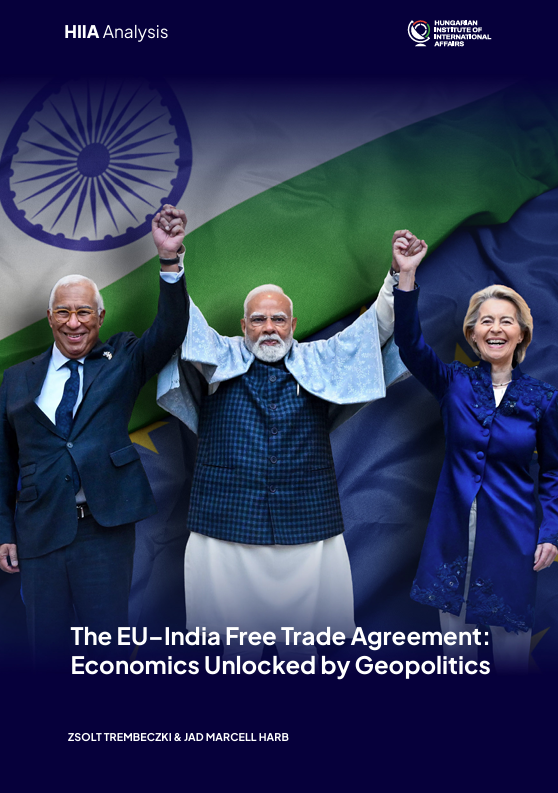
Despite this, by late 2025, it became clear that an agreement was within reach—should both the EU and India offer, and also limit their own expectations to, moderate concessions. India’s 2026 Republic Day celebrations were set as the new deadline for a final deal, with Indian Commerce Minister Piyush Goyal set to visit Brussels in the second week of the year.[72] This meeting apparently went a long way in terms of ironing out the remaining issues of contention. On January 26, as EU leaders attended India’s Republic Day as chief guests, sources confirmed that a deal had been reached,[73] and on January 27, at the sixteenth EU–India summit, the India–European Union Free Trade Agreement was finally announced by Prime Minister Narendra Modi, EU Commission President Ursula von der Leyen, and European Council President António Costa.
The Mother of All Deals
What Was Included: Genuine Depth, Careful Safeguards
The India–European Union Free Trade Agreement rests on geopolitical impetus and is built to get around—but not to erase—serious economic frictions between partners who share broader strategic interests.[74] Both sides lauded it as the “mother of all deals” that creates significant economic opportunities and is underpinned by shared interests and values, while also making sure to point out protections and guarantees for their respective domestic interest groups. A careful look at the specifics already known about the agreement substantiates this overall optimistic but qualified picture.
On tariffs and market access, the EU–India FTA is quite broad in scope and relatively deep in content, especially when compared with India’s other, typically more limited trade agreements. The European side, while having to make significant compromises, ultimately delivered on its promise of a genuinely substantive agreement. The Indian side, in turn, was—hereinto uncharacteristically—willing to compromise while remaining adamant on its most fundamental red lines.
The two parties agreed to reduce or entirely eliminate tariffs on well over 90 percent of their bilateral trade when weighted for value. India agreed to eliminate or cut tariffs on 92.1 percent of its tariff lines, together covering 97.5 percent of the EU’s export to the country. This breaks down as follows: 49.6 percent of tariff lines will see the immediate elimination of duties (including chemicals, textiles and apparel, and ceramics); 39.5 percent of tariff lines (such as cosmetics, plastics, car parts, and machinery) will have their tariffs phased out over five, seven, and ten years; of the remaining 3 percent of tariff lines, duties will be reduced at varying rates and phases, and some products (such as certain fruits including apples, pears, peaches, and kiwis) will be subject to tariff-rate quotas.[75] To major European automotive manufacturers’ delight, Indian tariffs on cars above a certain price tag (currently at 110 percent) will be reduced to 10 percent over the course of ten years—albeit with an annual quota of 250,000 units.[76] Electric vehicles are a special case; duties on them are largely frozen for five years, after which gradual reduction begins.[77] Of other politically high-profile products, tariffs on European beers, spirits, and wines will be reduced from 150 percent to just 50 percent, 40 percent, and 20 percent respectively, while olive oil, breads, pasta, and confectionery will become tariff-free.[78]
The EU in turn will give India preferential access to 97 percent of its tariff lines, covering 99.5 percent of India’s total EU-bound exports. Of these, 70.4 percent of tariff lines will have immediate duty elimination, covering 90.7 percent of imports from India, including such labor-intensive sectors as textiles, leather and footwear, tea, coffee, spices, sports goods, toys, gems and jewelry, and certain marine products. As highlighted in Part 3.1 of this analysis, this was a central ambition of India’s negotiators. Another 20.3 percent of tariff lines, adding up to a mere 2.9 percent of imports from India and including some marine products, processed food items, and arms and ammunition, will see their duties eliminated over three and five years. Finally, 6.1 percent of tariff lines, covering 6 percent of imports from India, will see varying degrees of tariff reduction, including tariff-rate quotas for cars, steel, certain marine products (namely prawns), and others.[79] The EU also gives India a 1.6 million-metric-ton duty-free steel quota (about half of what India has been annually exporting to the bloc) and a €500 million support package over two years to help India’s decarbonization—but no carve-out from the EU’s carbon border levy.[80]
The Services chapter is of particular importance for India. The EU has committed to ensuring market access and non-discriminatory treatment across 144 services subsectors, including ones where India particularly excels, such as IT and IT-enabled services (ITeS), professional services, education, and business services. India in turn made commitments on 102 services subsectors, covering EU priorities such as professional services, business services, telecommunications, maritime services, financial services, and environmental services. The agreement contains provisions facilitating professional mobility via temporary entry and stay for business visitors, intra-corporate transferees, contractual service suppliers, and independent professionals. It also eases the mobility of employees and their spouses and dependents of Indian corporations operating in the EU, covering all areas of services. Independent professionals also gain easier access in 17 sub-sectors, including IT, research and development, and higher education. On a symbolically highly important note for New Delhi, the FTA eases the practice of traditional Indian medicine in EU member states where specific regulation does not exist. A dedicated Digital Trade chapter integrates the rules of the WTO’s Electronic Commerce Joint Initiative, of which India is not a member. It includes protections for software source codes, online consumer rights, and the prevention of spamming.[81]
Tariff cuts notwithstanding, reducing non-tariff barriers and harmonizing other regulatory areas is a crucial aspect of free trade agreements, central to assessing whether a genuine good-faith arrangement has been achieved. In the EU–India FTA, rules of origin are aligned with recent EU FTAs, requiring “substantial processing” in either party, but with simplified self-certification (a statement of origin uploaded online) to ease customs procedures, especially for small and medium-sized enterprises. A Customs and Trade Facilitation chapter introduces advance rulings and expedited clearances to reduce red tape. Both parties retain recourse to anti‑dumping and anti‑subsidy measures under WTO standards. While the negotiations’ IPA track has not been concluded, the FTA itself will reinforce intellectual property protections provided under the WTO’s agreement on TRIPS relating to copyright, trademarks, designs, trade secrets, plant varieties, and the enforcement of intellectual property rights.[82]
Overall, the EU–India agreement makes more compromises than other EU FTAs but is mostly consistent with them; for an Indian FTA, though, it is remarkably broad and deep. “Comprehensive” is a fair descriptor—it certainly is the most comprehensive one India has ever signed.[83] That said, India’s own unique considerations are very much present in the final agreement, such as the carve-outs for sensitive agricultural products and multi-phase tariff reductions for strategically important industrial sectors.
What Was Left Out: Carve-Outs, Deferred Tracks, Parallel Agreements
Of such carve-outs, of particular importance are the sensitive agricultural items. Limits go far beyond the aforementioned calibrations, multi-phase tariff cuts, and quotas: the majority of core food products are untouched by the agreement. India kept staple farm products, most notably dairy (milk, cheese), cereals (wheat, rice, pulses), and soy entirely off the tariff menu. The EU reciprocated by retaining tariffs on other sensitive agriproducts such as beef, sugar, rice, honey, bananas, garlic, and ethanol. Import limits will apply to some other products, such as goat meat, sweetcorn, grapes, cucumbers, dried onions, rum made of molasses, and starches. Even in some areas where liberalization was agreed on, its impacts are moderated by further mechanisms. A bilateral safeguard clause allows either side to temporarily re-impose tariffs if imports surge and cause serious injury to domestic producers. Working groups are designed to iron out implementation issues in areas where tariff cuts and other provisions will be introduced gradually, such as wine and spirits. The European Commission also vows to increase audits and border checks on imported food and animal and plant products. In other words, current sanitary and technical barriers may be clarified and codified within the FTA but not relaxed.[84]
Agriculture is not the only area where one party’s ambitions were deferred to future talks or diluted into broad chapters with little to no binding provisions. For instance, India has been pushing for “data-secure” status under EU data security law while the EU has been pressing for stronger labor and environmental discipline in India. The former was not incorporated into the FTA, while the chapter on trade and sustainable development (TSD) commits both parties to labor and environmental objectives but with no enforcement provisions beyond dialogue and reporting requirements. Government procurements are not liberalized; access remains limited by each party’s respective domestic rules. Social security arrangements are not included in the FTA itself, but a constructive framework was reached to enable such agreements to be signed between India and all EU member states within five years.[85] The EU’s Carbon Border Adjustment Mechanism (CBAM), seen by India as a hidden, unfair tariff on its relatively carbon-intensive sectors like steel, remains fully in place with no derogations in India’s favor. Its interaction with tariff preferences will be subject to further technical negotiations, but the EU claims this will not result in favorable treatment for any country.[86]
Crucially, the two other legs of the negotiation’s three-track structure, the stand-alone Geographic Indications (GI) and Investment Protection Agreement (IPA), were not concluded alongside the FTA, meaning that no new investor-state arbitration regime or special protection for geographically unique products like Tokaj wine or Basmati rice will be introduced for the time being. The European Commission confirms that both tracks are being negotiated separately. Until then, investment disputes remain governed by existing rules, and GI producers lack special remedies against imitators.[87]
The EU–India Free Trade Agreement may rightfully take the spotlight, but the sixteenth EU–India summit also resulted in other non-trivial treaties. Often reported as part of the Free Trade Agreement, many mobility-related elements of the broader deal are in fact part of an EU–India Comprehensive Framework of Cooperation on Mobility, technically a separate memorandum of understanding parallel with the FTA itself. The mobility cooperation framework will be supported by a European Legal Gateway Office in India, helping Indian workers, students, and researchers find opportunities in Europe.[88]
The Security of Information Agreement was also signed to enable the exchange of classified information. This may eventually open the door for India’s participation in EU defense and security initiatives. The leaders also renewed the EU–India Agreement on Scientific and Technological Cooperation until 2030 and launched exploratory talks on India’s association to Horizon Europe.[89] Perhaps the most important parallel deal is the EU–India Security and Defence Partnership that focuses on areas such as maritime security, cybersecurity, the fight against terrorism, and defense industrial cooperation.[90]
Domestic Impacts and Global Consequences
India: Market Access, Growth, Strategic Signaling
After nearly two decades of on-and-off talks, the EU–India FTA represents India’s most ambitious trade pact to date. Independent assessments project that a deep EU–India FTA will have a modest but non-negligible macroeconomic impact. Back in 2008, when bilateral trade represented a significant lower volume but the EU (since replaced by the United States and China) was still India’s number one trading partner, a research report suggested that the short-term economic impact on India of a free trade agreement would be somewhere between 0.1 and 0.3 percent of India’s GDP, depending on depth scenario. It would also increase wages by 1–1.5 percent.[91] A more recent 2020 study put the overall net effect of an agreement with heterogeneous tariff cuts in most, but not all, sectors on India’s economy at around 0.3 percent of its GDP and an increase of 33–35 percent in India’s exports to the EU (at that point including the United Kingdom).[92] A 2023 study on services in the EU–India FTA based on the EU’s initial textual proposal predicted that India’s services export to the EU could grow by about 50 percent.[93]
While fundamentally speculative, such projections reinforce the Indian government’s narrative that the deal will increase growth and employment. Indeed, the FTA being a catalyst for job creation—especially in labor-intensive sectors—has been at the center of domestic messaging. The new deal essentially replaces Indian apparels’ and footwear makers’ recently lost preferential access to European markets under the Generalized System of Preferences with long-term, contractual, predictable rules. Commerce Minister Piyush Goyal predicted that duty-free access to the EU’s apparel market would help India’s textile export to swell from $7 billion to $40 billion, creating up to seven million new jobs.[94] Inherent official optimism notwithstanding, India’s baseline leverage in labor-intense industries (the country’s second-largest job source behind agriculture) is significant, and they stand to benefit substantially from EU tariff cuts percent—especially when compared to its main competitors in these sectors like Bangladesh and Pakistan.
The export of high-end Indian services to Europe was another priority of New Delhi during the negotiations. But better access to Europe’s services markets is not the only way India’s services sector and broader economy stand to benefit from the FTA’s Services chapter. EU services entering India, now guaranteed equal treatment and a more predictable environment, will also encourage innovation in India and create opportunities for high-skill local professionals.[95] The government also expects that the import of EU technology goods will reduce import costs for Indian businesses and in that way increase their global competitiveness, benefitting consumers.[96]
Job and wage increases, of course, would be asymmetric across sectors. Agricultural goods that will gain increased access to the European markets will sell for a higher price than they would in India, providing farmers with additional income, strengthening rural livelihoods.[97] But most laborers in agriculture or India’s sizeable informal sector will likely be largely left out of these wins. This is a calculated limitation accepted by Indian governments in exchange for not putting these vulnerable livelihoods at risk by exposing them to foreign competition.
A recurring lesson of trade agreements is that fully capitalizing on their potential requires robust domestic implementation. This is especially true for India, where gaps between policy goals and state capacity, and major bottlenecks in physical infrastructure, public utilities, and the legal and regulatory system, are well-documented and widely considered significant hindrances on the country’s growth potential.[98] Internal reforms in these areas are crucial for the country to fully capitalize on its demographic dividend and growing trade connections with the rest of the world. On the micro level, Indian small and medium-sized businesses’ awareness of and capacity to comply with EU regulatory standards—which, as the EU proudly claims, will not ease under the FTA—need to be improved for them to be able to take advantage of the opportunity the new trade deal offers.
With these considerations in mind, for domestic audiences, the Modi government has packaged the deal as a proof of India’s ability to strike game-changing agreements with other major centers of power, a major win for India’s competitive, export-oriented sectors, and an opportunity, not a threat, for the country’s farming and informal sectors. After 2025’s perceived humiliation at the hand of the second Trump administration, Prime Minister Narendra Modi is now trying to assert himself as a visionary world leader who is listened to by others in the global scene while adamantly protecting India’s national interests and pride.
This is politically crucial because since 2024, the country’s most recent general election, Modi and his Hindu nationalist Bharatiya Janata Party are for the first time in a decade reliant on coalition partners to maintain a parliamentary majority.[99] Indeed, the Opposition has already brought the prime minister under fire for not standing up for India’s interests sufficiently amid last year’s barrage of U.S. tariffs, India’s brief conflict with Pakistan, and Donald Trump’s humiliating suggestions that he forced India’s hand into ending said conflict with a ceasefire. The Indian National Congress, the Opposition’s leading force, now demands that the Modi government take Parliament into confidence over negotiations both with the United States and Europe.[100] The markedly more amiable atmosphere of EU–India relations and the trade deal’s significant concessions to India may ease the risk of such a potentially risky “hyphening” of EU and U.S. relations, but it is worth watching whether the Indian opposition, hoping to lead the country in the coming years, displays the maturity of not using such diplomatic and strategic issues as cheap tokens in daily political fights.
The European Union: Maintaining Standards, Buying into a Growth Story
The European side emphasizes the wide-ranging nature of the trade deal, including the cutting of duties on over 90 percent of tariff lines, potentially saving European firms roughly €4 billion annually in duties.[101] EU communication also underlines how the agreement reinforces economic openness and rules-based trade.[102] With such a broad scope, almost every sector will see high duties removed or markedly lowered. Winners include the currently ailing automotive industry beset by high energy prices and fierce Chinese competition in the EV market: their currently prohibitive 110 percent tariffs will be immediately lowered to 40 percent and then to 10 percent within five to ten years, although the industry still finds these measures insufficient.[103] Machinery (by far the largest component of EU exports to India), plastics, chemicals, aircraft, cosmetics, pharmaceuticals, and even iron and steel could also benefit significantly.[104] This suggests that major manufacturing countries will benefit the most—primarily Germany (machinery, cars) but also France (aircraft, luxury products), Italy (machinery, luxury products), and the Netherlands (pharmaceuticals).[105]
Notably, despite being the one sector most exempt from tariff reductions, the advantages of the FTA for European agriculture are disproportionately emphasized in the European Commission’s communication. One Commission document features a chart labelled “Benefits for EU farmers” (there are no such charts for any other sectors), highlighting substantial tariff reductions for spirits, wine (an important export product for France and Italy, whose support towards the deal is crucial), fruit juices and non-alcoholic beer, olive oil, and processed food.[106] Another EU document stresses similarly that key European agri-food exports will see their duties eliminated or significantly reduced, while the EU will protect its own agricultural sensitivities and retain its high sanitary and phytosanitary standards, which were among the main agricultural concerns in the case of the Mercosur deal.[107]
This visible push is undoubtedly intended to calm European farmers and convince them that a stand against the FTA would be unjustified. This is understandable if we look at the wider context in which this FTA was negotiated. The EU, striving to preserve its status as a custodian of the rules-based world order as traditionally understood, as well as to reduce its economic dependence on China and the United States, has accelerated talks on free trade agreements around the globe. The notorious deal with Mercosur was finalized in this environment after 25 years of talks. While unambiguously benefitting European industry, the opening of the European market for large agricultural exporters like Brazil and Argentina exasperated European producers, fomenting backlash against the agreement in a number of countries, most importantly France and Poland but also Hungary, hindering the deal’s ratification. Thus, the European Commission wants to avoid a situation where comparisons are drawn between the Mercosur and India deals, which are indeed unwarranted in terms of their effect on European agriculture, and seems to present the agricultural benefits of the FTA with India in a disproportionate manner as a preventive measure.
Since the EU–India deal is expressly and strictly a free trade agreement, its provisions fall under the EU’s exclusive competences. This means that its ratification process is markedly easier (requiring only the European Council’s qualified majority for the official signing and the European Parliament’s simple majority for ratification) than for “mixed agreements” (where member states’ unanimity and separate votes in every national parliament are required).[108] Fortunately for the Commission, the EU–India trade agreement seems to lack such grave dissensions across member states, hence its ratification process should be much smoother. Although attempts by the Parliament to demonstrate its (in such cases limited) power might create minor bumps, a parliamentary majority against the deal is ultimately unlikely. With this in mind, the EU–India trade agreement has a good chance of ratification in the coming year and entering into force by early 2027.
On a macroeconomic level, the EU–India FTA’s projected benefits in the short term are meaningful but modest. Projections from 2008 suggest that the EU’s GDP could grow an additional 0.1 percent should a deeper FTA be achieved and that the impact on wages would be indiscernible.[109] In 2020, the EU’s gain on liberalized trade was estimated to be around 0.03 percent of the bloc’s GDP.[110] However, tariff-free access to India’s markets at this point in time is a strategic investment. India has for the most part been the world’s fastest growing major economy since the mid-2010s, and China’s discernible slowdown after 2020 solidified this status.[111] By 2038, India is expected to have the world’s second-largest economy on purchasing power parity at around $34.2 trillion.[112] With the EU–India FTA, the European Union has “bought into” this prospective growth story before any other major economy did (save for a much smaller United Kingdom) on terms that, given some politically crucial concessions to India that are not major hinderances for the EU economically, seem more politically sustainable than what the United States with its aggressive tariff policies is likely to achieve in the short term. Other than the immediate geopolitical signal sent by the EU and India striking the deal, this longer-term dimension is arguably the most significant.
In sum, from a European perspective, the EU–India trade deal is calibrated to yield relatively modest but meaningful export gains in the short-to-medium term while reinforcing the EU’s regulatory model and positioning EU businesses well to take advantage of India’s future growth. The carving-out of most agriproducts, while for the most part an Indian demand, also shields the agreement from becoming a point of inter-sectoral and inter-member state contention as was the case with the EU–Mercosur trade agreement.
Hungary: Indirect Opportunities Through Supply‐Chain Integration
As one of the world’s most export-oriented economies—EU data in 2019 put Hungary’s exports at 82 percent of the country’s GDP[113]—Hungary as a baseline stands a good chance to reap benefits from increasing European access to major growing markets in the developing world. Hungary’s manufacturing and export base is dominated by machinery, vehicles, electronics, and chemicals.[114] In most of these sectors, Hungarian businesses participate in global trade chiefly through European (mostly Germany-centered) value chains.[115]
Bilateral trade with India is at a relatively low level: Hungary’s exports to India stood at 181.8 billion HUF (about €480 million) while imports stood at 290 billion HUF (about €760 million) in 2024. These figures are slightly below those in bilateral trade’s peaking in 2022 but represent significant growth over the course of the past decade.[116] From the perspective of Hungarian businesses, sectors of particular export potential towards India include water management solutions and technologies, water treatment, food processing machinery and technologies, agricultural technologies, automotives and their parts, waste management solutions, machinery, biotechnology, pharmaceuticals, and chemicals.[117]
As shown above, projections of the EU–India deal’s EU-wide impact are somewhat uncertain, with absolutely no indication of the Hungary-specific effects; statistical data about Hungary–India trade relations are also relatively scarce. Because of these limitations, assessments of the deal’s impact on Hungary must for the most part be based on indirect inference. But considering the EU–India FTA’s modest short-term projected macroeconomic impact on the one hand and the overlap between the list of industrial sectors it benefits and Hungary’s list of high-potential export sectors on the other, the deal’s impact on Hungary’s economy would likely be modest but positive, manifesting primarily through the country’s integration to European (chiefly Germany-centered) manufacturing value chains.
Hungary’s automotive industry may be among the winners of the EU–India free trade agreement. Cars and auto parts are Hungary’s top export industry; factories at Győr (Audi), Kecskemét (Mercedes), and elsewhere account for a large share of exports. India’s reduction of automotive tariffs could directly benefit these manufacturers, even though most of their output is already directed to European markets, and their Indian market share is currently tiny. Superficially, the picture may look mixed. Mercedes executives, for instance, speculated in 2022 that an FTA with the EU could turn India into a global export hub—meaning a competitor to the company’s factories in Hungary.[118] This, however, should not raise much alarm. With the agreement’s known limits on automotives, moving the production of cars sold in Europe to India would not be a viable strategy for car manufacturers. Machinery and equipment are another large component of Hungary’s industrial output and export basket. The FTA will mostly eliminate tariffs in this sector in both ways, with no quota limitations akin to the automotive industry. The resulting two-way competition may be challenging for machinery manufacturers but directly benefits other businesses that use their products as input. Pharmaceuticals, one of the few industries where Hungary has a genuinely home-grown export-oriented company of significant size (Richter Gedeon), also stands to gain. Indian pharma export will also benefit from tariff cuts, but with EU standards remaining ironclad and the FTA including relatively firm intellectual property rules, the entry of Indian generic drugs to Europe could see delay, and Hungary’s already compliant pharma sector would likely end up a net beneficiary of decreasing duties.
Hungary is one of the more agriculture-heavy EU member states. The FTA’s agricultural chapter being conservative meets Hungarian agriculture’s usual demands for protection in trade situations, mirroring how agricultural heavyweights France and Poland also supported the agreement. India’s gradual easing of tariffs on European wines, spirits, beer, and confectionery, while of limited macroeconomic impact, will open new opportunities for Hungarian producers. On the import side, Indian oilseed, pulses, and spices could enter the EU more freely, but sanitary rules and quotas are likely to limit volumes, and already EU-compliant Hungarian producers are unlikely to face much direct challenge. Some fruits or processed spices may constitute rare exception niches.
In sum, Hungary stands to see indirect, moderate short-term effects from the EU–India free trade agreement. The most visible channels will be automotive and other manufacturing supply chains. Specialty agriculture and pharmaceuticals may likewise see increasing opportunities in India, even though in absolute terms their impact on the national economy may be limited. The agreement’s agricultural carve-outs protect all strategic subsectors of Hungary’s agriculture. While available information about Hungary’s role in the negotiation process are almost non-existent, this overall picture may explain why Budapest so far voiced no objection to the agreement.
Geopolitical Consequences and Reactions from Major Poles
The EU–India FTA was heralded as the “mother of all deals,” not just for its economic and demographic scale but also—and according to some, mainly[119]—for its geopolitical implications. The 2021–2022 revival of negotiations was in large part based on shared threat perceptions around China’s growing influence, and the speed with which the agreement was finalized in the second half of 2025 was chiefly driven by the United States’ increasingly hostile policies towards both the EU and India. Under these circumstances, both European countries and institutions and India feel they need to hedge their partnerships, and although neither can entirely fill the hole left by the United States in the other’s strategic calculus, they are the “second-best” partners for each other in areas like trade, technology, and defense equipment. This hedging is concerning for some American allies in Europe. In India, it is seen as something regrettable but fundamentally compatible with the country’s multi-aligned foreign policy (notwithstanding the question of whether India overestimates its own leverage in a “multi-aligned world”[120]).
U.S. reactions to the agreement have been mixed. On the one hand, the agreement drew clear concern and even public criticism from officials. Treasury Secretary Scott Bessent sharply denounced Brussels for “prioritizing commercial interest” over the interests of the Ukrainian people by signing a trade deal with India, the largest buyer of Russian hydrocarbons. This, Bessent said, was in contrast with the United States imposing higher tariffs on India to steer it away from purchasing oil from Russia.[121] U.S. Trade Representative Jamieson Greer similarly quipped that “India comes out on top” with the agreement as its low-cost exporters gain access to Europe.[122] In Congress, Democratic Senator Mark Kelly raised alarm that India and the EU are forging closer ties while the United States is engaged in trade disputes with both.[123] On the other hand, some U.S. observers have warned against viewing the deal as necessarily undermining EU–U.S. or India–U.S. relations and even voiced some optimism about it giving new impetus to India’s trade negotiations with the United States.[124]
This insight may have been astute. On February 2, about six months after their trade talks first collapsed and a week after the EU–India FTA’s announcement, the United States and India announced an initial agreement on their prospective trade deal.[125] President Trump first made the announcement on social media, where he declared that he would reduce India’s tariffs, currently at 50 percent, to 18 percent; in turn, India would cut tariffs on American goods to “ZERO” and promised to stop buying Russian oil. The agreement, according to Trump, was struck during a phone call with Prime Minister Modi. The next day, Indian Commerce Minister Piyush Goyal confirmed that a deal would be signed “shortly,” and a joint statement would be released when the details are finalized. Crucially, however, the Indian side communicated no specifics about the agreement—let alone confirmed any commitment not to buy Russian energy or to completely tariff-free access of, say, American agriproducts to Indian markets.
It seems plausible that the conclusion of the EU–India trade agreement gave Washington a sense of urgency to also strike a deal with India. Should Trump’s claim about completely tariff-free access to Indian markets, India completely halting its import of Russian energy, and U.S. tariffs on India going down only to 18 percent prove true, it would also appear that with erstwhile pressure Washington achieved a more one-sidedly favorable deal than the European Union did with years of painstaking negotiations and compromises. Agreeing to such parameters would, however, be highly uncharacteristic for India, and the claims warrant a healthy dose of skepticism for the time being.[126]
Chinese and Russian reactions to the EU–India trade agreement have been muted, but unofficial yet state-adjacent commentary (such as pro-regime media reports[127]) suggest that both Beijing and Moscow are paying attention to this development. While the second Trump administration’s policies replaced the “China factor” as the main immediate drive behind a speedy home run in EU–India trade negotiations, and India has leveraged the symbolism of its membership in formats like BRICS and the SCO in response to adverse U.S. tariff policies, it still considers China its number one long-term security threat. Likewise, the EU may be more open to engagement with China since the start of Trump 2.0’s perceived hostility towards Europe, but this does not mean it no longer considers Beijing both a potential partner and a systemic challenger. That said, unlike the U.S.–India strategic partnership,[128] EU–India relations are unlikely to ever become an openly anti-China balancing exercise. As such, closer ties between Brussels and New Delhi should be of interest to, but likely does not outright alarm, Beijing.
The agreement’s implications are likely more direct for Russia—although still not very direct. India has a long-standing policy of not subjecting its relationship with any power center to the preferences of any of its other partners. Notably, while maintaining a growing strategic partnership with the United States and working on a prospective free trade agreement with the EU, it has continually refused Western pressure to distance itself from Russia, a traditional all-weather strategic partner, even in the wake of the latter’s war of aggression against Ukraine. India, nevertheless, has been working on reducing its dependency on Russia, most notably in the field of defense equipment, and Western partners (most notably one European country, France[129]) are among its main partners in this regard. The EU–India FTA, the EU–India Security and Defence Partnership, and speculations about India’s limited participation in certain EU defense programs point to the direction of India further increasing the Western component in its arms import and technology transfer basket at the expense of Russia’s relative weight. European leaders would be naïve to think that such agreements will convince India to turn its back to Russia. But deepening EU–India ties underline what Russia truly is for India: a longtime friend that is still useful, but whose utility is on an irreversibly decline.
South Asian neighbors are also paying attention: smaller economies like Bangladesh and Pakistan fear losing their relative advantage vis-à-vis India in terms of preferential access to the EU’s textiles and apparel markets.[130] In contrast, while the stances of their governments have also remained mostly muted, observers from traditional U.S. allies in the Indo-Pacific such as Japan, Australia, and South Korea have welcomed the European Union’s deeper engagement with India.[131] The deal fits into the EU’s Indo-Pacific strategy—indeed, it brings much needed substantive implementation—and may encourage like-minded countries to strengthen their own ties with the bloc. It also offers them a “case study in strategic optionality.”[132]
Conclusion
Three distinct things should be kept in mind: (1) It was mainly geopolitical drivers that made the deal possible; in other words, contrary to conventional intuition, in this case geopolitics was not a folly but an enabler of trade logic. (2) Despite its geopolitical motifs, economic gains from the EU–India FTA are likely to be substantial, albeit gradual. (3) Wins in both dimensions are fully consistent with the final agreement displaying considerable sectoral partiality and asymmetric depth.
To the first point: the two parties make no secret of the agreement’s geopolitical significance; neither is it much of a secret that many earlier hesitations were overridden by top-level political resolve in light of broad external forces outside the EU’s or India’s control. In a time of prolonged U.S.–China tensions, an openly protectionist, “tariff-happy” turn in U.S. trade policy under the second Trump administration, and growing techno-nationalism, the EU and India are using the deal to signal their strategic autonomy, ability to stand up to both American and Chinese pressure and unfair trade practices, and role as reliable pillars of—whatever is left of—the rules-based, relatively free global trading system.
To the second point: the EU–India FTA should still not be mistaken for a purely geopolitical move; the business case behind it is genuine. For India, now the world’s fastest-growing major economy but still in pressing need for export markets, investment, and technology influx, the European Union is the only prospective partner comparable to the United States in terms of market size, income levels, capital, and technological sophistication. For the EU, securing access to India’s markets before most competitors of scale did so is an early investment in the South Asian country’s future growth story. This “buy-in” to India’s future trajectory is perhaps the most overlooked aspect of the EU–India FTA. As for Hungary’s specific viewpoint, with its export-oriented economy deeply integrated into European value chains, this paper predicts the country’s gains from the EU–India FTA to be mostly indirect but substantial, chiefly materializing through increased demand for components of Germany-centered, India-bound exports and secondarily through the India-bound exports of some Hungarian enterprises and Hungary-bound investments from Indian partners.
To the third point: though a significant geopolitical and trade policy feat, one needs to be mindful about the agreement’s limitations and asymmetries. Reaching a truly “deep” FTA, in line with the EU’s original ambition, proved challenging because negotiators on both sides had to balance divergent domestic sectoral and socio-economic priorities, and especially in India’s case these directed towards an overall narrower agreement. To avoid upsetting domestic constituencies, the final deal excludes key agricultural products like cereals, soy, and dairy products (a vital concession for India’s smallholders), while the EU kept its Carbon Border Adjustment Mechanism (a landmark climate legislation decried by India as a hidden tariff on its more CO₂-intensive industries) intact.
In sum, the EU–India FTA is neither a purely geopolitical nor a narrowly economic achievement—nor is it a perfect achievement in either respect. It signifies both sides’ effort to adapt to a global environment where traditional alignments are becoming increasingly transactional, making the forging of new transactional partnerships an eminently logical hedging strategy. Its significance will be measured not in short-term headline GDP gains but by whether some decades down the line EU member states will have capitalized on their “early access” to India’s rapidly growing markets; whether India will have capitalized on its access to European markets and technology and channeled them into its own reform, capacity building, and infrastructure expansion efforts; and whether both sides will have become recognized as stable pillars of whatever world order and international trading system is to emerge in the coming years.
Endnotes
[1] Indian Ministry of Commerce and Industry, “Factsheet: India and European Union Trade Agreement. ‘Mother of All Deals’ Unlocking Opportunities Empowering India@2047,” January 27, 2026, https://www.pib.gov.in/PressReleasePage.aspx?PRID=2219146®=3&lang=1; European Commission, “The EU-India Trade Agreement,” January 27, 2026, https://commission.europa.eu/topics/trade/eu-india-trade-agreement_en.
[2] Zsolt Trembeczki, “EU–India Free Trade Talks: Can They Wrap Up in 2025?,” Hungarian Institute of International Affairs, June 4, 2025, https://hiia.hu/en/eu-india-free-trade-talks-can-they-wrap-up-in-2025/.
[3] European Commission, “Statement by President von der Leyen with President Costa and Indian Prime Minister Modi,” January 27, 2026, https://ec.europa.eu/commission/presscorner/detail/en/statement_26_210.
[4] Jörn Fleck et al., “The EU and India Are Creating a Free Trade Area of Two Billion People. What’s Next?,” Atlantic Council, January 27, 2026, https://www.atlanticcouncil.org/dispatches/the-eu-and-india-are-creating-a-free-trade-area-of-two-billion-people-whats-next/; The Times of India, “Zero Tariffs on Gems, Jewellery, Plastic: How Will FTA with EU Benefit India? ‘Mother of All Trade Deals’ Explained,” January 27, 2026, https://timesofindia.indiatimes.com/business/india-business/zero-tariffs-on-gems-jewellery-plastic-how-will-fta-with-eu-benefit-india-mother-of-all-trade-deals-explained/articleshow/127608915.cms.
[5] Mark Linscott, “The India–EU Trade Deal is Worth Watching, But Not Overhyping,” Atlantic Council, January 27, 2026, https://www.atlanticcouncil.org/dispatches/the-india-eu-trade-deal-is-worth-watching-but-not-overhyping/.
[6] Department for Business and Trade, “Guidance, Explainers and Other Documents to Help You Understand the Free Trade Agreement between the UK and India,” GOV.UK, November 25, 2026, https://www.gov.uk/government/collections/uk-india-trade-deal.
[7] European Commission, “The EU-US Trade Deal: Restoring Stability and Predictability,” July 27, 2025 https://commission.europa.eu/topics/trade/eu-us-trade-deal_en.
[8] Zsolt Trembeczki, “From Breakthrough to Breakdown: The Near Collapse of U.S.–India Trade Talks and What Comes Next,” Hungarian Institute of International Affairs, August 28, 2025, https://hiia.hu/en/from-breakthrough-to-breakdown-the-near-collapse-of-u-s-india-trade-talks-and-what-comes-next/.
[9] European Commission, “EU-India Agreements: Documents,” 2025, https://policy.trade.ec.europa.eu/eu-trade-relationships-country-and-region/countries-and-regions/india/eu-india-agreements/documents_en.
[10] Anil Wadhwa, “The India EU FTA- Current State of Play; the Remaining Issues and Possible Solutions,” Vivekananda International Foundation, November 21, 2025, https://www.vifindia.org/article/2025/november/21/The-India-EU-FTA-Current-State-of-Play.
[11] European Commission, “An EU-India Strategic Partnership,” COM(2004) 430, EUR-Lex, 2004, https://eur-lex.europa.eu/EN/legal-content/summary/eu-india-strategic-partnership.html.
[12] Aditya Satpute, “A Compromise between Strong Will and Strong Won’t: Accessing the EU India Broad-Based Trade and Investment Agreement (BTIA),” Social Science Research Network, April 1, 2014, https://papers.ssrn.com/sol3/papers.cfm?abstract_id=2418930.
[13] Geethanjali Nataraj, “Why Can’t India and the EU Sign an FTA?,” East Asia Forum, July 14, 2013, https://eastasiaforum.org/2013/06/14/why-cant-india-and-the-eu-sign-an-fta/.
[14] Vidhi Rupal, “India’s Exit from the RCEP: Why and What’s Next,” Social and Political Research Foundation, January 2020, https://sprf.in/wp-content/uploads/2021/01/Indias-Exit-from-RCEP.pdf.
[15] Indian Ministry of Commerce and Industry, “Brief on Regional Comprehensive Economic Partnership (RCEP),” 2014, https://www.commerce.gov.in/international-trade/trade-agreements/indias-current-engagements-in-rtas/brief-on-regional-comprehensive-economic-partnership-rcep/.
[16] Sushma Swaraj, “External Affairs Minister’s Speech at the 4th Ramnath Goenka Lecture, 2019,” speech, Indian Ministry of Externa Affairs, November 11, 2019, https://www.mea.gov.in/Speeches-Statements.htm?dtl/32038/External+Affairs+Ministers+speech+at+the+4th+Ramnath+Goenka+Lecture+2019.
[17] George Friedman, “Obama, Trump and Biden: Consistency in Foreign Policy,” Geopolitical Futures, January 19, 2021, https://geopoliticalfutures.com/obama-trump-and-biden-consistency-in-foreign-policy/.
[18] Mario Esteban et al., “Europe in the Face of US-China Rivalry,” European Think-tank Network on China, January 2020, https://merics.org/sites/default/files/2020-04/200123_ETNC_Report.pdf.
[19] Péter Goreczky and Zsolt Trembeczki, “The Rise of Economic Security: Derisking Strategies Around the World,” Hungarian Institute of International Affairs, October 25, 2024, https://hiia.hu/en/the-rise-of-economic-security-derisking-strategies-around-the-world/.
[20] Chayanika Saxena, “The Geopolitics of De-Risking from China: Is India In for a Win?,” Observer Research Foundation, February 2, 2024, https://www.orfonline.org/expert-speak/the-geopolitics-of-de-risking-from-china-is-india-in-for-a-win.
[21] Robert D. Blackwill and Ashley J. Tellis, “The India Dividend: New Delhi Remains Washington’s Best Hope in Asia,” Foreign Affairs, August 12, 2019, https://www.foreignaffairs.com/articles/india/2019-08-12/india-dividend.
[22] Lily McElwee, “The Rise and Demise of the EU-China Investment Agreement: Takeaways for the Future of German Debate on China,” Center for Strategic and International Studies, March 20, 2023, https://www.csis.org/analysis/rise-and-demise-eu-china-investment-agreement-takeaways-future-german-debate-china.
[23] European Commission, “The EU Strategy for Cooperation in the Indo-Pacific,” September 16, 2021, https://www.eeas.europa.eu/sites/default/files/jointcommunication_2021_24_1_en.pdf.
[24] European External Action Service, “EU and India Hold Third Strategic Partnership Review,” October 19, 2021, https://www.eeas.europa.eu/eeas/eu-and-india-hold-third-strategic-partnership-review_en.
[25] Amrita Narlikar, “Scripting a Third Way: The Importance of EU-India Partnership,” Observer Research Foundation, April 28, 2022, https://www.orfonline.org/expert-speak/scripting-a-third-way; Sumathi Bala, “‘Unprecedented Urgency’ May Have Pushed India and the EU to Revive Trade Talks after 9 Years,” CNBC, July 18, 2022, https://www.cnbc.com/2022/07/18/india-and-eu-revive-stalled-fta-talks-as-global-tensions-spark-urgency.html.
[26] European Commission, “EU Trade Relations with India. Facts, Figures and Latest Developments,” February 4, 2026, https://policy.trade.ec.europa.eu/eu-trade-relationships-country-and-region/countries-and-regions/india_en.
[27] Amitendu Palit, “Decoding India’s Revived Free Trade Agreement Rush,” World Economic Forum, September 15, 2022, https://www.weforum.org/stories/2022/09/decoding-india-s-revived-free-trade-agreement-rush/.
[28] European Commission, “EU-India Agreements: Documents.”
[29] Sergio Mariotti, “‘Open Strategic Autonomy’ as an Industrial Policy Compass for the EU Competitiveness and Growth: The Good, the Bad, or the Ugly?,” Journal of Industrial and Business Economics 52 (2025), 1–25, https://link.springer.com/article/10.1007/s40812-024-00327-y.
[30] The Economic Times, “Europe Has to Grow Out of Mindset That Its Problems are World’s Problems, says S Jaishankar,” June 4, 2022, https://economictimes.indiatimes.com/news/india/europe-has-to-grow-out-of-mindset-that-its-problems-are-worlds-problems-says-s-jaishankar/articleshow/91988948.cms.
[31] Afaq Hussain and Nicholar Shafer, “The India-Middle East-Europe Economic Corridor: Connectivity in an Era of Geopolitical Uncertainty,” Atlantic Council, August 27, 2025, https://www.atlanticcouncil.org/in-depth-research-reports/report/the-india-middle-east-europe-economic-corridor-connectivity-in-an-era-of-geopolitical-uncertainty/.
[32] Tushar Shetty, “Alliance of the Betrayed: The Quiet Rise of India-EU Relations,” The Diplomat, January 26, 2026, https://thediplomat.com/2026/01/alliance-of-the-betrayed-the-quiet-rise-of-india-eu-relations/.
[33] Marianne Schneider-Petsinger, “US–EU Trade Relations in the Trump Era Which Way Forward?,” Chatham House, March 2019, https://www.chathamhouse.org/sites/default/files/publications/research/2019-03-08US-EUTradeRelations2.pdf.
[34] Laura von Daniels, Claudia Major, and Nicolai von Ondarza, “How Europe is Preparing for Trump II,” German Institute for International and Security Affairs, March 2024, https://cdn.table.media/assets/wp-content/uploads/2024/03/24174012/European_Perspectives_on_Trump_II_WP_von_Daniels_Major_von_Ondarza-3.pdf.
[35] Zsolt Trembeczki, “Drone War, Trade War, Illusory Alternatives: Lessons from 2025 about India’s Multi-Alignment Strategy,” John Lukács Institute for Strategy and Politics, October 14, 2025, https://en-jli.uni-nke.hu/document/en-jli-uni-nke-hu/John%20Lukacs%20Analyses%20on%20Global%20Affairs_2025_12_ENG.pdf.
[36] Barath Harithas et al., “‘Liberation Day’ Tariffs Explained,” Center for Strategic and International Studies, April 3, 2025, https://www.csis.org/analysis/liberation-day-tariffs-explained.
[37] European Commission, “The EU-US Trade Deal: Restoring Stability and Predictability,” July 27, 2025, https://commission.europa.eu/topics/trade/eu-us-trade-deal_en.
[38] Mateusz Michnik, “Humiliation, or the Art of the Deal?,” European Policy Information Center, August 19, 2025, https://www.epicenternetwork.eu/wp-content/uploads/2025/08/EU%E2%80%93US-Agreement-Humiliation-or-the-Art-of-the-Deal-1.pdf.
[39] Mark Rutte, “Remarks by NATO Secretary General Mark Rutte,” speech, North Atlantic Treaty Organization, January 26, 2026, https://www.nato.int/en/news-and-events/events/transcripts/2026/01/26/remarks-by-nato-secretary-general-mark-rutte-at-the-meeting-of-the-european-parliaments-committee-on-security-and-defence; Kriti Gupta, “Debunking the ‘Sell-America’ Trade: Why Europe’s Move Could Fall Short,” J.P. Morgan Private Bank, January 26, 2026, https://privatebank.jpmorgan.com/apac/en/insights/markets-and-investing/tmt/debunking-the-sell-america-trade-why-europes-move-could-fall-short.
[40] Deccan Herald, “Donald Trump Hints at Trade Deal with India Soon; Says US Will Have Access to Indian Market,” June 16, 2025, https://www.deccanherald.com/world/donald-trump-hints-at-trade-deal-with-india-soon-says-us-will-have-access-to-indian-market-3633394.
[41] The White House, “Fact Sheet: President Donald J. Trump Addresses Threats to the United States by the Government of the Russian Federation,” August 6, 2025, https://www.whitehouse.gov/fact-sheets/2025/08/fact-sheet-president-donald-j-trump-addresses-threats-to-the-united-states-by-the-government-of-the-russian-federation/.
[42] Manoj Kumar, Trevor Hunnicut, and Aftab Ahmed, “Missed Signals, Lost Deal: How India-US Trade Talks Collapsed,” Reuters, August 6, 2025, https://www.reuters.com/world/india/missed-signals-lost-deal-how-india-us-trade-talks-collapsed-2025-08-06/.
[43] Rushali Saha, “India-Pakistan Ceasefire: Modi Faces ‘Re-Hyphenation’ Challenge after Trump’s Kashmir Mediation Claims,” Lowy Institute, May 12, 2025, https://www.lowyinstitute.org/the-interpreter/india-pakistan-ceasefire-modi-faces-re-hyphenation-challenge-after-trump-s-kashmir.
[44] Policy Circle, “India-EU FTA Talks Gain Urgency under US Trade Pressure,” August 29, 2025, https://www.policycircle.org/economy/india-eu-fta-talks-us-tariffs/.
[45] Zsolt Trembeczki, “How India Can Salvage Its Trump Trade Deal,” Asia Times, September 25, 2025, https://asiatimes.com/2025/09/how-india-can-salvage-its-trump-trade-deal/.
[46] Trembeczki, “EU–India Free Trade Talks.”
[47] Organisation for Economic Co-operation and Development, “Agricultural Policy Monitoring and Evaluation 2025,” October 30, 2025, 377–398, https://www.oecd.org/content/dam/oecd/en/publications/reports/2025/10/agricultural-policy-monitoring-and-evaluation-2025_354e7040/a80ac398-en.pdf.
[48] Priyam Saraf, “Automotive in South Asia: From Fringe to Global,” ResearchGate, October 2016, https://www.researchgate.net/publication/317385873_Automotive_in_South_Asia_-_From_Fringe_to_Global.
[49] Ajit Karnik, “Protectionism and Statism, Once Again,” Ideas for India, June 25, 2025, https://www.ideasforindia.in/topics/macroeconomics/back-to-the-past-protectionism-and-statism-once-again.
[50] Isabelle Joumard, “India’s Export Performance: The Goods and Services Nexus,” OECD ECOSCOPE, January 10, 2020, https://oecdecoscope.blog/2020/02/10/indias-export-performance-the-goods-and-services-nexus/.
[51] Organisation for Economic Co-operation and Development, “Trade Policy and the Global Economy – Scenario 4: Addressing Barriers to Services Trade,” 2019, https://www.oecd.org/content/dam/oecd/en/publications/reports/2019/06/trade-policy-and-the-global-economy-addressing-barriers-to-services-trade_41b5261e/7d420d52-en.pdf.
[52] Rahul Anand, Kalpana Kochhar, and Saurabh Mishra, “Make in India: Which Exports Can Drive the Next Wave of Growth?,” IMF Blog, May 5, 2016, https://www.imf.org/en/blogs/articles/2016/05/05/make-in-india-which-exports-can-drive-the-next-wave-of-growth; Prerna Prabhakar, Sanjay Kathuria, and TG Srinivasan, “Why is India Struggling with Manufacturing Competitiveness?,” Centre for Social and Economic Progress, May 8, 2025, https://csep.org/working-paper/why-is-india-struggling-with-manufacturing-competitiveness/; Ved Shinde, “Pivot to the West: India’s Changing Trade Strategy,” Lowy Institute, July 15, 2025, https://www.lowyinstitute.org/the-interpreter/pivot-west-india-s-changing-trade-strategy.
[53] Harsha Vardhana Singh, “India’s “Atmanirbhar Bharat” Vision Requires Open, Not Protectionist, Policies,” Atlantic Council, June 10, 2020, https://www.atlanticcouncil.org/blogs/new-atlanticist/indias-atmanirbhar-bharat-vision-requires-open-not-protectionist-policies/.
[54] D. Dhanuraj and Rahul V. Kumar, “Liberalizing Liquor Trade in India,” Centre for Public Policy Research, November 11, 2014, https://www.cppr.in/wp-content/uploads/2014/12/Report-on-Liberalizing-Liquor-Trade-in-India.pdf.
[55] Cláudia Ferreira Azevedo et al., “Sustainable Development in India’s FTAs,” Leiden Law Blog, July 28, 2022, https://www.leidenlawblog.nl/articles/sustainable-development-in-indias-ftas.
[56] Insight EU Monitoring, “EU and India Conclude Landmark Free Trade Agreement,” January 27, 2026, https://ieu-monitoring.com/editorial/eu-and-india-conclude-landmark-free-trade-agreement-background-and-fact-sheets/877826.
[57] Kate Abnett, “EU-India Trade Deal Leaves Bloc’s Carbon Border Tariff Intact,” Reuters, January 27, 2026, https://www.reuters.com/sustainability/climate-energy/eu-india-trade-deal-leaves-blocs-carbon-border-tariff-intact-2026-01-27/.
[58] Axel Novak, “On the Home Stretch towards Increased Free Trade between India and the EU,” deutschland.de, January 13, 2026, https://www.deutschland.de/en/topic/business/free-trade-agreement-eu-india.
[59] Vishu Adhana, “Netherlands Hopeful to Finalize Strategic Partnership with India before Summer: Dutch FM Veldkamp,” ANI, April 1, 2025, https://www.aninews.in/news/world/asia/netherlands-hopeful-to-finalize-strategic-partnership-with-india-before-summer-dutch-fm-veldkamp20250401190308/.
[60] Euractiv, “France, Germany, Poland Push for Swift EU-India Free Trade Deal,” January 27, 2026, https://www.euractiv.com/news/france-germany-poland-push-for-swift-eu-india-free-trade-deal/.
[61] World Integrated Trade Solution, “France Product Exports by Country in US$ Thousand 2023,” World Bank, 2023, https://wits.worldbank.org/CountryProfile/en/Country/FRA/Year/LTST/TradeFlow/Export/Partner/by-country/Product/Total.
[62] Usman Haider, “What’s Behind the New India-France Defense R&D Pact?,” The Diplomat, November 27, 2025, https://thediplomat.com/2025/11/whats-behind-the-new-india-france-defense-rd-pact/.
[63] Maria Kamińska, “India-EU Deal ‘More Beneficial than Challenging,’ Polish FM Says,” TVP World, January 27, 2026, https://tvpworld.com/91277946/india-eu-trade-deal-positive-polands-sikorski.
[64] European Commission, “EU-India Agreements: Documents.”
[65] European Commission, “Report on the Ninth Round of Negotiations,” September 2024, https://circabc.europa.eu/ui/group/09242a36-a438-40fd-a7af-fe32e36cbd0e/library/b74af87d-db3d-484e-8cb4-43b1a3cfd31c/details.
[66] European Commission, “EU-India Agreements: Documents.”
[67] Mohan Kumar, “Can Geopolitical Alignment Seal the India-EU FTA?,” Carnegie Russia Eurasia Center, March 27, 2025, https://carnegieendowment.org/russia-eurasia/research/2025/03/can-geopolitical-alignment-seal-the-india-eu-fta.
[68] European Commission, “Leaders’ Statement Following the Visit of President of the European Commission Ursula von der Leyen and College of Commissioners to India, 27-28 February 2025,” May 28, 2025, https://ec.europa.eu/commission/presscorner/detail/hr/statement_25_647.
[69] Reuters, “EU, India Unlikely to Finalize Trade Agreement by End of Year, Bloomberg News Reports,” December 12, 2025, https://www.reuters.com/world/india/eu-india-unlikely-finalize-trade-agreement-by-end-year-bloomberg-news-reports-2025-12-12/.
[70] Rajesh Roy and Sam McNeil, “U.S. Pressure Propels India and EU to Clinch Historic Free Trade Agreement,” PBS News, January 27, 2026, https://www.pbs.org/newshour/world/u-s-pressure-propels-india-and-eu-to-clinch-historic-free-trade-agreement.
[71] European Commission, “EU Acts against Unfairly Subsidised Optical Fibre Cables from India,” June 11, 2025, https://policy.trade.ec.europa.eu/news/eu-acts-against-unfairly-subsidised-optical-fibre-cables-india-2025-06-11_en.
[72] Antonia Zimmermann and Camille Gijs, “Trade Talks with India to Roll into the New Year, EU Trade Chief Says,” Politico, December 15, 2025, https://www.politico.eu/article/trade-talks-with-india-to-roll-into-the-new-year-eu-trade-chief-says/; Indian Ministry of Commerce and Industry, “Union Minister of Commerce and Industry Shri Piyush Goyal Visits Brussels for High-Level Dialogue with European Union’s Commissioner for Trade and Economic Security,” January 10, 2026, https://www.pib.gov.in/PressReleasePage.aspx?PRID=2213179®=3&lang=2.
[73] Aditi Shah and Philip Blenkinsop, “Exclusive: India to Slash Tariffs on Cars to 40% in Trade Deal with EU, Sources Say,” Reuters, January 26, 2026, https://www.reuters.com/world/india/india-slash-tariffs-cars-40-trade-deal-with-eu-sources-say-2026-01-25/.
[74] Marta Bengoa, “The India-EU Trade Deal: Two Billion People, One Economic Hedge,” ORF America, January 26, 2026, https://orfamerica.org/orf-america-comments/the-india-eu-trade-deal-two-billion-people-one-economic-hedge.
[75] Indian Ministry of Commerce and Industry, “Factsheet: India and European Union Trade Agreement”;
European Commission, “Memo: EU–India Free Trade Agreement: Chapter-by-Chapter Summary – Trade and Economic Security,” January 27, 2026, https://policy.trade.ec.europa.eu/eu-trade-relationships-country-and-region/countries-and-regions/india/eu-india-agreements/memo-eu-india-free-trade-agreement-chapter-chapter-summary_en.
[76] Saksham Mehta, “110% to 10% in 10 Years: Import Tariffs to be Cut on Some Vehicles, But with 2.5L Annual Quota,” The Times of India, October 27, 2026, https://timesofindia.indiatimes.com/business/india-business/110-to-10-in-10-years-import-tariff-to-be-cut-on-some-vehicles-but-with-2-5l-annual-quota/articleshow/127656511.cms.
[77] Manoj Kumar and Shivangi Acharya, “Details of EU-India Trade Deal,” Reuters, January 27, 2026, https://www.reuters.com/world/india/details-eu-india-trade-deal-tariffs-quotas-market-access-2026-01-27/.
[78] European Commission, “The EU-India Trade Agreement”; Indian Ministry of Commerce and Industry, “Factsheet: India and European Union Trade Agreement.”
[79] European Commission, “The EU-India Trade Agreement”; Indian Ministry of Commerce and Industry, “Factsheet: India and European Union Trade Agreement.”
[80] Kumar and Acharya, “Details of EU-India Trade Deal.”
[81] European Commission, “The EU-India Trade Agreement”; Indian Ministry of Commerce and Industry, “Factsheet: India and European Union Trade Agreement.”
[82] European Commission, “The EU-India Trade Agreement”; Indian Ministry of Commerce and Industry, “Factsheet: India and European Union Trade Agreement.”
[83] Garima Mohan in Roy and McNeil, “U.S. Pressure Propels India and EU to Clinch Historic Free Trade Agreement.”
[84] European Commission, “The EU-India Trade Agreement”; Indian Ministry of Commerce and Industry, “Factsheet: India and European Union Trade Agreement”; European Commission, “Factsheet – EU-India Free Trade Agreement: EU Agri-Food Exports.”
[85] European Commission, “The EU-India Trade Agreement”; Indian Ministry of Commerce and Industry, “Factsheet: India and European Union Trade Agreement”; European Commission, “Factsheet – EU-India Free Trade Agreement: EU Agri-Food Exports.”
[86] Abnett, “EU-India Trade Deal Leaves Bloc’s Carbon Border Tariff Intact.”
[87] European Commission, “EU and India Conclude Landmark Free Trade Agreement,” January 27, 2026, https://ec.europa.eu/commission/presscorner/detail/en/ip_26_184.
[88] European Commission, “16th EU-India Summit: Advancing Our Strategic Partnership across Trade and Defence,” January 27, 2026, https://ec.europa.eu/commission/presscorner/detail/en/ip_26_227; European Commission, “Security and Defence: EU and India Sign Security & Defence Partnership,” January 27, 2026, https://www.eeas.europa.eu/eeas/security-and-defence-eu-and-india-sign-security-defence-partnership_en.
[89] European Commission, “16th EU-India Summit”; European Commission, “Security and Defence.”
[90] European Commission, “16th EU-India Summit”; European Commission, “Security and Defence.”
[91] Joseph Francois, Hanna Norberg, and Miriam Manchin, Trade Impact Assessment of an EU-India Free Trade Agreement, Institute of International and Development Economics, September 2008, https://www.i4ide.org/content/wpaper/dp20080601.pdf.
[92] Cecilia Navarra, Assessing the Potential Impact of an EU-India Trade Agreement: Cost of Non-Europe Report, European Parliamentary Research Service, June 2020, https://www.europarl.europa.eu/RegData/etudes/STUD/2020/642841/EPRS_STU(2020)642841_EN.pdf.
[93] Hildegunn Kyvik Nordås, “Services in the India-EU Free Trade Agreement,” International Economics 176 (December 2023), https://www.sciencedirect.com/science/article/pii/S2110701723000720.
[94] Aditi Tandon, “India–EU FTA Expected to Generate 7 Million Jobs in Textile Sector Alone: Piyush Goyal,” The Tribune, January 27, 2026, https://www.tribuneindia.com/news/top-headlines/india-eu-fta-expected-to-generate-7-million-jobs-in-textiles-alone-piyush-goyal/.
[95] Indian Ministry of Commerce and Industry, “Factsheet: India and European Union Trade Agreement.”
[96] Indian Ministry of Commerce and Industry, “Factsheet: India and European Union Trade Agreement.”
[97] Indian Ministry of Commerce and Industry, “Factsheet: India and European Union Trade Agreement.”
[98] Devesh Kapur, “Why Does the Indian State Both Fail and Succeed?,” Journal of Economic Perspectives 34, no. 1 (Winter 2020), https://www.aeaweb.org/articles?id=10.1257/jep.34.1.31.
[99] Zsolt Trembeczki, “Humbled Victor: Analysing the 2024 Indian General Election,” Hungarian Institute of International Affairs, August 15, 2024, https://hiia.hu/en/humbled-victor-analysing-the-2024-indian-general-election/.
[100] The New Indian Express, “Congress Asks Centre to Take Parliament into Confidence over US, EU Trade Deals,” February 3, 2026, https://www.newindianexpress.com/nation/2026/Feb/03/congress-asks-centre-to-take-parliament-into-confidence-over-us-eu-trade-deals.
[101] European Commission, “Factsheet – EU-India Free Trade Agreement: Main Benefits,” January 27, 2026, https://policy.trade.ec.europa.eu/eu-trade-relationships-country-and-region/countries-and-regions/india/eu-india-agreements/factsheet-eu-india-free-trade-agreement-main-benefits_en.
[102] European Commission, “EU and India Conclude Landmark Free Trade Agreement.”
[103] Politico, “EU-India Trade Deal Falls Short of Car Industry Goals.”
[104] European Commission, “Factsheet – EU-India Free Trade Agreement: Main Benefits.”
[105] Jasmin Gröschl, EU-India Trade Deal: EUR30bn of Combined Yearly Export Gains in a Fragmented World, Allianz Research, January 26, 2026, https://www.allianz.com/content/dam/onemarketing/azcom/Allianz_com/economic-research/publications/specials/en/2026/january/2026_01_26_EU-India.pdf.
[106] European Commission, “The EU-India Trade Agreement.”
[107] European Commission, “Memo: EU-India Free Trade Agreement.”
[108] European Commission, “EU and India Conclude Landmark Free Trade Agreement”; Such mixed agreements, most memorably the EU–Canada agreement (CETA), have caused considerable headache for the Commission in the past. To avoid this, the Commission now customarily divides such agreements into one “trade-only” and one more political part. The Mercosur deal was handled in such way, although not without its own controversies: the Parliament sent it to the European Court of Justice to check the separation’s conformity with EU law.
[109] Francois, Norberg, and Pelkmans-Balaoing, Trade Impact Assessment.
[110] Navarra, Assessing the Potential Impact.
[111] World Bank, “GDP (Current US$) – India,” accessed January 30, 2026, https://data.worldbank.org/indicator/NY.GDP.MKTP.CD?locations=IN.
[112] EY India, “India May Emerge as Second-Largest Economy by 2038 with $34.2 Trillion GDP (PPP): EY Report,” EY, August 27, 2025, https://www.ey.com/en_in/newsroom/2025/08/india-may-emerge-as-second-largest-economy-by-2038-with-34-2-trillion-gdp.
[113] EU Chambers of Commerce in Hungary, About Hungary, accessed January 30, 2026, https://euchambers.hu/about-hungary/.
[114] KSH, Helyzetkép a külkereskedelemről [Overview of Foreign Trade], 2020 https://www.ksh.hu/docs/hun/xftp/idoszaki/kulker/2020/index.html.
[115] Erik Braun and Tamás Sebestyén, “A magyar járműipar beágyazottsága a hazai és nemzetközi értékesítési láncokba” [The Integration of Hungary’s Automotive Industry in Global Value Chains], Statisztikai Szemle 97, no. 7 (2019), https://www.researchgate.net/publication/335097938_A_magyar_jarmuipar_beagyazottsaga_a_hazai_es_nemzetkozi_ertekesitesi_lancokba.
[116] KSH, “A külkereskedelmi termékforgalom forintban, országok szerint [folyó áron, millió Ft]” [Foreign Trade Turnover in HUF, by Country [at Current Prices, in Millions of HUF]], accessed January 30, 2026, https://www.ksh.hu/stadat_files/kkr/hu/kkr0007.html.
[117] Hungary’s Embassy in India, “India,” accessed January 30, 2026, https://delhi.mfa.gov.hu/hu/india.
[118] MIC, “EU Trade Deal Could Make India An Export Hub for Mercedes,” September 30, 2022, https://www.mic-cust.com/mic-blog/posts/detail/ad/eu-trade-deal-could-make-india-an-export-hub-for-mercedes/.
[119] Rajnish Singh, “The Mother of All Deals: Why Geopolitics Finally Sealed the EU–India FTA,” European Policy Centre, January 26, 2026, https://www.epc.eu/publication/why-geopolitics-not-just-trade-finally-sealed-the-euindia-deal/; Shameek Godara, “India-EU Trade Deal: Beyond the ‘Mother of All Deals,’” Lowy Institute, February 2, 2026, https://www.lowyinstitute.org/the-interpreter/india-eu-trade-deal-beyond-mother-all-deals.
[120] Zsolt Trembeczki, “A Multi-Aligned World May Not Favour India,” India’s World, August 7, 2025, https://indiasworld.in/a-multi-aligned-world-may-not-favour-india/.
[121] The Economic Times, “Scott Bessent Says Disappointed by EU-India Deal; South Korea Must Ratify Trade Deal,” January 28, 2026, https://economictimes.indiatimes.com/news/international/world-news/scott-bessent-says-disappointed-by-eu-india-deal-south-korea-must-ratify-trade-deal/articleshow/127721295.cms.
[122] The Economic Times, “India Comes Out on Top in EU Trade Pact, Says US Trade Chief Greer,” January 28, 2026, https://economictimes.indiatimes.com/news/economy/foreign-trade/india-comes-out-on-top-in-eu-trade-pact-says-us-trade-chief-greer/articleshow/127680888.cms.
[123] Indo-Asian News Service, “India-EU Trade Pact Triggers Alarm Bells in Washington,” New India Abroad, January 28, 2026, https://www.newindiaabroad.com/english/news/india-eu-trade-pact-triggers-alarm-bells-in-washington.
[124] Linscott, “The India–EU Trade Deal is Worth Watching.”
[125] David Lawder and Aftab Ahmed, “US to Cut Tariffs on India to 18%, India Agrees to End Russian Oil Purchases,” Reuters, February 2, 2026, https://www.reuters.com/world/india/trump-says-agreed-trade-deal-with-india-2026-02-02/.
[126] Evan A. Feigenbaum, “The Trump-Modi Trade Deal Won’t Magically Restore U.S.-India Trust,” Carnegie Endowment for International Peace, February 3, 2026, https://carnegieendowment.org/emissary/2026/02/india-us-trade-deal-tariffs-trump-modi-relationship.
[127] Chu Daye, “US Treasury Secretary Bessent Calls EU-India Trade Deal ‘Very Disappointing’; Remarks Expose US Hegemonic Mindset: Chinese Expert,” Global Times, January 29, 2026, https://www.globaltimes.cn/page/202601/1354419.shtml; TASS, “Press Review: India, EU Sign Mother of All Deals and Moscow Offers Iran‑US Mediation,” January 28, 2026, https://tass.com/pressreview/2077685; TASS, “India Counts on Expansion of Joint Defense Production with EU — Modi,” January 27, 2026, https://tass.com/world/2077277.
[128] László Csicsmann and Zsolt Trembeczki, “India Nyugat-ellenes fordulata? Az amerikai–indiai kapcsolatok és a többirányú elköteleződés politikája” [India’s Anti-West Turn? Indo-U.S. Relations and Multi-Alignment], Hungarian Institute of International Affairs, October 31, 2025, https://hiia.hu/india-nyugat-ellenes-fordulata-az-amerikai-indiai-kapcsolatok-es-a-tobbiranyu-elkotelezodes-politikaja/.
[129] Harshit Prajapati, “India’s Defence Industry is Benefiting from Cooperation with France,” The Strategist, January 13, 2025, https://www.aspistrategist.org.au/indias-defence-industry-is-benefiting-from-cooperation-with-france/.
[130] Manzoor Ahmad, “As EU and India Move Closer, Where Does Pakistan Stand?,” The Express Tribune, February 2, 2026, https://tribune.com.pk/story/2590332/as-eu-and-india-move-closer-where-does-pakistan-stand; Shovongkor Karmakar, “Bangladesh’s Concerns over EU-India Free Trade Agreement,” Prothomalo English, February 3, 2026, https://en.prothomalo.com/business/local/gst3vkckor.
[131] Godara, “India-EU Trade Deal”; Jack Waterford, “Is the Trumpism Tide Turning? The Nations Distancing Themselves from the US,” Oberon Review, January 30, 2026, https://www.oberonreview.com.au/story/9164377/jack-waterford-australias-trade-opportunities-with-india-eu/.
[132] Godara, “India-EU Trade Deal.”