
South Asia’s Youth Elections: Why Gen Z Power Won in Nepal, Lost in Bangladesh

HIIA Analysis – Written by Zsolt Trembeczki
Nepal’s snap election on March 5, 2026, is the clearest case yet of a South Asian “protest cycle” turning into a governing mandate, not merely a reset of coalition arithmetic. This stands in stark contrast with this year’s other widely watched South Asian “Gen Z-inspired” contest, Bangladesh’s February election, where a historically established “traditional party” returned to power, and the flagship youth force won only a token parliamentary foothold. This contrast highlights the difficulty of channeling youth movement energy into electoral viability—but also proves its power when paired with serious constituency-level ground game and disciplined national organization. While Nepal’s establishment parties can all be considered either pro-India or pro-China, the victorious RSP party rejects such alignments—that said, delicate balancing between Nepal’s two neighbors will remain a fundamental feature in Kathmandu’s foreign policy. From a European perspective, the downstream effects of the new Nepalese government’s success or failure will be felt chiefly through long-distance migration patterns: Nepalese guest workers, whose remittances are a key pillar of the Himalayan country’s economy, are an important component of the labor migration influx in multiple eastern Central European countries, including Poland, Romania, and Hungary.
The PDF version is available here!
Introduction
The early months of 2026 saw both Bangladesh and Nepal, two demographically young transitionary democracies, holding their first election since street revolts ousted their earlier governments. In Bangladesh, where the student-led 2024 “July Uprising” overthrew the authoritarian government of Prime Minister Sheikh Hasina and her Awami League party, a large plurality voted for the Bangladesh Nationalist Party (BNP), another longstanding establishment force and the Awami League’s traditional foil. Leaders of the youth movement performed poorly at the ballots, while a religious Islamist alliance became the leading force of the opposition for the first time.[1] In Nepal, however, a starkly contrasting result emerged. Relying on broadly similar anti-corruption and anti-impunity slogans as their Bangladeshi ideological brethren, the Rashtriya Swatantra Party, the Nepalese party most closely associated with the leaders and demographics of the September 2025 Gen Z protests, won a convincing plurality of the popular vote and almost two-thirds of the parliamentary seats. While in Bangladesh relative continuity prevailed, Nepal’s establishment politics was fundamentally reshaped.[2]
This analysis, which builds on our earlier work on the February 2026 Bangladeshi election,[3] presents a summary of the political processes that led from Nepal’s 2025 Gen Z protests to the March 5 elections and juxtaposes Nepal’s youth revolt and post-revolt electoral experience with that of Bangladesh. This comparative framing is useful because it turns “youth politics” and “movement energy” from generic commentary talking points into a genuine variable behind political outcomes. It thereby helps explain why new forces managed to break through in one country but failed to make lasting impact in the other—possibly allowing for more generalizable inferences about the conditions under which generational movements become electorally viable alternatives and those under which they fail to do so. Besides these more theoretical aims, the analysis also investigates the 2026 Nepalese election’s implications for South Asia’s regional balance of power and for Europe’s relations with Nepal. From a European perspective, the impact of domestic political and economic developments in South Asia’s smaller and mid-sized countries for the most part indirect, yet it may have non-trivial ramifications for the Sino–Indian balance of power in South Asia and the Indo-Pacific region, as well as for Europe’s migration patterns.
From Protest to Ballot and the Geopolitics of Nepal’s Gen Z Revolt
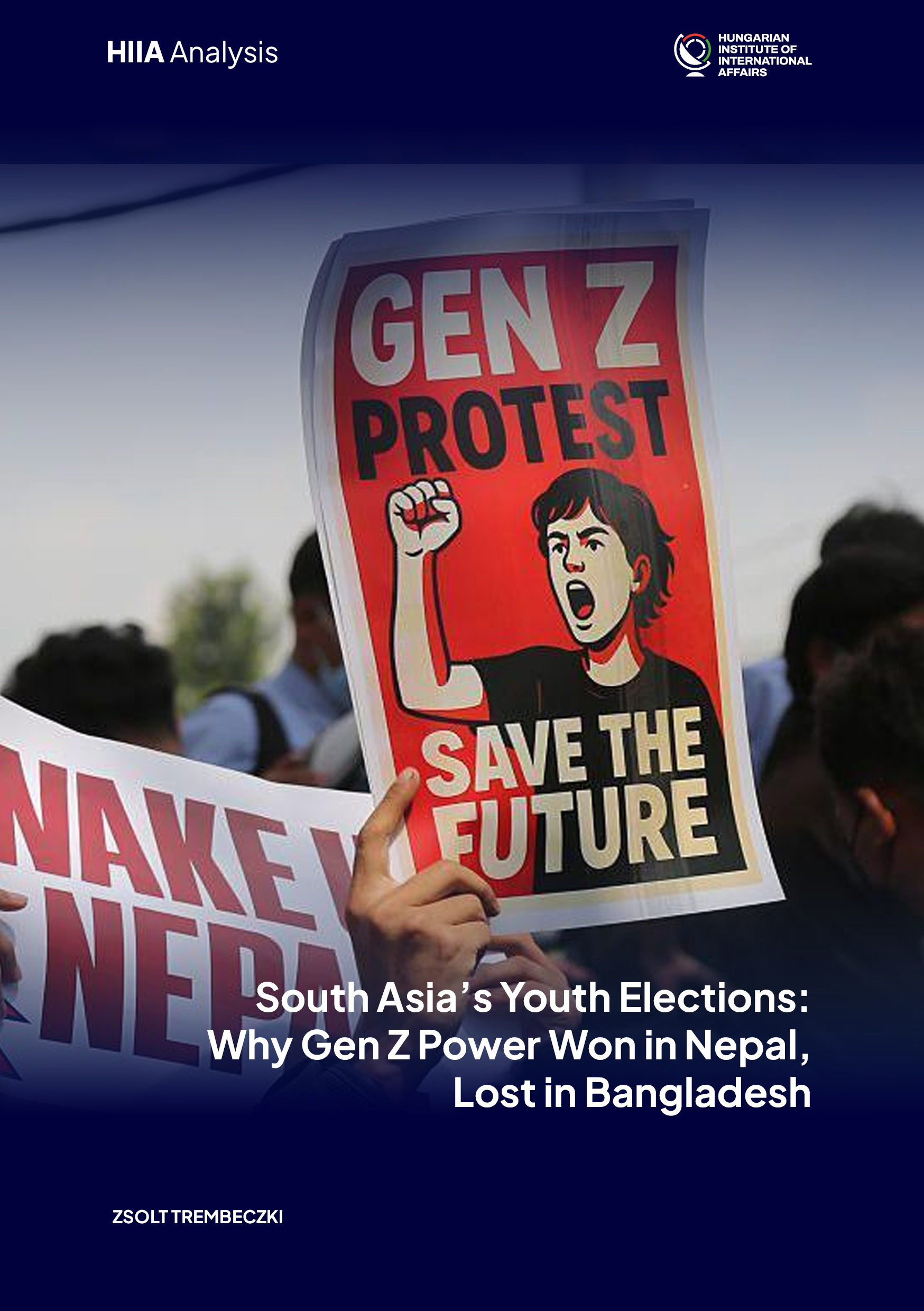
Nepal’s 2026 March vote was an early election called in the wake of the country’s September 2026 “Gen Z” protest wave. Widely described as “youth-led” and catalyzed by a national ban on 26 social media platforms, the revolt was fueled by deeper grievances over the corruption of Nepal’s traditional establishment parties, perceived elite impunity, and widespread unemployment. The “NepoKid” and “NepoBaby” hashtags were trending on social media, referring to children of the political elite who were openly displaying their privileges in the form of sport cars, foreign universities, and general lavish lifestyles. The protests’ main symbols, such as the stylized pirate flag from One Piece, a popular manga, anime, and live action series, fit into the pattern of Asia’s other 2025 Gen Z mass movements, such as those in Indonesia and the Philippines.[4]
The protests soon turned violent and ultimately deadly, with reports citing 70–80 lives lost. Several prominent locations, including the parliament building in Katmandu and the homes of multiple politicians were besieged and set ablaze.[5] Prime Minister K.P. Sharma Oli was forced out and replaced with Sushila Karki, the country’s chief justice, who received the most votes in an informal online Discord poll set up by the protestors.[6] While the revolt’s visual identity—images of young people confronting the police and occupying burnt buildings—was dominated by men,[7] it led to the appointment of the country’s first female prime minister. Parliament was dissolved and—unlike in Bangladesh, where Nobel laurate Muhammad Yunus’ interim government remained in office for about 18 months—a snap election was speedily scheduled for March 5 of the next year.
Under this limited timeframe, the Karki government’s primary job was general de-escalation, the prevention of renewed street violence, and setting up election logistics—all while establishment parties, ambitious upcoming organizations, and the street movement eyed each other with little trust or common ground. Similarly to Bangladesh, whether the youth movement would be able to convert its street energy to lasting political arrangements was a major question of the transitory period and the upcoming election.[8]
About 18.9 million eligible citizens registered to vote (800,000 of them for the first time) in a nationwide single-phase poll conducted under a mixed electoral system combining 165 single-member constituencies with a proportional mechanism allocating 57 parliamentary seats.[9] This system, although it still favors the single largest plurality, is less biased for the winner than the overwhelmingly first-past-the-post model of nearby Bangladesh. True to the Gen Z protest’s roots, much of the campaign moved to the online space, with traditional banners and pamphlets to a large degree replaced with social media posts and influencer activities. This also put huge pressure on the Election Commission to prevent the spread of misinformation and disinformation.[10]
This preparatory work was done amid a rare constellation of geopolitical agreement between three major outside actors: India, China, and the United States all stood in favor of timely and orderly elections.[11] India especially put pressure on traditional parties to secure their support for interim Prime Minister Karki, meanwhile hoping that either RSP or the Nepali Congress, two moderate parties, would do well on voting day. For its part, China had to come to terms with the poor performance expected of its two preferred communist parties. Still, amid Chinese suspicion of American government and NGO involvement in Nepal’s Gen Z protests, Beijing still preferred a timely replacement of Karki’s “pro-U.S.” government. On the American side, the transition was seen as a way of blocking China’s cross-Himalayan inroads to mainland South Asia.
Parties, Alliances, and Movement Linkage
Since its transition to multi-party electoral democracy in 1990, Nepal’s politics has developed into a highly ossified “cartel-like” arrangement of a handful establishment parties. Since the 2014 split in the country’s influential communist movement, these included three dominant parties: the center-left, social democratic Nepali Congress, widely perceived as a pro-India party; the “Communist Party of Nepal (Unified Marxist-Leninist),” or “CPN (UML)” in short, whose foreign policy tilts towards China but which nominally accepts the multiparty parliamentary framework; and the “Communist Party of Nepal (Maoist Centre)” that favors more radical change. Over the past decade, these parties have entered into multiple “revolving-door” coalition arrangements with each other—each short-lived but led in turn by one of the three prime ministers: Congress’ Sher Bahadur Deuba, Maoist Centre’s Pushpa Kamal Dahal, or—most recently—K.P. Sharma Oli. Altogether, since the 1990s, Nepal has had over thirty governments, none completing a full five-year term.[12]
The party landscape entering 2026 still carried the imprint of this historical legacy, though some traditional parties tried to re-label their older promises and reframe their traditional legitimacy for the post-uprising era. The Nepalese Communist Party (a fusion of Maoist Centre and a handful smaller far-left parties) blended its traditional socialist language with a new focus on governance-and-services-delivery. The “Vision–10” manifesto of the Nepali Congress was also anchored in governance and deliverable plans, explicitly acknowledging that youth grievances must be reflected in future governance and politics. In stark contrast, the CPN (UML)’s campaign centered on sovereignty, even framing the uprising as a conspiracy and itself—implicitly—as the guardian of the old order. [13]
Meanwhile, the street revolt against Prime Minister Oli’s coalition presented a rare opening for new forces to emerge as national alternatives. Of these, the Rashtriya Swatantra Party (RSP), a centrist formation combining economic liberalism and social progressivism, proved the most salient. Unlike the National Citizen Party (NCP), Bangladesh’s youth party, the RSP has been in existence since 2022 and even joined the 2022–2024 Dahal government as a junior partner. Still, after some post-revolt mergers, it had multiple nationally or regionally popular leaders perceived as credible among its ranks, who together embodied a “kind of a pan-Nepal appeal.”[14] Among these recruits was Balendra “Balen” Shah, a 36-year-old hip-hop artist and structural engineer, who served as an independent mayor of Kathmandu, the nation’s capital, for four years before becoming the party’s 2026 prime ministerial candidate.
The RSP, positioning itself as the vessel of youth politics and genuine change but trying to shift away from pure “protest politics,” presented its agenda as a “contract” with citizens, even calling for penalties in case promises were not fulfilled.[15] In the end, instead of fielding a brand-new party, the youth movement found the RSP provided both a platform for novel politics and a relatively new but already tested and organized structure for contesting nationwide elections. Institutional mechanics also supported the RSP’s conversion and the channeling of youth movements into electoral politics. Nepal’s mixed electoral system, combining both proportional representation (110 seats) and single-member districts (165 seats), allowed the RSP, the institutional vessel of the youth movement, to hedge against the risk of uneven geographic distribution, including a fair degree of urban concentration, and maintain an independent, characteristic voice instead of seeking other allies. By election day, this hedging was no longer a decisive factor: the RSP won both the proportional and single-member lanes with a comfortable majority. But from the initial post-revolt days it stood in stark contrast with the dynamics in Bangladesh, where the youth movement’s NCP party entered a much less forgiving, first-past-the-post environment with a “missing incumbent” field and soon felt compelled to ally with ideologically alien Islamist forces.[16]
Early Results and Immediate Implications
On March 5, 2026, voting took place in overwhelmingly peaceful manner. Participation was satisfactory but not quite euphoric: estimates for the turnout cluster around 60 percent—broadly comparable to, but slightly below the figures from earlier years.[17] Key outside actors, including India, the United States, and the European Union, welcomed the peaceful conduct of the election and congratulated the winners.[18]
The result was straightforward: the Rashtriya Swatantra Party won 44.17 percent of constituency votes and 47.84 percent of proportional votes, securing 125 first-past-the-post and 57 proportional seats—amounting to a total of 182 seats (66 percent) in the country’s Federal Parliament. This result suggests a minor but clear delta between the party’s national attraction and the candidates it fielded in individual single-member districts. Nevertheless, in a bold political move, Balendra “Balen” Shah, the RSP’s prime ministerial candidate, defeated ousted Prime Minister K.P. Sharma Oli in the latter’s own rural constituency (Jhapa 5, far away from Shah’s metropolitan home turf in Kathmandu) with 68,348 votes against 18,734. The country’s traditional parties were reduced to significantly smaller caucuses—Nepali Congress with 38 seats, the CPN (UML) with 25, and the Nepalese Communist Party with only 17. The newly founded, agrarian–laborist Shram Sanskriti Party and the monarchist and Hindu nationalist Rashtriya Prajatantra Party won seven and five seats, respectively.[19] Women make up about 35 percent of the newly elected legislature—only marginally more than the constitutionally guaranteed 33 percent.[20]
In short, like in Bangladesh, the winner won a decisive constituency mandate—only in Nepal’s case this winner was not one of the major legacy parties but a generational newcomer. With such a clear majority, government formation this time deviated from Nepal’s traditional exercise in coalitional bargaining, and on March 28 Balendra Shah was sworn in as the country’s fortieth and youngest-ever prime minister.[21] On the very same day, former Prime Minister K.P. Sharma Oli and former Home Minister Ramesh Lekhak were arrested over alleged criminal negligence during the 2025 violent crackdown.[22]
The new government’s room for policymaking is therefore quite spacious. This may prove a crucial factor for the sustained legitimacy of Nepal’s post-revolt political arrangements, given that the 2025 Gen Z protest were fueled not only by political corruption and digital restrictions but also domestic economic underperformance. Youth unemployment, limited industrial development, and national dependence on remittances, especially those from the Gulf region and Malaysia,[23] have long characterized Nepal’s economic landscape. Creating more domestic opportunities for young cohorts and improving government services despite Nepal’s limited fiscal capabilities will be a demanding job for the parliamentary majority. For this difficult job, the new Shah government has been endowed with a popular mandate that matches the scale of the challenge.
Other institutions, however, still provide a check on government power. Even if the prime minister’s party commands an almost two-thirds supermajority in the lower house, major international treaties or constitutional changes require a similar supermajority in both chambers of Nepal’s legislature (unlike in Bangladesh’s unicameral system). As of now, the RSP has no representation in the upper house, forcing it into consensus politics on such matters even if day-to-day governance is conducted with a lower-house supermajority.[24] While constitutional continuity may not be the most fashionable cause in Nepal in the wake of the 2025 Gen Z revolt, the country may benefit from this combination of government mandate and institutional balance.
Why Youth Politics Failed in Bangladesh, Triumphed in Nepal
South Asia’s two “youth elections” in 2026 were held in structurally similar situations, following youth-led street revolts that washed away parts of the old establishments that were perceived as out of touch with young generations’ concerns and had tried to use forceful measures to preserve their positions of power. This similarity should not be overplayed: in the case of Bangladesh, former Prime Minister Sheikh Hasina’s regime had consolidated a dominant-party hybrid regime, harassed political opponents, co-opted state institutions, and conducted elections that could not be considered free and fair.[25] Her overthrow during the 2024 July Revolution cost around 1,000–1,500 lives according to varying estimates.[26] In Nepal, even if perceived as corrupt, out-of-touch, and ossified, the old political structure was characterized by ever-changing coalitions of multiple competing parties, the dynamics of which were worryingly, but not entirely, removed from electoral outcomes. Still, the two countries’ respective 2026 elections were anticipated as moments of clarity, generational break, and transition from post-revolt to institutionalized parliamentary politics.
In this regard, the two elections’ outcomes partly delivered, though not necessarily in cathartic ways. Both brought about new governments with commending parliamentary majorities, supported by clear majorities of the popular vote. This increases the probability of decisive governance in a sensitive time when domestic and global economic difficulties risk the legitimacy of post-revolt democratic consolidation.
The differences, however, are significant. In Bangladesh, citizens voted back into power one of the traditional poles of the country’s political landscape. Prime Minister Tarique Rahman’s Bangladesh Nationalist Party has extensive governing experience and an immediate two-third majority in parliament. The youth-led, newly-formed National Citizen Party, meanwhile, only secured six parliamentary seats, and even then only in alliance with an Islamist coalition that for the first time in the country’s history has emerged as the main opposition force. In contrast, Nepal’s youth movement consolidated around the RSP, a relatively but not entirely new organization that was ready to fight constituency-level battles on its own, at scale, in every region of the country.
This difference in the respective fortunes of the youth movements of Bangladesh and Nepal can be attributed to three main factors. First, in Bangladesh, quasi-single party oppression lent credibility even to a formerly dominant establishment party, while Nepal’s unpopular “crop rotation” coalitions had sufficiently eroded all traditional elite brands. Second, unlike Bangladesh’s NCP, which was an improvised network that initially prioritized political and generational purity, Nepal’s RSP was willing and able to secure faces that had at least some (albeit recent and short) executive credibility, as well as recognition and traction across regions. Third, unlike Bangladesh’s NCP, which was forced into a seat-sharing agreement with the ideologically distinct Islamists by the country’s predominantly first-past-the-post system, Nepal’s electoral institutions provided two channels for converting votes to mandates, giving the RSP the latitude to avoid pre-election alliance politics.
Comparing the 2026 Elections in Bangladesh and Nepal |
||
| Dimension | Nepal (March 2026) | Bangladesh (February 2026) |
| Trigger of protests resulting in the election | September 2025 youth uprising after a social media ban and corruption grievances; government fell and early election followed. | 2024 “Monsoon Revolution” ousted prior government; long interim period preceded the February 12, 2026, election. |
| Electoral system and what it rewards | Mixed system: 165 single-member constituency seats plus 110 proportional seats; inclusion rules shape proportional representation lists. | 300 single-member constituencies plus 50 seats for women appointed by the ruling party; 2026 election held alongside a constitutional referendum. |
| Main vehicle of the youth movement | Rastriya Swatantra Party (RSP), founded in 2022, became central channel for protestor legitimacy and anti-establishment voting. | National Citizen Party (NCP) formed from uprising student networks but struggled to convert street salience into seats. |
| Dynamics between centrists vs. religious right-wing | Mainly about anti-cartel sentiment vs. established parties; one medium-sized pro-monarchy, Hindu nationalist party. | Main Islamist party, Jamaat-e-Islami, had long been quarantined by mainstream parties; NCP entered seat-sharing agreement with Jamaat, which eroded the former’s credibility. |
| Outcome | RSP won 125 constituency seats and 57 proportionality seats out of 275 total seats—one seat short of a two-thirds majority. | Bangladesh Nationalist Party (BNP), a pillar of the establishment, won 209 of 300 seats (a two-thirds majority); NCP won merely six seats. |
Nepal’s External Orientation and Geopolitical Implications
Foreign policy was not the first question voters asked either in Bangladesh or in Nepal, but the two countries’ new political orders will face some of their first tests in this realm. Both countries are geopolitically sandwiched between two giants, India and China, requiring successive governments to engage both sides in a delicate exercise of balancing. In both countries’ cases, the geographic upper hand is held by India, but Chinese trade and infrastructure financing, as well as possible political influence, offer pathways for hedging. The 2024 Bangladeshi and 2025 Nepali revolts and the 2026 electoral outcomes in both countries have changed elements and even the emphasis of their balancing strategies but not the fundamental logic, at least not in the long term.
Almost entirely surrounded by India but with a coastal location and a population of over 173 million people, Bangladesh has traditionally maintained cordial political relations with New Delhi while looking to China to hedge its bets in trade and infrastructure financing. While Sheikh Hasina’s regime had particularly cordial relations with Indian Prime Minister Narendra Modi’s government, India was outright hostile to the post-July Revolt transitionary government headed by Nobel laurate Muhammad Yunus, accusing it of tolerating violence against Bangladesh’s Hindu minority. Dhaka, in turn, has showed increasing willingness to hedge towards the alternative China–Pakistan axis of South Asian geopolitics. While the February electoral win of Prime Minister Tarique Rahman’s Bangladesh Nationalist Party presented an opening, re-normalizing India–Bangladesh relations would require structure and institutionalization, such as regular intelligence-sharing platforms or transboundary water sharing rules, besides a good top-level nexus.[27]
Landlocked Nepal’s geographic predicament is even more complicated. While the country is seemingly sandwiched between its two neighbors, its northern border with China is for the most part sealed by the Himalayas, whereas the forgiving Terai region, where the Himalayas’ gentle southern slopes merge into the Gangetic Plain, form a far more porous borderland with India. The country’s connectivity to the outside world almost exclusively depends on its cordial relations with India—a point painfully driven home by the blockade New Delhi unofficially imposed on Nepal in 2015–2016 in response to Kathmandu’s constitutional reform pushed through mainly by the two communist parties, which disfavored the Madeshi people, an ethnic group in Southern Nepal with close linguistic and cultural ties to northern India.[28]
Nepal’s traditional governing parties managed this environment through elite bargaining between mostly pro-China and mostly pro-India forces, largely outside public scrutiny. Communist parties, especially the CPN (UML), have traditionally looked to China as their main supporter against the pre-2009 Hindu monarchy, while the Nepali Congress and the small Hindu monarchist Rashtriya Prajatantra Party look to India to counterbalance Chinese and communist influence.
The emergence of the new RSP government with a strong parliamentary mandate now introduces the possibility of elevating this balancing policy from an ad hoc coalitional outcome to a more institutionalized strategy. At the same time, the almost complete lack of diplomatic experience of Balen Shah and other RSP figures and the underdeveloped, slogan-like foreign policy segment of their electoral manifesto, which envisions Nepal as a “bridge rather than buffer” between China and India, raises questions about their ability to fully capitalize on this opportunity.[29]
Prime Minister Balendra Shah’s first foreign trip will be to India, where, as his first diplomatic test, he will have to demonstrate both pragmatic engagement with South Asia’s dominant local power and sufficient distance from a potentially overbearing neighbor. While nothing close to his predecessor Oli’s anti-India track record, Shah himself has a history of anti-India remarks, such as the displaying of a map of “Greater Nepal” (covering Indian territories) in his office as Mayor of Kathmandu or calling Nepalese courts “Indian slaves.”[30] Even upon receiving his recent invitation, he said he would not go to India “just to get [his] photo taken.” On the other hand, there are signs of growing pragmatism towards India. For instance, Balendra Shah dropped from his poll pledge a Chinese-backed industrial park to be built in his electoral district near India’s geographically sensitive Siliguri Corridor.[31] Some of Shah’s demands from India may concern the improvement of his country’s connectivity, such as the opening of new air traffic entry points or improving infrastructure in border regions.[32] For its part, India will likely appreciate the domestic political delicacy of these considerations and is expected to offer more concessions in an act of “strategic altruism.”
The India–China conundrum is only one, albeit the most important, part of the foreign policy challenges facing the Shah government. The new administration will also have to negotiate with Russia to achieve the repatriation of around 15,000 Nepalese citizens enlisted by the Russian Army for Moscow’s war of aggression against Ukraine.[33] Nepal’s national economy and diplomacy will be put to the test further by the ongoing war in the Middle East, where around two million Nepalese citizens live and work—one of whom has already reportedly died.[34] Given Nepal’s limited resources, any genuinely robust rescue effort would require assistance from India, China, or both. Nepal’s complete dependence on energy imports through India, itself an energy import dependent country, will also lead to difficult negotiating situations amid the current turmoil in global energy markets.[35] Securing these forms of assistance while elevating Nepal from its former “buffer status” vis-à-vis both India and China is a very ambitious goal for the new government in Kathmandu.
From a European viewpoint, migration patterns may be the most direct levers through which both Bangladesh’s and Nepal’s political transition affects the continent. Unlike Bangladesh, the economy of which is relatively deeply embedded in global manufacturing supply chains, especially in the garment sector serving European markets, Nepal lacks a large-scale export footprint in the rest of the world. Labor and student mobility, however, are an increasingly visible policy issue in Nepal’s relations with Europe, and Nepalese guestworkers represent an increasingly important element of the labor force in Central and Eastern European countries such as Romania, Hungary, and Croatia.[36] With illegal migration becoming a growing problem, the European Union and the International Organization for Migration have co-launched the Mainstreaming Migration into International Cooperation and Development (MMICD) project to ensure that migration from Nepal is regulated, safe, and channeled into national and local development planning. Growing political stability and improving domestic economic performance would help the Nepalese side meaningfully cooperate with such European efforts.[37]
Conclusion
Nepal’s March 2026 election is one of the clearest examples of a protest movement not only overthrowing a government but also successfully converting street legitimacy into electoral power. In contrast to Bangladesh’s 2024–2026 transition from Sheikh Hasina’s authoritarian rule, where voters ultimately flocked to the other traditional pole of the political establishment, Nepal’s electorate granted a decisive parliamentary mandate to the main political force linked to the protests. Comparing the two countries’ 2025–2026 trajectory underscores a broader lesson about the relationship between youth social movements and electoral politics. Youth mobilization alone does not win elections. What instead matters is whether protest energy can be channeled into organizations that can contest elections both nationally and locally and present themselves as credible governing alternatives—even if this comes at the cost of using already existing (but brand-wise salvageable) parties and political figures as the movement’s vehicle to power.
Nepal achieved this transformation in March 2026. Whether it can be sustained remains to be seen. Prime Minister Balendra Shah’s government inherited a state shaped by decades of coalitional uncertainty, economic dependence on migration and remittances, and a decades-long geopolitical tug-of-war between its two enormous neighbors, India and China. With India, in particular, which almost exclusively controls Nepal’s access points to the rest of the world, the new government must find a modus vivendi without appearing too submissive to Indian dominance domestically. While the electoral manifesto of Shah’s party, the RSP, was thin on foreign policy details, New Delhi will likely take the opportunity to attract Nepal away from China’s orbit and show some goodwill in the Nepalese prime minister’s upcoming visit. China, meanwhile, has seen its influence diminishing as its favored communist interlocutors in Nepal suffered a heavy defeat in the March election. The sustained legitimacy of Nepal’s post-revolt, post-election political arrangement will depend first on the perceived success or failure of the new leadership’s economic governance—but also, indirectly yet not less crucially, on the management of Nepal’s dependencies on far larger and increasingly rivalrous neighbors.
Endnotes
[1] Zsolt Trembeczki, “The 2026 Bangladeshi National Election: Dominant Center, Islamist Surge,” Hungarian Institute of International Affairs, March 10, 2026, https://hiia.hu/en/the-2026-bangladeshi-national-election-dominant-center-islamist-surge/.
[2] Biswas Baral, “Balendra Shah’s Landslide Electoral Victory Reshapes Nepali Politics,” The Diplomat, March 9, 2026, https://thediplomat.com/2026/03/balendra-shahs-landslide-electoral-victory-reshapes-nepali-politics/.
[3] Trembeczki, “The 2026 Bangladeshi National Election.”
[4] Rebecca Ratcliffe, “‘A Symbol of Liberation’: How the One Piece Manga Flag Became the Symbol of Asia’s Gen Z Protest Movement,” The Guardian, September 24, 2025, https://www.theguardian.com/world/2025/sep/24/how-one-piece-manga-flag-became-symbol-asia-gen-z-protest-movement-liberation.
[5] Sumina Suwal, “The 2025 Gen Z Uprising in Nepal: A Three-Part Analysis,” Harvard T.H. Chan School of Public Health, November 17, 2025, https://hsph.harvard.edu/atrocity-prevention-lab/news/the-2025-gen-z-uprising-in-nepal-a-three-part-analysis/.
[6] Amish Raj Mulmi, “From Streets to Discord: How Nepal’s Gen Z Toppled a Government,” Carnegie Endowment for International Peace, September 24, 2025, https://carnegieendowment.org/research/2025/09/nepal-gen-z-topple-government.
[7] Nirvana Bhandary, Nepal’s Gen Z Revolution and the Politics of Visibility, April 19, 2026, https://www.boell.de/en/2026/04/19/nepals-gen-z-revolution-and-politics-visibility.
[8] Nayana Prakash, “Nepal’s General Election Will Test the Political Power of Gen Z,” Chatham House, March 3, 2026, https://www.chathamhouse.org/2026/03/nepals-general-election-will-test-political-power-gen-z.
[9] International Foundation for Electoral Systems, “Elections in Nepal: 2026 General Elections,” IFES Election Snapshot, 2026, https://www.ifes.org/tools-resources/election-snapshots/elections-nepal-2026-general-elections.
[10] Open, “Ink Fades, Influencers Rise in Nepal’s Hybrid Election Campaign,” February 26, 2026, https://openthemagazine.com/world/ink-fades-influencers-rise-in-nepals-hybrid-election-campaign.
[11] Biswas Baral, “The Post-Election Climate in Nepal Looks Particularly Harsh for China, as Nepal’s Major Communist Forces Are Not Expected to Do Well in the Elections,” The Diplomat, February 19, 2026, https://thediplomat.com/2026/02/geopolitical-jockeying-in-nepal-ahead-of-march-general-elections/.
[12] Reuters, “Nepal’s Long History of Political Instability,” March 2, 2026, https://www.reuters.com/world/asia-pacific/nepals-long-history-political-instability-2026-03-02/.
[13] Kathmandu Post, “Parties Finalising Election Manifestos as NCP Publishes Its Document,” February 12, 2026, https://kathmandupost.com/politics/2026/02/12/parties-finalising-election-manifestos-as-ncp-publishes-its-document; Meena Bhatta, “Nepal’s Alternative Alliance: Generational Shift or Politics as Usual?,” The Diplomat, January 3, 2026, https://thediplomat.com/2026/01/nepals-alternative-alliance-generational-shift-or-politics-as-usual/.
[14] Biswas Baral, “An Alliance of Political Newcomers Seeks to End Old Parties’ Monopoly in Nepal,” The Diplomat, January 8, 2026, https://thediplomat.com/2026/01/an-alliance-of-political-newcomers-seeks-to-end-old-parties-monopoly-in-nepal/.
[15] Kathmandu Post, “Parties Finalising Election Manifestos as NCP Publishes Its Document”; Meena Bhatta, “Nepal’s Alternative Alliance: Generational Shift or Politics as Usual?,” The Diplomat, January 3, 2026, https://thediplomat.com/2026/01/nepals-alternative-alliance-generational-shift-or-politics-as-usual/.
[16] Trembeczki, “The 2026 Bangladeshi National Election.”
[17] The Kathmandu Post, “Voter Turnout around 60 Percent in Nepal’s Parliamentary Elections”, March 5, 2026, https://kathmandupost.com/national/2026/03/05/voter-turnout-around-60-percent-in-nepal-s-parliamentary-elections; The Guardian, “Nepal: Voting Closes in Election Pitting Old Guard against Powerful Youth Movement,” March 5, 2026, https://www.theguardian.com/world/2026/mar/05/nepal-election-2026-voting-balen-shah-sharma-oli.
[18] Prime Minister’s Office, “India, PM Congratulates People and Government of Nepal on Successful and Peaceful Conduct of Elections,” March 7, 2026, https://www.pmindia.gov.in/en/news_updates/pm-congratulates-people-and-government-of-nepal-on-successful-and-peaceful-conduct-of-elections/?comment=disable; European Union External Action Service, Nepal: Statement by the Spokesperson on the general election, March 5, 2026, https://www.eeas.europa.eu/eeas/nepal-statement-spokesperson-general-elections_en; Review Nepal, “U.S. Congratulates Nepali People on Elections, Signals Readiness to Work With New Government,” March 6, 2026, https://reviewnepal.com/national/u-s-congratulates-nepali-people-on-elections-signals-readiness-to-work-with-new-government.html.
[19] Nepali Times, “Nepal Election Live Results,” March 7, 2026, https://nepalitimes.com/news/nepal-election-live-results.
[20] IPU Parline, Nepal, Global data on national parliaments, 2026, https://data.ipu.org/parliament/NP/NP-LC01/data-on-women/#:~:text=Here’s%20some%20information%20about%20women%20in%20parliament,return%20the%20list%20to%20the%20party%20concerned.
[21] Kul Chandra Neupane and Ganga BC, “Balendra Shah Becomes 40th Prime Minister of Nepal,” The Kathmandu Post, March 28, 2026, https://kathmandupost.com/politics/2026/03/28/balendra-shah-becomes-40th-prime-minister-of-nepal.
[22] The Kathmandu Post, “Ex-PM KP Sharma Oli, Former Home Minister Ramesh Lekhak Detained over Gen Z Protest Crackdown,” March 28, 2026, https://kathmandupost.com/national/2026/03/28/ex-pm-kp-sharma-oli-former-home-minister-ramesh-lekhak-detained-over-gen-z-protest-crackdown.
[23] Zsolt Trembeczki, “South Asian Migration Worldwide and to Europe: An Aspirations and Capabilities Account,” Külügyi Szemle 24, no. 3 (2025): 204–231, https://hiia.hu/wp-content/uploads/2025/09/KSZ-25-3-12-Trembeczki-Zsolt.pdf.
[24] Jai Singh Magara, “New National Assembly Arithmetic Puts Check on Lower House Dominance,” Kathmandu Post, March 10, 2026, https://kathmandupost.com/national/2026/03/10/new-national-assembly-arithmetic-puts-check-on-lower-house-dominance.
[25] Freedom House, Bangladesh: Freedom at Glance, 2026, https://freedomhouse.org/country/bangladesh.
[26] Office of the UN High Commissioner of Human Rights, OHCHR Fact-Finding Report: Human Rights Violations and Abuses related to the Protests of July and August 2024 in Bangladesh, February 12, 2025, 10–11, https://www.ohchr.org/en/documents/country-reports/ohchr-fact-finding-report-human-rights-violations-and-abuses-related.
[27] Amal Chandra and Abhijay A., “India–Bangladesh reset requires structure beyond sentiment”, East Asia Forum, April 23, 2026, https://eastasiaforum.org/2026/04/23/india-bangladesh-reset-requires-structure-beyond-sentiment/.
[28] Tej Karki, “Political Blackmailing: A Case Study of India’s Unofficial Blockade on Nepal,” SSRN, 2022, https://papers.ssrn.com/sol3/papers.cfm?abstract_id=4197326; International Crisis Group, Nepal’s Divisive New Constitution: An Existential Crisis, April 4, 2016, https://www.jstor.org/stable/resrep31770.
[29] Ankit Tiwari, “After the Revolution, Nepal’s Foreign Policy is Anyone’s Guess,” The Interpreter, March 26, 2026, https://www.lowyinstitute.org/the-interpreter/after-revolution-nepal-s-foreign-policy-anyone-s-guess.
[30] Tiwari, “After the Revolution, Nepal’s Foreign Policy is Anyone’s Guess.”
[31] Anil Giri, “Balen Shah Drops BRI-Tied Industrial Park from Poll Pledge,” The Kathmandu Post, April 23, 2026, https://kathmandupost.com/politics/2026/02/24/balen-shah-drops-bri-tied-industrial-park-from-poll-pledge.
[32] L.B. Thapa, “What Nepal Wants from India,” The Rising Nepal, April 23, 2026, https://risingnepaldaily.com/news/79140.
[33] Saloni Muraka, “Russia halts recruitment of Nepalese into its army”, Nepal News, January 8, 2025, https://english.nepalnews.com/s/long-reads/russia-halts-recruitment-of-nepalese-into-its-army/.
Sugam Pokharel, Matthew Chance, Mihir Melwani, Nishant Khanal, “Russia has recruited as many as 15,000 Nepalis to fight its war. Many returned traumatized. Some never came back”,CNN, February 11, 2024, https://edition.cnn.com/2024/02/10/asia/nepal-fighters-russia-ukraine-families-intl-cmd.
[34] Nepal News, ”Is Nepal Preparing to Evacuate Workers from the Gulf?”, March 12, 2026, https://english.nepalnews.com/s/explainers/is-nepal-preparing-to-evacuate-workers-from-the-gulf/.
[35] Tiwari, “After the Revolution, Nepal’s Foreign Policy is Anyone’s Guess.”
[36] Gergely Brückner, “Nagy tömegben jönnek ázsiaiak a magyar munkaerőpiacra, de egyszer haza kell menniük” [Asians Are Coming to Hungary’s Labor Market in Large Numbers, But Eventually They Must Leave], Telex, July 7, 2023, https://telex.hu/belfold/2023/07/07/nagy-tomegben-jonnek-azsiaiak-a-magyar-munkaeropiacra-de-egyszer-haza-kell-menniuk; Emese Vig, “100 ezer külföldi munkavállalónak ad vízumot Románia 2025-ben is” [Romania Grants Visas to 100 Thousand Foreign Workers in 2025 as Well], TransTelex, January 3, 2025, https://transtelex.ro/penzcsinalok/2025/01/03/kulfoldi-munkavallalok-2025; Miklós Lengyel, “Ne lepődjön meg, hogy nepáli vagy bangladesi vendégmunkás várja a horvát szálláson” [Don’t Be Surprised if You Find Nepalese or Bangladeshi Guest Workers at Your Accommodation in Croatia], Hvg.hu, August 7, 2023, https://hvg.hu/gazdasag/20230807_A_fiatalok_azt_hiszik_hogy_az_egesz_vilag_rajuk_var.
[37] Trembeczki, “South Asian Migration Worldwide and to Europe.”