
Robert J. Palladino, the U.S. Chargé d’Affaires in Budapest: The Trump administration is ushering a golden era of U.S.-Hungarian relations.

In his first public interview since arriving in Hungary, Robert J. Palladino, the newly appointed Chargé d’Affaires of the United States, participated in an in-depth conversation hosted by the Hungarian Institute of International Affairs (HIIA), in collaboration with the U.S. Embassy in Budapest. The event, held on 8 April 2025, was entitled “New Momentum in Hungarian-American Relations” and featured a dialogue between Mr. Palladino and Gladden Pappin, President of HIIA.


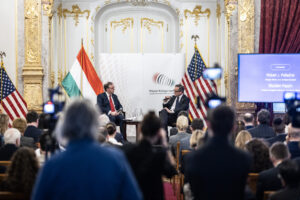
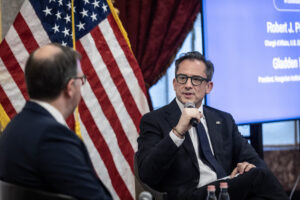
In his opening remarks, Mr. Pappin welcomed Mr. Palladino to Hungary and introduced him to the audience. The discussion that followed offered a wide-ranging and candid exchange on diplomacy, shared values, and the future of Hungarian-American cooperation.
Mr. Palladino began by expressing his honor to be in Hungary. Reflecting on his first 31 days in the country, he shared his appreciation for the cultural and historical differences between Hungary and the United States—particularly highlighting Hungary’s successful and admirable efforts to restore and preserve its cultural heritage.
The conversation addressed several major themes, beginning with the current state of bilateral relations and the evolving direction of U.S. diplomacy. Mr. Palladino emphasized that the return of President Trump to the Oval Office presents a renewed opportunity for both Americans and Hungarians to focus on shared goals: prosperity, safety, and security. He underscored a “back to basics” approach in U.S. foreign policy, grounded in common sense and traditional values.
When asked about anticipated changes in foreign policy, Mr. Palladino noted that the Trump administration had brought in “a lot of patriots” committed to putting the American people first—an approach he believes will accelerate cooperation with key partners like Hungary. “We do better when we can look a partner in the eye and approach things from the same perspective,” he remarked. He emphasized the importance of common language, mutual understanding, and shared priorities, adding: “This is the perspective that we find the Hungarian government understands quite well.”
On the U.S. trade strategy, Mr. Palladino explained that President Trump seeks to ensure reciprocity in international trade relationships. He noted that progress has already been made in reducing non-tariff barriers and ensuring that the U.S. is treated fairly abroad.
Addressing the Russo-Ukrainian war, Mr. Palladino expressed cautious optimism, praising Hungary’s consistent advocacy for peace—a vision he said is shared by President Trump. “Hungary’s support means a great deal to us,” he said. “As we enter a stage of difficult diplomacy, we need to see commitment and progress from all parties. European security requires shared responsibility—and we hope to see more leadership from our European partners, particularly our critical NATO allies and EU friends, in strengthening unified leverage. Hungary plays an important role here.”
On European defense, Mr. Pappin noted Hungary’s similar outlook to that of the current U.S. administration. Mr. Palladino agreed, underscoring the need for a stronger, more capable Europe. “We share blood, we share history, and we share our future. We fought together on the same battlefields, built the foundations of Western civilization—and our children will shape the future together,” he said. “We want to see a stronger Europe—not as a counterweight, but as a better partner for the United States.”
In response to a final question about how the U.S. Embassy plans to move beyond the tensions that characterized previous diplomatic relations, Mr. Palladino was clear: “Elections have consequences, and we are heading in a different direction. But a political reawakening is already underway at a very high level.” He noted that doors are being reopened in the U.S.-Hungary relationship—an opportunity, he said, “to turn the page and open a new chapter.” The goal, he continued, is to translate improved leadership-level relations into real results.
While acknowledging that the U.S. and Hungary are sovereign nations with differences, Mr. Palladino emphasized their underlying similarities and shared interests. He committed to returning to traditional diplomacy, with no “activism” at the U.S. Embassy. “We will be focused on achieving results for the American people. Among our top priorities will be energy, defense, commerce, and strengthening people-to-people ties between Hungarians and Americans.”
Mr. Palladino pointed in particular to the area of shared security, noting that Hungary and the United States have a significant opportunity to grow even closer in defense cooperation. “We’re seeing momentum in the military space,” he said, highlighting increased cooperation on the ground and in strategic planning. He also noted that the strong relationship between the Prime Minister and the President provides a productive framework for advancing this collaboration further. “This could be a golden age between our two nations,” he remarked, “but only if we keep working hard to turn goodwill into results.” He concluded on an optimistic note: “Hungary is our ally. And we want a strong Hungary.”