
Realpolitik and Las Malvinas: Argentina’s Moment for Triangular Diplomacy

HIIA Analysis – Written by Bailey Schwab
The Falkland/Malvinas Islands are once again in the news in both Argentina and the United Kingdom.[1] This is due to a leaked internal email from the Pentagon laying out measures Washington could take to punish its NATO allies, particularly Spain and the United Kingdom, for not having sufficiently supported its war against Iran, one of which was to reevaluate Washington’s support for Britain’s sovereignty claim over the Falkland/Malvinas Islands—over which Argentina also claims sovereignty.[2] This led to excited emotions on both sides of the Atlantic. Downing Street responded by reasserting that sovereignty over the islands “rests with the UK.”[3] Argentine President Javier Milei posted to his X account that “Las Malvinas fueron, son y siempre serán argentinas” (the Falklands were, are, and always will be Argentine).[4] While the memory of the 1982 war is still fresh in the public consciousnesses of both societies, the hype about another conflict is unrealistic and—of course—undesirable. It is undesirable because of the loss of life that it would entail. It is unrealistic because, notwithstanding Britain’s ability to defend the islands being in a much worse relative position compared to 1982, the only way that conflict would start is if Argentina invaded, which it does not have the necessary capability to do at the moment. While diplomacy is the preferred option for all parties, it should be stated that diplomacy is not an alternative to conflict between states; it is a complement to it. If done effectively, however, kinetic conflict can be avoided.
The PDF version is available here!
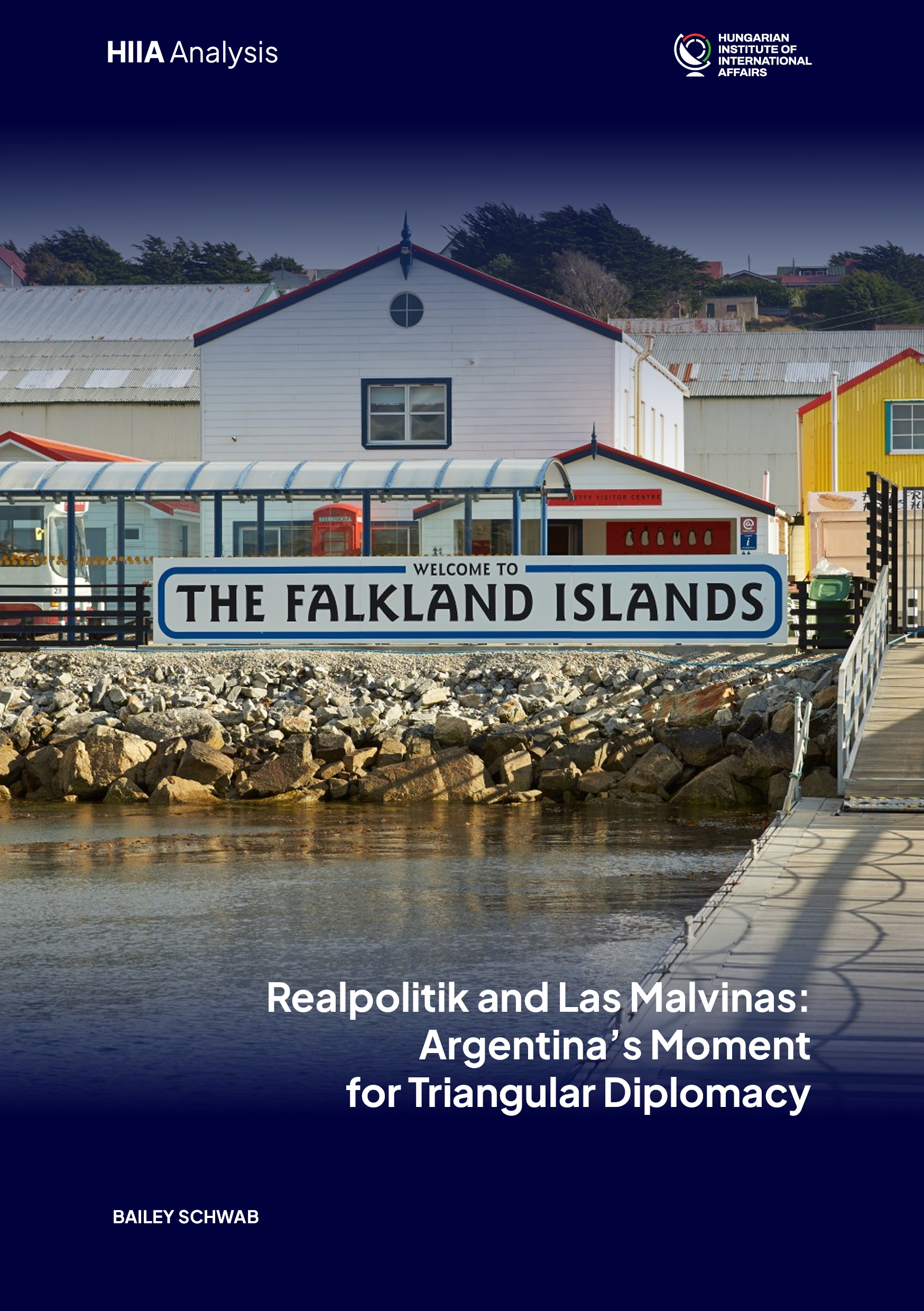
Thus, this research paper will make the case that there is an opportune moment for Argentina to adopt its own form of what could be termed “triangular diplomacy” in its approach to reclaim Las Malvinas, in large part due to America’s broader global strategic realignment. The triangular diplomacy concept was made famous by former U.S. National Security Adviser Henry Kissinger, who recognized the possibility for strategic realignment that the split between the Soviet Union and China afforded the United States. Kissinger aimed at peace with both Marxist powers. In turn, “‘triangular’ refers to the shape of three opposing state powers facing at each other. The way that was implemented was smoothing diplomatic relations with communist China, in order to corner the Soviet Union in a two-against-one situation.”[5] One of the seminal issues of Argentine foreign policy must now be navigated by Buenos Aires within a growing rift between the United States and the United Kingdom (and Europe as a whole), which itself presents a unique opportunity from an Argentine perspective.
That opportunity is the ability to position Argentine diplomacy triangularly between the United States and the United Kingdom. In this context, I argue that Argentine triangular diplomacy could be implemented according to the following principles:
- Argentina could now nurture the dynamics arising out of the new U.S. emphasis on the Western Hemisphere, as articulated and implemented by the Donald Trump 2.0 administration. Shifting American priorities towards Latin America, and the Western Hemisphere as a whole, is part of an American effort to undo what the Trump administration terms the “neglect” of previous administrations in allowing other great powers to expand their influence in the region.[6] The hemisphere is becoming an area where geopolitical competition between the great powers is playing out, as reflected in a new scramble for Antarctica as well as China’s development of dual-use infrastructure throughout the Americas, such as the Espacio Lejano Space Station in Argentina’s own Neuquén Province. The Trump administration has made it clear that while it will be hard to totally excise other great powers from the region, such countries should not engage in any military cooperation with China, and the United States should reassert its own presence. The military buildup in the Caribbean in the fall of 2025 and Operation Absolute Resolve were manifestations of this shift in policy. Thus, if Argentina can develop and frame proposed solutions to the Malvinas sovereignty dispute in terms that will benefit America’s geostrategic position, the latter may become even more sympathetic to the Argentine claim.
- Argentina must engage the United Kingdom on a pragmatic basis. Since the Falklands War in 1982, Argentina has engaged in an evolving diplomatic campaign to claim the islands from the United Kingdom. Over the years, Argentina has made formal complaints to the United Nations about Britain’s militarization of the South Atlantic as well as repeated references to the U.N. General Assembly’s characterization of the dispute recognizing the specificity of the Malvinas question, which, according to former Argentine Foreign Minister Santiago Cafiero, “comes from the fact that part of the territory of an independent state (the Argentine Republic) was usurped by an act of force perpetrated by the United Kingdom in 1833.”[7] Notwithstanding appeals to international law on the international stage, what has occasionally damaged Argentina’s case diplomatically is the inflamed rhetoric of its leaders in relation to the United Kingdom, however understandable such rhetoric may be. That which Argentina lacks in relative strategic capability, it tries to make up for in rhetoric. As Argentine defense analyst Juan Battaleme posited in a recent radio interview, previous Argentine leaders have often unhelpfully invoked nationalist sentiments that do not permit for ground to be made with Britain on the issue. According to their thinking, despite the large number of investments the United Kingdom has in Argentina, diplomacy cannot be conducted without placing the Malvinas issue at the center of discussions, yet nothing tangible positively changed in relation to the Argentine claim.[8] Milei, on the other hand, has stated that although Argentina’s claim to sovereignty is nonnegotiable, he is willing to engage in dialogue on a whole range of issues, including the Malvinas. For example, Milei is expected to visit the United Kingdom shortly and will be the first Argentine president to do so since Carlos Menem in October 1998. He is expected to discuss the arms embargo the U.K. has maintained on Argentina since the end of the war.
- The U.K.–U.S. special relationship has essentially been declared dead by both the U.K. House of Lords in its April 2026 report on the relationship between the two countries and the current British ambassador to Washington in recently leaked comments, and this presents a golden opportunity for Argentina.[9] Just as Kissinger exploited the rift between the Soviet Union and China, as Washington’s and London’s perceived interests have diverged and will continue to do so on a range of global security matters—as per the recent Lords’ report[10]—Argentina can use this rift to its own advantage to strengthen its claim of sovereignty over the Malvinas. Although Argentina does not have the economic, intelligence, or military capabilities to supplement the United States’ global security policy as the United Kingdom did, for example, during the Cold War and the War on Terror, and the geopolitical nuances in South America and Europe are very different, there is scope for Argentina to position itself as one of the most ideologically and strategically aligned countries with the United States, as Britain once did. By doing so, along with other small and middle powers, it can maneuver to fill the political space increasingly being left by European allies such as the U.K. as they seek “strategic autonomy” while the U.S. deprioritizes Europe and reprioritizes what it perceives to be its national interests, such as what occurs within what it considers its own backyard. Within this context, by “hugging the Americans close”—as Britain once used to refer to its approach to the United States—Argentina can seek political favors, such as a potential revision of U.S. support for Britain’s sovereignty claim over the Falklands/Malvinas.[11]
This piece will be structured into three sections. The first section will provide a brief history of the dispute between Argentina and the United Kingdom over the Falklands/Malvinas. The second section will develop the points made regarding Argentina’s opportunity to engage in its own triangular diplomacy strategy, vis-à-vis the United Kingdom and the United States in relation to the Falklands in more detail. The third section will explore the limits of the strategy and, in particular, Argentina’s current inadequacies that weaken its sovereignty claim.
In short, the goal of such triangular diplomacy would be to secure something tangible. In this light, Argentina must recognize that despite the map of the islands being featured on their currency and in their passports, full sovereignty in the immediate future is more than likely not on the cards. Nevertheless, this does not mean that achieving important victories at the margin of the sovereignty issue—what some may call a gradualist strategy—such as, say, obtaining the right to jointly administrer the Mount Pleasant military base with U.S. oversight, may be more achievable and not necessarily too outlandish to ponder given recent events. While Argentina would need to diplomatically punch above its weight to achieve such a feat, if it wants to become a first-rank security and geopolitical actor in the region, innovative and bold diplomatic initiatives are where it must start.
A Brief History of the Dispute
As the author is English and half Argentinian, they are well aware that the debate over the source of the dispute is a minefield in and of itself. In essence, the origins of the dispute, and of the 1982 conflict, lay in competing and unresolved claims to sovereignty that, depending on who you ask, either began in 1833, which is when Britain took control of the islands by force, or in 1810 when Spanish territory was integrated into the broader territorial integrity of the recent rebellious Argentine nation based on the principle uti possidetis juris. Prior to 1833, the Argentine argument is that Spain had transferred its colonial possessions to Argentina, which then, in relation to the Malvinas, carried out various acts demonstrating its sovereignty, including the designation of governors, authoring legislation on fisheries resources, and granting territorial concessions.[12] However, on January 2, 1833, the British Royal Navy arrived and reasserted sovereignty, subsequently evicting an Argentine military garrison at Puerto Luis and other authorities. The British argument narrates that the Argentines then inhabiting the islands were invited to remain, but under British rule. Over subsequent years, according to the Argentine perspective, the British “implemented measures to favor the settlement of subjects of the Crown with a view to preserving the ‘British character’ of the population of the islands and making it difficult for Argentines from the mainland to settle.”[13] Over time, the Argentine character of the population became essentially nonexistent. However, while neither party ever relinquished its sovereignty claim, tensions between the two over the issue remained relatively low throughout the nineteenth and the first half of the twentieth centuries.
Following the Second World War, the British Empire underwent decolonization, returning former colonial territories back to colonized peoples and thus relinquishing a lot of overseas territory in the process. In turn, over time, rhetoric ramped up. During the 1970s, the two sides engaged in more regular and serious negotiations to rectify their differences. Many solutions were floated, such as a Hong Kong-style model involving a formal transfer of sovereignty to Argentina along with a 99-year lease back to Britain. The latter grew warmer to this as many in the political establishment thought of the Falklands issue as a nuisance, as the benefits of continued control were outweighed by the diplomatic and political effort and time dedicated to resolving it. After the Argentine military junta took power in 1976 during what was termed the “National Reorganization Process,” the junta thought that the British did not care about defending their claim of sovereignty of the islands. The junta, initially led by Jorge Videla, the president of Argentina from 1976 to 1981, tested the theory through what historian Richard C. Thornton called a “gradualistic strategy.” This saw the establishment of Argentine scientific stations on South Thule in the South Sandwich group, outlying islands claimed by Britain as dependencies, to displace Britain “gradually from the entire South Atlantic as well as the Antarctic. In the case of South Thule, British intelligence learned of the maneuver, but London did nothing.”[14] In October 1977, Buenos Aires planned to reinforce its position, but British intelligence learned of the junta’s intention and “London moved to preclude it. The Callaghan government deployed a nuclear submarine to the South Atlantic and quietly informed the junta that it had done so.”[15]
As time progressed, the junta moved from its initial “gradualistic” policy, which included a 1978 plan to establish a presence on South Georgia as they had on South Thule, toward the eventual decision by General Leopoldo Galtieri—who Washington named Argentina’s “General Patton”—to use force in 1982. On April 2, 1982, Argentine forces seized the islands by force. Great Britain immediately responded by deploying a task force of 113 ships and 28,000 men, and, on June 14, British forces won after six weeks of fighting and reestablished British authority.[16] Since then, British power has decided the question of possession, albeit not that of sovereignty.[17] This, in turn, speaks to a broader issue hinging upon modern discussions in international politics: international law does not mean much if it cannot be enforced. Ultimately, what underwrites law is the ability and willingness to employ violence to enforce and fulfill it.
The realpolitik of the late 1970s and early 1980s that surrounded and precipitated the Argentine invasion of the Falklands must be dealt with here. During the period, the political and geopolitical interests of each of Argentina, the United States, and the United Kingdom converged in interesting and overlapping ways. In Argentina’s case, in the early 1980s, there was mounting international pressure, including from the departing Jimmy Carter administration (1977–1981), against its perceived human rights abuses during what is now called the “Dirty War.” This period saw thousands of Argentines either killed or kidnapped and never to be seen again, as the junta sought to combat suspected left-wing agitators and terrorists, believing that such measures were necessary to ensure national security after a period of economic and social instability—the latter in no small part caused by leftist terrorism, such as the terrorism conducted by the Montoneros.[18] However, the Argentine junta regime was essentially given the green light by Kissinger, who told officials, “If there are things that have to be done, you should do them quickly.”[19] Thus, despite the lull in relations during the Carter years with its emphasis on human rights, in the American anti-communist struggle in the so-called Third World during the Cold War, particularly in Latin America, the incoming administration of Ronald Reagan initially thought of the regime as a useful ally. For example, the Argentine military provided training to the Nicaraguan Contras, who were being financed by the Reagan administration, in their struggle against the communist, Sandinista government.
The Reagan administration was nevertheless concerned about the fact Argentina had militarized to such a degree in its effort to compete with Brazil for South American hegemony that it had decided in 1978 to acquire its own nuclear weapons.[20] Argentina also had a missile program during this time, and the first ballistic missile was tested in 1982. Thus, the problem facing the Reagan administration was the growing danger represented by Argentina as an emergent nuclear weapons state.[21] Consequently, Thornton suggests, “It was the failure to resolve that problem bilaterally that led to what I have termed the ‘Falklands Sting’—the scheme to overthrow the junta by leading it into disastrous conflict with Britain over the Falkland Islands. Military defeat would discredit the junta and see its replacement by civilian political leaders already demanding a return to civilian rule.”[22] Moreover, a British victory would strengthen the position of Prime Minister Margaret Thatcher, who in the early 1980s was the most unpopular British prime minister since the introduction of polling. Strengthening the political position of Thatcher so that she would win reelection in 1983 was a crucial objective for the Reagan administration, which wanted to get rid of the détente framework of the 1970s, advance a much more strengthened form of containment against the Soviet Union, as well as build up the U.S. military and reconstruct its geopolitical position, which had declined in the 1970s under the “malaise” of Carter.[23] Containment, however, required a strong partnership with Britain, which would enable a strong defense of the European continent.
In turn, the historical record shows that after President Roberto Eduardo Viola (Videla’s successor) refused to desist in pursuing a nuclear weapons program, the Reagan administration began courting Galtieri, the man within the regime who was more pro-American and amenable to more antagonistic solutions to the Malvinas issue than the gradualistic approach then adopted by his colleagues. The Americans, through high-profile visits to Galtieri and repeated invitations to the United States throughout 1981, assured him that the U.S. would assist Argentina in its claim over the Malvinas. While the mainstream narrative of the conflict suggests that the Argentines invaded the island without warning and thus caught the British by surprise, this is untrue. All Argentine provocations throughout 1981 were known to British and American intelligence as they were breaking the Argentine codes, which resulted in advanced knowledge of their moves. After provocations involving Argentine commercial voyagers and the British in March 1982, Galtieri’s eventual decision, “to seize the Falkland Islands sooner than planned gave Thatcher just enough time to take action to recover them.”[24]
Contrary to what Galtieri and the Argentine government believed would be the case, during the conflict the Americans were providing a lot of military assistance to the British, including air-to-air missiles, aviation fuel, intelligence, and military stockpiles on Ascension Island.[25] According to Richard Perle, who was an assistant defense secretary in 1982, “Britain would probably have lost the war without American assistance. That’s how significant it was.”[26] Similarly, Lord Powell of Bayswater, Thatcher’s foreign affairs adviser, also said that Britain would have lost the war without American assistance.[27] Caspar Weinberger, then U.S. Secretary of Defense, received an honorary knighthood in Britain for his role in advancing support for Britain during the conflict; U.S. Secretary of State Alexander Haig was more sympathetic to the Argentine position than many in the administration and preferred keeping the junta in power and transferring sovereignty to Argentina—he was replaced by George Shultz just over a month after the conflict ended. As a consequence of what was presented as a stunning victory, Thatcher won the 1983 election based on what has been termed the “Falklands Factor,”[28] thereby saving the Reagan administration from a “loony left”[29] U.K. government, keeping a staunch pro-containment ally in Europe to confront the Soviet Union much more aggressively, and Argentina transitioned to civilian rule and abandoned its efforts to acquire nuclear weapons.
In sum, an important lesson to be taken from the history of international politics is that alliances and friendships between states are transient and exist to the degree they can advance the states’ interests. However, alliances and friendships are contingent upon a multitude of other factors, including the structure of the international system, the relative position of the states within it, and the stability and importance of one’s region within the global balance of power. During the late Cold War period, America valued Argentina only insofar as it could assist it in the periphery through rolling back the gains made by leftist groups and governments in places such as Latin America. The United Kingdom, on the other hand, which was located in what was then the more strategically critical theatre, was richer, and had more military capability to assist it in the confrontation of the Soviet Union, was—obviously—a much more valuable partner. When push came to shove, no matter how much lip service the Americans had given the Argentines over its sovereignty claim, geopolitical and strategic considerations necessitated aligning with the United Kingdom. In the modern era, though, circumstances are different. No longer are the interests of the United States and the United Kingdom as aligned as they once were; in fact, in many ways, they are now misaligned. No matter how much emphasis is placed on shared values, language, and culture, the special relationship has now been declared dead on both sides of the Atlantic due to strategic, not moral, considerations. Furthermore, the United States under Trump has deprioritized Europe as a strategic theatre and elevated, according to the national and defense strategy documents, the Western Hemisphere as a whole—in particular, Latin America—as needing more American time, attention, and resources dedicated to its protection according to U.S. interests. Herein lies Argentina’s diplomatic opportunity.
Argentina’s Opportunity for Triangular Diplomacy
Before delving into more detail about the ways Argentina can engage in its own form of triangular diplomacy to advance its sovereignty claim over the Malvinas, it is important to explain the points of contention between each of the three states that make the triangular diplomacy framework relevant. As stated above, triangular diplomacy refers to the shape of three opposing powers facing each other, as was the case between the United States, China, and the Soviet Union in the 1970s. In this case, the triangular element is more nuanced, since Argentina, the United States, and the United Kingdom do not oppose each other in the same way or with the same intensity as the original case. However, there are significant issues on which the sides disagree.
The Triangular Nature of Argentine–U.S.–U.K. Relations
In the case of Argentina and the United States, while the relationship has improved under Milei and Trump, the latter is still concerned with the cooperation Argentina has undertaken with China in previous years in both military and economic terms.[30] Before Trump gave Milei a $20 billion bailout in late 2025 prior to the Argentine legislative elections, he told him that Argentina and China should not be doing anything beyond trade with each other, and they “certainly shouldn’t be doing anything having to do with the military with China.”[31] The Argentine–Chinese nexus is still a cause of concern for the United States given that it would like to excise China’s territorial footprint in Latin America as much as possible and Argentina’s previous economic engagement and military cooperation with the People’s Republic of China, which in 2015 manifested in weapons sales and defense cooperation agreements extending beyond the scope of any made between China and any other Latin American nation at that point.[32] To earn favor from the United States, Argentina has done well to wane its purchases of arms from China and increase those from Western partners, including the United States and Europe.[33] In this light, it should continue to signal to the U.S. that it will serve as a partner in its new hemispheric posture.
In the case of Argentina and the United Kingdom, as the previous section demonstrated, the Falklands/Malvinas dispute is—of course—the biggest point of diplomatic contention between the two countries. Nevertheless, despite the tensions over the issue, the two countries do a lot of trade with each other. Total trade in goods and services between the United Kingdom and Argentina was £2.2 billion in the four quarters to the end of Q3 2025, “an increase of 11.4% or £229 million in current prices from the four quarters to the end of Q3 2024.”[34] Of this £2.2 billion, total U.K. exports to Argentina amounted to £920 million, and total U.K. imports from Argentina amounted to £1.3 billion—Argentina exports more to the U.K. than it imports. The importance of this is that while there is an existing historical diplomatic dispute over claimed territory, which led to war between the two just over forty years ago, the increasing and significant economic intercourse between them and the trade surplus Argentina has with the U.K. reflect the complex interdependence between these two states.[35] Thus, diplomacy between the U.K. and Argentina extends beyond the Falklands/Malvinas dispute. Consequently, any future negotiations will have to consider how other aspects of their relations will, could, and should be instrumentalized to affect outcomes.
In the case of the United Kingdom and the United States, there is a long history between them that has, at various moments, impacted the structure of the international system itself. Not only did the global system-forming empire of the former immediately precede the global system-forming empire of the latter, but there existed between the two what former Prime Minister Winston Churchill termed a “special relationship.”[36] Not only do the two share a common language, but the United States was a former colony of Britain, and many of the ideas underpinning the political philosophy of its constitution stemmed from the British Isles, including those of John Locke, and the English Bill of Rights (1689) shaped the American legal landscape, which found expression in the U.S. Constitution and the Bill of Rights.[37] Further, the relationship has been defined by deep military cooperation, intelligence sharing, and trade between these world powers, which some scholars have characterized as unparalleled.[38] From the First and Second World Wars to the Cold War and later the War on Terror, the Americans and British have fought alongside each other and shaped global politics and history as a consequence.
An unspoken secret about the relationship, however, is that the power imbalance that has practically existed between the two since the First World War, which Britain would have lost without American intervention (as was the case with the Second World War), has been instrumentalized by the United States to further advance its global strategic priorities.[39] While the public rhetoric behind the cooperation of the two Anglo great powers has leaned heavily into the themes of shared culture, language, and political philosophy, the fact of the matter is that since the early twentieth century, but formally since the end of the Second World War, the direction and architecture of the relationship have been defined and driven by American interests and priorities—no matter how enthusiastic and willing British leaders have been to assist the United States in implementing its geo-stratagem, as in the case of Thatcher’s support for Reagan’s more forceful European posture during the 1980s or Tony Blair’s alignment during the Iraq War. (The latter’s willingness to hug the Americans close led to ridicule of him at the time as George W. Bush’s “poodle”[40]). However, the relationship between the two has weakened over the past few years to such a degree that the British Ambassador to Washington, Christian Edwards, suggested, “‘Special Relationship’ is a phrase I try not to utter because it’s quite nostalgic, it’s quite backwards-looking, and it has a lot of sort of baggage about it…I think there is probably one country that has a special relationship with the United States—and that is probably Israel.”[41] Not only are senior political figures on both sides of the Atlantic declaring the special relationship to now be a dud, but this relationship—as with all others in international politics—is also neither fixed nor permanent. It is driven by interdependent relationships, the global distribution of power, and the interests of the relevant parties in responding to how that power is distributed at specific moments in time. When those interests are misaligned, the relationship will weaken. In the past few years, this is exactly what has begun to occur between the United States and the United Kingdom. Argentina should take note.
In turn, it is where American interests have diverged from those of the United Kingdom, as well as Europe’s more broadly, which Argentina can instrumentalize in its favor. Namely, the deprioritization of the European theatre in American grand strategy and the prioritization of more critical regions, such as the Indo-Pacific and its own sphere of influence, the Western Hemisphere. Herein, therefore, presents one opportunity for Argentina to position itself as one of America’s staunchest and most steadfast allies in what the latter considers to be a critical region, just as Britain did in Europe during the Cold War—adjusting, of course, to relative capabilities in their respective contexts.
The Trump Corollary to the Monroe Doctrine and Argentina
The Trump administration’s emphasis on Latin America, within its broader hemispheric strategy, can be summed up in its 2025 National Security Strategy. The document stated that the U.S. would reassert the Monroe Doctrine to restore U.S. preeminence to protect the homeland and to access key geographies throughout the region.[42] This led to initiatives such as the Shield of the Americas, which intends to forge a coalition with nations across the Americas to stop foreign interference in the hemisphere, tackle narco-terrorist cartels, and curb illegal immigration.[43] Operation Absolute Resolve in January 2026 was in many ways the Trump doctrine toward the Western Hemisphere in action and at its climax: the overwhelming use of military force to remove a recalcitrant leader undermining American interests in the region. It is, therefore, clear that despite the current conflict in Iran, which many suggest is taking American attention away from the more critical areas the Trump administration stated it intended to focus upon, Latin America is receiving a lot more emphasis in U.S. foreign policy than it received in recent history.
Argentina has been engaged by the United States as part of its “expand” and “enlist” approaches to implement the hemispheric strategy.[44] This has been seen in defense cooperation, particularly arms sales, between the U.S. and Argentina. For example, Argentina’s military expansion and modernization witnessed numerous deals with the United States for a range of weapons platforms. In December 2025, six F-16 Fighting Falcon jets purchased from the United States arrived in Argentina.[45] This was complemented by Argentina buying three Scorpène-class submarines and four OPV-87 offshore patrol vessels from France, as well as other platforms from other NATO and European partners.[46]
Comparing Military Capabilities
This modernization of Argentine defense is contextualized by a declining British military presence in the South Atlantic region. While the United Kingdom’s operational capability in the Falklands is based on a combination of permanent presence, force rotation, and long-range logistical support, which allows it to maintain an active military deployment in the South Atlantic, numerous weaknesses have emerged in recent years.[47] The United Kingdom also has important defense partnerships with South American countries that touch upon the Falklands debate. For example, in April 2026, Chile’s government under José Antonio Kast issued a statement indicating their support of Argentina’s claim over the Malvinas.[48] However, British weapons manufacturing company BAE Systems sells and services many weapons systems to Chile and, in cooperation with the Royal Navy, works closely with the Chilean military, which participates in joint exercises and other forms of military cooperation with Britain.[49] Evidently, Britain’s military footprint in the region is not insignificant and has been welcomed by countries who may politically support Argentina on the Falklands/Malvinas issue. Nonetheless, when compared to Britain’s overall military capacity and capabilities in 1982, concerns have been raised that Britain would not be able to defend the islands if Argentina were to invade today.
Not only, as we have seen, have both American and British officials stated that Britain would have lost the Falklands War in 1982 without American assistance in its various forms, but the size of the U.K. Armed Forces, particularly that of the Royal Navy, has shrunk dramatically since 1982. Currently, the Royal Navy only has 63 commissioned ships, and of this number only 25 are real fighting ships, such as submarines, aircraft carriers, destroyers, and frigates. Although patrol and survey vessels are armed, they are not true fighting warships.[50] Britain still has 15 overseas territories, many of which, such as the Falklands, require naval protection. Of the fighting ships of 2026, Britain has ten submarines, two aircraft carriers, six destroyers, and seven frigates. As one analyst put it, the especially low submarine availability “not only results in a limited deployment capacity for submarine forces but also in the inability to deploy a carrier strike group,” which is particularly alarming given that five of the six Astute-class attack submarines are not fully operational, and the sixth is in Australia.[51] Recall that Thatcher’s “task force,” which she deployed to retake the islands after the Argentine invasion in 1982, consisted of 127 ships: 43 Royal Navy vessels, 22 Royal Fleet Auxiliary (RFA) ships, and 62 merchant ships.[52] In short, the size of the entire British Royal Navy in 2026 is dwarfed just by the task force sent to recapture the Falklands in 1982.
Strengthening Argentina’s position in the region, from a hard power perspective, should be considered a step in the right direction, no matter how marginal vis-à-vis the Malvinas sovereignty question for the time being. The reason is that while smaller states—small in the hard power sense, economically and militarily—such as Argentina, must by necessity be patient, persistent, and institutionally resilient in international diplomacy, military power still supports foreign policy even without engaging in combat. This is primarily due to the leverage that military capability gives a state. While international law presupposes that countries are autonomous and sovereign, “reality shows that relations between countries are often unequal. There is a proportional relationship between a country’s military strength and its influence on international relations (diplomatic, economic, commercial, and political), depending on its capabilities of cooperation, subordination, conditionality, or confrontation with other countries.”[53]
At the time of writing, the Global Military Index, which measures countries’ overall military capability on a 0–100 scale based on verifiable data across various dimensions, ranks Argentina 44th.[54] By comparison, the United Kingdom is ranked 11th globally, and its defense budget exceeds Argentina’s by 20 to 1. Argentina falls short by not having a nuclear arsenal, as well as fewer tanks and naval platforms; however, the latter is made nuanced by the poor condition of the Royal Navy at the current moment.[55] While it would be beyond the scope of this piece to explore what a potential conflict would look like between Argentina and the United Kingdom, the art of good diplomacy is about avoiding war. All parties should avoid the use of force. That being said, hard power is still the currency in international politics and without the ability to have leverage over the party with whom you are negotiating, there is little incentive for them to offer any concessions. In the case of the Falklands, there is no international legal outcry as there was over the Chagos Islands, which prompted the United Kingdom to offer a return of sovereignty to Mauritius.[56] In turn, only Argentina’s diplomatic tact and American influence will effectuate any potential agreements with the United Kingdom. Argentina spending more on defense would be a positive start. By showing that, if it wanted and needed to, Argentina would be able to render Britain’s defense of the islands obsolete— something many British analysts currently believe is the case—the Argentine position in negotiations will be strengthened.[57]
The significance of Britain’s declining ability to provide a sufficient defense in the South Atlantic and Argentina’s defense modernization effort in the context of the U.S. Western Hemispheric strategy, a main component of which is to access key geographies, is that Argentina can now nudge the United States toward a position its political establishment is already leaning toward: a reassessment of its stance vis-à-vis the sovereignty of the islands. This should be done on the basis of the following justifications: first, Britain’s military is overstretched around the world to such a degree it found it difficult to send just one destroyer—HMS Dragon—to defend Cyprus from Iran in March, after the vessel had to be docked following technical issues; second, if the U.K. has proven unwilling to allow the U.S. to use its bases for its strikes against Iran, Argentina would not refuse the use of the Falklands as part of any hemispheric defensive measure the U.S. thought pertinent. Argentine officials should lean heavily upon these arguments in their discussions with American officials. In fact, Argentine cooperation with the United States is already being recognized by leading American figures. Marc Zell, Chairman of Republicans Overseas Israel, posted the following on X in March 2026: “Argentina is sending naval units to assist the U.S. in safeguarding international shipping in the Strait of Hormuz. The UK has refused. In 1982, President Reagan came to the aid of then PM Margaret Thatcher who was defending the UK colony in the Falkland Islands, claimed by Argentina which refers to them as the Malvinas Islands. In light of the UK’s cowardly refusal to support the US in the Persian Gulf conflict, I think it only appropriate for the Trump Administration to consider reversing US policy on the Falklands and support the Argentinian claim.”[58]
In the context of America’s grand strategy and the fracturing of its relationships with long-standing European partners, what such remarks indicate—as does the aforementioned leaked Pentagon email indicating the United States should reassess its stance toward the sovereignty issue—is that Argentina should now make clear that any U.S. reassessment favorable to the Argentine position will be rewarded, in the event of an eventual U.K. concession permitting an Argentine territorial footprint on the islands, with an Argentine assurance that the islands can also be utilized by the United States, particularly in relation to access and monitoring of Antarctica.[59] As a recent article from the BBC put it, “Falklands is a pressure point for the UK—and the United States knows it.”[60] Nevertheless, despite the fissures in the U.K.–U.S. relationship, Argentina should still engage with the United Kingdom on a pragmatic basis and resist the temptation to give in to faux nationalism and heated rhetoric, which is usually used for domestic political purposes or to make faulty assumptions about British intentions over the islands based on perceived trends that indicate it no longer wishes to protect them. Just because the United Kingdom has given the Chagos Islands back to Mauritius and decided to lease the military base on Diego Garcia does not mean—as Milei has said in the past—that the Malvinas may become Argentina’s again.[61] Argentina made a similar mistaken judgement in 1982.
Las Malvinas in Argentine Diplomacy
It is a well-known secret in Argentine politics that when leaders become unpopular with the people—as is the case with Milei due to the country’s poor economic performance and charges of corruption—they invoke the British scapegoat and reheat the Malvinas issue to boost their popularity as part of a rally-around-the-flag strategy.[62] Even some historians suggest that the war in 1982 was, for the Argentine junta, a “diversionary war” launched to neuter the domestic unrest forming due to the country’s poor economy and the junta’s excessive repression and rally the public against a foreign enemy instead.[63] Milei, to his credit, has repudiated the approach of his predecessors, who frequently reaffirmed Argentina’s sovereignty claim by calling for bilateral negotiations with Britain.
Argentine Foreign Minister Pablo Quirno said on social media, “The Argentine Republic once again expresses its willingness to resume bilateral negotiations with the United Kingdom that will allow for finding a peaceful and definitive solution to the sovereignty dispute and bring an end to the special and particular colonial situation in which they are immersed.”[64] Nonetheless, Argentine historian Federico Lorenz told Reuters that it was difficult to “think the United States can force Britain to modify its position if it changes its own, since Britain is a strategic ally of the US.”[65] Although Argentina should position itself as a strategic U.S. ally in its own right vis-à-vis its reassertion of power in the Western Hemisphere, what such a remark suggests is that Argentina must nevertheless manage its expectations in its diplomacy with the United Kingdom over the Falklands/Malvinas. Managed expectations must underwrite pragmatic engagement with Britain, since the latter is in a much stronger position to defend its claim than Argentina.
Whereas in relative terms the Malvinas constitutes a much more central part of the Argentine national psyche than it does in the British, the latter still also spilled blood to protect the sovereignty of what it considers as its territory, which, notwithstanding where one sits on the issue, was violated through force by Argentina—although, of course, Argentina would argue that its sovereignty was violated by force by Britain in 1833. It is reasonable to suggest that the junta’s decision to use force to seize the islands in 1982, no matter the degree to which they were goaded into this decision by the Americans,[66] has solidified the British position on the sovereignty question more than anything else. Unlike in the 1970s, when negotiations were ongoing between the parties, after the conflict the question of British sovereignty became just as nonnegotiable as it has always been for Argentina. Not only is this because of the memory of the 1982 war, which was the last time since the end of the Second World War when Britain could confidently brand itself as “great again”—as Thatcher put it a month after the conflict’s end—but also because the British position is underwritten by the concept of self-determination, which served to legitimize the British military’s response in 1982.[67] What Argentina referred to as the “militarization” of the islands and the region more broadly ever since was Britain’s attempt to provide protection to its people and territory so that it could never again be threatened.[68] Mount Pleasant, which was opened in 1985, the Royal Air Force’s station in the islands, goes by the motto, “Defend the Right.” The fundamental purpose of the military base, which hosts between 1,000 and 2,000 British military personnel, is to deter Argentine force. Moreover, in 2013, the people of the islands voted overwhelmingly to remain British.[69] In short, the British will not give up the Falklands easily.
A New Form of Argentine Engagement with the United Kingdom
What does this mean for how Argentina should engage the United Kingdom over the issue? It means that within the logic of triangular diplomacy, Argentina’s overtures to the United States to present itself as a key strategic ally in Latin America and the Western Hemisphere more broadly—to strengthen its diplomatic position on the issue—must be matched by offering something to the British in exchange for any concessions, even at the margins of the sovereignty or administrative issue. Practically, this means adopting the three following approaches. First, recognizing the British perspective and thus not dismissing it offhand or using hot-headed language as Argentine officials have been known to do. For example, in late April 2026, Argentina’s vice president told Falklanders to “go back to Britain” if they “feel English.”[70] Many important diplomatic victories, from the Good Friday Agreement to the Oslo Accords, would not have occurred if the sides had come to the table with this mentality. Second, having the courage to not go for full home runs and accepting concessions the other side is willing to make at the margins.
The fact of the matter is that the core sovereignty positions are structurally irreconcilable in the near term. Marginal British concessions from permissions to form joint fishery management zones to shared scientific exploration and coordinated environmental protection regimes would all be positive, practical, and pragmatic steps toward solving the issue of the islands’ administration and sovereignty. In Stuart Eizenstat’s Art of Diplomacy, the experienced diplomat writes that having courage means sometimes breaking from the established patterns of one’s predecessors, which may sometimes disappoint one’s own political base, in order to make diplomatic advancements.[71] Third, Argentina must have the stamina to play the long game. The dispute is approaching two hundred years old, and both sides have spilled blood and treasure in trying to resolve it in their favor. Despite the noise in recent times over American remarks on the issue and interpretations of what the recent U.K.–Chagos deal implies for British Overseas Territories, it would be a mistake for Argentine diplomats to forget recent history and, in turn, become excited and rush any favorable outcome.[72] To act strategically is, in large part, to think historically.[73]
The Not-So-Special Relationship and Broader Transatlantic Relations
The final aspect to consider is the breakdown of the so-called “special relationship” between the United States and the United Kingdom and what this could imply for Argentina in the Falklands/Malvinas question. We have already seen how the U.K. ambassador to the United States dismissed the special relationship as something of the past and how American officials, including the president, have shown their disappointment at the United Kingdom not adequately assisting the United States in its war against Iran.[74] However, the current cracks appearing in the relationship go beyond just the current conflict in Iran. For example, within the Trump administration’s “civilizational erasure” paradigm through which it has framed certain developments throughout Europe, including mass migration and the supposed censorship of critical voices by liberal governments, the United Kingdom is now being viewed as a potential strategic liability. Recall in 2024 when JD Vance, then the Republican vice-presidential nominee, suggested that Britain could become the “first Islamist country with nuclear weapons,” hinting at the country’s large Muslim demographic.[75] In this vein, during their meeting in September 2025, Trump and Vance berated U.K. Prime Minister Keir Starmer over the supposed decline in freedom of speech in the United Kingdom.[76] It would have been inconceivable for such remarks to be uttered just a few years ago.
Furthermore, the aforementioned U.K. House of Lords report published in April 2026 advised that the United Kingdom needed to look beyond the Donald Trump White House and adjust policy to account for long-term trends in American foreign policy. Lord Robertson, former NATO secretary general and chair of the report, said, “The U.S.’s geostrategic competition with China, its related de-prioritization of European security and an increasing public scepticism of globalization are all trends which will shape future administrations, whether they be Republican or Democrat.”[77] The report concluded, therefore, that the United Kingdom needed to reframe its relationship with the U.S. and “dismiss previous sentimentality about a ‘special relationship.’”[78] The United Kingdom, and Europe as a whole, are now preparing for a world with a more retrenched United States, which means they will need to take on more of the burden for their defense. In turn, the United Kingdom, with this House of Lords report, has suggested that the decline in the special relationship is occurring due to shifting U.S. priorities that the latter considers require a much more transactional and unilateral approach. More critically for the U.K. and other European countries is that the United States has deprioritized the European theatre as a whole, thereby demoting the importance of European allies and friendships in the making of U.S. foreign policy. This is not merely a product of Donald Trump’s policy.
Richard Haas, former member of the George H.W. Bush administration and former head of the Council on Foreign Relations, wrote a piece in the Washington Post in June 2011, entitled “Why Europe No Longer Matters.”[79] A few months later, in November 2011, Barack Obama’s Secretary of State, Hillary Clinton, delivered a speech in Hawaii titled “America’s Pacific Century.” In that speech, Clinton declared, “It is becoming increasingly clear that in the 21st century, the world’s strategic and economic center of gravity will be the Asia Pacific… And one of the most important tasks of American statecraft over the next decades will be to lock in a substantially increased investment—diplomatic, economic, strategic, and otherwise—in this region.”[80] This declaration has since become known as the “pivot to Asia.” The logic behind the pivot was driven by an amalgamation of strategic and economic factors, namely that by 2010 China had become the world’s second largest economy and overtaken the United States in manufacturing output and power generation. American strategists were acutely aware that, as manufacturing is the foundation of industry, and strong industry comes with strong military power, and with strong military power comes the ability to potentially dominate a key region such as the Indo-Pacific, the Chinese were thereby more effectively able to compete for global leadership.
Thus, the Trump administration’s prioritization of the Indo-Pacific and refocusing on the Western Hemisphere are a consequence of the shift of the global balance of power—specifically, the rise of China as a peer competitor to the United States. Notwithstanding disagreements over the degree to which the administration’s actions have distracted from the focus on more strategically important regions, what is clear is that the Trump administration has further entrenched the deprioritization of Europe, including the United Kingdom, into U.S. foreign policy. In the National Security Strategy published in November 2025, the order of U.S. regional priorities was thus: the Western Hemisphere, the Indo-Pacific, Europe, the Middle East, and then Africa. In sum, there is an ongoing separation of interests between the United States and Europe. The former sees the latter as too dependent on it for its security and not willing to let go of the post-war order based on its own neuroses.
Therefore, while it has been suggested that Argentina should position itself as a willing and strategic ally in the reorientation of U.S. foreign policy in the Western Hemisphere, when it comes to the breakdown in the U.S.–U.K. special relationship, it would be unwise to let this crisis go to waste. What this means is that Argentina must leverage its relationship with the United States by invoking the current tensions with the United Kingdom to extract concessions and a genuine reassessment of the American position toward the sovereignty issue. At present, the official U.S. stance is that it recognizes “de facto United Kingdom administration of the islands but take[s] no position regarding sovereignty.”[81] Argentina should not think nor expect the United States to change its stance based on leaked emails. However, it would also be a mistake to not interpret the leaked emails and other public remarks made by U.S. politicians in the same vein as signaling some type of shift in how the United States is starting to see the United Kingdom: not as an indispensable ally, but as a strategic and political liability. This is where Argentina can learn from the intrigues of Kissinger in managing relations and tensions between the Soviet Union and China.
Limits of Argentine Triangular Diplomacy
There are three fundamental weaknesses to Argentina’s strategic position that would limit its ability to employ triangular diplomacy to effectuate positive concessions from the United Kingdom. First, the relatively poor economic state of the country. Fundamentally, this limits the degree to which Argentina can spend on its defense. Second, the domestic political situation, as polling often suggests that Argentines view the United States negatively and, therefore, seeking close strategic alignment with it may be unpopular at home. Third, the United Kingdom engages in deep military cooperation with key South American partners, such as Brazil and Chile, which, despite their public support for Argentina’s claim over the Malvinas, value their partnerships with Britain to such a degree that they have permitted British military aircraft to use their airports to stop over before travelling onto the Falklands.[82] Therefore, overcoming these obstacles will be challenging and for as long as Argentina remains a second-rate power in the region, it will have to lean heavily on skillful diplomacy, long-term strategic thinking, and sensible fiscal responsibility which takes into account the country’s current to medium to long-term defense needs.
Conclusion
Argentina faces a window of opportunity on the Malvinas question. This paper has shown that, while the structural realities remain stubborn—Britain retaining possession, the islanders rejecting Argentine sovereignty, and the balance of hard power still favoring London (even if in relative decline)—the strategic environment around the dispute has changed. The erosion of the so-called “special relationship,” the reemphasis of the Western Hemisphere within American grand strategy, and Argentina’s tentative repositioning within that framework create diplomatic space that simply did not exist in previous decades. Nonetheless, that space is narrow, contingent, and reversible.
Triangular diplomacy offers Buenos Aires a way to operate inside that space with purpose. However, it will only work if Argentina treats it as statecraft, not symbolism. In practice, this means trading rhetoric for real leverage, aligning selectively with American priorities without becoming dependent, and engaging Britain without the political theatrics that have historically undermined Argentina’s credibility on the issue. Most importantly, it means abandoning the illusion that sovereignty can be won in a single stroke with a home run. Incremental gains, whether they be in access, administration, resource management, or security arrangements, are not betrayals of the national cause. Rather, they are the only plausible path to advancing it under current conditions. If Buenos Aires misreads the moment, leans too heavily on Washington, or provokes London without leverage, it risks repeating the fundamental error of 1982, namely that of acting on mistaken signals and opportunism. Nonetheless, it would be mistaken to not recognize that the current historical moment is providing the greatest opportunity for it to make genuine strides in decades. As Kissinger and Nixon proved with their triangular diplomacy in the early 1970s, with strategic foresight, determination, and diplomatic tact, great diplomatic feats are possible.
Endnotes
[1] Where one sits on the issue of sovereignty will probably determine how one labels these islands located in the South Atlantic. To the Argentinians, they are Las Malvinas. To the British, they are the Falkland Islands. This paper will use these terms interchangeably.
[2] Al Jazeera, “US Considers Suspending Spain from NATO, Reported Internal Email Suggests,” April 24, 2026, https://www.aljazeera.com/news/2026/4/24/us-weighs-retaliation-against-nato-allies-over-iran-war-divisions-reuters.
[3] Rachel Flynn and Toby Mann, “No. 10 Says Falklands Sovereignty Rests with UK after Report of US ‘Review,’” BBC News, April 24, 2026, https://www.bbc.com/news/articles/cde51y0zgjyo.
[4] Rachel Flynn and Felipe Llambías, “Las Malvinas/Falklands ‘pertenecen a Reino Unido,’ dice el gobierno británico tras reportes de que EE.UU. estaría revisando su posición sobre las disputadas islas” [The Falkland Islands ‘Belong to the United Kingdom,’ Says the British Government Following Reports That the U.S. May Be Reconsidering Its Position on the Disputed Islands], BBC News, April 24, 2026, https://www.bbc.com/mundo/articles/c0q9jz884kzo.
[5] Christos Bekas-Moraris, “The Triangular Diplomacy’s Center of Gravity,” The American College of Greece, December 19, 2023, https://www.acg.edu/about-acg/institute-of-global-affairs/student-working-papers/triangular-diplomacy-center-of-gravity/.
[6] The White House, National Security Strategy of the United States of America (The White House, November 2025), 15.
[7] Santiago Cafiero, “The Question of the Malvinas,” Center for International Relations and Sustainable Development, 2023, https://cirsd.org/horizon-article/the-question-of-the-malvinas-islands/. This is a good source for a study into the international law perspective of the dispute from an Argentine standpoint.
[8] Juan Battaleme, “Estrategia Inteligente por Malvinas – Entrevista a Juan Battaleme en Ciudadano News,” posted February 16, 2026, by Senador Liberal, YouTube, 10 min., 32 sec., https://www.youtube.com/watch?v=VcPcKO5ctM8&t=228s.
[9] UK Parliament, “Adjusting to New Realities: Rebalancing the UK-US Partnership,” April 22, 2026, https://committees.parliament.uk/committee/360/international-relations-and-defence-committee/news/213225/adjusting-to-new-realities-rebalancing-the-ukus-partnership/; Christian Edwards, “America’s Only Special Relationship is ‘Probably Israel,’ Says British Ambassador to US in Leaked Comments,’ CNN, April 29, 2026, https://edition.cnn.com/2026/04/28/world/us-special-relationship-israel-uk-ambassador-turner-intl.
[10] UK Parliament, “Adjusting to New Realities: Rebalancing the UK-US Partnership.” The House of Lords report concluded that the United Kingdom needed to reframe its relationship with the United States and “dismiss previous sentimentality about a ‘special relationship.’”
[11] Peter Riddell, Hug Them Close: Blair, Clinton, Bush and the ‘Special Relationship’ (Politicos, 2004).
[12] Cafiero, “The Question of the Malvinas.”
[13] Cafiero, “The Question of the Malvinas.”
[14] Richard C. Thornton, The Falklands Sting: Reagan, Thatcher, and Argentina’s Bomb (Brassey’s, 1998), xvi.
[15] Thornton, The Falklands Sting, xvi.
[16] Lawrence Freedman, “The Official History of the Falklands War,” History Today 55, no. 6 (2005), https://www.historytoday.com/archive/official-history-falklands-war.
[17] Thornton, The Falklands Sting, xiv.
[18] Allen Wells, “Argentina Conducts a Dirty War Against Leftists,” EBSCO, 2023, https://www.ebsco.com/research-starters/history/argentina-conducts-dirty-war-against-leftists.
[19] Carlos Osorio and Kathleen Costar, “Kissinger to the Argentina Generals in 1976: ‘If There Are Things That Have to Be Done, You Should Do Them Quickly,” The National Security Archive, August 27, 2004, https://nsarchive2.gwu.edu/NSAEBB/NSAEBB133/index.htm.
[20] Jack Anderson, “Argentines May go Ahead with the Bomb,” The Washington Post, June 7, 1982, https://www.cia.gov/readingroom/docs/CIA-RDP90-00965R000100150092-7.pdf.
[21] Thornton, The Falklands Sting, xix.
[22] Thornton, The Falklands Sting, xix.
[23] Marie Louise Kelly, host, Consider This from NPR, “What Jimmy Carter’s ‘Malaise’ Speech Tells Us about His Presidency,” NPR Podcasts, January 3, 2025, 14 min., 16 sec., https://www.npr.org/2025/01/03/1222640179/what-jimmy-carters-malaise-speech-tells-us-about-his-presidency.
[24] Thornton, The Falklands Sting, xxiii.
[25] Time Magazine, “Just How Much Did the U.S. Help?,” June 28, 1982, https://time.com/archive/6882618/just-how-much-did-the-u-s-help/.
[26] Nicholas Watt, “Crucial Falklands Role Played by US Missiles,” The Guardian, September 6, 2002, https://www.theguardian.com/uk/2002/sep/06/falklands.world.
[27] Watt, “Crucial Falklands Role Played by US Missiles.”
[28] Mark N. Franklin and Lawrence Freedman, “The Falklands Factor,” Contemporary Record 1, no. 3 (1987), 27–29, https://www.tandfonline.com/doi/pdf/10.1080/13619468708580910.
[29] Lucy Ward, “Livingstone Invented Loony Left, Claims Bitter Kinnock,” The Guardian, October 18, 1999, https://www.theguardian.com/politics/1999/oct/18/londonmayor.london.
[30] Bailey Schwab and Zsolt Reile, “Arms Sales and the Politics of Hemispheric Power: The Trump Administration’s New Arms Transfer Strategy,” Hungarian Institute of International Affairs, April 2026, https://hiia.hu/en/arms-sales-and-the-politics-of-hemispheric-power-the-trump-administrations-new-arms-transfer-strategy/.
[31] Manuel Tobias and Patrick Gillespie, “Trump Says He’d Be ‘Very Upset’ by Chinese Military in Argentina,” Bloomberg, October 15, 2025, https://www.bloomberg.com/news/articles/2025-10-14/trump-says-he-d-bevery-upset-by-chinese-military-in-argentina.
[32] U.S.–China Economic and Security Review Commission, “China’s Military Agreements with Argentina: A Potential New Phase in China-Latin America Defense Relations,” November 5, 2015, https://www.uscc.gov/sites/default/files/Research/China%27s%20Military%20Agreements%20with%20Argentina.pdf.
[33] Schwab and Reile, “Arms Sales and the Politics of Hemispheric Power.”
[34] Department for Business and Trade, “Trade and Investment Factsheets,” March 26, 2026,
[35] Complex interdependence refers to theory, operating at the level of the international system developed by Keohane and Nye, which “conceives of interdependence as broader than just the realities of economics, recognizing, for example, that the mutual vulnerability of nuclear destruction stopped the Soviet Union and the United States from going to war. Nuclear deterrence is a form of interdependence…It posits a spectrum, one that has at one end a realist ‘ideal type,’ in which states are concerned only with survival and security and for whom war is an ever-present option. At the other end lies the world of ‘complex interdependence,’ in which states are mutually dependent on each other for their well-being. Any given outcome in international life will depend on where a state sits on that spectrum.” See: Robert O. Keohane and Joseph S. Nye, eds., Power and Interdependence: World Politics in Transition (Longman, 2012), xv.
[36] U.S. Embassy and Consulates in the United Kingdom, “Special Relationship Anniversary 1946-2016,” https://uk.usembassy.gov/special-relationship-anniversary/.
[37] Irwin Halfond, “British Background to U.S. Judiciary,” EBSCO, 2022, https://www.ebsco.com/research-starters/law/british-background-us-judiciary.
[38] James Wither, “An Endangered Partnership: The Anglo-American Defence Relationship in the Early Twenty-First Century,” European Security 15, no. 1 (2006), 47–65.
[39] For studies into the instrumentality of American assistance in the First World War, see: David Stevenson, With Our Backs to the Wall: Victory and Defeat in 1918 (Penguin Books, 2012); Adam Tooze, The Deluge: The Great War, America and the Remaking of the Global Order, 1916–1931 (Penguin Books, 2014).
[40] Rob Watson, “Tony Blair: The US Poodle?,” BBC News, January 31, 2003, http://news.bbc.co.uk/2/hi/americas/2711623.stm.
[41] Chris Edwards, “America’s Only Special Relationship Is ‘Probably Israel,’ Says British Ambassador to US in Leaked Comments,” CNN, April 29, 2026, https://edition.cnn.com/2026/04/28/world/us-special-relationship-israel-uk-ambassador-turner-intl.
[42] The White House, National Security Strategy of the United States of America (The White House, November 2025), 15.
[43] U.S. Department of State, “The United States to Host the Shield of the Americas Summit,” March 6, 2026, https://www.state.gov/releases/office-of-the-spokesperson/2026/03/the-united-states-to-host-the-shieldof-the-americas-summit/; Bailey Schwab, “Attack on Venezuela and the Removal of Maduro from Power: The Trump Doctrine in Action,” Hungarian Institute of International Affairs, January 6, 2026, https://hiia.hu/wp-content/uploads/2026/01/Schwab-Attack-on-Venezuela-and-the-Removal-of-Maduro-from-Power-The-Trump-Doctrine-in-Action-1.pdf.
[44] The enlist aspect refers to the U.S. enlisting “established friends in the Hemisphere to control migration, stop drug flows, and strengthen stability and security on land and sea. We will expand by cultivating and strengthening new partners while bolstering our own nation’s appeal as the Hemisphere’s economic and security partner of choice.” See: The White House, National Security Strategy of the United States of America, 16.
[45] U.S. Embassy in Argentina, “First F-16 Fighter Jets Arrive in Argentina with U.S. Support,” December 6, 2025, https://ar.usembassy.gov/first-f-16-fighter-jets-arrive-in-argentina-with-u-s-support/.
[46] Redacción Zona Militar, “Argentina Will Seek to Move Forward in Obtaining French Financing to Finalize the Purchase of New Scorpène Submarines from Naval Group,” Zona Militar, December 5, 2025, https://www.zona-militar.com/en/2025/12/05/argentina-will-seek-to-move-forward-in-obtaining-french-financing-to-finalize-the-purchase-of-new-scorpene-submarines-from-naval-group/.
[47] Germán Alejandro Romero, “The Operational Capacity of the United Kingdom Armed Forces and Their Deployment in the Malvinas Islands,” March 23, 2026, https://www.zona-militar.com/en/2026/03/23/the-operational-capacity-of-the-united-kingdom-armed-forces-and-their-deployment-in-the-malvinas-islands/.
[48] Gabriel Esteffan, “El apoyo de Chile a reclamo de Argentina sobre soberanía no es ‘conveniente políticamente’, advierte abogada internacionalista” [Chile’s Support for Argentina’s Sovereignty Claim Is Not ‘Politically Expedient,’ Warns an International Law Expert], ADN Radio, April 8, 2026, https://www.adnradio.cl/2026/04/08/el-apoyo-de-chile-a-reclamo-de-argentina-sobre-soberania-no-es-conveniente-politicamente-advierte-abogada-internacionalista/.
[49] Bailey Schwab, “Deepening European and Latin American Security Cooperation,” Hungarian Institute of International Affairs, April 20, 2026, https://hiia.hu/wp-content/uploads/2026/04/Schwab-Deepening-European-and-Latin-American-Security-Cooperation.pdf.
[50] Mark Felton, “The Shocking State of Britain’s Navy 2026,” posted March 22, 2026, by Mark Felton Productions, YouTube, 12 min., 52 sec., https://www.youtube.com/watch?v=Gru2EDJvj9Q.
[51] Romero, “The Operational Capacity of the United Kingdom Armed Forces.”
[52] SSAFA, “Falklands 40: The British Forces,” accessed May 7, 2026, https://www.ssafa.org.uk/support-us/our-national-campaigns/falklands-40/falklands-40-the-british-forces/.
[53] Manuel Bermúdez Tapia, “The Influence of Military Strength on National Sovereignty in International Relations,” Colombian Journal of Military and Strategic Studies 18, no. 30 (2020): 291–306.
[54] Global Military Index, “Argentina Military Forces,” accessed May 13, 2026, https://www.globalmilitary.net/countries/arg/.
[55] Global Military Index, “Military Strength: Argentina vs. United Kingdom,” accessed May 13, 2026, https://www.globalmilitary.net/compare/countries/arg-vs-gbr/.
[56] Northeastern University School of Law, “ICJ: U.K. Rule Over Chagos Prevents Full Decolonization of Mauritius,” March 1, 2019, https://cglj.org/2019/03/01/icj-u-k-rule-over-chagos-prevents-full-decolonization-of-mauritius/.
[57] Rear Admiral Chris Parry, “Britain Unable to Defend Falklands, Chris Parry on Royal Navy Cuts,” posted May 5, 2026, by GB News, YouTube, 38 min., 17 sec., https://www.youtube.com/watch?v=tPHQolZKx8A.
[58] Marc Zell (@GOPIsrael), “Argentina is sending naval units to assist the U.S. in safeguarding international shipping in the Strait of Hormuz. The UK has refused. In 1982 President Reagan came to the aid of then PM Margaret Thatcher who was defending the UK colony in the Falkland Islands,” X, March 18, 2026, https://x.com/GOPIsrael/status/2034136302958838008.
[59] Klaus Dodds, “The Falkland Islands as a ‘Strategic Gateway’: Britain and the South Atlantic Overseas Territories,” RUSI Journal 157, no. 6 (2012), https://www.rusi.org/explore-our-research/publications/rusi-journal/falkland-islands-strategic-gateway-britain-and-south-atlantic-overseas-territories.
[60] Joe Inwood, “Falklands Is a Pressure Point for the UK—and the US Knows It,” BBC News, April 24, 2026, https://www.bbc.com/news/articles/cly7w3zjl38o. Argentina is sending naval units to assist the United States in safeguarding international shipping in the Strait of Hormuz. The United Kingdom has refused. In 1982, President Reagan came to the aid of then Prime Minister Margaret Thatcher, who was defending the UK colony in the Falkland Islands.
[61] Dominic Penna, “Chagos Deal Proves Falklands Could Be Argentine Again, Says Country’s President,” The Telegraph, October 29, 2024, https://www.telegraph.co.uk/politics/2024/10/29/keir-starmer-javier-milei-chagos-falklands/.
[62] Leila Miller, “Argentina’s Milei Walks Fine Line on Falklands amid US-UK Tensions,” Reuters, April 28, 2026, https://www.reuters.com/world/americas/argentinas-milei-walks-fine-line-falklands-amid-usuk-tensions-2026-04-28/.
[63] Amy Oakes, “Diversionary War and Argentina’s Invasion of the Falkland Islands,” Security Studies 15, no. 3 (2006): 431–463.
[64] Leila Miller, “Argentina Calls for Renewed Negotiations over Falkland Islands,” Reuters, April 24, 2026, https://www.reuters.com/world/americas/argentina-calls-renewed-negotiations-over-falkland-islands-2026-04-24/.
[65] Miller, “Argentina’s Milei Walks Fine Line on Falklands amid US-UK Tensions.”
[66] Thornton, The Falklands Sting.
[67] Margaret Thatcher, “Speech to Conservative Rally at Cheltenham,” speech, Cheltenham Racecourse, July 3, 1982, http://www.margaretthatcher.org/document/104989.
[68] Rory Carroll, “Britain is Militarising Falklands, Argentina Tells UN,” The Guardian, February 12, 2012, https://www.theguardian.com/uk/2012/feb/10/falkland-islands-argentina-formal-protest-un.
[69] BBC, “Falklands Referendum: Voters Choose to Remain UK Territory,” March 12, 2013, https://www.bbc.com/news/uk-21750909.
[70] Daily Mail (@DailyMail), “Argentina’s Vice President Tells Falklanders to ‘Go Back to Britain’ If They ‘Feel English,’” X, April 27, 2026, https://x.com/DailyMail/status/2048747535922086245.
[71] Tufts University, “An Interview with Ambassador Stuart E. Eizenstat,” April 22, 2025, https://fletcher.tufts.edu/news-media-mentions/all-news/art-diplomacy-lessons-lifetime-negotiating-table.
[72] Olivia Ireland, “Rubio Downplays Reports US Could Review UK’s Claim to Falklands,” BBC, April 30, 2026, https://www.bbc.com/news/articles/c809r2721ymo. Secretary of State Marco Rubio recently downplayed the leaked email saying that “it was just an email” and that the reaction was “overexcited.”
[73] Francis J. Gavin, Thinking Historically: A Guide to Statecraft and Strategy (Yale University Press, 2025).
[74] Richard Wheeler and Becky Morton, “Trump ‘Not Happy’ with UK Response to Iran Conflict,” BBC, March 17, 2026, https://www.bbc.com/news/articles/cp816jwg411o.
[75] Jessica Elgot and Ben Quinn, “Labour Rejects JD Vance ‘First Islamist Country with Nuclear Weapons’ Remarks,” The Guardian, July 16, 2024, https://www.theguardian.com/politics/article/2024/jul/16/trump-running-mate-jd-vance-uk-first-islamist-country-nuclear-weapon.
[76] BBC, “Key Takeaways from Trump-Starmer News Conference,” September 18, 2025, https://www.bbc.com/news/articles/cre5nylyzd4o.
[77] “Lord Robertson: UK’s ‘Naïve Belief’ the US ‘Will Always Be There’ Has Diminished Its Defence Capabilities,” Chatham House, April 23, 2026, https://www.chathamhouse.org/2026/04/lord-robertson-uks-naive-belief-us-will-always-be-there-has-diminished-its-defence.
[78] UK Parliament, “Adjusting to New Realities: Rebalancing the UK-US Partnership,” April 22, 2026, https://committees.parliament.uk/committee/360/international-relations-and-defence-committee/news/213225/adjusting-to-new-realities-rebalancing-the-ukus-partnership/.
[79] Richard N. Haas, “Why Europe No Longer Matters,” The Washington Post, June 17, 2011, https://www.washingtonpost.com/opinions/why-europe-no-longer-matters/2011/06/15/AG7eCCZH_story.html.
[80] Hillary Rodham Clinton, “America’s Pacific Century,” Honolulu, Hawaii, November 10, 2011, , https://2009-2017.state.gov/secretary/20092013clinton/rm/2011/11/176999.htm.
[81] Office of the Spokesperson, “U.S. Position on the Falkland (Malvinas) Islands,” question taken at press briefing, January 19, 2012, https://2009-2017.state.gov/r/pa/prs/ps/2012/01/182294.htm.
[82] The Guardian, “Brazil Defends Decision to Let RAF Stop at Its Airports en Route to Falklands,” February 8, 2022, https://www.theguardian.com/uk-news/2022/feb/08/brazil-defends-decision-to-let-raf-stop-at-its-airports-en-route-to-falklands.