
No Longer Awkward: India Embraces Israel amid Regional Tensions

HIIA Analysis – Written by Zsolt Trembeczki
Indian Prime Minister Narendra Modi’s February 2026 visit to Israel formalized a strategic convergence that has been rapidly building over the last decade. The upgraded framework, now designated as a “Special Strategic Partnership for Peace, Innovation & Prosperity,” mostly covers already existing areas of cooperation—military technology, arms industry, cybersecurity, space activities, etc.—but aims to better institutionalize the existing cooperation and feed it into India’s ambition for self-reliance in technology and manufacturing. In the following months, the visit also acquired broader regional significance: within days, the U.S.–Israeli war on Iran put India’s multi-aligned posture to the test and brought Gulf security, shipping through the Strait of Hormuz, Arab–Israeli normalization, and the long-term viability of the India–Middle East–Europe Economic Corridor (IMEC) to the forefront. India still seeks to balance its comparably cordial ties with all three poles of the Middle Eastern geopolitical conundrum—that is, Israel, the Gulf Arab monarchies, and Iran—but the war has underlined the limits of this balancing act and may also entail a reputational price for India’s image as the self-declared leader of the Global South. From a European perspective, India’s growing footprint in Western Asia and the way in which Israel–India–Gulf Arab cooperation evolves will be crucial for the longer-term viability of the India–Middle East–Europe Economic Corridor.
The PDF version is available here!
1. The February 2026 Visit: Both Substance and Symbolism
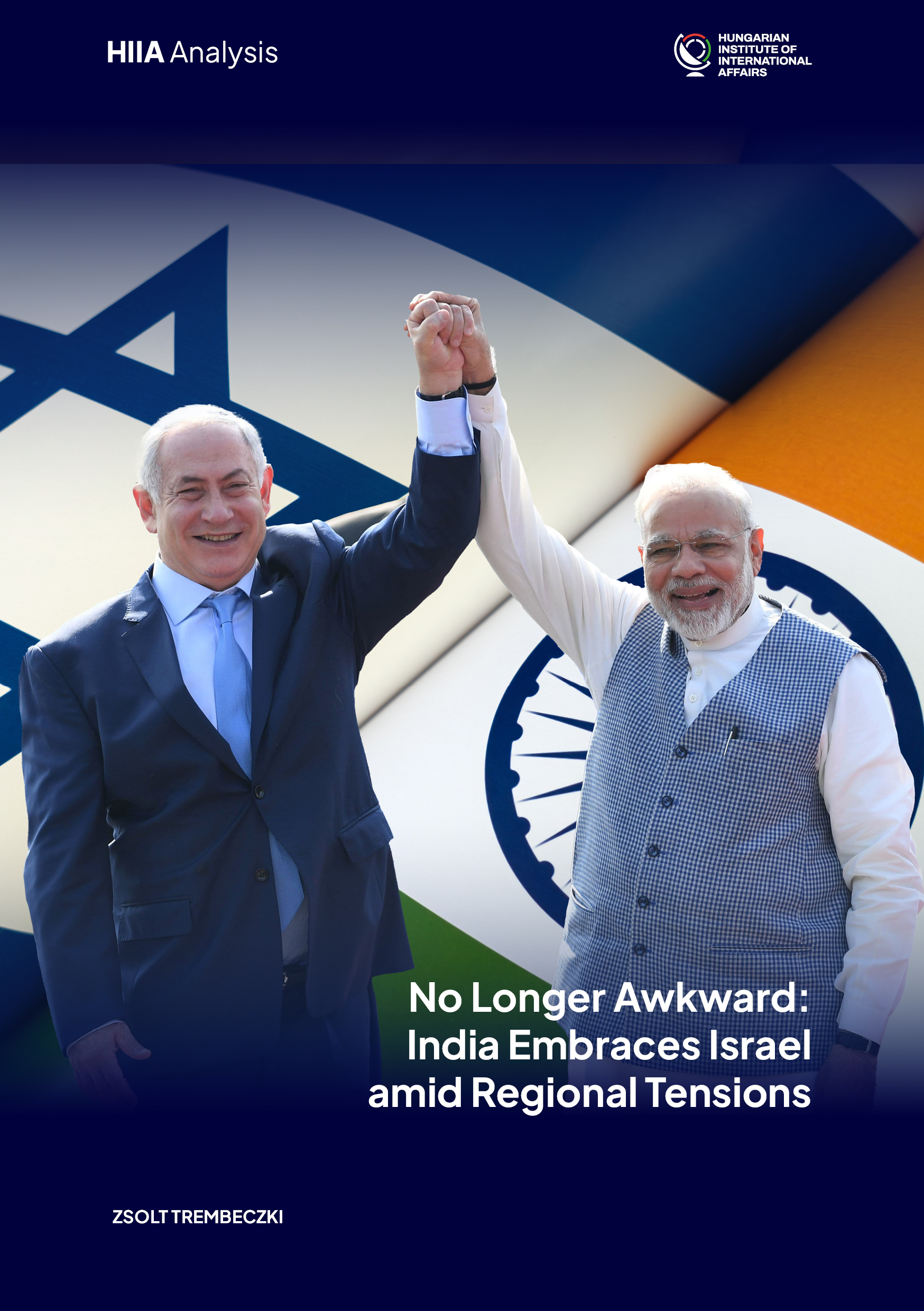
Indian Prime Minister Narendra Modi’s state visit to Israel on February 25–26, 2026, marked the bilateral relationship’s most explicit political embrace since diplomatic normalization in 1992. Modi was received in Jerusalem by Israeli Prime Minister Benjamin Netanyahu with full ceremonial honors and became the first Indian prime minister to address the Knesset, Israel’s legislative body.[1] In his speech, Modi framed India and Israel as two ancient civilizations bound by democratic values and a shared experience of terrorism, expressed the “deepest condolences” regarding the October 7, 2023, Hamas pogrom and declared that “no cause can justify the murder of civilians,” and reiterated his country’s “zero tolerance” approach to terrorism, drawing parallels with India’s own experience, including the 2008 Mumbai terrorist attack.[2]
While Modi also expressed support for diplomatic efforts toward peace in the region, including a UN-endorsed Gaza peace initiative, his visit did not include any parallel engagement with the Palestinian leadership, such as a stopover at Ramallah—a significant departure from the earlier Indian posture regarding the Israeli–Palestinian conflict but following the precedent of his latest visit in 2017. On Israel’s side, Modi was awarded the inaugural “Speaker of the Knesset Medal,” the Knesset’s highest honor, and Netanyahu referred to him as “more than a friend, a brother.” Modi also visited the Yad Vashem Holocaust memorial, reinforcing his visit’s historical and civilizational narrative.[3]
Beyond the optics, the visit’s most consequential formal outcome was a joint declaration elevating the existing “Strategic Partnership” to a “Special Strategic Partnership for Peace, Innovation & Prosperity.” The statement’s points, spanning government-to-government, business-to-business, and people-to-people domains with particular focus on critical and emerging technologies, defense cooperation, artificial intelligence, cybersecurity, space, and innovation ecosystems, were typical of similar India–Israel bilateral documents issued in recent decades, but its language suggests an ambition to further deepen cooperation in areas that have already been expanding since 2014.[4] On defense, procurement discussions were not publicly disclosed in detail, but reports indicate that a multi-year package centered on air defense and high-end battlefield technologies was negotiated.[5]
Technology cooperation received similar emphasis. India and Israel launched a new initiative on Critical and Emerging Technologies (CET), led by the countries’ respective national security advisors, and a Memorandum of Understanding on Cooperation in Artificial Intelligence was signed, along with agreements on cybersecurity, including a multi-year strategic program and the establishment of the India–Israel Cyber Policy Dialogue. Space cooperation between the Israel Space Agency and the Indian Space Research Organization was also reaffirmed, and it was agreed that funding for an India–Israel joint research call and industrial research and development (R&D) through the India–Israel Industrial R&D and Innovation Fund (I4F) would be expanded.[6]
These institutional mechanisms point to a maturing relationship that goes beyond the transfer of arms toward genuine ecosystem integration in innovation and dual-use technologies. This aligns with India’s long-standing objectives of shifting from defense import dependence toward more co-development, licensed production, and indigenous manufacturing capacity (often summarized under the banner of “Atmanirbhar Bharat,” or “Self-Reliant India”) and becoming a technologically vibrant, prosperous nation by mid-century (as set out in the “Viksit Bharat 2047,” or “Developed India 2047,” vision).
What gave these otherwise mostly expected outcomes special strategic weight was the inadvertent timing, at least on India’s part. Within days of Modi’s visit, U.S.–Israeli strikes on Iran pushed the regional security environment from tense but manageable to outright warlike and highlighted the underlying uncertainty of traffic through the Strait of Hormuz—meaning, of India’s maritime connection to IMEC’s overland section. Even amid a fragile ceasefire as of late April, maritime traffic through the strait remains far below normal levels, and the United States has moved to enforce a naval blockade on Iranian ports.
2. India’s Israel Shift and Israel’s Role in India’s Defense and Technology Diversification
Taken together, Modi’s visit should not be seen as a complete departure from the trend of past decades. Historically strained India–Israel relations had already become reasonably constructive by the 1990s–2000s and gained further momentum during the post-2014 Modi Era; the visit did, however, consolidate earlier trends by elevating bilateral ties to a formally expressed “Special Strategic Partnership.” The visit’s language, sequence, and symbolism made clear that India has moved its relationship with Israel from robust but sectorally selective—and at times politically awkward—cooperation to openly acknowledged strategic alignment in areas ranging from defense and technology to regional connectivity. Some commentators criticized it as an abandonment of India’s long-standing Nehruvian principles[7]—which Modi’s team, openly critical of the legacy of India’s secularist founding figures, would no doubt welcome.[8]
To be clear, this is a significant development. Throughout the Cold War, India positioned itself as a leading voice of postcolonial solidarity, Third Worldism, and non-alignment, while its leaders also felt compelled to signal to the country’s sizeable Muslim minority that continual conflict with Pakistan did not isolate India from the broader Muslim world. These considerations translated into consistent diplomatic support for the Palestinian cause. India voted against the 1947 UN partition plan, and while it recognized the State of Israel in 1950, full diplomatic relations were only established in 1992. After that point, cooperation in agriculture, water management, and defense expanded, first incrementally, then rapidly by the late 1990s. Israel’s supplying of critical defense equipment during the 1999 Kargil War with Pakistan underscored a pragmatic security logic behind politically low-profile India–Israel relations.[9]
The shift under Narendra Modi’s governments since 2014, therefore, did not initiate cooperation with Israel; it did, however, boost its political visibility and strategic and emotional framing. His 2017 visit was the first ever by an Indian prime minister. Formal support for Palestinian statehood under a two-state solution was maintained, but the delicate packaging of engagement with Israel and Palestine was functionally deprioritized. This evolution was driven by two distinct but overlapping logics: pragmatic security considerations and ideological affinity. The first is rooted in shared threat perception regarding militant Muslim neighbors and Islamist terrorism and is expressed through deepening cooperation in defense industry, intelligence sharing, border management, and technological solutions to asymmetric threats.
To the second, ideological point, India’s Hindu nationalist political family, where Prime Minister Modi’s Bharatiya Janata Party (BJP) belongs, is far more sympathetic to Israel’s national project than the erstwhile governments of the secularist, more Muslim-accommodating Indian National Congress had been. Parallels have been drawn between Jewish and Hindu civilizational narratives, Hindutva and Zionist ethno-religious nationalism, and both movements’ “real estate disputes” with neighboring Muslim populations or domestic Muslim minorities.[10]
Growing India–Israel ties should not, however, be simplified to mere ideological alignment. Israel’s niche role in India’s defense acquisition basket—as a reliable supplier of high-quality defense equipment and sensitive dual-use technologies with no political strings attached—has been made more valuable by two strategic developments: first, the accelerating shift in warfare toward sensors, drones, precision fires, air and missile defense, and electronic and cyber domains; and second, India’s efforts to diversify its portfolio of suppliers and collaborators away from excessive dependence on Russian equipment, albeit without abandoning Russia politically or even fully in procurement terms. By the 2020s, Israel had emerged as one of India’s top defense suppliers, while India accounted for a third of Israel’s arms exports between 2020 and 2024[11]—including items like the Barak-8 air defense system, Heron-1 and Heron-TP drones, SPICE precision-guided bombs, Spike anti-tank guided missiles, and the Phalcon airborne early warning and control system.
With these four considerations in the background, the Modi governments’ reformulation of Indian foreign policy’s maxim from traditional non-alignment to “multi-alignment” (described by External Affairs Minister Subramanyam Jaishankar as a departure from rigid equidistance between major powers and favoring issue-based partnerships in a multipolar environment[12]) finally provided a doctrinal permission structure for the February 2026 strategic embrace of Israel in the Israeli–Palestinian conflict. Under its multi-aligned doctrine, New Delhi has also embraced defense- and technology-oriented strategic ties—albeit not a formal alliance—with the United States to counterbalance the growing regional influence of China, India’s primary perceived threat vector, while simultaneously maintaining membership in organizations dominated by China, such as BRICS and the Shanghai Cooperation Organization, preserving long-standing ties with Russia, and expanding partnerships in Southeast Asia, West Asia, Europe, and the Global South. Despite 2025’s challenges in India–U.S. relations, this fundamental strategic calculus still stands in 2026.[13] India’s ties with Israel are a par excellence demonstration of multi-alignment: no formal alliance, no civilizational bloc, but a targeted partnership with a technologically advanced middle power focusing on defense, security, and technology.
3. IMEC, Iran, and the Gulf: Corridor Geopolitics Amid Regional Escalation
At the same time, in accordance with the multi-alignment doctrine, the recent developments should not be seen as India taking Israel’s side in the Middle East’s tangled web of adversary relations: successfully or not, New Delhi will try balancing its strategic partnership with the Jewish state with strategic partnerships with both the Gulf Arab monarchies and Iran. Saudi Arabia, the United Arab Emirates (UAE), and other Gulf monarchies are key energy security partners for New Delhi, major destinations for millions of Indian workers who send remittances back home, and crucial nodes in India’s westward connectivity ambitions. Iran, meanwhile, is a traditionally cordial partner in improving India’s overland access to Central Asia. Navigating this tangled web of relations is a particularly delicate act in 2026 as tensions in the region increase. These challenges will not alter the logic of India’s West Asian posture but increase its constraints.
At the center of India’s regional economic agenda is the India–Middle East–Europe Economic Corridor (IMEC), announced on the margins of the 2023 New Delhi G20 Summit. Despite its much more limited geographic and sectoral scope, IMEC is often framed as an alternative—at least regionally—to China’s Belt and Road Initiative.[14] It also aims to create an overland strategic alternative to the Suez Canal, bypassing the Gulf of Aden and the Red Sea in favor of the Arabian Peninsula and Israel.[15] Specifically, IMEC envisions a multimodal connectivity architecture linking ports on India’s western coast to ports in the UAE, then via desert railroads across Saudi Arabia and Jordan to Israel’s Port of Haifa, and finally through Mediterranean shipping routes to European ports. It combines rail infrastructure, port upgrades, energy pipelines, and digital cables, transporting goods, energy, and information from India to the Middle East and then to Europe.[16]
From a European perspective, greater eastward connectivity across West Asia and deeper Israeli–Gulf–Indian cooperation would represent welcome forces of relative stabilization in a nearby region where conflict and instability have mostly been outside European actors’ direct control, even though their impact has regularly spilled over into Europe. For Saudi Arabia and the UAE, diversification and integration with advanced technological partners remain priorities. For Israel, embedding itself in trans-regional infrastructure, shared with erstwhile hostile Arab states, enhances strategic depth and regional legitimacy. For India, IMEC offers better connectivity to West Asian and European markets, limited de-risking from the traditional Suez-bound routes, and an opportunity to position itself as a key node between Europe and the Indo-Pacific and as a key broker of Israeli–Arab normalization.
Indeed, Modi’s February 2026 visit to Israel reaffirmed both sides’ commitment to IMEC. At the same time, the vision’s viability is contingent on relative stability across multiple jurisdictions in a chronically unstable region and a larger degree of normalization in the ties of Israel and Gulf Arab countries. This latter process unfolded gradually during the first Trump administration, signified by the Abraham Accords under which four Arab nations (the UAE, Bahrain, Morocco, and Sudan) recognized the State of Israel and widened their political, business, and people-to-people channels to the Jewish state. Israeli–Emirati normalization was especially welcome for India, which sees both as key regional strategic partners and had been specifically consulted by UAE officials regarding the move.[17] While Saudi Arabia has not formally joined the accords due to domestic pressures for formal support for the Palestinian case,[18] a less public-facing but quite robust normalization process between the Saudis and Israel has in fact been taking place for a while, centering on shared strategic interests in the fight against radical political Islam and the containment of Iran.[19]
However, in the light of the war in Gaza, Gulf monarchies’ appetite for further normalization with Israel has—at least for the time being—decreased visibly.[20] Saudi Arabia’s September 2025 defense agreement with Pakistan in the wake of Israeli airstrikes on neighboring Qatar, in particular, can be seen as signifying a negative trajectory both in Saudi–Israeli and in Saudi–Indian relations.[21] Together with Turkey, it may even be part of what Benjamin Netanyahu referred to as a “radical Sunni axis” days before Modi’s visit, against which the Israeli prime minister proposed the formation of a “hexagon of alliances” involving not only India and Israel, but also Greece, Cyprus, and yet-to-be-named African and Asian countries.
IMEC’s future certainly hinges on whether the Israeli–Saudi normalization process can be salvaged despite the Gaza war’s political fallout. In the India–Saudi nexus, however, there is reason for optimism even under the shadow of the Saudi–Pakistani agreement. For its part, Saudi Arabia is unlikely to interpret the agreement as binding it to take anti-India stances in the Indo-Pakistani rivalry, and multi-aligned India, of all countries, appreciates countries not picking sides in conflicts between two otherwise valuable partners.[22] The very reference to IMEC during Modi’s Israel visit is a clear signal that New Delhi has hopes for the revival of geostrategic and geo-economic alignment along the Israel–Saudi Arabia–UAE–Israel axis.
This hope may be substantiated by more recent developments around Iran, another key interlocutor along IMEC’s geographic stretch. IMEC’s viability is inseparable from the region’s broader security environment. Iran’s location near the Strait of Hormuz, where about one-fifth of the world’s oil shipments is handled and through which IMEC’s India–Middle East segment would pass, makes the country a necessary interlocutor. Threatening the closure of this crucial chokepoint has long been Iran’s ostensible ace in the hole should its enemies—the United States and Israel—make military moves against its nuclear program, military assets, or leadership. While Iran did not make good of this threat during the 2025 U.S.–Israeli strikes, and its naval assets took heavy damage in the first stage of the 2026 conflict, this time, Tehran managed to first effectively halt and then later significantly reduce traffic across the strait just by relying on relatively cheap drone strikes and fears of mines in the vicinity.[23]
The conflict’s impact on IMEC’s viability may be a double-edged sword. It has, on the one hand, underlined the inherent geopolitical uncertainties behind IMEC’s design. As of the end of April, the war’s maritime aftershocks are still very much felt. The continuation of a fragile U.S.–Iran ceasefire is on and off the negotiating table, but shipping through the Strait of Hormuz remains severely disrupted, with traffic far below normal levels after Iran’s assertion of tight control over transit routes, a U.S. naval blockade of Iranian ports, and shipping companies’ continued hesitancy to risk their insurances.[24] On the other hand, the conflict may present an opportunity to meaningfully reduce some of the structural uncertainties for the foreseeable future and thereby increase IMEC’s viability.
Despite the initial shock, an eventual U.S.–Israeli success in dismantling Iran’s drone, missile, and naval warfare capabilities could go a long way in reducing longer-term risks to maritime traffic in the region—similar to how Israel’s post-2023 actions (such as the cornering of Hamas in besieged Gaza or Operation Grim Beeper against Hezbollah[25]) have fundamentally shaken Iran’s other ace card, its regional proxy network.[26] Taken together, these developments could transform Iran from a powerful potential spoiler to a long-shot threat to IMEC.
The 2026 Iran war may indirectly also bring about a favorable turn on IMEC’s diplomatic front. In an optimistic reading, Iran’s targeting of residential areas, ports, and other civilian infrastructure (in addition to U.S. military installations) in the Gulf Arab countries could help ease recent diplomatic tensions between Saudi Arabia and the UAE[27] (although the latter’s sudden withdrawal from OPEC in April could raise doubts[28]) and knock Gulf Arab–Israel relations back to a trajectory of at least informal, low-key, functional normalization.[29] The conflict also underlines the strategic premium on diversifying maritime trade routes between Europe and the Indo-Pacific region.
To be sure, the situation around Iran puts Indian diplomacy to the test. In the past, even during periods of heightened U.S.–Iran tensions, India has maintained a carefully calibrated engagement with Iran, balancing sanctions compliance with the optics of its own strategic autonomy and the preservation of its infrastructure investments in the country. The development of the Chabahar port in Iran’s southeast has long been central to India’s efforts to secure overland access to Afghanistan and Central Asia while bypassing Pakistan. Long tolerated by the United States, risks around the project have been accumulating under the second Trump administration,[30] and there are signs India may—at least for the time being—be moving on.[31] Now, India’s embracing of Israel just days before U.S.–Israeli strikes on Iran began further complicates this balancing act.[32] Growing tensions between Israel and Iran were, however, not exactly subtle even in the weeks leading up to Modi’s visit. That in this environment Modi still chose to visit Israel suggests that India has made up its mind about its priorities, valuing Israel’s technological and military-industrial base and IMEC’s promise of westward connectivity over Iran’s sensitivities.[33]
That said, just as in the Israeli–Saudi context, it is almost inconceivable that New Delhi would formally renounce its cordial relations with Tehran at Israel’s behest. As already demonstrated in Russia’s case, subordinating its relations with one partner for the sake of another partner’s third-party interests is a long-standing no-go for Indian foreign policy—a fact that Israel, Gulf Arab states, and Iran need to pragmatically accept. If Iran intends to keep at least New Delhi’s broad goodwill, it will have to put up with the fact that explicitly anti-Israel moral support is no longer on offer.
4. The Global Context: Post-2025 Hedging and India’s Global South Image
If the regional layer explains how India positions itself in the Middle East, the global layer explains why that positioning matters. India’s partnership with Israel is embedded in a broader recalibration of New Delhi’s alignment policy. From the mid-2010s, this primarily aimed to deepen strategic cooperation with the United States and U.S. allies to balance against China’s military and economic rise while still preserving India’s freedom to engage adversaries of the U.S.-led alliance system like Russia, Iran, and even China itself. Since 2025, marked by the second Trump administration’s cozying-up to Pakistan and imposition of punitive tariffs on India, direct middle power–to–middle power engagement has gained relative priority to ease overreliance on a still crucial but sometimes overbearing U.S. partnership.[34]
Modi’s embrace of Israel, alongside continued engagement with Russia, cautious normalization with China, and the speeding-up of the EU–India Free Trade Agreement,[35] fits this pattern. It is not a replacement for India’s U.S. partnership—in fact, more cordial ties with Israel would also feed into the “Indo-Abrahamic Alliance” concept[36] and the I2U2 (India, Israel, United States, UAE) minilateral format, sometimes also called the “West Asian” or “Middle Eastern Quad”—all designs aimed at coordinating U.S. and Indian engagement with two agile and diversified Middle Eastern partners on issues like infrastructure connectivity, regional security, and emerging technologies. At the same time, a more direct India–Israel nexus decreases India’s dependence on third partners in pulling levers in West Asia and secures access to high-end technology and defense equipment source adjacent to, but not dependent on, the United States. Israel’s relatively small size is offset by its specialization in precisely those technological niches that India seeks, and its political willingness to cooperate in sensitive defense areas without extensive political conditionality is a major point of attraction in an increasingly transactional global environment.
Consolidating ties with Israel does, for sure, come at a reputational cost in some circles and partnerships. This is another dimension where India will have to exercise its balancing skills. New Delhi has long claimed to be a leading voice for the developing world—in the early Cold War days, this manifested in its role in the Non-Aligned Movement, and in the Nehru-critical days of Modi it has been reframed as India being both the leader of the “Global South” and the “Vishwaguru” (“teacher of the world”) that connects said Global South to Western partners.
The war in Gaza following the October 7, 2023, Hamas terror attack against Israel has, however, generated considerable opposition to the Jewish state in Africa, Latin America, and parts of Asia—regions where India seeks diplomatic influence and moral leadership on the global stage. Israel’s critics from developing countries to Western media and academia have framed its policies in humanitarian and postcolonial terms in ways that make association with them awkward for India. It also entails some domestic political risks. The Indian National Congress, India’s historically dominant party and now the leading force of the Opposition, has already attacked Modi’s visit as being “ill-timed” and risking ties with Iran and Palestine,[37] and news and expert commentary has not been uniformly enthusiastic either.[38] Foreign policy, however, has never been a particularly salient issue in India’s electoral politics, so such voices of discontent are unlikely to have any material impact on Modi’s foreign policy or his actual domestic standing.
The visit nevertheless suggests that New Delhi values tangible benefits from ties with Israel over the often unclear and contested notion of leadership within the Global South. They most certainly outweigh the domestic perceptions of India’s sizeable Muslim minority with whom Modi’s Hindu nationalist BJP party has always had a difficult, at times openly hostile, relationship. But, just as in the case of the U.S.–India–Russia, U.S.–India–China, or Israel–India–Iran nexuses, India’s decision-makers are unlikely to see a fundamental contradiction between ties with Israel and leading the Global South and will keep pursuing a calibrated balancing act between engagement with Israel and good standing with the Muslim world and Sub-Saharan Africa—most likely following a narrative of “principled autonomy.”
5. Conclusion
Prime Minister Modi’s February 2026 visit to Israel did not inaugurate a new foreign policy doctrine; instead, it consolidated and formalized developments in India–Israel ties that have been ongoing since 1992 and accelerated significantly since the mid-2010s. A more openly articulated, institutionally embedded “Special Strategic Partnership for Peace, Innovation and Prosperity” serves India’s interests regarding its military modernization, technological upscaling, domestic manufacturing, and westward connectivity ambitions. It is especially crucial for securing access to high-end, technology-heavy military equipment, as India is seeking to prevent overreliance on Russian gear or U.S. strategic support. It is also important for keeping the India–Middle East–Europe Economic Corridor, a regional connectivity plan both riddled with security uncertainties and underpinned by significant structural incentives, alive. By April 2026, with a fragile ceasefire in place and peace talks ongoing but Hormuz traffic still severely disrupted and intense U.S. pressure on Iranian maritime trade continuing, it is all the more clear that India’s embracing of Israel is not only a bilateral milestone but also part of a wider (even if partial, hedged, “multi-aligned”) regional re-alignment.
This strategic embrace comes at some reputational cost in India’s relations with the Gulf Arab states, Iran, and parts of the Global South. Indian foreign policy, however, has generally been understood by partners as putting a high premium on strategic autonomy and not allowing its partnerships to be constrained by adversarial relations between its partners. Israel’s adversaries that maintain a cordial relationship with India likely understand this and will not make their relationships with India conditional on any particular Indian position on the Israeli–Palestinian or Israel–Iran conflicts. The visit certainly signaled that India does not view deepening ties with Israel as incompatible with maintaining engagement across West Asia’s competing poles.
Endnotes
[1] Muqtedar Khan, “Modi Crosses the Rubicon and Embraces Israel,” The Diplomat, February 26, 2026, https://thediplomat.com/2026/02/modi-crosses-the-rubicon-and-embraces-israel/.
[2] Government of India, Ministry of External Affairs, “Prime Minister’s Address to the Knesset (February 25, 2026),” February 25, 2026, https://www.mea.gov.in/Speeches-Statements.htm?dtl/40821/Prime_Ministers_Address_to_the_Knesset_February_25_2026.
[3] Muqtedar Khan, “Modi Crosses the Rubicon and Embraces Israel.”
[4] Government of India, Ministry of External Affairs, “India–Israel Joint Statement (February 26, 2026),” February 26, 2026, https://www.mea.gov.in/bilateral-documents.htm?dtl/40828.
[5] Cherylann Mollan, “India and Israel Pledge to Boost Ties in Defence and Technology,” BBC News, February 27, 2026, https://www.bbc.com/news/articles/cly14vppym2o.
[6] Ministry of External Affairs, “India–Israel Joint Statement.”
[7] Muqtedar Khan, “Modi Crosses the Rubicon and Embraces Israel.”
[8] The Hindustan Times, “‘Stop Nehru’s Cult Worshipping’: Jaishankar Attacks First Indian PM For ‘Getting Pak, China Wrong,’” March 20, 2024, https://www.youtube.com/watch?v=fVv-xpZxPtg.
[9] P.R. Kumaraswamy, “Israel: A Maturing Relationship,” in The Oxford Handbook of Indian Foreign Policy, eds. David M. Malone, C. Raja Mohan, and Srinath Raghavan (Oxford University Press, 2015), 539–551.
[10] Akhilesh Pillalamarri, “Why is India’s Hindu Right Pro-Israel?,” The Diplomat, June 24, 2024, https://thediplomat.com/2024/06/why-is-indias-hindu-right-pro-israel/; Kavita Chowdhury, “India’s Hindutva Proponents and Zionist Israel: Strange Bedfellows,” The Diplomat, December 2, 2022, https://thediplomat.com/2022/12/indias-hindutva-proponents-and-zionist-israel-strange-bedfellows/; Vikram Visana, “India: Why Hindu Nationalism and Zionism Are Ideological Cousins,” The Conversation, June 5, 2024, https://theconversation.com/india-why-hindu-nationalism-and-zionism-are-ideological-cousins-230497.
[11] Cherylann Mollan, “India and Israel Pledge to Boost Ties in Defence and Technology.”
Diya Gupta, “Brothers-in-Arms: How Modi and Netanyahu Are Bringing India and Israel Closer Together,” France 24, February 26, 2026, https://www.france24.com/en/middle-east/20260226-brothers-in-arms-modi-and-netanyahu-deep-ties-remain-unshakable; Zain Hussain and Alaa Tartir, “Recent Trends in International Arms Transfers in the Middle East and North Africa,” Stockholm International Peace Research Institute, April 10, 2025, https://www.sipri.org/commentary/topical-backgrounder/2025/recent-trends-international-arms-transfers-middle-east-and-north-africa.
[12] Subramanyam Jaishankar, The India Way: Strategies for an Uncertain World (Harper Collins, 2022), 39.
[13] Zsolt Trembeczki, “Drone War, Trade War, Illusory Alternatives: Lessons from 2025 about India’s Multi-Alignment Strategy,” John Lukacs Institute for Strategy and Politics, October 14, 2025, https://en-jli.uni-nke.hu/document/en-jli-uni-nke-hu/John%20Lukacs%20Analyses%20on%20Global%20Affairs_2025_12_ENG.pdf.
[14] Alberto Rizzi, “The Infinite Connection: How to Make the India-Middle East-Europe Economic Corridor Happen,” European Council on Foreign Relations, April 23, 2024, https://ecfr.eu/publication/the-infinite-connection-how-to-make-the-india-middle-east-europe-economic-corridor-happen/.
[15] Alexandros Itimoudis, “IMEC Corridor Emerges as Strategic Alternative to Suez,” Container News, November 30, 2025, https://container-news.com/imec-corridor-emerges-as-strategic-alternative-to-suez/.
[16] Afaq Hussain and Nicholar Shafer, “The India-Middle East-Europe Economic Corridor: Connectivity in an Era of Geopolitical Uncertainty,” Atlantic Council, August 27, 2025, https://www.atlanticcouncil.org/in-depth-research-reports/report/the-india-middle-east-europe-economic-corridor-connectivity-in-an-era-of-geopolitical-uncertainty/.
[17] Elizabeth Roche, “India Welcomes Israel-UAE ‘Historic’ Agreement,” LiveMint, August 14, 2020, https://www.livemint.com/news/india/india-welcomes-israel-uae-historic-agreement-11597418334718.html.
[18] TRT World, “Saudi Arabia Ties Abraham Accords with Israel to Creation of Independent Palestine,” November 18, 2025, https://www.trtworld.com/article/342bdeaaf685.
[19] Mohamed Osman, “The Strategic Logic behind Saudi Israeli Normalization,” The Times of Israel Blogs, March 6, 2026, https://blogs.timesofisrael.com/the-strategic-logic-behind-saudi-israeli-normalization/.
[20] László Csicsmann and Hanga Horváth-Sántha, “Az Ábrahám-egyezmények öt év után. Milyen esélyei vannak az arab–izraeli normalizációnak a gázai háború fényében?” [The Abraham Accords Five Years On: The Prospects of Arab–Israeli Normalization in Light of the War in Gaza], Hungarian Institute of International Affairs, October 14, 2025, https://hiia.hu/wp-content/uploads/2025/10/Csicsmann-Horvath-Santha-Az-Abraham-egyezmenyek-ot-ev-utan.-Milyen-eselyei-vannak-az-arab-izraeli-normalizacionak-a-gazai-haboru-fenyeben.pdf.
[21] Jean-Loup Samaan, “Is India Losing Clout in the Gulf?,” Atlantic Council, December 9, 2025, https://www.atlanticcouncil.org/blogs/menasource/is-india-losing-clout-in-the-gulf/.
[22] Saaransh Mishra, “India’s Balancing Act between Russia and the US amidst Growing Tensions,” Observer Research Foundation, February 10, 2022, https://www.orfonline.org/expert-speak/indias-balancing-act-between-russia-and-the-us-amidst-growing-tensions.
[23] Camila Domonosake, “WATCH: How Traffic Dried Up in the Strait of Hormuz since the Iran War Began,” NPR, March 4, 2026, https://www.npr.org/2026/03/04/nx-s1-5736104/iran-war-oil-trump-israel-strait-hormuz-closed-energy-crisis.
[24] Yasmine Farouk, Chris Newton, and Ali Vaez, “With a Fragile Ceasefire under Threat, What Future for the Strait of Hormuz?,” International Crisis Group, April 10, 2026, https://www.crisisgroup.org/qna/global/iran-israelpalestine-united-states/fragile-ceasefire-under-threat-what-future-strait-hormuz.
[25] Michael Doran, “The Brilliance of ‘Operation Grim Beeper,’” Hudson Institute, September 20, 2024, https://www.hudson.org/technology/brilliance-operation-grim-beeper-lebanon-pager-explosion-israel-iran-michael-doran.
[26] Randa Slim, “After Khamenei: Regional Reckoning and the Future of Iran’s Proxy Networks,” Stimson Center, March 2, 2026, https://www.stimson.org/2026/after-khamenei-regional-reckoning-and-the-future-of-irans-proxy-networks/.
[27] Allison Minor, “The Gulf that Emerges from the Iran War Will Be Very Different,” March 2, 2026, https://www.atlanticcouncil.org/dispatches/the-gulf-that-emerges-from-the-iran-war-will-be-very-different/.
[28] William F. Wechsler, “‘A long time coming’: How to understand the UAE’s decision to leave OPEC”, Atlantic Council, April 28, 2026, https://www.atlanticcouncil.org/dispatches/a-long-time-coming-how-to-understand-the-uaes-decision-to-leave-opec/.
[29] Nava Freiberg, “Iran’s Strikes on Arab States Open Door to New Gulf Approach toward Israel,” The Times of Israel, March 5, 2026, https://www.timesofisrael.com/irans-strikes-on-arab-states-open-door-for-new-gulf-approach-toward-israel/.
[30] Michael Kugelman, “New U.S. Tariffs Imperil Indian-Backed Port in Iran,” Foreign Policy, January 21, 2026, https://foreignpolicy.com/2026/01/21/india-iran-afghanistan-chabahar-port-infrastructure-investment-trump-tariff/.
[31] Ajmal Abbas, “Disappointing That Chabahar Dropped from India’s Budget: Iran Foreign Minister,” India Today, February 26, 2026, https://www.indiatoday.in/india/story/abbas-araghchi-chabahar-being-dropped-india-budget-disappointing-tehran-delhi-iran-foreign-minister-2874555-2026-02-26.
[32] Iftikhar Gilani, “With Iran under Attack, Modi’s Jerusalem Visit Will Haunt India,” Frontline, February 28, 2026, https://frontline.thehindu.com/world-affairs/modi-israel-visit-2026-strategy-iran-attack/article70687391.ece.
[33] Rafi Glick, “Modi in Israel amid US Iran Tensions: The Axis, IMEC and the Path to Great Power,” The Times of Israel Blogs, February 24, 2026, https://blogs.timesofisrael.com/modi-in-israel-amid-us-iran-tensions-the-axis-imec-and-the-path-to-great-power/.
[34] Zsolt Trembeczki, “Drone War, Trade War, Illusory Alternatives: Lessons from 2025 about India’s Multi-Alignment Strategy,” John Lukacs Institute for Strategy and Politics, October 14, 2025, https://en-jli.uni-nke.hu/publications/john-lukacs-analyses-on-global-affairs/john-lukacs-analyses-on-global-affairs-2025.
[35] Zsolt Trembeczki and Jad Marcell Harb, “The EU–India Free Trade Agreement: Economics Unlocked by Geopolitics,” Hungarian Institute of International Affairs, February 9, 2026, https://hiia.hu/wp-content/uploads/2026/02/Analysis-by-Trembeczki-Harb-The-EU%E2%80%93India-Free-Trade-Agreement-Economics-Unlocked-by-Geopolitics.pdf.
[36] Mohammed Soliman, “An Indo-Abrahamic Alliance on the Rise: How India, Israel, and the UAE Are Creating a New Transregional Order,” Middle East Institute, July 28, 2021, https://mei.edu/publication/indo-abrahamic-alliance-rise-how-india-israel-and-uae-are-creating-new-transregional/.
[37] The Hindu, “Modi’s Israel Visit ‘Ill-Timed’, Creates Perception of Political Endorsement of Military Action: Congress,” February 28, 2026, https://www.thehindu.com/news/national/modi-israel-visit-congress-political-endorsement-of-military-action/article70687912.ece.
[38] Khan, “Modi Crosses the Rubicon and Embraces Israel.”