
Much Ado About Nothing – Donald Trump’s Visit to China

HIIA Perspective – Written by Gergely Salát
The most important outcome of the Beijing summit was that it took place at all. It had been nine years since a U.S. president last visited China, and relations between the two countries had significantly deteriorated over the past decade. In a geopolitical environment defined by a war in the Middle East, the blockade of the Strait of Hormuz, and an unresolved tariff war, the mere fact of a personal meeting in itself constituted a political accomplishment. As for substantive results, the balance is rather modest: no joint statement was issued, no joint press conference was held, and no agreements were signed. On most of the sensitive issues—as far as we know—there was no meaningful convergence of positions. However, it would be misleading to suggest that nothing happened. In reality, the summit helped outline the framework within which the world’s two most powerful states will seek to manage their relationship in the coming years, which in itself is a significant development.
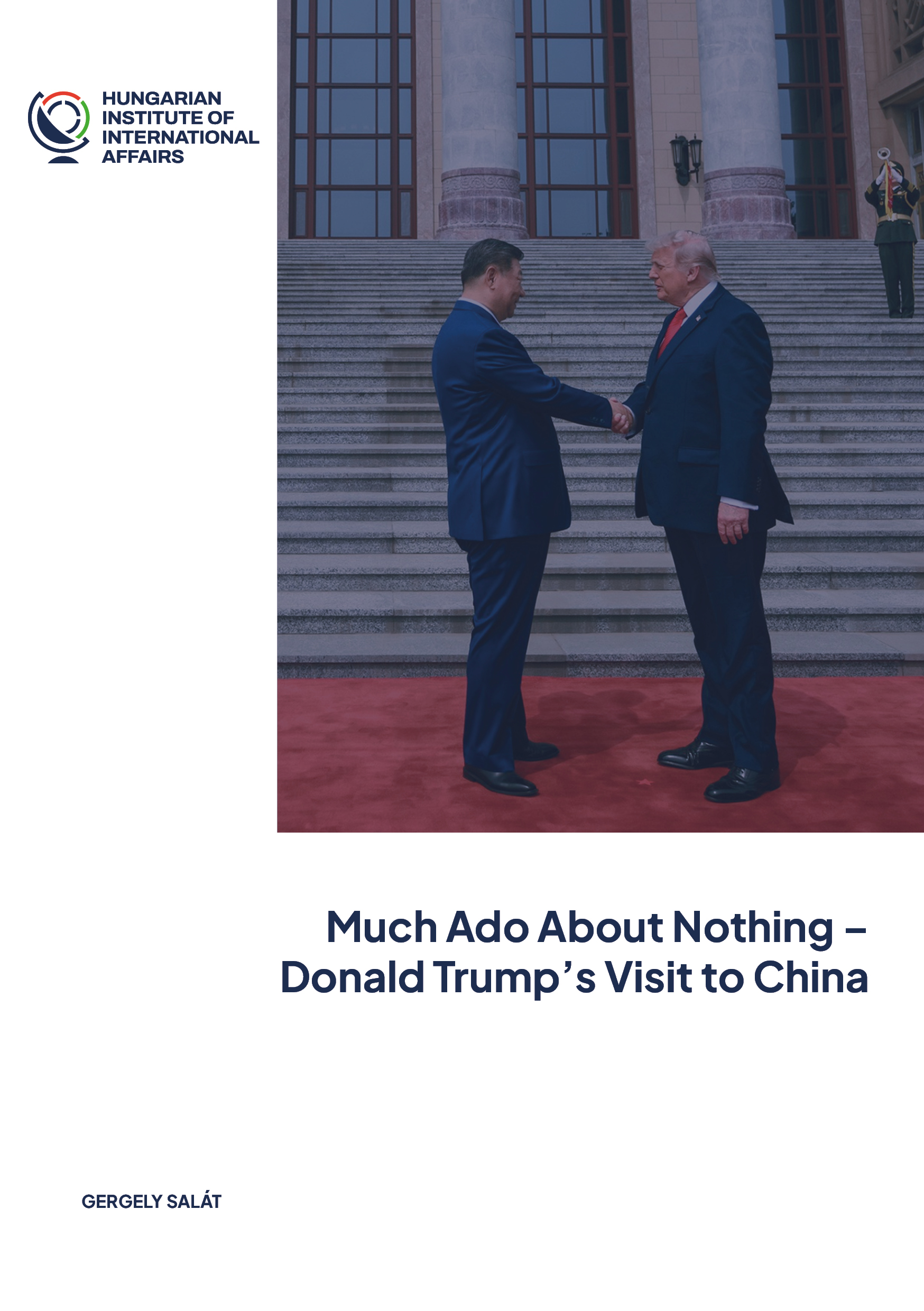
Donald Trump arrived in Beijing on May 13, and the protocol of the three-day visit—reception at Tiananmen Square, talks at the Great Hall of the People, a visit to the Temple of Heaven, a gala dinner, and a concluding round of consultations in the gardens of the Zhongnanhai government compound, which is typically closed to outsiders—offered a diplomatic choreography that, on the one hand, satisfied the U.S. president’s preference for ceremonial grandeur and, on the other, presented Beijing as the capital of a superpower and Xi Jinping, China’s head of state and leader of the Communist Party, as a global leader and equal counterpart to the American president. The ceremony itself carried a clear message: with every gesture, the Chinese communicated respect for their guest while also making it clear that they—far from being limited to protocol alone—set the conditions and parameters of the visit. Trump, who had consistently and sharply criticized China during his election campaigns and taken significant measures against it, adapted to the framework established by the Chinese side to a surprising degree: He behaved in a restrained manner, did not deviate from the prepared script, and—uncharacteristically for him—avoided responding to press questions on several sensitive issues.
The PDF version is available here!
The Context
Trump and Xi had already held a brief meeting in South Korea last year, which produced results only on issues of secondary importance.[1] Prior to the current summit, U.S. Treasury Secretary Scott Bessent and Chinese Vice Premier He Lifeng coordinated positions in South Korea, and during these preparatory talks the parties likely agreed on what they would—and, more importantly, would not—discuss, at least in public.[2]
The evaluation of such summits is complicated by the fact that the most important negotiations between the parties naturally take place behind closed doors, and we can only draw conclusions from post hoc official summaries and public statements by politicians—documents which often create the impression that the parties were present at two very different negotiations.[3] This was also the case this time around: In their statements, the Chinese, as usual, spoke in vague generalities, carefully avoiding any mention of concrete commitments, while the Americans communicated in a much more detailed and specific manner and were more inclined to highlight tangible results—or more precisely, the potential for such results.[4] Both sides used the occasion primarily to communicate with their own public: The messages of the summit were addressed at least as much to their domestic audiences as to the other party.[5]
To properly assess the summit’s substance, it is useful to recall the context in which it took place. In his second term, Trump has so far proven less confrontational toward China than many expected: While the technological and trade pressure inherited from the Biden administration has continued, and the trade war has escalated, this has not been accompanied by the usual rhetorical or ideological escalation. In the context of tariffs—with both sides raising tariffs on each other’s goods to well above 100 percent—a relatively quick truce was reached and has since been extended several times.[6] At the same time, Washington approved a record-breaking arms package for Taiwan last year, and the chip export ban has also remained in place. China responded with its own set of measures. During the 2025 exchange of moves and countermoves, both sides became familiar with each other’s vulnerabilities and their own, and it became clear to both that neither could inflict damage on the other without triggering a similarly painful response. As a result, over time, both parties increasingly focused on reducing their vulnerabilities rather than trying to rapidly force the other to its knees.
The timing of the summit was not particularly favorable for either side: At present, Washington’s attention and energy are largely absorbed by the war in Iran—which is why the summit, originally planned for March, was postponed to May—while Trump’s domestic popularity is at a low point, and the blockade of the Strait of Hormuz is affecting the entire global economy. The situation on the Chinese side is no more stable: The economy is faltering, the export-dependent growth model has generated a series of serious vulnerabilities, and within the party leadership—amid preparations for the 2027 Party Congress—significant internal tensions are becoming increasingly apparent, as also indicated by the ongoing purges within the military, which point to power struggles.[7]
The Goals
The rivalry between the two countries is structural in nature. Competition for global technological, military, and economic leadership arises almost automatically from China’s rise, and it cannot be eliminated through diplomatic gestures—at best, it can be managed. At the summit, both sides appeared to acknowledge this. The only question was what rules and frameworks would govern a competition that neither side wishes to escalate into open conflict.
Trump’s objectives during the visit were in many respects difficult to define. One of the president’s defining characteristics is his transactional mindset: he is primarily interested not in long-term strategic considerations but in immediate deals. None, however, had been prepared in advance, and consequently none were concluded. Chinese expectations were far more straightforward. For Beijing, the key requirement was that the U.S. president treat China as an equal partner: travel to China, negotiate with Xi under dignified circumstances, and refrain from statements—particularly on Taiwan—that could undermine China’s domestic and international position. Trump met this minimum threshold, and although he did not secure any tangible concessions, Beijing emerged from the visit in a strategically advantageous position. The Chinese success is reinforced by the fact that Trump’s visit fits into a broader sequence of events: The heads of state or government of all permanent members of the UN Security Council have traveled to China in recent months, and Putin is set to visit Beijing this week. This in itself illustrates that China is successfully positioning itself as one of the central hubs of global diplomacy, a role that Trump’s visit further strengthened.
The Topics
The most sensitive issue at the summit was Taiwan—though not a formal negotiating topic, it was a sword of Damocles hanging over the discussions. Xi Jinping set the tone at the outset by saying that the Taiwan question is the most important issue in U.S.–China relations and warning that Washington mishandling it could lead to conflict. This is not a new warning, but it carried particular weight in the context of a personal summit—and, on this occasion, Trump acknowledged it without comment and did not deviate. One of China’s likely, albeit unspoken, objectives was to pressure the United States into canceling or at least postponing the $11 billion arms package for Taiwan; when asked by the press, Trump said only that no decision had yet been made and declined to elaborate further.[8] If Washington retreats on this issue in the coming months, it could indicate a behind-the-scenes agreement. For now, however, the publicly stated position remains the one reiterated in Beijing by U.S. Secretary of State Marco Rubio: The United States’ Taiwan policy remains unchanged.[9] Trump, for his part, was unusually disciplined on this issue: He adhered closely to the half-century-old principle of strategic ambiguity—under which Washington does not explicitly commit to defending Taiwan militarily but also does not rule it out entirely—more strictly than his predecessor Joe Biden, who on several occasions caused controversy by stating that the United States would defend Taiwan militarily.
The most pressing geopolitical issue—the war in Iran and the blockade of the Strait of Hormuz—was also on the agenda, although there does not seem to have been any substantive outcome. Trump had hoped that China, which is by far Iran’s largest oil buyer and thus holds significant leverage over Tehran, would be able to exert pressure on the Iranian leadership to reopen the Strait and bring the conflict to an end. According to Trump, the Chinese stated that they oppose Iran’s nuclear armament and would like to see the strait reopened, which the U.S. president portrayed as a diplomatic success. In reality, however, these positions were ones Beijing had already expressed previously and therefore represented no real novelty; nor—as far as is known—did China commit to any concrete steps. Trump’s communication on the issue was somewhat contradictory: At one point, he spoke of China’s role as a mediator, while at another he claimed that no such role was necessary. There may nevertheless be some basis for the idea that China is seeking to steer Tehran toward ending the war, as a resolution of the situation would also be in Beijing’s interest as the world’s largest oil importer.[10]
No progress was made on trade tensions either. The parties did not announce an extension of the ceasefire in place since 2025, no lasting agreement was reached on rare earths—whose export restrictions China used last year to visibly demonstrate it has cards to play[11]—and no new developments emerged regarding the semiconductor export ban. Trump himself stated on the return journey that he and Xi had not discussed tariffs at all.[12] The White House, however, announced the establishment of the Board of Trade and Board of Investment, intended to manage bilateral relations through institutionalized channels without the need to reopen sensitive tariff negotiations.[13] If these bodies are indeed set up, they would not represent a strategic shift but could facilitate the day-to-day management of issues.
On the return journey, Trump spoke of “fantastic deals,” but in concrete terms mentioned only the purchase of 200 Boeing aircraft—less than the 500 initially expected.[14] He also touted large-scale Chinese purchases of agricultural products—soybeans, corn, wheat, and meat—as well as increased Chinese oil and gas imports, but the Chinese side did not confirm these announcements. Experience suggests that the implementation of such trade promises made at summits is uncertain. The list of business leaders accompanying Trump to Beijing was in itself notable—it included Elon Musk (Tesla, SpaceX), Jensen Huang (Nvidia), Tim Cook (Apple), as well as representatives of Boeing, Goldman Sachs, Meta, and Qualcomm—but it remains unclear whether they achieved anything beyond a display of economic strength. Several of them, especially the heads of Nvidia and Qualcomm, are in a particularly difficult position, as they are being pushed away from the Chinese market by their own government, while Chinese authorities are also tightening restrictions against them at the same time.
As usual, the Americans also raised the issue of fentanyl, the precursor chemicals of which, according to Washington’s position, originate from China, and the United States has long been trying to persuade China to restrict the export of these substances.[15] In the Chinese accounts, the issue was not mentioned.[16]
“Constructive Strategic Stability”
The most interesting substantive development of the summit was not any of the announced deals or unresolved conflicts, but rather the conceptual framework put forward by Beijing to define the future of bilateral relations: “constructive strategic stability.” Elaborating on this new vision, Xi said it should be a “positive” stability founded on cooperation, a “sober” stability involving moderate competition, a “constant” stability in which differences of opinion can be managed, and a “durable” stability that carries the promise of peace.[17] The key element is the second one: This is one of the first instances of open acknowledgement by the Chinese side that an element of competition is present in the bilateral relationship—something Beijing had rejected for much of the Biden years. The recognition, however, is carefully calibrated: Competition does not appear as a primary feature but is subordinated to cooperation and contained within the broader framework of stability.
This conceptual innovation is not empty diplomatic wordplay. China’s long-term interest is to buy time to strengthen its technological, military, and geopolitical position, and this requires ensuring that the bilateral relationship does not escalate into an unpredictable conflict. U.S. containment efforts—tariffs, chip embargoes, rare-earth diversification, and so on—slow this process but do not stop it. If China can ensure that both sides compete within the framework of “strategic stability,” it effectively gains time for its internal catch-up process. The international acceptance of this conceptual framework is therefore a vital interest of China.[18] At the talks, the American side clearly lacked a sufficiently experienced China specialist capable of interpreting Chinese conceptual language. As a result, what was a political-strategic framework for Beijing may have sounded to Trump and his team like the usual Chinese rhetorical flourishes, essentially positive and business-friendly. As such, based on current statements, Washington appears to have accepted the use of the Chinese conceptual structure; once differences in interpretation emerge, however, this could still become a source of disputes. In framing the China–U.S. relationship, Trump on this visit again returned to the earlier G2 concept according to which the two superpowers should jointly manage global affairs.[19] For the Chinese, this framework is simultaneously appealing and uncomfortable: On the one hand, it reinforces China’s status as an equal great power; on the other, it is burdensome because it also implies shouldering responsibility. For this reason, Beijing essentially rejects it.
The Results
So what, then, did the summit actually achieve? Trump said that he and Xi had solved many different problems that others would not have been able to solve—but he did not go into specifics.[20] The reality is that none of the major disagreements were resolved. There was no breakthrough, and perhaps not even any real convergence, on Taiwan, tariffs, the chip embargo, rare earths, or Iran. At the same time, there were signs of progress on several—non-strategic—issues. The two sides agreed on the need to continue communication. Trump invited Xi to Washington, an invitation that the Chinese leader accepted, and there is also the possibility of further meetings later this year at the G20 and APEC summits. The establishment of the Trade Council and the Investment Council could institutionalize consultations between the two countries. Through more regular contact, communication may become more predictable, reducing the risk of accidental misunderstandings.
At present, the most important development appears to be that the world’s two strongest powers have agreed on one thing: They will compete, but within certain boundaries and without seeking one another’s destruction. Whether these boundaries can prove durable will be answered in the coming months—above all by the fate of the Iranian ceasefire, the Washington summit planned for September, and the substance the two sides ultimately give to the conceptual framework of “constructive strategic stability” proposed by China.
Endnotes
[1] Salát Gergely, “Csúcsformán kívül: Amerikai–kínai kapcsolatok a Trump–Hszi találkozó után” [Beyond the Summit: U.S.–China Relations After the Trump–Xi Meeting], Hungarian Institute of International Affairs, November 7, 2025, https://hiia.hu/csucsforman-kivul-amerikai-kinai-kapcsolatok-a-trump-hszi-talalkozo-utan/.
[2] Heejin Kim and Brenda Goh, “U.S. Treasury’s Bessent, China’s He Wrap Up S. Korea Talks Ahead of Trump-Xi Summit,” Reuters, May 13, 2026, https://www.reuters.com/world/asia-pacific/us-treasurys-bessent-arrives-south-korea-trade-talks-with-chinas-he-ahead-2026-05-13/.
[3] The American summary of the formal negotiations: “Readout of President Trump’s Meeting With Chinese President Xi Jinping,” U.S. Embassy & Consulates in China, May 15, 2026, https://china.usembassy-china.org.cn/readout-of-president-trumps-meeting-with-chinese-president-xi-jinping/; the Chinese version: “President Xi Jinping Holds Talks with U.S. President Donald J. Trump,” Ministry of Foreign Affairs of the People’s Republic of China, May 14, 2026, https://www.fmprc.gov.cn/eng/xw/zyxw/202605/t20260514_11910330.html.
[4]Shannon Tiezzi, “Trump, Xi Seek ‘New Chapter in China-US Relations,’” The Diplomat, May 15, 2026, https://thediplomat.com/2026/05/trump-xi-seek-new-chapter-in-china-us-relations/.
[5] Fan Chen, “How Did the US and China Tell 2 Different Stories About the Summit?,” South China Morning Post, May 14, 2026, https://www.scmp.com/news/china/diplomacy/article/3353600/how-did-us-and-china-tell-two-different-stories-about-summit.
[6] Angelina Nagy and Gergely Salát, “Amerikai–kínai kereskedelmi háború: az alkalmazkodás módjai” [The U.S.–China Trade War: Ways to Adapt], Hungarian Institute of International Affairs, April 30, 2025, https://hiia.hu/amerikai-kinai-kereskedelmi-haboru-az-alkalmazkodas-modjai/; Gergely Salát, “Amerikai–kínai vámháború: megmentett tűzszünet” [U.S.–China Trade War: A Last-Minute Ceasefire], Hungarian Institute of International Affairs, June 25, 2025, https://hiia.hu/amerikai-kinai-vamhaboru-megmentett-tuzszunet/; Gergely Salát, “Elmaradt katasztrófa: a kínai–amerikai vámháború első tanulságai” [The Disaster That Never Happened: Initial Lessons from the China–U.S. Trade War], Hungarian Institute of International Affairs, August 26, 2025, https://hiia.hu/elmaradt-katasztrofa-a-kinai-amerikai-vamhaboru-elso-tanulsagai/.
[7] Stephen McDonell, “China Has Purged Its Highest-Ranked Military General. Why?,” BBC News, January 27, 2026, https://www.bbc.com/news/articles/c8d0l0g8yz5o.
[8] Simone McCarthy, “Trump’s Beijing Visit Was More Vibes Than Details. And Xi Set the Tone,” CNN, May 16, 2026, https://edition.cnn.com/2026/05/16/china/xi-trump-china-visit-taiwan-analysis-intl-hnk.
[9] Connor Greene, “Xi Warns Trump Over Taiwan During High-Stakes China Summit,” Time, May 14, 2026, https://time.com/article/2026/05/14/xi-warns-trump-over-taiwan-during-high-stakes-china-summit/.
[10] Péter Goreczky and Angelina Zsófia Nagy, “Még több bizonytalanság: Kelet- és Délkelet-Ázsia az iráni háború árnyékában” [More Uncertainty: East and Southeast Asia in the Shadow of the War in Iran], Hungarian Institute of International Affairs, April 16, 2026, https://hiia.hu/meg-tobb-bizonytalansag-azsia-az-irani-haboru-arnyekaban/; “Trump and Xi Discuss the Strait of Hormuz and China’s Role in the Iran War,” Time, May 14, 2026, https://time.com/article/2026/05/14/trump-xi-china-iran-strait-hormuz/.
[11] Gergely Salát, “Kritikus ásványok, kritikus döntések: a ritkaföldfémek Kína geopolitikájában” [Critical Minerals, Critical Decisions: Rare Earth Elements in China’s Geopolitics], Hungarian Institute of International Affairs, June 13, 2025, https://hiia.hu/kritikus-asvanyok-kritikus-dontesek-a-ritkafoldfemek-kina-geopolitikajaban/.
[12] Suranjana Tewari, “Trump and Xi Conclude ‘Very Successful’ Talks But Few Deals Confirmed,” BBC, May 15, 2026, https://www.bbc.com/news/articles/clypj01189lo.
[13] Jonathan Cheng, “China Says It Has Agreed with U.S. to Set Up Trade and Investment Bodies,” The Wall Street Journal, May 15, 2026, https://www.wsj.com/world/china/china-says-it-has-agreed-with-u-s-to-set-up-trade-and-investment-bodies-f4752b03.
[14] Mike Crawley, “Trump Claims ’Fantastic Trade Deals’ With China. What Really Happened?,” CBC News, May 15, 2026, https://www.cbc.ca/news/world/trump-xi-china-summit-analysis-9.7201162.
[15] Gergely Salát, “Új ópiumháború? A fentanil az amerikai–kínai kapcsolatokban” [A New Opium War? Fentanyl in U.S.–China Relations], Hungarian Institute of International Affairs, June 13, 2025, https://hiia.hu/uj-opiumhaboru-a-fentanil-az-amerikai-kinai-kapcsolatokban/.
[16] Sarah Shamim, “Trump-Xi Summit: China, US Disagree on What They Agreed On,” Al Jazeera, May 15, 2026, https://www.aljazeera.com/news/2026/5/15/trump-xi-summit-china-us-disagree-on-what-they-agreed-on.
[17] Chen Qiaoshen, “‘Constructive Strategic Stability’: China, US Eye New Vision for Ties,” CGTN, May 14, 2026, https://news.cgtn.com/news/2026-05-14/-Constructive-strategic-stability-China-US-eye-new-vision-for-ties-1N8BqABl5fy/p.html; “Xinhua Headlines: Chinese, U.S. Presidents Agree on New Vision for Bilateral Ties in Beijing Talks,” Xinhua, May 14, 2026, https://english.news.cn/20260514/23be0339ab314ba08795b96a0cdfbb31/c.html.
[18] Yaqi Li, “While Trump Sought Business Deals, Beijing Came Prepared to Redefine China-US Relations,” The Diplomat, May 16, 2026, https://thediplomat.com/2026/05/while-trump-sought-business-deals-beijing-came-prepared-to-redefine-china-us-relations/.
[19] Dewey Sim and Cao Jiaxuan, “As Trump Wraps Up China Trip, What Will He and Xi Take from Historic Summit?,” South China Morning Post, May 15, 2026, https://www.scmp.com/news/china/diplomacy/article/3353660/well-be-back-latest-takeaways-xi-trump-talks.
[20] Amy Hawkins, “What Was Actually Achieved at Trump and Xi’s ‘Stalemate Summit’ in Beijing?,” The Guardian, May 15, 2026, https://www.theguardian.com/us-news/2026/may/15/what-was-achieved-trump-xi-summit-beijing.