
Lebanon’s Dilemma in the Shadow of the Iran War

HIIA Analysis – Written by Lillian Zsófia Aronson
The latest escalation in Lebanon is unfolding in the shadow of a much larger regional war, but its trajectory will shape stability across the Levant, with ripple effects that could reach Europe and beyond. In response to the assassination of Iranian Supreme Leader Ali Khameini, Hezbollah, a Lebanese proxy of the Iranian regime, renewed its cross-border attacks against Israel in early March after nearly a year of relative calm. Hezbollah’s attacks were met with a decisive Israeli military response, which has plunged Lebanon back into crisis, with more than a thousand dead, almost five thousand injured, more than one million displaced, and severe disruptions to essential services.[1] Even though a ceasefire was reached in the Persian Gulf on Tuesday night, fighting continues on the Lebanese front, and Wednesday was the deadliest day yet with more than 250 deaths.[2] The events unfolding are a symptom of a longstanding problem: For decades, a weak Lebanese state has failed to disarm Hezbollah and monopolize the use of force, which has perpetuated instability. Beirut’s swift move to ban Hezbollah’s military activities on March 2 and pursue accountability are at best too little, too late. The government’s unprecedented decision to pursue direct negotiations with Israel, however, could reshape the strategic logic sustaining the status quo, even though there is little momentum at present. For now, the fighting will continue until Hezbollah’s capabilities are sufficiently weakened, as neither side has strong incentives to settle, but eventually there will be a window of opportunity for decisive action, and Europe may have a role to play.
The PDF version is available here!
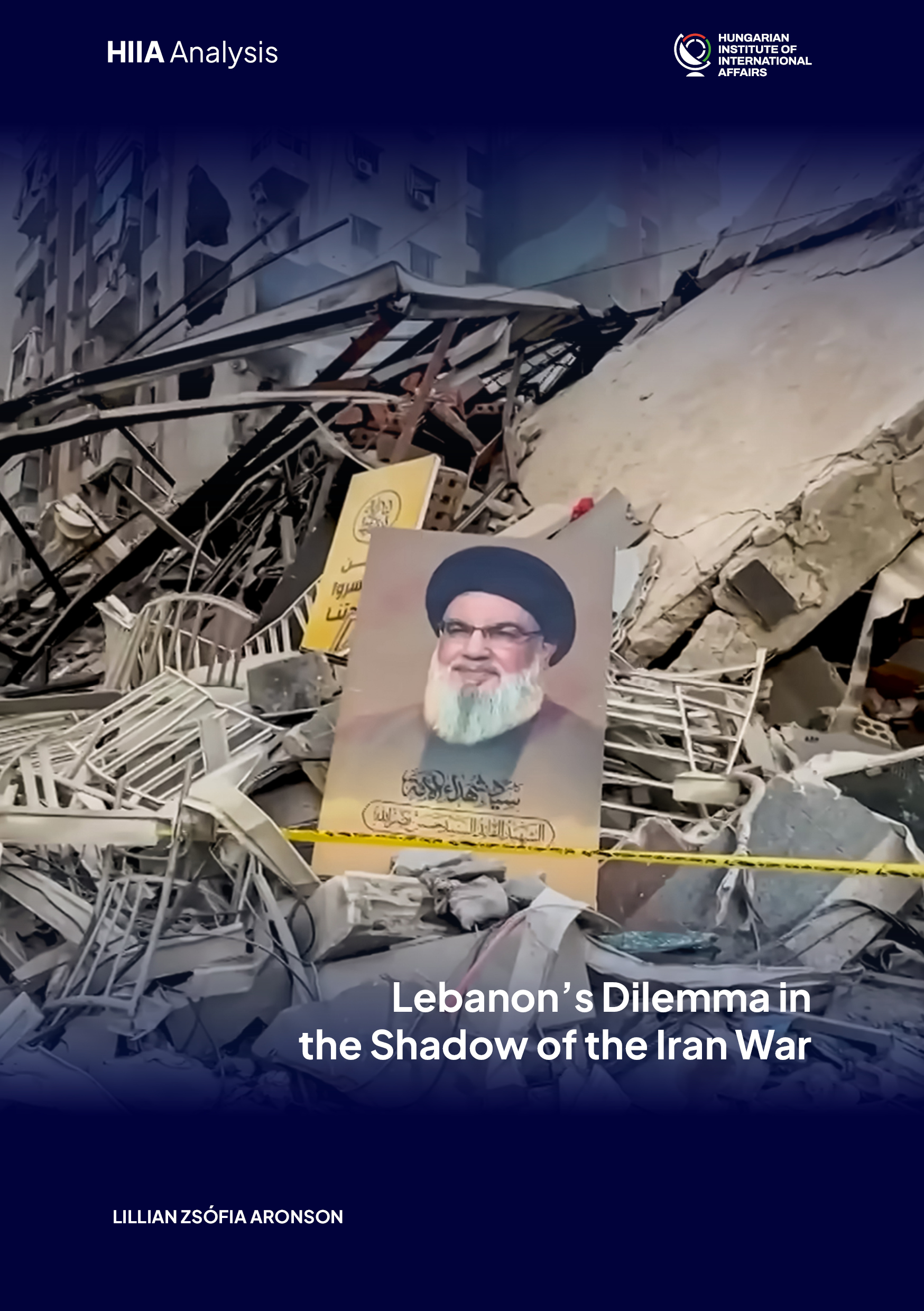
The Making of an Iranian Proxy
For about three decades following its independence from France in 1943, the “Switzerland of the Middle East” was a beacon of stability in a volatile region. Dubbed the “Paris of the Middle East,” its capital, Beirut, functioned as an economic, social, intellectual, and cultural hub in the mid-twentieth century, thanks to earlier modernization efforts and its ability to capitalize on early Cold War dynamics, like capital flight following nationalizations in Egypt and Syria and growing petrodollar wealth in the Gulf.[3] Beneath the surface, though, trouble was brewing.
Lebanon is one of the most diverse countries in the modern Middle East. The country has 18 officially recognized religious sects: 12 Christian groups, four Muslim groups, the Druze (who do not identify as Muslim but developed from a branch of Shia Islam and are sometimes lumped together with Muslim groups), and the Jewish community.[4] Much as in Central Europe, imperial powers had taken advantage of this diversity by playing different groups against one another, with France pursuing a divide-and-rule strategy that favored Lebanese Christians.[5] At independence, the National Pact established a delicate compromise, securing political guarantees for the Christians in exchange for greater socio-political opportunities for others.[6] Most notably, it prescribed a 6:5 ratio of Christians to Muslims in political and administrative life and reserved the presidency for a Maronite Christian, the premiership for a Sunni Muslim, and the speakership of parliament for a Shia Muslim.
This system, which institutionalized sectarianism, was unprepared to face the dramatic upheavals of subsequent decades. While 53 percent of the population of Lebanon was Christian at the time of the last official census conducted in 1932,[7] the demographic balance shifted sharply in favor of the Muslims in the second half of the twentieth century, especially following waves of (primarily Sunni Muslim) Palestinian inflows after the creation of Israel in 1948, the 1967 Arab–Israeli War, and the 1970 “Black September” crisis, after which Palestinian armed groups expelled by Jordan moved to Lebanon and began functioning as “states within a state.” Mounting socio-economic and political grievances within Lebanese society and the pressure created by these new arrivals culminated in a civil war that lasted from 1975 to 1990 and killed more than 120,000, wounded around 300,000, and displaced nearly one million.[8]
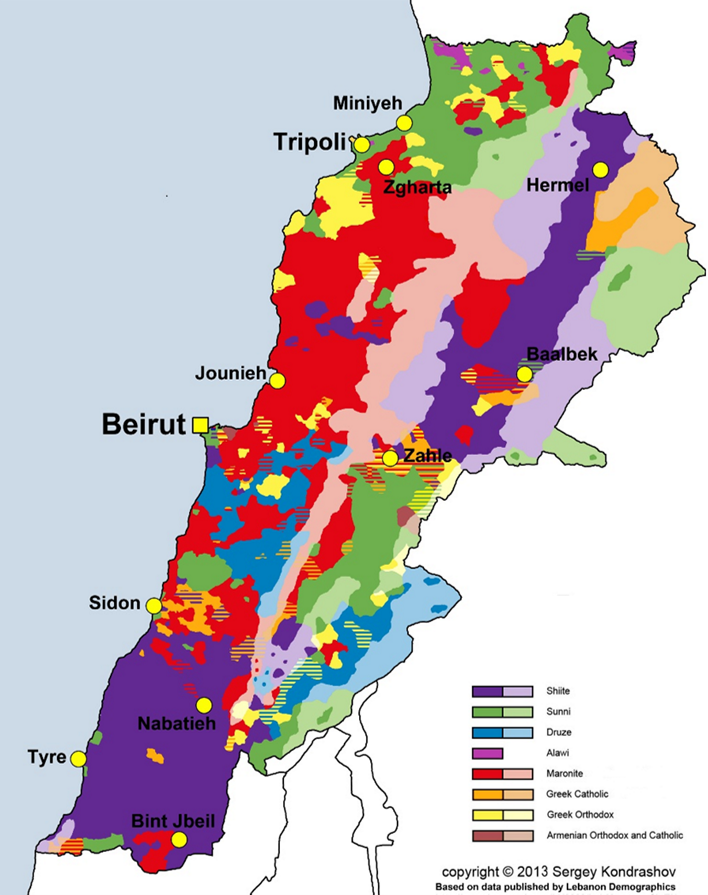
Figure 1. Geographic distribution of Lebanon’s primary religious communities. Visualization by Sergey Kondrashov using data from Lebanon Demographics in 2013. Note: The precise religious composition of Lebanon remains highly uncertain given that the last official nationwide census was conducted in 1932, but approximations such as this are nevertheless useful for understanding the dynamics continuing to unfold today.
It was in this chaos that Hezbollah (the “Party of God”) was created in 1982 by Shia clerics in southern Lebanon and the Iranian Revolutionary Guard Corps (IRGC), which sought to export the revolution that had established a Shia theocracy in Iran just three years prior.[9] Although the group also targeted Western interests and clashed with rival Shia militias, its primary focus was the Israeli incursion into southern Lebanon in response to cross-border attacks by Palestinian guerrillas using the region as their base. Hezbollah was the only militia that the National Assembly did not order the dissolution of in 1991 following the end of the civil war precisely so that it could continue to “resist” this ongoing Israeli presence.[10] Years later, Lebanese Prime Minister Rafik Hariri noted that cracking down on a group seen as heroic by so many would have been “political suicide.”[11] (Hariri was later killed in a car bombing for which the UN-backed Special Tribunal for Lebanon has since convicted three Hezbollah members.[12]) Beginning with its 1992 entry into parliament, the group soon evolved from a purely militant group into a disciplined parliamentary bloc and provider of key services in Shia-dominated areas.[13]
Successive Failures to Disarm Hezbollah
Israel withdrew from southern Lebanon in 2000, but Hezbollah managed to hold on to its military wing and continue to grow in strength, arguing that “resistance” was still necessary.[14] In 2006, the group provoked an unnecessary war with Israel that further reinforced its raison d’être,[15] and its brief armed conflict with government forces in 2008 allowed it to secure the Doha Agreement,[16] which essentially recognized its armed status.[17] Two notable crises then pushed the Lebanese state to the brink. The Syrian civil war that erupted in 2011 triggered an influx of more than 1.5 million Syrians—equivalent to roughly a quarter of Lebanon’s population—placing acute pressure on an already weak state.[18] This helped precipitate the complete financial and economic meltdown that came to a head in late 2019, triggered by decades of corruption, clientelism and unsustainable debt, resulting in a complete banking-sector freeze, triple-digit inflation, a currency collapse exceeding 98 percent, GDP contraction of roughly 40 percent, and poverty rates surpassing 80 percent.[19] Hezbollah was able to thrive in this chaotic and unstable environment, building a parallel cash-based shadow economy as Iranian funding and supplies continued to flow steadily.[20]
By October 2023, the group had become one of the world’s most heavily armed non-state actors, with tens of thousands of members and a large and diverse stock of rockets and missiles.[21] As a result, when Hamas, a Palestinian member of Iran’s network of proxies,[22] launched a large-scale attack on southern Israel on October 7, Hezbollah fired on northern Israel in solidarity, which led to a year of border clashes and eventually another Israeli ground invasion of southern Lebanon in the fall of 2024. Despite the government not playing a role in the war, the toll on Lebanon was severe: more than 4,000 deaths, the displacement of over 1.2 million people, and economic losses estimated at $8.5 billion[23]—equivalent to roughly one-quarter of the country’s total GDP in 2023.[24] The fighting finally ended with a fragile ceasefire that took effect on November 27, 2024.[25] Under its terms, both Israeli forces and Hezbollah were to withdraw from the part of Lebanon south of the Litani River while the Lebanese Armed Forces, supported by the United Nations Interim Force in Lebanon (UNIFIL), assumed responsibility for the area. It was at best a temporary solution, though, as it left Hezbollah armed.
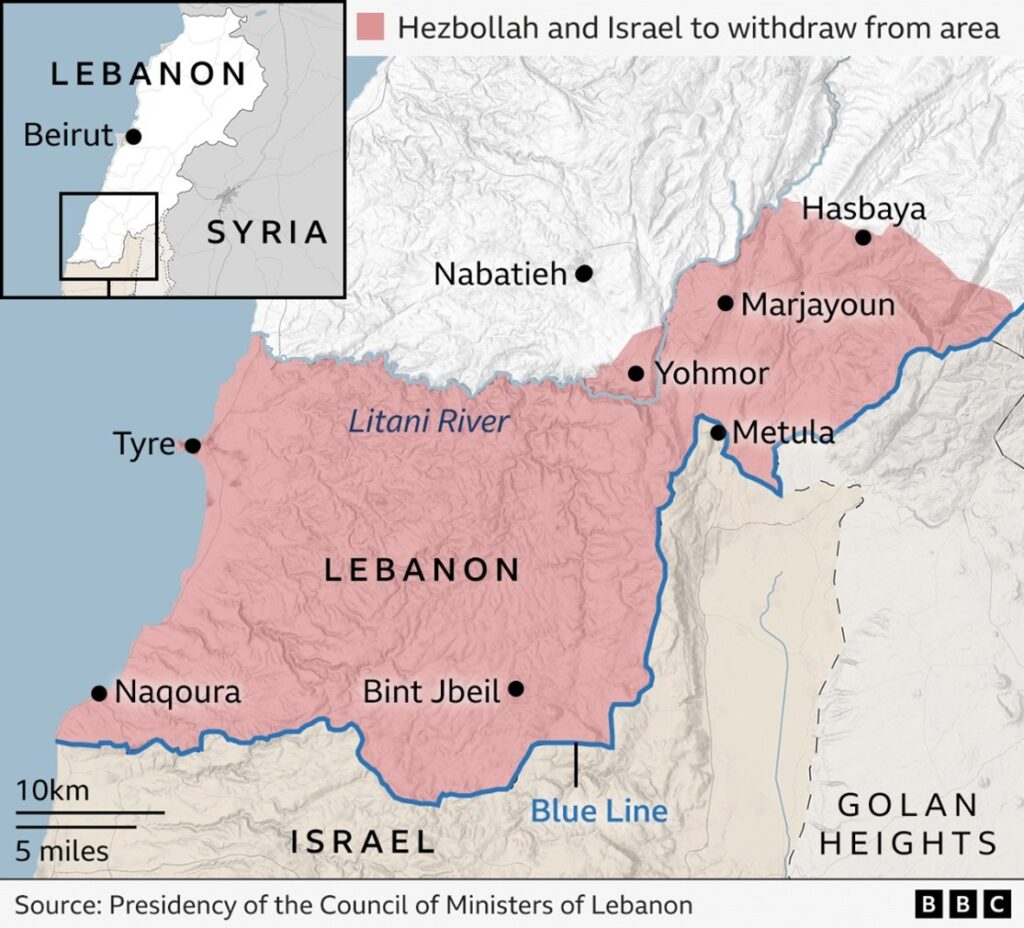
Figure 2. The zone from which both Israel and Hezbollah agreed to withdraw under the terms of the November 2024 ceasefire agreement. Visualization by the British Broadcasting Corporation based on information provided by the Presidency of the Council of Ministers of Lebanon.
Even after the ceasefire went into effect, Israeli forces continued to maintain a presence in Lebanon and conduct daily military operations to prevent Hezbollah from rebuilding.[26] Hezbollah did have a substantial amount of rebuilding to do, as the 2023–2024 conflict inflicted significant losses on its weapons stockpiles and leadership structure. It largely managed to adapt, though, for example by shifting its emphasis toward more local manufacturing of weapons, which became increasingly important with the fall of the Assad regime in Syria, which cut Hezbollah off from key Iranian supply lines.[27] Tehran also dispatched more IRGC advisors to Lebanon to assist in restructuring the movement, which led to a more complex command structure and more direct coordination with Iran on operations.[28]
There was reason for hope in 2025. In January, Lebanon’s parliament elected former army commander General Joseph Aoun as president, ending a two-year presidential vacuum in a rare cross-sectarian consensus that momentarily echoed the pragmatic bargaining of the post-Taif era.[29] In February, the designation of reformist former International Court of Justice president Nawaf Salam as prime minister and the formation of a new government followed.[30] Over the course of the year, the country’s real GDP grew by an estimated 3.5 percent, inflation moderated, and the banking sector showed tentative signs of stabilization, unlocking modest international reconstruction pledges.[31] Simultaneously, the fall of the Assad regime in December 2024 brought relative calm to the country’s eastern border and triggered large-scale Syrian refugee returns—more than 383,000 documented from Lebanon alone by late 2025[32]—easing pressure on public services and labor markets. Against this backdrop, it seemed that the disarmament of Hezbollah might finally be possible, which as much as 79 percent of Lebanese support.[33]
But the government was overly cautious, waiting seven months to task the Lebanese Army with confiscating Hezbollah’s arms south of the Litani River. The group did eventually hand over thousands of rockets and missiles, and the Lebanese Army declared that the first phase of disarmament was complete in January of this year, but a month later, an underground tunnel storing missiles and drones was discovered, raising doubts.[34] Hezbollah also maintains that the ceasefire signed in 2024 applies only to the south. Its persistent refusal to fully disarm derives from a strategic calculus that fuses ideological conviction, organizational survival, and regional alignment, yet the extent to which this strategy serves the very community Hezbollah claims to represent is increasingly questionable.
How Hezbollah Dragged Lebanon into Yet Another War
The joint attack by the United States and Israel on Iran on February 28 constituted a significant shock to the regional status quo. Hezbollah, still relatively weak, initially signaled restraint but warned of its involvement in the event that the United States and Israel crossed certain red lines, such as targeting Iranian Supreme Leader Ayatollah Ali Khamenei.[35] Following the confirmation of his death, Hezbollah renewed its attacks on Israel on March 2, launching missiles and drones for first time in well over a year. In response, Israel launched military operations including precision airstrikes, drone strikes, and even limited ground incursions in Shia-dominated areas in southern Lebanon, eastern Lebanon’s Bekaa Valley, and the Dahiyeh southern suburb of Beirut, citing not only the recent attacks but also the armed group’s explicit ongoing refusal to implement key provisions of the November 2024 ceasefire.[36]
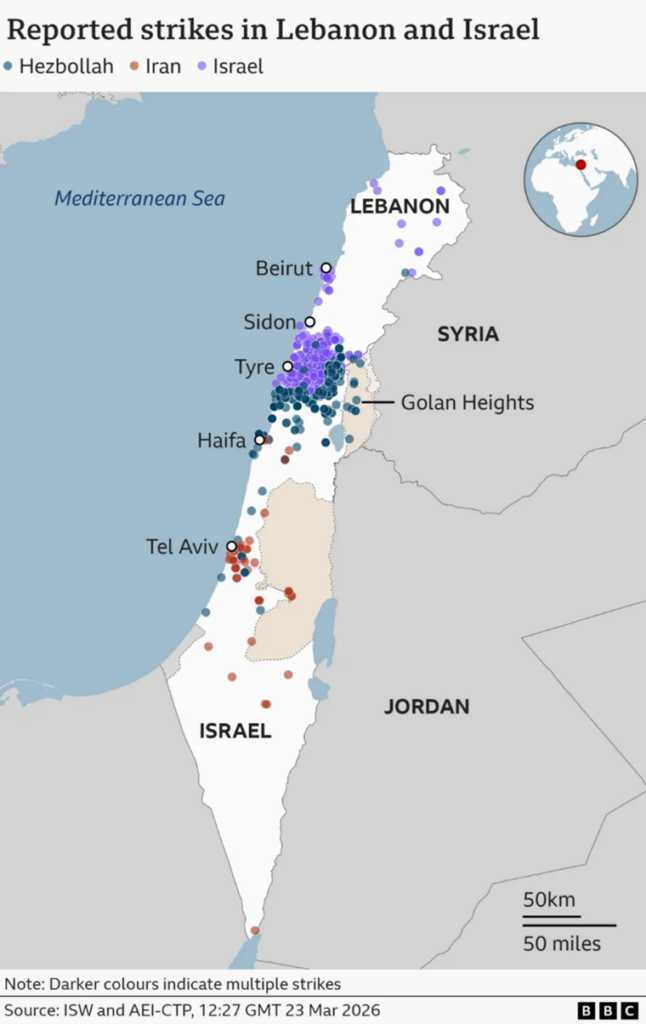
Figure 3. Reported strikes in Lebanon and Israel as of March 23, 2026. Visualization by the British Broadcasting Corporation using data from the Institute for the Study of War and the American Enterprise Institute’s Critical Threats Project.
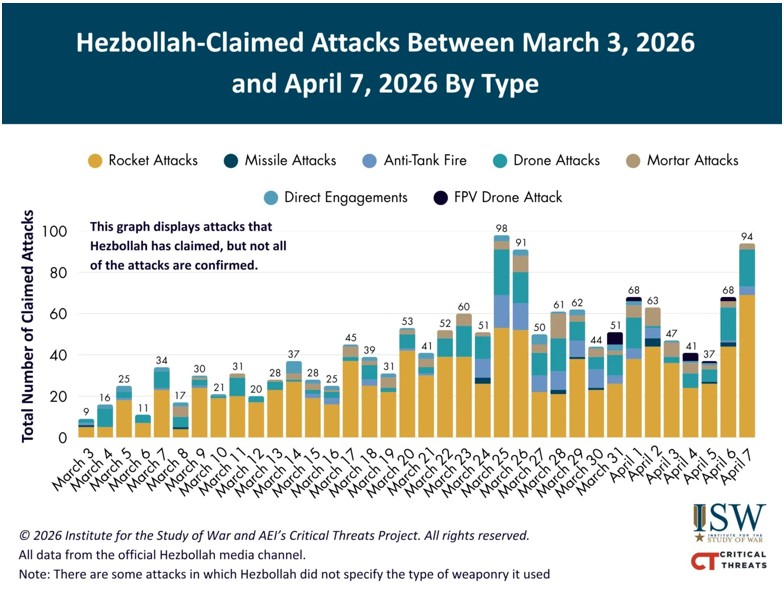
Figure 4. Hezbollah-claimed attacks between March 2, 2026, and April 7, 2026, by type. Visualization created by the Institute for the Study of War and the American Enterprise Institute’s Critical Threats Project using data from the official Hezbollah media channel.
The Lebanese government, faced with Hezbollah dragging the country into yet another war, reacted by formally banning the group’s military activities—interestingly, even Hezbollah’s Shia ally in parliament voted in favor, although the party insists that there is no rift.[37] Prime Minister Nawaf Salam, meanwhile, urged the national security forces to prevent further cross-border attacks originating on Lebanese soil and begin implementing disarmament north of the Litani River “using all means necessary.”[38] Prosecutor General Jamal Hajjar was asked to ensure accountability for those who launched rockets or ordered attacks, which led to twelve arrests by March 3,[39] and Army Commander Rodolph Haykal was given authorization to use force as necessary to ensure disarmament sooner rather than later.[40] Nevertheless, the state’s weakness and lack of adequate resources continue to present obstacles. There is also the risk of sparking widespread internal violence if government forces clash with Hezbollah fighters. The state’s room for maneuver thus remains limited.
The failure to effectively curb Hezbollah’s activities resulted in a further escalation in mid-March. On March 17, the group announced the start of its “Khaybar 1” operation, a reference to the seventh-century battle of Khaybar during which Muslim forces led by the Prophet Mohammed conquered an Arabian Jewish oasis.[41] Israel responded to this move by expanding its ground offensive and air attacks, with some fearing that the “prolonged operation” mentioned by the Israeli military chief in recent days could turn into a large-scale ground invasion in the coming days and weeks.[42] So far, the strategy seems to be to cut off Hezbollah forces in the south from supply lines in the north of the country, as Israeli attacks have hit the majority of the bridges crossing the Litani River,[43] and Israeli Defense Minister Israel Katz has instructed forces to destroy all crossings being used by Hezbollah.[44]
Prospects for Peace
The question now is how long the current escalation will last. Diplomatic efforts are already underway, with France spearheading a peace initiative centered on a Hezbollah ceasefire in exchange for an end to Israeli ground operations, coupled with expanded support for the Lebanese state—potentially tied to recognition of Israel.[45] It seems highly unlikely, however, that such initiatives will gain traction in the short term. For Hezbollah, continued fighting reinforces its credibility as a vanguard of the “Axis of Resistance” and defender of Lebanon against Israel; it has little room to de-escalate without signaling weakness and allowing the state to strengthen, even as the conflict further degrades its already diminished capabilities. Israel, though locked in a multi-front war that could hit the economy hard,[46] appears closer than ever to its goals and faces significant domestic pressure ahead of the October 2026 elections to deliver on the government’s promises of “total victory.”[47] The most likely scenario, therefore, seems to be a continuation until Hezbollah is sufficiently weakened to create space for an off-ramp.
The trajectory of the war in Iran will also play a role in shaping how the conflict plays out. If the Iranian regime would have collapsed, Hezbollah would have lost critical funding—the group received an estimated one billion dollars in Iranian funds last year[48]—along with Iranian-supplied weaponry, training, and strategic guidance. At the moment, with a two-weak ceasefire in place and talks about to commence in Islamabad,[49] the collapse of the Islamic Republic appears highly unlikely, but even a negotiated settlement could increase pressure on Hezbollah by allowing Israel to focus more of its resources on southern Lebanon—just as the ceasefire has increased the violence.[50] Israeli Prime Minister Benjamin Netanyahu has already signaled that the war with Lebanon will continue even if the Iran front is closed.[51]
In any case, once the dust settles, ending the cycle of violence will require the step Beirut has long avoided: asserting the state’s monopoly on the use of force. Yet the scale of the challenge is non-negligible. U.S. sources seem to believe the group could have had as many as 40,000 fighters and 15,000–20,000 rockets and missiles prior to the current escalation despite sustained Israeli operations.[52] Military intervention by outside forces only reinforces Hezbollah’s raison d’être, and a direct confrontation risks triggering a devastating civil conflict and alienating a large segment of the Shia population. Once Hezbollah is significantly weakened for a ceasefire to be achieved, the best chance for sustainable peace involves strengthening the Lebanese Army and employing a negotiated, phased, internationally supervised demobilization, coupled with credible security guarantees and economic incentives for the withdrawal of both Israeli and Hezbollah forces from southern Lebanon, as well as strong mechanisms for monitoring and adjudicating violations.[53] This, however, will require substantial international commitments, which may be hard to come by for a while, given competing demands and the widescale economic impacts of the war with Iran.[54]
The relationship between Israel and Lebanon remains at the heart of the issue. If the relationship improved, Hezbollah’s justification for maintaining its armed wing may be weakened, and there might also be greater incentive for Western actors to support the Lebanese government. On March 19, Prime Minister Nawaf Salam made an urgent appeal to U.S. President Donald Trump, asking him to intervene and calling for direct talks with Israel.[55] Such talks would not be entirely unprecedented. In December of last year, Lebanese and Israeli officials held their first direct talks in decades as part of the implementation process of the November 2024 ceasefire, which Israeli Prime Minister Benjamin Netanyahu’s office called “an initial attempt to create a basis for a relationship and economic cooperation,” although the Lebanese prime minister stressed that they were “far from” diplomatic normalization or economic cooperation.[56] Indirect talks are already under way through the United States and France, with the deliberate exclusion of Hezbollah’s participation.[57] For now, Salam does not seem to have ruled it the possibility of recognizing Israel, although this would carry significant political costs if attempted.[58]
One of the major challenges before any direct talks could begin is determining the composition of the negotiating team, as Hezbollah and its allies are legitimate members of the government representing a key segment of the population, and their exclusion could allow them to reject any agreement as illegitimate, although their inclusion risks derailing negotiations altogether. While there is already a proposed delegation including two Christians, a Sunni Muslim, and a Druze, Parliament Speaker Nabih Berri currently maintains that the Shia alliance will not nominate a representative—at least until there is a “genuine guarantee” that Israeli attacks on Lebanon will stop.[59] The Hezbollah–Amal alliance’s opposition is not the only challenge, though; Israel has not yet responded to the Lebanese government’s offer and seems to have little interest in doing so for now, especially since the Americans have limited bandwidth to engage.[60]
Where Do We Go from Here?
For now, it seems the best that Beirut can do is protect civilians to the extent possible while maintaining a delicate balancing act, trying to limit the militant activities of Hezbollah and build towards a long-term resolution to the issue without triggering a devastating internal conflict. Hezbollah has indeed threatened civil war if negotiations with Israel begin while the conflict is ongoing, raising the stakes of any government action.[61] While the French have increased their support for Lebanon, tripling humanitarian aid[62] and even sending armored vehicles,[63] far more external support is needed, as well as will on both sides, in order to end the hostilities. The fighting will likely continue until Hezbollah’s capabilities are sufficiently weakened, but eventually there may be a window of opportunity for decisive action.
In the meantime, maintaining domestic political stability remains critical. Lebanon was supposed to hold parliamentary elections in May, but on March 9, lawmakers voted 76 to 41, with four abstentions, to postpone these elections and extend their mandate by two years.[64] According to one analyst, Hezbollah MPs “took their seats, participated in the vote, and left without speeches or statements.”[65] It is undeniable that the widespread displacement, severe damage to infrastructure, and ongoing attacks in some parts of the country make any kind of credible electoral process impossible. But the postponement of elections has become an issue all too familiar in Lebanese politics. Perhaps most notably, the parliament elected in 1972 remained in office throughout the fifteen-year civil war, and the one elected in 2009 delayed elections for almost a decade until 2018.[66] The issue of postponement has become as much of a political issue as a logistical one. The question remains whether the current political system will be able to break out of the recurring cycles of crises and become a stable, well-functioning system capable of serving its citizens.
The conflict’s implications extend well beyond Lebanon. Neighboring Syria is at a vulnerable point in its post-Assad transition, and while the war could have the positive effect of curbing Iranian influence, any spillover of instability threatens disaster. Regionally, the war is already disrupting energy markets and infrastructure, driving up maritime costs and stalling projects across the Eastern Mediterranean[67]—precisely at a moment when Europe had looked to Eastern Mediterranean supplies as a hedge against volatility. For the United States, the degradation of Hezbollah’s capabilities advances a core U.S. objective—strengthening Israel’s security—and could enable Washington to reallocate attention toward other priorities in the Western Hemisphere and the Indo-Pacific. Yet risks of fragmentation and prolonged instability remain high. The trajectory of the broader regional war and Lebanese negotiations with Israel will be decisive in determining whether Lebanon can move toward a more promising future or remain trapped in a cycle of crisis, with implications that will extend well beyond the country’s borders.
Endnotes
[1] “Israeli Attacks Have Killed 1,497 People since March 2,” L’Orient Today, April 6, 2026, https://today.lorientlejour.com/article/1502403/israeli-attacks-have-killed-1497-people-since-march-2.html; Thameen Al-Kheetan, “Situation in Lebanon,” United Nations Office of the High Commissioner for Human Rights, March 17, 2026, https://www.ohchr.org/en/press-briefing-notes/2026/03/situation-lebanon.
[2] “Israeli Strikes Pummel Lebanon, Killing 250 in Deadliest Day of War,” The Daily Star, April 9, 2026, https://www.thedailystar.net/news/world/us-israel-war-iran/news/israeli-strikes-pummel-lebanon-killing-250-deadliest-day-war-4147316.
[3] Fawwaz Traboulsi, A History of Modern Lebanon (Pluto Press, 2012).
[4] U.S. Department of State, “2023 Report on International Religious Freedom: Lebanon,” accessed March 17, 2026, https://www.state.gov/reports/2023-report-on-international-religious-freedom/lebanon/.
[5] Meir Zamir, The Formation of Modern Lebanon (Croom Helm, 1985).
[6] Traboulsi, A History of Modern Lebanon.
[7] Wissam Raji et al., “The Lebanese Demographic Reality” in Yearbook of International Religious Demography 2018, eds. Brian Grim et al. (Brill, 2018), 123–131.
[8] Fawaz A. Gerges, “Lebanon,” in The Cold War and the Middle East, ed. Yezid Sayigh and Avi Shlaim (Clarendon Press, 1997), 77–101; Khalil Gebara, “Lebanon Remembers a War That Never Truly Ended,” Arab News, April 13, 2026, https://www.arabnews.com/node/2596902.
[9] “What Is Hezbollah?,” Council on Foreign Relations, accessed March 21, 2026, https://www.cfr.org/backgrounders/what-hezbollah.
[10] Yara Sarkis, “A Look Back at Disarmament in Lebanon: When Militias Yielded to the State,” L’Orient Today, May 27, 2025, https://today.lorientlejour.com/article/1461951/a-look-back-at-disarmament-in-lebanon-when-militias-yielded-to-the-state.html.
[11] John Daniszewski and Marjorie Miller, “4 Children Die in Lebanon as Israel Targets Ambulance,” Los Angeles Times, April 14, 1996, https://www.latimes.com/archives/la-xpm-1996-04-14-mn-58542-story.html.
[12] “Rafik Hariri Killing: Hezbollah Duo Convicted of 2005 Bombing on Appeal,” British Broadcasting Corporation, March 10, 2022, https://www.bbc.com/news/world-middle-east-60691507.
[13] Council on Foreign Relations, “What Is Hezbollah?”
[14] “Old Games, New Rules: Conflict on the Israel-Lebanon Border,” International Crisis Group, November 18, 2002, https://www.crisisgroup.org/sites/default/files/07-old-games-new-rules-conflict-on-the-israel-lebanon-border.pdf.
[15] Hanin Ghaddar et al., “Hezbollah Turns 40: Implications of the Group’s Internal, Regional, and Strategic Shifts,” Washington Institute for Near East Policy, December 2, 2022, https://www.washingtoninstitute.org/policy-analysis/hezbollah-turns-40-implications-groups-internal-regional-and-strategic-shifts.
[16] Alistair Harris, “The Cedar Dissolution: Lebanon’s Civil Strife,” Royal United Services Institute, May 15, 2008, https://www.rusi.org/explore-our-research/publications/commentary/cedar-dissolution-lebanons-civil-strife.
[17] Yahya Mahmassani, “Letter dated 22 May 2008 from the Permanent Observer of the League of Arab States to the United Nations addressed to the President of the Security Council,” United Nations Security Council, June 10, 2008, https://www.securitycouncilreport.org/atf/cf/%7B65BFCF9B-6D27-4E9C-8CD3-CF6E4FF96FF9%7D/Lebanon%20S2008392.pdf.
[18] “Vulnerability Assessment of Syrian Refugees in Lebanon 2024,” World Bank, November 20, 2025, https://microdata.worldbank.org/index.php/catalog/8101; Cathrine Brun et al., “The Economic Impact of the Syrian Refugee Crisis in Lebanon,” World Refugee and Migration Council, September 2021, https://wrmcouncil.org/wp-content/uploads/2021/09/Lebanon-Syrian-Refugees-WRMC.pdf.
[19] “Lebanon: Poverty and Equity Assessment 2024,” World Bank, 2024, https://documents1.worldbank.org/curated/en/099052224104516741/pdf/P1766511325da10a71ab6b1ae97816dd20c.pdf.
[20] Hanin Ghaddar, “Hezbollah Has Created Parallel Financial and Welfare Systems to Manage the Current Crisis,” Washington Institute for Near East Policy, December 9, 2020, https://www.washingtoninstitute.org/policy-analysis/hezbollah-has-created-parallel-financial-and-welfare-systems-manage-current-crisis.
[21] Council on Foreign Relations, “What Is Hezbollah?”
[22] Noah Rudin et al., “The Axis of Resistance,” Middle East Institute, December 3, 2025, https://mei.edu/backgrounder/axis-of-resistance/.
[23] “Lebanon Interim Damage and Loss Assessment (DaLA),” World Bank, November 2024, https://documents1.worldbank.org/curated/en/099111224112085259/pdf/P5063801c62fbe0c21beff1d0a436d07e02.pdf.
[24] “GDP (Current US$) – Lebanon,” World Bank, accessed March 20, 2026, https://data.worldbank.org/indicator/NY.GDP.MKTP.CD?locations=LB.
[25] “Full Text: The Israel-Hezbollah Ceasefire Deal,” Times of Israel, November 27, 2024, https://www.timesofisrael.com/full-text-the-israel-hezbollah-ceasefire-deal/.
[26] “Special Report: One Year Since the Ceasefire in Lebanon – The Israeli Thwarting Effort Against Hezbollah’s Reconstruction Effort,” Alma Research and Education Center, November 27, 2025, https://israel-alma.org/special-report-one-year-since-the-ceasefire-in-lebanon-the-israeli-thwarting-effort-against-hezbollahs-reconstruction-effort/.
[27] Yaakov Lappin and Tal Beeri, “Hezbollah – Independent Weapons Production, a Hybrid Doctrine in Light of a Strategic Need,” Alma Research and Education Center, November 2, 2025, https://israel-alma.org/hezbollah-independent-weapons-production-a-hybrid-doctrine-in-light-of-a-strategic-need/.
[28] Souhayb Jawhar, “War with Israel Forces Lebanon to Confront Hezbollah’s Arms,” Middle East Council on Global Affairs, March 13, 2026, https://mecouncil.org/blog_posts/war-with-israel-forces-lebanon-to-confront-hezbollahs-arms/.
[29] Will Todman, “Lebanon Finally Elects a President,” Center for Strategic and International Studies, January 10, 2025, https://www.csis.org/analysis/lebanon-finally-elects-president.
[30] Daniel Bellamy, “Newly Appointed Prime Minister Nawaf Salam Forms Government in Lebanon,” Euronews, February 8, 2025, https://www.euronews.com/2025/02/08/newly-appointed-prime-minister-nawaf-salam-forms-government-in-lebanon.
[31] “Lebanon: Economic Rebound Marks Cautious Recovery amidst Progress on Reforms,” World Bank, January 22, 2026, https://www.worldbank.org/en/news/press-release/2026/01/22/lebanon-economic-rebound-marks-cautious-recovery-amidst-progress-on-reforms.
[32] “Lebanon – Syrian Returns & Movements Snapshot 31 October 2025,” Office of the United Nations High Commissioner for Refugees, November 11, 2025, https://data.unhcr.org/en/documents/details/119553.
[33] “Most Lebanese Say Only Army Should Have Weapons,” Gallup, December 4, 2025, https://news.gallup.com/poll/699071/lebanese-say-army-weapons.aspx.
[34] David Schenker, “Lebanon’s Failure to Disarm Hezbollah Comes with a Price,” Washington Institute for Near East Policy, March 14, 2026, https://www.washingtoninstitute.org/policy-analysis/lebanons-failure-disarm-hezbollah-comes-price.
[35] “Hezbollah Official Says Will Not Intervene in Event of ‘Limited’ US Strikes on Iran,” Asharq Al Awsat, February 28, 2026, https://english.aawsat.com/arab-world/5244749-hezbollah-official-says-will-not-intervene-event-limited-us-strikes-iran.
[36] Emanuel Fabian, “Army Targets Hezbollah Command Centers, Weapons Sites in Strikes on Beirut Suburbs,” Times of Israel, March 11, 2026, https://www.timesofisrael.com/idf-targets-hezbollah-command-centers-weapons-sites-in-strikes-on-beirut-suburbs/.
[37] Ali Rizk, “Why Hezbollah’s ‘Irrational’ Gambit against Israel Makes Sense,” Quincy Institute for Responsible Statecraft, March 11, 2026, https://responsiblestatecraft.org/hezbollah-lebanon-israel/.
[38] Yara Abi Akl, “Government Announces ‘Total Ban on Any Military Activity’ by Hezbollah,” L’Orient Today, March 2, 2026, https://today.lorientlejour.com/article/1496916/government-announces-total-ban-on-any-military-activity-by-hezbollah.html.
[39] Naim Berjawi and Abdulsalam Fayez, “Lebanese Army Detains 12 Hezbollah Members after Rocket Fire on Israel,” Anadolu Agency, March 3, 2026, https://www.aa.com.tr/en/middle-east/lebanese-army-detains-12-hezbollah-members-after-rocket-fire-on-israel/3848780.
[40] Abi Akl, “Government Announces ‘Total Ban on Any Military Activity.’”
[41] “Hezbollah Announces Launch of ‘Khaybar 1’ Operations,” L’Orient Today, March 17, 2026, https://today.lorientlejour.com/article/1499667/hezbollah-announces-launch-of-khaybar-1-operations.html.
[42] Hugo Bachega, “Israel to Expand Ground and Air Attacks against Hezbollah in Lebanon,” British Broadcasting Corporation, March 23, 2026, https://www.bbc.com/news/articles/c30rl05evd8o.
[43] Wassim Seifeddine, “Israel Destroys Vital Bridges in Southern Lebanon in Preparation for ‘Ground Invasion,’” Andolu Agency, March 23, 2026, https://www.aa.com.tr/en/middle-east/israel-destroys-vital-bridges-in-southern-lebanon-in-preparation-for-ground-invasion-/3876075.
[44] Bachega, “Israel to Expand Ground and Air Attacks.”
[45] “هل يقبل حزب الله وإسرائيل بمبادرة ماكرون؟” [Will Hezbollah and Israel Accept Macron’s Initiative?], Al Jazeera, March 8, 2026, https://aja.ws/ap73rs; Barak Ravid, “Scoop: French Plan to End Lebanon War Includes Recognition of Israel,” Axios, March 14, 2026, https://www.axios.com/2026/03/14/israel-lebanon-war-peace-hezbollah-france.
[46] Sharon Wrobel, “War Set to Cost $3 Billion a Week If Current Limits on Economy Persist, Ministry Warns,” Times of Israel, March 4, 2026, https://www.timesofisrael.com/war-set-to-cost-3-billion-a-week-if-current-limits-on-economy-persist-ministry-warns/.
[47] Stav Levaton, “Poll: Most Jewish Israelis Support Iran War, Toppling Regime; Arab Backing Far Lower,” Times of Israel, March 4, 2026, https://www.timesofisrael.com/poll-most-jewish-israelis-support-iran-war-toppling-regime-arab-backing-far-lower/.
[48] Jonathan Spicer, “US Sanctions Official Says Time is Right to Cut Iran’s Hezbollah Funding,” Reuters, November 9, 2025, https://www.reuters.com/world/middle-east/us-sanctions-official-says-time-is-right-cut-irans-hezbollah-funding-2025-11-09/.
[49] “Iran Says Talks with US Will Begin in Pakistan’s Islamabad on Friday,” Al Jazeera, April 8, 2026, https://www.aljazeera.com/news/2026/4/8/iran-says-talks-with-us-will-begin-in-pakistans-islamabad-on-friday.
[50] The Daily Star, “Israeli Strikes Pummel Lebanon, Killing 250 in Deadliest Day of War.”
[51] Tarek Chouiref, “Israel’s Netanyahu Says Any Deal between US, Iran Would Not End Lebanon War: Report,” Andolu Agency, March 31, 2026, https://www.aa.com.tr/en/middle-east/israel-s-netanyahu-says-any-deal-between-us-iran-would-not-end-lebanon-war-report/3885923.
[52] “Hezbollah Has 40,000 Operatives, 15,000 Projectiles, Says US Envoy,” Jewish News Syndicate, November 1, 2025, https://www.jns.org/israel-news/hezbollah-has-40000-operatives-15000-projectiles-says-us-envoy.
[53] Andrea Tenenti, “The Israel-Hezbollah Ceasefire was Built to Fail,” Al Jazeera, March 11, 2026, https://www.aljazeera.com/opinions/2026/3/11/the-israel-hezbollah-ceasefire-was-built-to-fail.
[54] Neil Shearing, “How Will the Iran War Affect the Global Economy?,” Chatham House, March 11, 2026, https://www.chathamhouse.org/2026/03/how-will-iran-war-affect-global-economy.
[55] Nick Paton Walsh et al., “Under Israeli Bombardment, Lebanon Urges Trump to Intervene, Calls for ‘Immediate’ Talks with Israel,” CNN, March 19, 2026, https://edition.cnn.com/2026/03/19/middleeast/lebanese-prime-minister-exclusive-interview-latam-intl.
[56] Lazar Berman, “Officials from Israel and Lebanon Hold First Direct Talks in Decades in Naqoura,” Times of Israel, December 3, 2025, https://www.timesofisrael.com/officials-from-israel-and-lebanon-hold-first-direct-talks-in-decades-in-naqoura/.
[57] Guy Azriel, “Israel and Lebanon are Expected to Hold Talks in the Coming Days, Officials Say,” i24NEWS, March 15, 2026, https://www.i24news.tv/en/news/middle-east/levant-turkey/artc-israel-and-lebanon-are-expected-to-hold-talks-in-the-coming-days-officials-say.
[58] Walsh et al., “Under Israeli Bombardment.”
[59] Lara El Hachem, “Dispute over Ceasefire and Shiite Representation Complicates Proposed Lebanon-Israel Negotiations: The Details,” Lebanese Broadcasting Corporation International, March 17, 2026, https://www.lbcgroup.tv/news/news-bulletin-reports/915479/dispute-over-ceasefire-and-shiite-representation-complicates-proposed/en.
[60] Reuters, “Israel Declines Lebanon’s Offer for Direct Talks, Sources Say,” Jerusalem Post, March 13, 2026, https://www.jpost.com/middle-east/article-889871.
[61] “Aoun to Hezbollah: ‘Better a Thousand External Enemies than One Internally,’” L’Orient Today, April 5, 2026, https://today.lorientlejour.com/article/1502276/aoun-to-hezbollah-better-a-thousand-external-enemies-than-one-internally.html.
[62] “France Triples Emergency Aid to Lebanon As More than 700,000 Displaced,” Radio France International, March 11, 2026, https://www.rfi.fr/en/international/20260311-france-triples-emergency-aid-as-lebanon-displacement-grows.
[63] Jérôme Bonnafont, “War Is Once Again Spreading to Lebanon,” Permanent Mission of France to the United Nations in New York, March 11, 2026, https://onu.delegfrance.org/war-is-once-again-spreading-to-lebanon.
[64] Issam Kayssi, “An Extension Under Fire,” Malcolm H. Kerr Carnegie Middle East Center, March 13, 2026, https://carnegieendowment.org/middle-east/diwan/2026/03/lebanons-parliament-extends-its-term-under-fire.
[65] Kayssi, “An Extension Under Fire.”
[66] Kayssi, “An Extension Under Fire.”
[67] Salma El Wardany, “Egypt Reshuffles LNG Imports, Seeks More as Israel Cuts Gas,” Bloomberg, February 28, 2026, https://www.bloomberg.com/news/articles/2026-02-28/egypt-seeks-earlier-lng-imports-as-israel-cuts-gas-amid-iran-war.