
Is the EU Selling Serbia an Illusory Dream?

HIIA Analysis – Written by Filip Ilankovic
Serbia’s long and increasingly uncertain path toward EU membership reflects how enlargement has lost its strategic significance, turning into a bureaucratic utopia detached from geopolitical realities and justified mainly through hypocrisy and double standards. Despite still formally negotiating, Serbia’s accession process has come to a standstill, constrained by enlargement fatigue, shifting priorities after the start of the war in Ukraine, and unresolved political conditionality—most notably the Kosovo issue. At the same time, the political fast-tracking of the accession of Ukraine and Moldova has undermined the credibility of the EU’s merit-based accession framework. In addition, the prolonged nature of the process and domestic media campaigns have eroded public support for EU membership within Serbia and created space for Russia and China to expand their influence. Without renewed political will and tangible incentives from the EU, the promise of membership remains an illusion sustained by rhetoric rather than real prospects.
The PDF version is available here!

Enlargement Fatigue Meets Strategic Blindness
Often described as Europe’s most successful foreign policy,[1] the enlargement process seems to be failing at its core purpose and has quietly lost momentum, at least in the Western Balkans. A quarter of a century ago, joining the European family was regarded as a great opportunity and privilege for the developing countries in Eastern and Southeastern Europe. For some, it has devolved into a bureaucratic waiting game, which makes the whole process less desirable. The Western Balkan countries have been officially waiting for this opportunity since the Thessaloniki summit in 2003, where all countries expressed strong willingness to become member states of the European Union.[2] Apart from Croatia, all the participants have been waiting in line ever since. For some, the process even seems to be moving backward, and European Union membership looks like a moving target instead of a stable foreign policy goal.
The European Union’s first strategic mistake was bringing “enlargement fatigue” into the framework of the negotiations. The 2004 enlargement of the European Union brought a whole new set of challenges to the organization and made it clear that the EU was in need of internal reforms. However, this became an excuse that proved detrimental for the integration of the Western Balkan region, with the exception of Croatia.
Croatia was a country with relative internal political stability, modest economic growth, and an excellent geostrategic position on the Adriatic Sea. A devoted EU candidate state and a committed NATO member state since 2009, it managed to escape the abyss of Western Balkan integration and eventually joined the European Union in 2013. It is worth noting that Hungary made Croatia’s EU accession a priority during its 2011 EU Council Presidency. Croatia’s accession to the EU, however, marked the beginning of enlargement fatigue in Brussels. Jean-Claude Juncker, President of the European Commission at the time, publicly announced in 2015 that “no further enlargement will take place over the next five years” and stated that the EU and its citizens needed to take a break from enlargement so that the EU can consolidate what has been achieved and digest the addition of thirteen new member states in just ten years.[3] Together with the explicit enlargement fatigue, the EU implicitly placed geopolitics and political support above the long-advocated merit-based approach to enlargement.
Not only did the imposed deadlock from the president of the European Commission stall the enlargement process, but the global crises and geopolitical pressures that marked the previous decade significantly hindered the Western Balkans’ accession to the EU. Just after Juncker’s deadline for enlargement expired and the new von der Leyen Commission stepped in, the EU policy priorities drastically changed due to COVID-19, the Russian invasion of Ukraine and the subsequent energy crisis, the decline of European competitiveness, Trump’s second term, and inflation. Simply said, global and regional crises stole the spotlight from the Western Balkan countries.
The other crucial factor disrupting the enlargement process is “strategic blindness,” which points to the fact that the EU is neglecting the strategic importance of the Western Balkans region.[4] It seems that enlargement policy became shortsighted with the failure to understand how an integrated Western Balkan region would contribute to stability. This region is prone to ethnic tensions and possible instability, which have historically generated spillover effects affecting European security, making sustained EU engagement essential near its borders. Integrating all the countries into the EU’s system and providing citizens with tangible benefits would lower the risk of escalations. The region also lies along key migration and transit routes linking the Middle East, Asia, and Africa with the EU, making cooperation a must for managing migration flows, countering human trafficking, and strengthening border control. Although there is existing cooperation on tackling migration issues, further integration is necessary for more efficient and effective policy implementation. In addition, the Western Balkans represents a crucial corridor for transport, energy, and digital infrastructure, which further benefits the EU’s efforts to improve connectivity, diversify energy routes, and reduce reliance on single suppliers.
For more than a decade, Brussels has treated the Western Balkans as a technical question rather than a geopolitical one. The process has become dominated by procedural language, often referring to the chapters, clusters, reports, joint meetings, and all other time-consuming processes that offer little or no tangible results. At the same time, Brussels has ignored the fact that its procrastination in this process undermines the legitimacy and goals of enlargement policy. Instead of politically recognizing the strategic importance of the region and, by doing so, legitimizing the integration process, the EU has been prioritizing the geopolitical importance of Ukraine and Moldova since the Russian Federation invaded Ukraine in February 2022, illustrating the double standards of Brussels.
Although the narrative of “enlargement momentum” is present in everyday discourse, Western Balkan countries—with the recent exceptions of Montenegro and Albania—recognize that they are excluded from this dynamic. A few EU member states, such as Hungary, consistently point to the significance of enlargement toward the Balkan peninsula but with limited success. From time to time, EU officials highlight the importance of the region rhetorically, but these statements are undermined by the pessimistic reality of stagnation. If this trend continues, it will have noticeable consequences for enlargement policy, and it will keep Western Balkan countries in the “eternal” waiting room.
Serbia’s Integration Journey: A Long Road to Nowhere?
To understand the root cause of the prolonged process of enlargement, one must observe Serbian domestic developments in the past several decades. The fall of Slobodan Milošević’s regime marked the beginning of the twenty-first century in Serbia, together with the emergence of new political power—the Democratic Opposition of Serbia (DOS). It was an electoral alliance formed to defeat Milošević but lacked consensus and a joint understanding of the EU integration pathway. The alliance’s main leaders were Vojislav Koštunica, the last president of the Federal Republic of Yugoslavia, and Zoran Djindjić, the first prime minister of Serbia after the fall of the Milošević regime. Koštunica was a president with nationalist tendencies who had throughout his political career strongly opposed the demands of the International Criminal Tribunal for the former Yugoslavia (ICTY) regarding the extradition of Serbian citizens, Kosovo’s independence question, and Republika Srpska losing the status it gained with the Dayton peace agreement. His nationalist attitude is important as these red lines have affected the enlargement process up to the present day. Certain analysts have suggested, however, that at the EU–Western Balkans summit in Zagreb in November 2000,[5] Koštunica realized early on that future EU membership would require concessions on these matters.[6] Zoran Djindjić, on the other hand, believed that making certain concessions was a necessity for the Federal Republic of Yugoslavia not to be internationally isolated and, therefore, supported the extradition of Slobodan Milošević to the ICTY in 2001.[7] This marked the beginning of the end for the DOS and presented obstacles for effective internal and external policy implementation.
Regardless of internal divisions and crises, Serbia’s foreign policy objectives were made clear at the Thessaloniki summit. The summit took place three months after Prime Minister Djindjić was assassinated in Belgrade, indicating that EU integration was not the ambition of one man, but the strategic goal of the entire country. The integration process continued in the following years as Serbia started to adapt to EU laws and norms while at the same time transforming its economy from a state-owned socialist regime to a capitalist market economy.[8] This transition period between 2000 and 2008 could be described as unofficial integration, where the EU integration served as a “moral compass” rather than a technical process. Nevertheless, there were also periods of stagnation for multiple reasons, most notably a lack of cooperation with the ICTY.[9] Not surprisingly, this happened in 2006, when Koštunica served as the prime minister of Serbia and Montenegro proclaimed its independence from the country. Negotiations between Serbia and the EU were restarted after 2007, which resulted in the signing of the Stabilization and Association Agreement between the EU and Serbia in April 2008. Consequently, Serbia officially applied for EU candidacy in 2009 and was granted candidate country status in 2012 by the European Council. The period after 2008 was challenging for Serbian decision-makers, as Kosovo unilaterally proclaimed independence in February 2008, which was endorsed by the United States and the majority of EU member states. Despite this, becoming an EU member remained the strategic goal.[10]
The issue of Kosovo was, and still is, the biggest obstacle to full membership status for Serbia. Although Kosovo is de facto independent and recognized by most Western countries, it is still regarded as a Serbian province by the majority of Serbia’s political elite and population. Strong nationalist sentiment shapes virtually all decisions of the Serbian leadership, most notably its approach to EU integration, as most EU member states recognize Kosovo. To Serbia and its people, Kosovo is not a region significant for strategic purposes but rather a symbol of Serbian history and heritage. Taking that symbol away would mean the suicide of a nation and the beginning of the end of the state. The key to understanding the essence of the EU–Serbia disagreement is understanding historical processes like these, which contributed to the victimization narrative in Serbia and, consequently, growing antagonism toward the European Union.
Historically, Serbia made significant progress toward EU integration only after offering some concessions. It was not a coincidence that the European Commission recommended opening EU membership talks with Serbia in April 2013, just several days after the notorious Brussels agreement was signed between Serbian and Kosovo government representatives, with the EU as mediator.[11] It was the first ever written agreement between two parties, signed under pressure and conditionality deriving from the EU.[12] Since the Brussels agreement was regarded as de facto recognition of Kosovo’s statehood by the nationalist parties, interest groups, and even the Serbian Orthodox Church, several thousand people protested in the streets of Belgrade following its signing.[13] The signature of the Serbian prime minister at the time offered Pristina’s claim to statehood legitimacy, and the content of the agreement only confirmed it. Nevertheless, signing the agreement was a political signal from the new government in Belgrade[14] that the European path is the strategic goal of Serbia and that it is ready to make concessions. Despite EU enlargement fatigue, the period between the signing of the Brussels agreement and the Russian full-scale invasion of Ukraine could be regarded as the “golden period” in Serbia’s integration path, at least in terms of the numbers.[15] During this period, Serbia opened 22 of 35 negotiation chapters and provisionally closed two.
The EU integration of Serbia was a slow process, but at least there was limited progress in technical terms. The last visible progress was the opening of Cluster 4, “Green agenda and sustainable connectivity,” in December 2021. Four years have passed since then, and it is obvious that the door to integration is temporarily closed for Serbia. The European Commission gave the green light to open the remaining chapters from Cluster 3, Competitiveness and Inclusive Growth, but some EU member states are blocking the process in the Council of the EU. Countries like the Baltic states, Sweden, Finland, Germany, the Netherlands, and Belgium are blocking Serbia because of non-alignment with the EU’s Common Foreign and Security Policy (CFSP) on sanctioning Russia, no results in the Belgrade–Pristina dialogue, and overall rule of law concerns.[16] Other countries, like Croatia and Bulgaria, are using their vote as blackmail to solve bilateral disputes. For example, Bulgaria has consistently blocked Serbia’s progress due to the gradually improving bilateral relationship between Serbia and North Macedonia, which is against Bulgarian interests.[17] As an act of protest against the political blockade, Serbia did not send officials to the EU–Western Balkans summit in Brussels in December 2025—the first time it had ever not done so.[18] Several reasons lead to the halt of the integration process, the most important being the war in Ukraine, Serbia’s multi-vector foreign policy, and Brussels’ overall dissatisfaction with Serbia’s internal reforms. The sentiment among many Serbians is that Ukraine jumped the queue for EU membership while some Western Balkan countries like Serbia were forgotten in the merit-based waiting line.[19]
Eroding Faith on Both Sides
The drawn-out nature of the process and the many obstacles that have emerged since the very beginning of the integration story have led to deteriorating public opinion polls. In 2003, support for joining the European Union was around 72 percent,[20] but by 2025, only 33 percent would vote for accession.[21] Looking deeper, only 38 percent of Serbians have an overall positive image of the European Union, and this data is devastating when compared with the positive image of Russia (59 percent) and China (57 percent). Although the EU is the biggest donor and investor in Serbia, only 29 percent of citizens are aware of that. Hostile rhetoric toward “the West” is to blame, originating from the highest officials and government-friendly media outlets.[22] However, the most concerning fact is that 45 percent of citizens think that Serbia will never become an EU member. The most crucial reasons for this are territorial issues with Kosovo, the broader perception that there is a lack of EU interest in Serbia, and an inability to meet the standards of the EU. Many living in Serbia view the state’s declared strategic goal as an empty narrative, which calls the country’s entire strategic direction into question.
Moreover, the attitudes of EU citizens do not sound much better.[23] Only 47 percent of the EU citizens view Serbia’s potential accession favorably. The main reasons for this are fears regarding uncontrolled migration, corruption, and organized crime, as well as the cost for European taxpayers. However, it is worth mentioning that 67 percent of respondents felt uninformed about enlargement, which makes it difficult to have a constructive opinion. On the contrary, 71 percent of citizens in Serbia think that they are well informed about the enlargement process.
Unfortunately, public opinion on both sides reinforces the stagnation in the integration process. Nevertheless, public opinion could be influenced by positive informational campaigns from both sides. Serbian media could do more to provide a more positive image about the benefits of joining the club, instead of using harsh language and making political accusations.[24] EU member states, for their part, could explain to their citizens that the benefits outweigh the perceived difficulties that integration might bring. Some studies suggest that if Serbia becomes a full-fledged EU member state tomorrow, the financial cost per EU capita would be just €2.37 annually. If the entire WB region would access the EU, the cost would be €5.29 annually.[25] For the price of one coffee in some EU capital city, a strategically important region could become part of the EU club. Seen in this light, the financial costs are negligible. Preventing the spread of disinformation and increasing the dissemination of positive information should be a priority for both sides if there is political will for enlargement.
Belgrade’s Best Friend in Brussels
Over time, many positive messages about enlargement toward the Western Balkans became clichéd. Voices of encouragement from Brussels, Berlin, or Paris sound nice but have done very little to advance the overall integration process. Nevertheless, some EU members take a more proactive approach and actively express their willingness to contribute to the enlargement of the European Union. One member state that stands out for its wide-ranging contribution to the Western Balkans region is Hungary. The Hungarian government has been the most vocal supporter of these countries joining the European Union, and it not only sends frequent political messages but also uses its position within the EU to make real change. For example, during the Hungarian presidency of the Council in the first half of 2024, Hungary managed to push for the opening of the first cluster with Albania. Another success of the Hungarian presidency was the introduction of the Single Euro Payments Area (SEPA) system in Albania and Montenegro, which was necessary due to the significant volume of remittances these countries receive from their diasporas. [26] Bulgaria and Romania joined the Schengen area in the same period. These successes confirmed that the Balkan region is a key priority for the Hungarian government.
Within the region, Serbia is a top priority for Hungary. The presence of a Hungarian ethnic minority plays an important role in Hungarian support for Serbia’s integration. Over 180,000 ethnic Hungarians live in the Serbian northern province of Vojvodina, a region deeply connected with Hungarian culture and history.[27] If Serbia joins the EU, these people would be among the first to reap the benefits of enlargement. Further integration into the Schengen area would mean that they would be free to travel between the two states without having to wait several hours at the border crossing as they do now.[28] There would be numerous benefits, including the elimination of roaming charges, improved employment and business opportunities, and better access to education and emergency healthcare. Furthermore, the economy would likely grow at a faster pace due to the efficiency that the four freedoms of the EU provide and the expansion into new markets. Politically, the EU would be stronger with more member states involved in international voting mechanisms (like in the United Nations General Assembly, where each country has one vote) and gain leverage internationally via Serbia’s existing bilateral relations with countries like Russia, China, the Gulf states, and certain African states. Security-wise, enlargement would strengthen EU borders, improve control over migration flows, and enhance the EU’s ability to preserve peace and stability in a historically unstable region. Hungary has already embraced several initiatives to tackle these issues and enhanced regional cooperation with Serbia, alongside Austria and Slovakia.[29] This benefits not only regional and bilateral cooperation but also contributes to Serbia’s overall integration process. Not many countries realize the scope of the benefits of EU enlargement, but luckily for the Western Balkan countries, Budapest does.
Beyond its strong political backing of Serbia within the EU, Hungary also supports Serbia more broadly. In January 2025, the U.S. Treasury Department announced that it would impose sanctions on the Serbian oil company Naftna Industrija Srbije (NIS). However, sanctions were postponed eight times in Serbia’s favor with the assistance of a Hungarian lobby in Washington.[30] Hungary provides technical support as well, including sending its own EU experts to the Serbian Ministry for European Integration with the goal of maximizing assistance in the EU integration process.[31] Budapest also supports the region militarily.[32] Its most notable presence is within KFOR units in Kosovo and Operation Althea-EUFOR units in Bosnia and Herzegovina. The presence of military forces sends a strong message that emphasizes a commitment to peace and stability in the region.
Political Trajectory or Merit-Based Approach?
For years, stories about joining the EU based on clearly defined conditionality and merits have echoed in people’s heads. These were exceptionally loud during von der Leyen’s mandate in Brussels. Nevertheless, there is an impression that the EU’s officials are not always honest—even toward their own citizens.[33] The claim that a candidate country will be successful in its accession path by complying with the Copenhagen criteria has begun to ring hollow. Although the narrative of a merit-based approach is frequently reiterated by EU officials from Brussels and ambassadors in candidate countries, reality shows that political trajectories play a much more important role. This reality has become increasingly clear since the Russian invasion of Ukraine in February 2022.
One clear indicator of politics being placed above a merit-based approach would be Ukraine and Moldova skipping the queue in the accession “waiting room.” Moldova held an election in September 2025 and confirmed its trajectory with pro-EU parties declaring victory. These elections, however, were won with substantive support coming from Brussels, resembling the strategy of the heavily criticized opposing Russian side.[34] The EU showed willingness to interfere to “assist” Moldova in maintaining its political trajectory toward EU membership.
Another, more significant example is Ukraine. Based on geopolitical circumstances and the unfortunate war, Ukraine has been given the status of “defender of Europe”[35] and granted the right to fast-tracked membership.[36] Ursula von der Leyen has openly pushed the idea of Ukraine joining the EU by the end of 2030 or even sooner.[37] Claiming that a war-torn country ranked 105/180 in the Corruption Perception Index[38] could become an EU member state in the next couple of years could undermine the integrity of the EU. Dangerous pro-Ukraine propaganda originating from Brussels has been challenged by some EU member states, most vocally by Hungary. Budapest is looking at the bigger picture, as it is directly exposed to all of the risks arising from Ukraine’s future membership in the EU, including dangers to the Common Agricultural Policy, concerns over crime and corruption, and challenges related to uncontrolled migration. Fast-tracked membership based on political trajectory rather than merit could jeopardize the EU’s existence, which is why other member states hide behind Hungary’s decision to exercise veto power when it comes to Ukraine’s accession.[39] Candidate countries, meanwhile, do not have the legal means to object to Ukraine’s accession. Instead, these countries are turning away from their European dreams into the hands of other players actively working to expand their influence in the region.
If the EU Loses Serbia, Others Will Win
The biggest danger to EU integration comes not from within the EU or Serbia, but from the competing interests of other parties in the region. The most notable players are the Russian Federation and China. Both have an agenda to work against the EU’s interests. Even though China and Russia are pushing for a stronger presence in Serbia, there is no conflict of interest between them. Russia mainly focuses on gas and oil infrastructure, as well as energy security issues as leverage for political influence.[40] China, on the other hand, has a major stake in infrastructure and construction, as well as the mining industry.[41]
Russia has been present in Serbia for centuries. Strong cultural and historical ties make cooperation highly likely to continue in the twenty-first century. However, this cooperation goes against the interests of Brussels in contemporary geopolitical circumstances, making it very difficult for Serbian decision-makers to balance between the two poles. Hostile relations between most EU leaders and the Kremlin since 2022 has contributed to the halting of Serbian integration, due to Serbia’s attempt to maintain its multi-vector foreign policy. As Serbia is a small country, it is prone to the external influence of a greater power. As the EU became inactive in the region, a power vacuum created an opportunity for other actors to enforce decisions more quickly. The Kremlin saw an opportunity to fortify its strategic position in Serbia and intensified its bilateral relations with political dialogue. In addition, amid student-led protests from November 2024, Russia has increased its media presence, often targeting Brussels by accusing EU officials of planning, and organizing a “colored revolution,” or a new “Maidan revolution” in Serbia.[42] With this move, Russia expressed support for the Serbian government and, in return, secured a stable political presence in Belgrade. Kremlin is strongly benefiting from fueling the negative perception of the EU among citizens in Serbia.
China has different priorities. Serbia is not a core priority for Chinese interests, but it has been a relatively easily accessible market for smart investments. Ever since the Serbian Progressive Party took power in 2012, Belgrade’s primary economic goals have been to attract foreign investors and build new infrastructural connections. China had the capacity to do both, faster and bureaucratically easier than its European counterparts. Some projects, like the Budapest-Belgrade fast railway or the construction of modern highways in central Serbia, were parts of the Belt and Road initiative, going hand in hand with both countries’ interests. Economically speaking, China is the second largest trading partner and has surpassed Germany as the biggest single importing country for Serbia in 2024 (See Chart 1). Exports from Serbia to China tripled in just two years from $369 million in 2020 to $1186.1 million in 2022.[43] Also, Serbia signed a free trade agreement with China in October 2023,[44] which has benefited the growth of Serbian exports by 53.7 percent.[45]
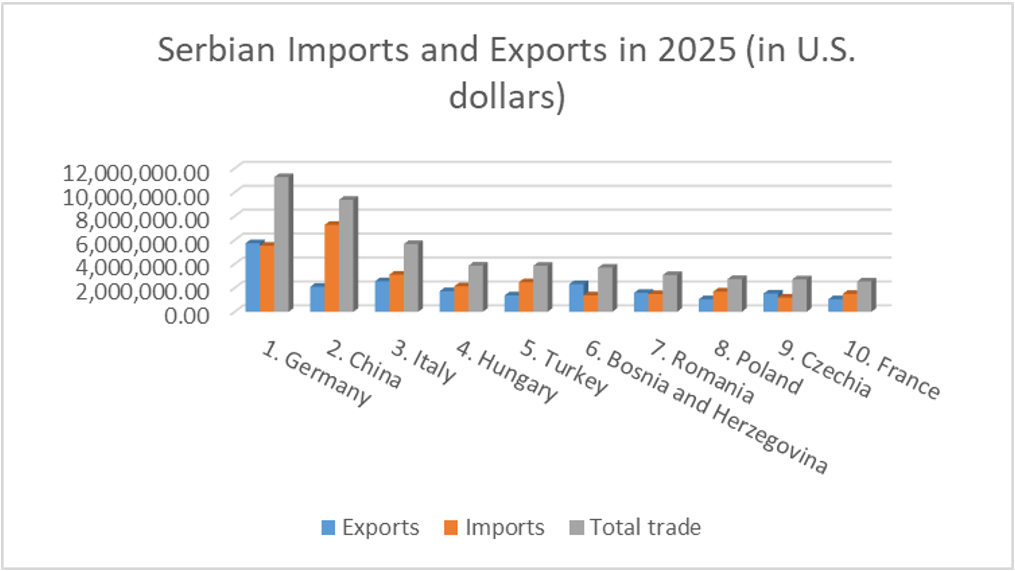
Figure 1. Serbian Exports and Imports in 2025 (in U.S. Dollars).[46]
During the COVID pandemic, Chinese vaccines were the first to arrive in Serbia.[47] While the rest of Europe was still struggling to find a solution to end the pandemic, China sent clear signals that it is a reliable partner and friend by sending one million COVID vaccines. Just for comparison, the American company Pfizer sent 19,500 vaccines, and Russia sent 250,000 Sputnik V vaccines in the same month, several days later. The UK sent 150,000 AstraZeneca doses one month later, which is substantial, but nothing in comparison with its Chinese and Russian counterparts. What the EU did regarding pandemic assistance was a donation of 26 vehicles for the transport of vaccines, nine months after all other actors sent almost 1.5 million vaccines.[48] Interestingly, the Chinese supply of vaccines portrayed favorably in the Serbian domestic media, framing it as an example of the “steel” friendship between China and Serbia, while the EU donations went “under the radar.”[49] Since the COVID crisis, Serbian public opinion regarding China has improved, coupled with political and economic cooperation at the state level. According to the recent polls, more than 50 percent of Serbian look favorably toward economic and political cooperation with China.[50]
How to Move from Illusion to Realism?
Even though the presence of external powers in Serbia is gradually increasing, public support for the EU is low, and the process of EU integration is progressing slowly, there is still a possibility for Brussels to make changes and to take a proactive approach. The EU should consider replacing external dependencies with targeted European investments in strategic sectors. For reference, only two Chinese mining companies, Zijin and HBIS, extracted €2.5 billion worth of mining goods in 2023, and the number is on the rise.[51] European companies had the opportunity to acquire these mining sites a decade ago, but they did not take advantage of them. European companies could focus more on new investments and pay attention to desperately needed projects. For example, the construction of the Belgrade metro could be the perfect starting point. Even though the Chinese company PowerChina is the main contractor for the first phase,[52] which includes project development and execution, the German company Deutsche Bahn and the French company Systra are managing the project.[53] The French company Egis is also providing consultancy services.[54] This variety of companies reflects Serbian multi-vector foreign policy. Simply put, the origin of the country doesn’t matter so long as there are no unnecessary bureaucratic obstacles and the business transaction is in line with Serbia’s domestic development goals. With this in mind, European companies can invest in the underdeveloped industries in Serbia and take advantage of the untapped potential that the country offers, especially in the agricultural sector, new mining sites, and renewable energy investments. Given its geographical proximity, cultural connection, and economic capabilities, the EU would be an excellent choice for foreign investments in Serbia.
The process of integrating Serbia into the EU seems like a never-ending cycle of shifting blame from Belgrade to Brussels and vice-versa. The truth is that both sides contributed to the current deadlock through passivity and, at times, misguided activism. The biggest losers of this deadlock are the citizens of Serbia and the strategic goals of the European Union. Responsibility for breaking the cycle of blame lies with the actor providing incentives, which, in this case, is the European Union. The first step should be offering Serbia a strong incentive to fully commit to the integration process—a good start would be the opening of Cluster 3. On Belgrade’s part, this would need to be followed by true reforms that prove its credibility. If this strategy fails, no other strategy will be successful.
Illusion or Strategy?
Serbia’s long and often contradictory journey toward the European Union reflects both the ambitions and mounting fatigue of the enlargement process. The country has formally met many requirements, but the goal has become increasingly distant. What began as a vision of transformation slowly turned into a test of endurance. For Brussels, enlargement no longer represents a strategic priority but a procedural routine, overshadowed by internal crises and shifting geopolitical concerns. As a result, Serbia remains in a waiting room where few still believe the door to EU membership will ever open.
Prolonged uncertainty has weakened credibility on both sides. The EU continues to speak the language of commitment but rarely follows through with action. Serbia, in turn, performs the rituals of integration while keeping one foot outside the process. In this space between promise and hesitation, other powers have found opportunities. Russia, China, and several middle power actors like Türkiye and the United Arab Emirates have strengthened their presence, filling the political and economic gaps left by Europe’s indecision.
Hungary stands out as one of the few EU member states that treats enlargement as a matter of strategic necessity rather than charity. For Budapest, Serbia’s accession is not only a question of regional stability but also of Europe’s long-term security and energy connectivity. Its continued advocacy highlights an uncomfortable truth for Brussels: When smaller states have greater clarity about the Union’s strategic interests than its core members, the credibility of the entire project is at risk.
The question, therefore, is no longer whether Serbia is ready for Europe, but whether Europe is ready for Serbia. If the European Union fails to revive the political and moral purpose of its enlargement policy, it will lose more than a candidate country. It will lose its claim to relevance in its own neighborhood. Restoring that vision will require more than reports, clusters, and negotiations. It will require the courage to act, the will to decide, and the honesty to admit that waiting indefinitely is not a strategy. Without that change, the European dream offered to Serbia will remain what many already believe it to be: an illusion sustained by rhetoric rather than reality.
Endnotes
[1] Pat Cox, “Enlargement: The EU’s Most Powerful and Successful Policy Tool,” European Economic and Social Committee, May 16, 2026, https://www.eesc.europa.eu/en/news-media/eesc-info/eesc-info-may-2024/articles/118799.
[2] “EU-Western Balkans Summit Thessaloniki, 21 June 2003,” European Commission, June 21, 2003, https://ec.europa.eu/commission/presscorner/detail/en/pres_03_163.
[3] Frank Schimmelfennig, “Juncker’s Enlargement Standstill Threatens the EU’s Credibility,” Friends of Europe, November 12, 2015, https://www.friendsofeurope.org/insights/junckers-enlargement-standstill-threatens-the-eus-credibility/.
[4] Alicia García-Herrero, “The EU Should Have Woken Up Long Ago to China’s Growing Influence in the Western Balkans,” Bruegel, February 3, 2025, https://www.bruegel.org/newsletter/eu-should-have-woken-long-ago-chinas-growing-influence-western-balkans.
[5] “Zagreb Summit Final Declaration,” European Council, November 24, 2000, https://www.consilium.europa.eu/uedocs/cms_data/docs/pressdata/en/er/declang4.doc.html.
[6] “Takovska 10: Četvrt veka evropskog puta – dokle je stigla Srbija, a koliko se promenila Evropska unija” [Takovska 10: A Quarter Century of the European Path – How Far Serbia Has Come, and How Much the European Union Has Changed], Radio Television of Serbia, October 7, 2025, https://www.rts.rs/vesti/politika/5801280/takovska-10-cetvrt-veka-evropskog-puta–dokle-je-stigla-srbija-a-koliko-se-promenila-evropska-unija.html.
[7] “Konferencija za novinare povodom izručenja Slobodana Miloševića” [Press Conference on the Handover of Slobodan Milošević], video, posted March 7, 2012, by the Zoran Djindjic Foundation, YouTube, 7 min., 7 sec., https://www.youtube.com/watch?v=kUHEZm-8cMw.
[8] Bojan Vranić and Goran Dajović, “Demokratska tranzicija Srbije: (re)kapitulacija prvih 25 godina” [Serbia’s Democratic Transition: (Re)capitulation of the First 25 Years], University of Belgrade Faculty of Law, 2016, https://ius.bg.ac.rs/wp-content/uploads/2022/01/Demokratska-tranzicija-Srbije.pdf.
[9] Jelena Obradovic-Wochnik, “Strategies of Denial: Resistance to ICTY Cooperation in Serbia,” in War Crimes, Conditionality and EU Integration in the Western Balkans, eds. Judy Batt and Jelena Obradovic-Wochnik (European Union Institute for Security Studies, 2009), 29–48, http://www.jstor.org/stable/resrep07052.6.
[10] Boris Tadić, “Nikad nisam rekao da EU nema alternativu!” [I Never Said That the EU Has No Alternative!], Istinomer, November 25, 2011, https://www.istinomer.rs/izjava/nikad-nisam-rekao-da-eu-nema-alternativu/.
[11] “EU Commission: ‘Start Serbia Membership Talks,’” BBC News, April 22, 2013, https://www.bbc.com/news/world-europe-22245931.
[12] Florian Bieber, “The Serbia-Kosovo Agreements: An EU Success Story?,” Review of Central and East European Law 40, no. 3–4 (2015): 285–319, https://doi.org/10.1163/15730352-04003008.
[13] “Protest protiv Briselskog sporazuma” [Protest against the Brussels Agreement], Pečat, May 2013, https://www.pecat.co.rs/2013/05/protest-protiv-briselskog-sporazuma/.
[14] The Serbian Progressive Party-led government that took power in 2012, both in parliamentary and presidential elections.
[15] Ministry of European Integration, “Serbia and EU: History,” Government of the Republic of Serbia, accessed December 16, 2025, https://www.mei.gov.rs/eng/serbia-and-eu/history/.
[16] Dušan Gajić, “2026: Još jedna godina blokade?” [2026: Another Year of Blockade?], Savremena politika, December 30, 2025, https://savremenapolitika.com/2026‑jos‑jedna‑godina‑blokade/.
[17] “Spisak zemalja koje su se usprotivile otvaranju Klastera 3 sa Srbijom” [List of Countries That Opposed the Opening of Cluster 3 with Serbia], Blic, December 19, 2025, https://www.blic.rs/vesti/politika/spisak‑zemalja‑koje‑su‑se‑usprotivile‑otvaranju‑klastera‑3‑sa‑srbijom/w6csvf2.
[18] “An EU-Western Balkans Summit Overshadowed by Serbia’s Absence,” New Union Post, December 17, 2025, https://newunionpost.eu/2025/12/17/serbia-eu-western-balkans-summit-2025/.
[19] Aleksandar Ivković, “Is There a Realistic Possibility of Ukraine Overtaking the Western Balkans on the EU Path?,” European Western Balkans, February 27, 2024, https://europeanwesternbalkans.com/2024/02/27/is-there-a-realistic-possibility-of-ukraine-overtaking-the-western-balkans-on-the-eu-path/.
[20] Government of the Republic of Serbia, “Serbia’s EU Integration Supported by 51% of Citizens,” January 13, 2012, https://www.srbija.gov.rs/vest/en/82910/serbias‑eu‑integration‑supported‑by‑51‑of‑citizens.php.
[21] “Annual Perception Surveys 2025 Published,” WeBalkans.eu, September 2, 2025, https://webalkans.eu/en/news/surveys-on-perceptions-of-the-eu-in-the-western-balkans-published/.
[22] Simone De La Feld, “Setbacks on Rights and ‘Obvious Anti-EU Narrative’: Serbia Joins Ranks of ‘Bad’ Candidates for Accession,” Eunews, November 4, 2025, https://www.eunews.it/en/2025/11/04/setbacks-on-rights-and-obvious-anti-eu-narrative-serbia-joins-ranks-of-bad-candidates-for-accession/.
[23] “Eurobarometer Survey: Attitudes towards EU Enlargement,” European Union, September 2025, https://europa.eu/eurobarometer/surveys/detail/3413.
[24] Marija Lekić, “Zašto građani Srbije više ne veruju EU: Postavljaju se uslovi koji za druge ne važe” [Why Serbian Citizens No Longer Trust the EU: Conditions Are Being Imposed That Don’t Apply to Others], Blic, September 16, 2025, https://www.blic.rs/vesti/politika/zasto-gradjani-srbije-vise-ne-veruju-eu-postavljaju-se-uslovi-koji-za-druge-ne-vaze/103lqxx.
[25] Strahinja Subotić and Ana Milinković, “Koliko me košta Zapadni Balkan?” [How Much Does the Western Balkans Cost?], European Policy Centre, January 14, 2026, https://cep.org.rs/wp-content/uploads/2025/12/Koliko-me-košta-Zapadni-Balkan.pdf.
[26] Jad Marcell Harb et al., “The Evaluation of the Hungarian Presidency of the Council of the EU,” Hungarian Institute of International Affairs, December 17, 2024, https://hiia.hu/wp-content/uploads/2025/01/HIIA-Perspective-Hungarian-EC-Presidency-1.pdf.
[27] Statistical Office of the Republic of Serbia, “Population by Ethnicity and Mother Tongue, by Region,” accessed January 14, 2026, https://data.stat.gov.rs/Home/Result/3104020304?languageCode=en-US.
[28] Virág Gyurkovics and Csaba Segesvári, “Long Hours of Waiting Time at the Serbian-Hungarian Border – The Reason Might Be System Problems,” Átlátszó, October 12, 2023, https://atlatszo.rs/en/2023/10/12/long-hours-of-waiting-time-at-the-serbian-hungarian-border/.
[29] “5 Facts – New Regional Formats in Central Europe – Options for Hungary,” Hungarian Institute of International Affairs, April 18, 2024, https://hiia.hu/en/5-facts-new-regional-formats-in-central-europe-options-for-hungary/.
[30] Đedović Handanović, “Mađarska podržala zahtev NIS-a za novo odlaganje sankcija” [Hungary Supported NIS’s Request for a New Sanctions Delay], Radio Television of Vojvodina, March 26, 2025, https://rtv.rs/sr_lat/ekonomija/aktuelno/djedovic-madjarska-podrzala-zahtev-nis-a-za-novo-odlaganje-sankcija_1616311.html.
[31] Milena Antonijević, “Mađarski ministar za EU o evrointegracijama Srbije i odnosima Srbije i Mađarske” [Hungarian Minister for EU on Serbia’s EU Integration and Serbia–Hungary Relations], Euractiv, December 7, 2023, https://euractiv.mondo.rs/politika/a5145/Madjarski-ministar-za-EU-o-evrointegracijama-Srbije-i-odnosima-Srbije-i-Madjarske.html.
[32] “Hungary Continues to Firmly Support Serbia’s EU Accession,” Ministry of Defence of Hungary, September 22, 2025, https://defence.hu/news/hungary-continues-to-firmly-support-serbia-s-eu-accession.html.
[33] Simone De La Feld, “Majority of Europeans Have No Confidence in the EU,” Eunews, December 11, 2025, https://www.eunews.it/en/2025/12/11/majority-of-europeans-have-no-confidence-in-the-eu.
[34] Szilágyi Mátyás, “A Nyugat geopolitikai előrenyomulása – Parlamenti választások Moldovában” [The West’s Geopolitical Advance – Parliamentary Elections in Moldova], Hungarian Institute of International Affairs, October 8, 2025, https://hiia.hu/a-nyugat-geopolitikai-elorenyomulasa-parlamenti-valasztasok-moldovaban/.
[35] “To Ukrainians I Want to Say This: Europe Has Stood with You, Stands with You, and Will Continue to Stand with You,” Delegation of the European Union to Ukraine, February 19, 2025, https://www.eeas.europa.eu/delegations/ukraine/ukrainians-i-want-say-europe-has-stood-you-stands-you-and-will-continue-stand-you_en.
[36] Philipp Blenkinsop and Giulia Paravicini, “EU Aims to Fast-Track Ukraine Membership Bid in 2025,” Politico, January 28, 2025, https://www.politico.eu/article/ukraine-eu-volodymyr-zelenskyy-aims-membership-bid-in-2025/.
[37] Patrick Wintour, “Ukraine Could Join EU Before 2030, Says von der Leyen as U.S. Foreign Policy Shifts,” Politico, February 24, 2025, https://www.politico.eu/article/vdl-ukraine-eu-2030-european-commission-press-nato-ukraine-kyiv-foreign-policy-shift/.
[38] “Corruption Perceptions Index 2024: Ukraine,” Transparency International, accessed January 14, 2026, https://www.transparency.org/en/countries/ukraine.
[39] Zoltán Kovács, “Viktor Orbán Defends Veto as Safeguard for Hungary’s Interests in EU Debate,” Hungary Today, October 2, 2025, https://hungarytoday.hu/viktor-orban-defends-veto-as-safeguard-for-hungarys-interests-in-eu-debate/.
[40] Milan Lazovich, “Brothers Forever: Russian–Serbian Economic Partnership Amid Geopolitical Turbulence,” Russian International Affairs Council, September 19, 2025, https://www.russiancouncil.ru/en/analytics-and-comments/analytics/brothers-forever-russian-serbian-economic-partnership-amid-geopolitical-turbulence/.
[41] Katarina Zakić et al., “Serbia’s Relations with the EU and China 2013–2023: Political, Security, and Economic Domains,” Institute of International Politics and Economics, July 10, 2024, https://serbiacompass.com/wp‑content/uploads/2024/12/00‑Final_Intergral‑Report‑1.pdf.
[42] Nataša Anđelković, “Ruska služba: ‘Evropska unija sprema “Majdan” u Srbiji’; Brisel: ‘To nije tačno’” [Russian Service: ‘European Union Is Preparing a “Maidan” in Serbia’; Brussels: ‘That Is Not True’], BBC News, September 17, 2025, https://www.bbc.com/serbian/articles/c0r01dqzy2jo/lat.
[43] Zakić et al., “Serbia’s Relations with the EU and China.”
[44] “China‑Serbia Free Trade Agreement,” Ministry of Commerce of the People’s Republic of China, accessed January 14, 2026, https://fta.mofcom.gov.cn/topic/enserbia.shtml.
[45] Marko Čadež, “Čadež: Kina lane najveći investitor u Srbiji, očekujemo nove kineske investicije” [Cadež: China Was the Largest Investor in Serbia Last Year, We Expect New Chinese Investments], Radio Television Vojvodina, March 11, 2025, https://rtv.rs/sr_lat/ekonomija/aktuelno/cadez‑kina‑lane‑najveci‑investitor‑u‑srbiji‑ocekujemo‑nove‑kineske‑investicije_1616311.html.
[46] Statistical Office of the Republic of Serbia, “Country of Destination Rank / Origin, by Value of Exports / Imports,” accessed February 25, 2026, https://data.stat.gov.rs/Home/Result/170401?languageCode=en-US.
[47] Svetlana Božić Krainčanić, “Kineske vakcine stigle u Srbiju, Vučić ih dočekao na aerodromu” [Chinese Vaccines Arrived in Serbia, Vučić Welcomed Them at the Airport], Radio Free Europe, January 16, 2021, https://www.slobodnaevropa.org/a/31048716.html.
[48] Zlatan Kapić, “EU donirala Srbiji vozila za prevoz vakcina i medicinskog osoblja” [EU Donates Vehicles to Serbia for Transporting Vaccines and Medical Personnel], Anadolu Agency, September 14, 2021, https://www.aa.com.tr/ba/balkan/eu‑donirala‑srbiji‑vozila‑za‑prevoz‑vakcina‑i‑medicinskog‑osoblja/2364318.
[49] Sofija Popović, “‘Steel friendship’ between Serbia and China Criticised by European Commentators,” European Western Balkans, March 30, 2020, https://europeanwesternbalkans.com/2020/03/30/steel‑friendship‑between‑serbia‑and‑china‑criticised‑by‑european‑commentators/.
[50] “Građani Srbije imaju pozitivnije mišljenje o Kini nego o EU” [Citizens of Serbia Have a More Positive Opinion of China than of the EU], Ekspres, February 20, 2025, https://www.ekspres.net/vesti/gradjani-srbije-imaju-pozitivnije-misljenje-o-kini-nego-o-eu-projekat-compass-20-2-2025/.
[51] “Kineske firme najveći izvoznici Srbije sa 2,5 milijardi evra” [Chinese Firms are Serbia’s Largest Exporters with 2.5 Billion Euros], Radio Free Europe, February 22, 2024, https://www.slobodnaevropa.org/a/kineske-kompanije-najveci-izvoznici-srbije-kina-srbija-izvoz/32830656.html.
[52] “Beogradski metro: Kinezi” [Belgrade Metro: The Chinese], Radio Television of Serbia, December 10, 2024, https://www.rts.rs/lat/vesti/ekonomija/5599493/beogradski-metro-kinezi.html.
[53] “Beogradski metro: izgradnja i projekat” [Belgrade Metro: Construction and Project], Radio Television of Serbia, May 8, 2023, https://www.rts.rs/lat/vesti/drustvo/5187542/goran-vesic-beogradski-metro-izgradnja-projekat.html.
[54] “Offering the Capital a Modern Metropolitan Network for Everyone,” Egis Group, accessed January 14, 2026, https://www.egis-group.com/projects/offering-the-capital-a-modern-metropolitan-network-for-everyone.