
Deepening European and Latin American Security Cooperation

HIIA Perspective – Written by Bailey Schwab
Introduction
Since the wars of independence in the eighteenth and nineteenth centuries, the U.S. proclamation of the Monroe Doctrine in 1823, which declared that any outside interference in the Western Hemisphere from European powers would be considered a hostile act by the United States, and the global rise of China—which included the expansion of its footprint in Latin America—European influence in Latin America has waned significantly. What exists today is a set of disparate bilateral and multilateral agreements and mechanisms for dialogue mainly pertaining to fighting transnational organized crime, and various development programs and initiatives. In essence, European cooperation with Latin America has, in the words of Argentine defense expert Juan Battaleme, “patronizing undertones.”[1] However, Latin America is a dynamic and important region with a lot of strategic implications in the current world order that Europe would be mistaken to ignore.
The PDF version is available here!
This piece, therefore, makes the case for deeper security and defense cooperation between the European Union and Latin America on a more pragmatic and strategically grounded basis. By deepening cooperation beyond a layered set of bi-regional frameworks and institutional dialogues, the once so-called old and new worlds of Western civilization can confront the challenges facing Western policymakers as a unified front in a world order defined by increased interstate competition that is seeing other great powers make inroads into both geographies. Thus, by a deepened security and defense cooperation between the European Union and Latin America, the paper refers to the advancement of the national security interests of both regions by developing the capacity of Europe’s and Latin America’s security forces to respond to geopolitical challenges, which will include providing service training, promoting military-to-military contacts, and transferring defense materiel. The justification is fourfold.
First, increased cooperation between defense forces can be used as a way to begin the process of excising China’s territorial footprint from Latin America. This will also be welcomed by the United States, under its now defensively forward hemispheric posture as codified and implemented by Donald Trump 2.0, whose reassertion of power in the Americas is—in large part—dedicated to undoing the inroads made by China into critical sectors of the region’s economic and defense infrastructure. Second, there will be opportunities to reinvigorate Europe’s defense industry to avoid industrial fragmentation and to respond and adapt to current geopolitical challenges.
Again, this is aligned with current U.S. arms transfer strategy under the presidency of Donald Trump, which is instrumentalizing arms transfers as a tool of American foreign policy to “expand strategically relevant industrial production capacity in the United States.”[2] Third, deepening security cooperation would be a symbol of both Europe’s and Latin America’s commitment to Western civilizational defense. By doing so, the Western alliance can become truly transatlantic by involving not just North America and Europe, but also North and South America. The question, then, becomes how this deepened security cooperation could be implemented. In turn, the paper suggests the following initiatives.
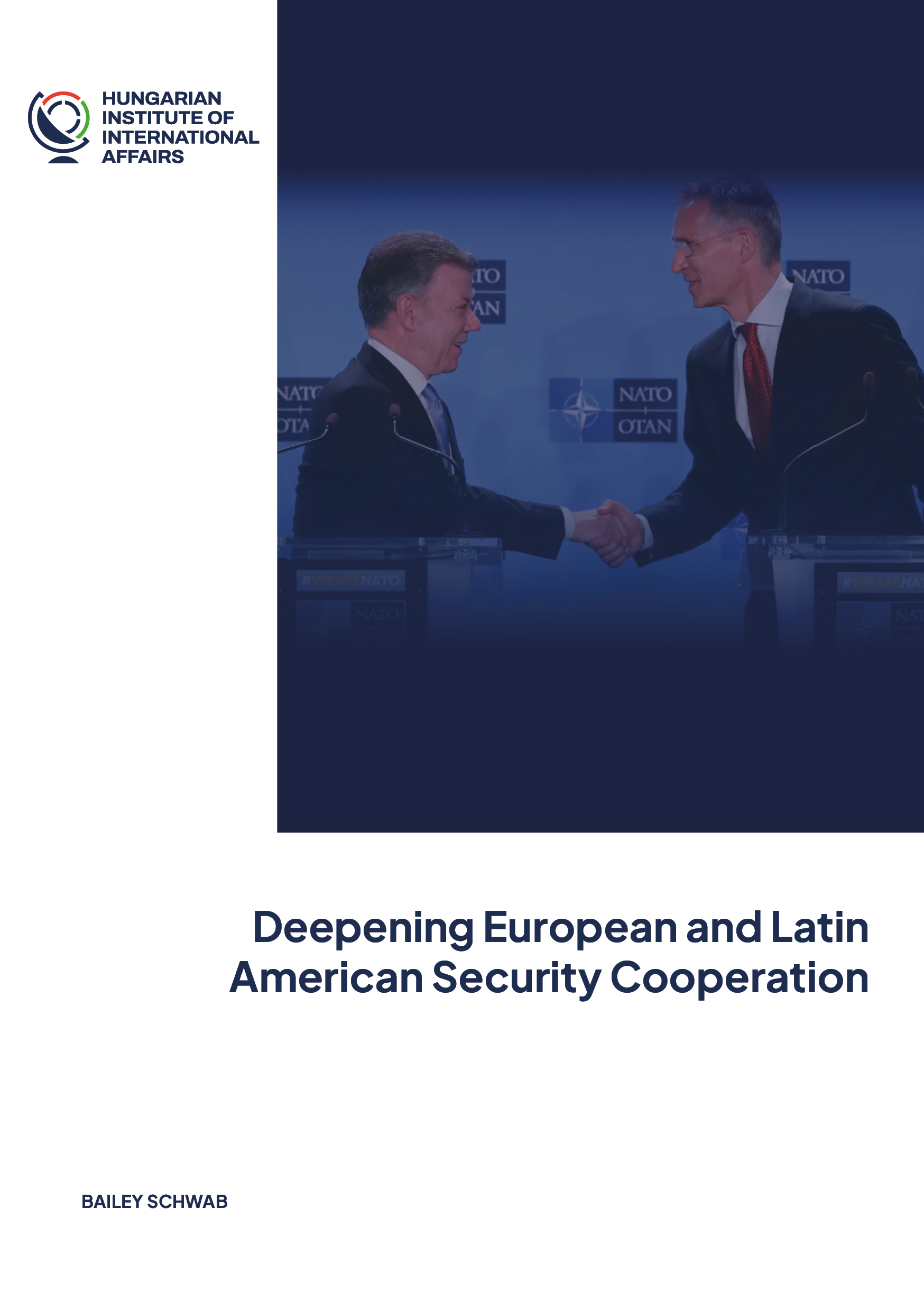
First, European arms manufacturers need to start working with Latin American militaries to deliver technical and industrial capacity to not only develop but also assist in the preparation and support of all relevant weapons systems. Second, while there are a few cooperative frameworks, such as the Global Gateway, these are mainly focused on development and not defense.[3] Nevertheless, there does exist the El PACCTO initiative, financed by the European Union Development Cooperation Instrument dedicated to advancing cooperation between security and justice actors to fight transnational organized crime, the next phase of which needs to have its scope expanded. Third, NATO should make partnerships with other Latin American countries, as it did with Colombia—which became the organization’s first Latin American partner in 2017.[4]
Before going into these reasonings, it is necessary to mention that all of these justifications and methods of implementation are in line with U.S. national security interests, and its current foreign policy posture. This is a significant consideration when suggesting any European military cooperation in the Americas—the “backyard” of the United States—since the seminal statement of U.S. foreign policy, the Monroe Doctrine, which is still in force and has been reemphasized under Donald Trump, was initially motivated by keeping European powers out of the Americas. However, the current geopolitical climate in 2026 is not the same as it was in 1823 in many dimensions. The most critical of these has been China’s encroachments into Latin America, leading it to become the subcontinent’s largest trading partner, which has included the People’s Republic lending hundreds of billions of dollars to certain nations, investing in dual-use infrastructure, and securing access to Latin America’s natural resources—including its oil and rare earths.
These encroachments precipitated the Trump administration’s reemphasis on Latin America, and the Western Hemisphere as a whole. As the 2025 National Security Strategy put it, “After years of neglect, the United States will reassert and enforce the Monroe Doctrine to restore American pre-eminence in the Western Hemisphere, and to protect our homeland and our access to key geographies throughout the region.”[5] This has led to numerous initiatives, such as the Shield of the Americas, dedicated to forging an historic coalition of nations that will “work together to advance strategies that stop foreign interference in our hemisphere, criminal and narco-terrorist gangs and cartels, and illegal and mass immigration.”[6]
All of this is to say that European cooperation with Latin America will demonstrate alignment and a commitment to the American-led western alliance. Speaking to an audience of Latin American leaders, U.S. Secretary of Defense, Pete Hegseth, declared, “All the nations represented in this room are offsprings of Western civilization. Our nations are and always will be united by our heritage, our history and geography in this new world. We share the same interests, and because of this, we face an essential test, whether our nations will be and remain Western nations with distinct characteristics. Christian nations under God.”[7] When this is contextualized by the American assessment of Europe’s civilizational erasure, as was articulated in the 2025 National Security Strategy, the opportunity for the Western and Christian world to work together as a united strategic front becomes ever more expedient.
The Strategic Rationale for Deepening Security Cooperation
Deepening European–Latin American cooperation in security will contribute to the West’s effort to better engage in the current global security competition with China. As many international relations experts suggest, the United States should prioritize great power competition with China, and this should serve as the axis around which Western policy orientates.[8] Latin America, in turn, must be seen as a key terrain upon which this competition will and should play out. This is in no small part due to the fact that China has made significant inroads into Latin America. Granted, excising it from the region will prove a very hard task, not least since, on the surface at least, certain countries within the region receive much in return for their business with the People’s Republic.
For example, China’s state firms are a major source of foreign direct investment, energy and infrastructure lending, and investment in space industries.[9] China’s inroads have even crossed over into the realm of security cooperation through arms sales—which is a significant form of geopolitical influence—and other initiatives, such as the Global Security Initiative.[10] Therefore, while the United States, under Trump, has realized that America has neglected the region in recent years because of it being distracted fighting the War on Terror in the Middle East and, more recently, attempting to fight Russia in a proxy war in Ukraine, Europe can show initiative and alignment with the recent shift in U.S. policy toward reemphasis on the need to secure Latin America and the Western Hemisphere as a whole from the encroachments of other great powers.
Second, Europe’s defense industry can be further revitalized through making inroads into the Latin American market, which is composed of countries with unique and interesting security concerns that necessitates innovative ways of thinking about, developing, and transferring all kinds of weapons systems. Europe is now seriously thinking about rearming, and this is now being implemented—albeit slowly, and with a strong push by the Trump administration. Defense, however, has the potential to become a strong economic driver across Europe, particularly in the realm of industrialization.[11] As a report on Europe’s defense industry by the European Parliament recently suggested, “the EU is now seeking to rebuild military capability and strengthen its defence industrial base.”[12]
While there have been increases in turnover in recent years, the numbers are still relatively humble when viewed in a global context. For example, in 2024, 48 of the top 100 defense companies were based in the U.S. and accounted for around $334 billion in defense revenue.[13] Five of the top 100 defense firms were Chinese-based, accounting for $355 billion in revenue in 2024.[14] This is contrasted to the EU-based industry’s revenue of €148 billion in 2024.[15]
In turn, while the EU is seeking to increase its own defense procurement from EU suppliers, the EU’s defense industry may be able to leverage the diverse needs and requirements of Latin American countries to revamp the industrial base. For example, Argentina faces problems such as limited funding, modernization demands, technological gaps, and competition from foreign suppliers.[16] Brazil, on the other hand, has more specific needs—given its relatively dominant position—and thus requires systems such as advanced air fighters to maintain its position as leader in the region.[17]
Therefore, with European defense companies working with Latin American countries, and their militaries, there is scope to tailor products and services to specific demands, which will contribute to the diversification of the European defense industry, thereby contributing to making it relevant, more adaptable, and broader in scope. All of these are necessary as part of the strategic autonomy initiative and will be welcomed by the United States in its efforts to prioritize more critical regions—such as the Indo-Pacific. If the European Union is to pursue strategic autonomy in a serious manner, which for Europe means it having a greater role in European defense within the confines of NATO with its own ability to maneuver independently, then, as Battaleme wrote, Latin America should “be its primary source of support to sustain that strategy.”[18]
Third, deepening security cooperation will help to strengthen civilizational and historical ties between Europe and Latin America. Even today, much of the architecture in cities such as Buenos Aires have distinctively European styles. Europe’s civilizational legacy is thus felt very strongly in the region. More fundamentally, since the Spanish arrived in Latin America, the religion of Christianity molded, coerced, refashioned, and enriched Latin America.[19]
As González wrote, “The conquistadores were not only men in armor riding horses and carrying firearms. They were also men in clerical garb riding mules and carrying crosses.”[20] In turn, there are deep historical and cultural bonds that exist between the two regions, which can serve as strong foundations upon which to build and promote through shared dialogues. By appealing to something beyond strategy and security, cooperation will be further strengthened by cultural ties, which will make it more durable.
Recommended Initiatives for Deepening Security Cooperation
Develop Strategic Partnerships between EU Defense Companies and Latin American Militaries
Strategic partnerships with private defense companies can enable nations to “enhance operational readiness, accelerate innovation, and ensure long-term security.”[21] There is already precedent for European weapons manufactures working closely with countries in Latin America. For example, the British weapons manufacturing company, BAE Systems, works very closely with the Brazilian and Chilean militaries. They do so by not only manufacturing weapons systems, but also servicing those systems after they have been transferred, which contributes to the development of strong partnerships.[22]
The British Royal Navy, many of whose naval platforms are also developed by BAE, works closely with these—and other Latin American—militaries through joint exercises and other forms of military cooperation.[23] In the words of John Stocker—BAE’s Regional Managing Director for the Americas—BAE “sits behind those partnerships” and delivers technical and industrial capability and knowhow to prepare systems, and then support them once they have been transferred.[24]
Manufacturers operating in the European Union need to become more proactive in this regard if they are to stay relevant, revamp, and develop to meet the challenges pertaining to changes in warfare and in the world order. Weapons manufacturers learn from their clients through listening to their concerns, security interests, perceived threats, combat experience, and operational needs. Certain EU manufacturers do already engage Latin American militaries, though. For example, Saab, the Swedish automotive manufacturer, is becoming a “household name” across Latin American militaries due to its securing of high-profile contracts with the Brazilian Air Force and Colombia’s shipbuilding corporation COTECMAR.[25]
Saab wants to expand its regional footprint, which it is doing through these contracts with these militaries, such as the ongoing program in Brazil to purchase a fleet of 36 Saab JAS 39 Gripen E multirole fighter aircraft.[26] Such partnerships allow Latin American militaries to benefit from access to cutting-edge weapons technologies, enable nations to enhance operational readiness, and thus ensure long-term security while making the EU’s defense industry more robust.
Expanding El PACCTO’s Scope
El PACCTO is an EU project dedicated to providing technical assistance to Latin American countries to fight organized crime through strengthening the entire criminal justice chain. The first phase was introduced in 2017 and lasted until 2022. This phase included eighteen Latin American countries, and its purpose was to “give technical assistance to Latin American countries for an effective fight against organized crime, by strengthening the entire criminal justice system.”[27] The second phase included 32 Latin American nations, its budget was increased from €19 million in phase one to €58.8 million, and it was launched in 2023 and scheduled to last until 2027. The purpose of this phase is to strengthen the EU–LAC partnership on justice and security. It seeks to “build more effective, transparent, and rights-based criminal justice systems, contributing to safer and more just societies.”[28] It does so by strengthening the collaboration of national and regional institutions in Latin America and the Caribbean, strengthening the capacities of justice and security institutions to fight organized crime, and developing an operational coordination of justice and security actors to investigate the main areas of organized crime activity.[29] As there has been a trajectory of expanding the project’s scope from stage one to stage two, the same needs to be done from stage two to stage three after the former has expired in 2027.
Conceptually, this could be proposed by developing a program to build upon the strengthened collaboration achieved during stage two to include contingents of Latin American and EU militaries undertaking joint military exercises and war gaming for scenarios countering, for instance, narco-traffickers. For example, just as the United Kingdom and international partners conduct training in Belize to develop peace and security in collaboration with local forces, the EU’s Common Security and Defence Policy can be brought in to El PACCTO’s initiative to participate in advising on military training, anti-piracy operations, and border assistance.[30] The way in which the Europeans could sell this to the Americans is by suggesting that while the United States is often engaged elsewhere around the world, to ensure the region’s security architecture does not become weakened through neglect (America’s resources and attention diverted to other environs), the European Union is ready to work together to tackle shared challenges within its remit, such as drug trafficking, which will strengthen the transatlantic relationship as well as address joint security problems emerging from the region.
Fostering Global Partnerships between NATO and Latin American Nations
Although Colombian President Gustavo Petro announced in July 2025 that Colombia would abandon its status as a “global partner” of the North Atlantic Treaty Organization (NATO), this relationship between the Latin American country and NATO set a precedent.[31] It did so because Colombia was the first and only country in Latin America to become a global partner of NATO. The global partnership Colombia held with NATO, held only by six other countries (Australia, Japan, South Korea, New Zealand, and Pakistan), did not necessarily entail military obligations but allowed for “invaluable cooperation in areas such as defense transparency, information sharing, modernization of the armed forces, participation in training activities, and access to projects on civil security.”[32] Colombia also assisted NATO with demining projects, maritime security, and military training to improve joint interoperability.[33]
In turn, there is precedent for NATO, spearheaded by the United States, to engage Latin American nations to foster these global partnerships. In this regard, the most significant military power in the region, Brazil, should be the primary focus. Although this will be challenging given that Brazil often openly expresses hostility toward American and European foreign policy choices, without attempting to engage Brazil, there is a risk that the most powerful Latin American country will cooperate further with Russia or China. However, while Brazil has opposed many decisions made by the United States, and NATO more broadly, one analyst noted that “this opposition has not been characterized by outright rejection of the Alliance, but rather by a selective form of band-wagoning aimed at protecting the national defense industry and arms manufacturers,” rather than strict political opposition.[34]
For example, in May 2013, the NATO Defense College and Brazil conducted strategic discussions on security challenges, mutual perceptions, and possible paths to deepening Brazil–NATO relations.[35] As the report published by the NATO Defense Council in 2015 suggests, the relationship between the two does not have the formalized arrangement of NATO’s Partnership for Peace or the Euro-Atlantic Partnership Council or even any concrete agreements on how NATO and Brazil will work together on security.[36] Therefore, there is a case to be made for NATO to reignite these discussions with Brazil with the overarching intention of making it a global partner to tackle current geopolitical discussions. If the United States is serious about reasserting dominance in Latin America, then ignoring Brazil—given its regionally dominant position in rare earths, military power, and economy—will create a vacuum that other powers and organizations will seek to instrumentalize.
Conclusion
Deepening European–Latin American security cooperation is not a matter of institutional expansion or rhetorical alignment. Rather, it is a strategic necessity shaped by shifting power realities. The era in which Latin America could be treated as peripheral to European security calculations has ended—this is particularly true when we take into consideration the volume of illegal drugs, specifically cocaine, flows into Europe from this region. Thus, external penetration by rival powers, the reassertion of U.S. power in the region, and Europe’s own search for strategic relevance create new opportunities for deepened security cooperation. This piece has suggested ways to move cooperation from abstract suggestions and the existing limited cooperation on issues pertaining to development and organized crime to developing frameworks to augment cooperation in the realms of security and defense industry.
Dialogue frameworks and symbolic partnerships are insufficient on their own. What is required is the construction of durable linkages between defense industries, military institutions, and operational planning structures. This means embedding European actors within the security ecosystems of Latin American states in ways that generate mutual dependence through initiatives such as training, procurement, maintenance, and joint exercises, rather than episodic engagement. In sum, the realistic objective set out here is not for the EU to displace external actors in Latin America, which it, of course, cannot do. What it needs to do is set more realistic—and actual—objectives to become if not indispensable in specific domains of security cooperation, then a key factor in Latin America’s security architecture.
Endnotes
[1] Juan Battaleme, “Why Europe Needs Latin America,” Americas Quarterly, August 4, 2025, https://www.americasquarterly.org/article/why-europe-needs-latin-america/.
[2] The White House, “Establishing an America First Arms Transfer Strategy,” February 6, 2026, https://www.whitehouse.gov/presidential-actions/2026/02/establishing-an-america-first-arms-transfer-strategy/.
[3] European Commission, “Global Gateway,” accessed March 23, 2026, https://commission.europa.eu/topics/international-partnerships/global-gateway_en.
[4] NATO, “Relations with Colombia,” October 3, 2024, https://www.nato.int/en/what-we-do/partnerships-and-cooperation/relations-with-colombia.
[5] The White House, National Security Strategy of the United States of America (The White House, November 2025), 15.
[6] U.S. Department of State, “The United States to Host the Shield of the Americas Summit,” March 6, 2026, https://www.state.gov/releases/office-of-the-spokesperson/2026/03/the-united-states-to-host-the-shield-of-the-americas-summit/.
[7] Reuters, “U.S., Latin American Countries Face Test Whether They Will Remain Western and Christian, Hegseth Says,” March 5, 2026, https://www.reutersconnect.com/item/us-latin-american-countries-face-test-whether-they-will-remain-western-and-christian-hegseth-says/dGFnOnJldXRlcnMuY29tLDIwMjY6bmV3c21sX1ZBMTMxMjA1MDMyMDI2UlAx.
[8] John J. Mearsheimer, “The U.S. Must Prioritize Great Power Competition,” Center for International Relations and Sustainable Development, January 9, 2026, https://cirsd.org/horizon-article/the-u-s-must-prioritize-great-power-competition/.
[9] “China’s Growing Influence in Latin America,” Council on Foreign Relations, June 6, 2025, https://www.cfr.org/backgrounders/china-influence-latin-america-argentina-brazil-venezuela-security-energy-bri.
[10] Brian Fonseca, Nicole Writt, and Martin Brown, “China’s Quiet Security Push in Latin America,” Americas Quarterly, September 11, 2025, https://americasquarterly.org/article/chinas-quiet-security-push/.
[11] “Why Sweden is Becoming a Defense Powerhouse as Europe Rearms,” posted March 14, 2026, by Bloomberg Television, YouTube, 12 min., 17 sec., https://www.youtube.com/watch?v=OnLoufhuGU8.
[12] European Parliament, “European Defence Industry,” February 2026, https://www.europarl.europa.eu/RegData/etudes/ATAG/2026/782647/EPRS_ATA(2026)782647_EN.pdf.
[13] European Parliament, “European Defence Industry.”
[14] European Parliament, “European Defence Industry.”
[15] European Parliament, “European Defence Industry.”
[16] “2026 Budget: Argentine Defense Continues with Zero Investment,” Agenda Malvinas, September 26, 2025, https://agendamalvinas.com.ar/en/noticia/presupuesto-2026-la-defensa-argentina-sigue-con-inversion-cero.
[17] “Latin America’s Defence Priorities,” posted April 11, 2025, by Saab, YouTube, 5 min., 16 sec., https://www.youtube.com/watch?v=KJ3y-v1Lx_w.
[18] Battaleme, “Why Europe Needs Latin America.”
[19] Ondina E. Gonzalez and Justo L. Gonzalez, Christianity in Latin America: A History (Cambridge University Press, 2008).
[20] Gonzalez and Gonzalez, Christianity in Latin America, 3.
[21] Future Air Force Conference 2026, “The Importance of Cooperation with Industry in Defence,” September 8, 2025, https://www.futureairforce.cz/aktuality/the-importance-of-cooperation-with-industry-in-defence/.
[22] John Stocker, Marina Miron, and Luis Carlos, “Securing the Future: The Next Generation of Defence Cooperation,” moderated by Vinicius de Carvalho, posted February 6, 2026, by Royal United Services Institute, YouTube, 49 min., 5 sec., https://www.youtube.com/watch?v=Uov2OTjQ920&t=2s.
[23] This is, perhaps, unsurprising given that the British have some overseas territories in and around Latin America—most notably, the Falklands Islands. Thus, it has a staked interest in building security partnerships in the region.
[24] Royal United Services Institute, “Securing the Future.”
[25] “Saab Showcases Its Projects and Goals to Equip the Armed Forces of Latin America,” Zona Militar, May 24, 2025, https://www.zona-militar.com/en/2025/05/24/saab-showcases-its-projects-and-goals-to-equip-the-armed-forces-of-latin-america/.
[26] “Saab Showcases Its Projects and Goals to Equip the Armed Forces of Latin America.”
[27] Ministry of Foreign Affairs, European Union and Cooperation of Spain, “El PACCTO 2.0,” https://www.fiap.gob.es/en/proyectos_fiiapp/el-paccto-2-0-2/.
[28] Ministry of Foreign Affairs, European Union and Cooperation of Spain, “El PACCTO 2.0.”
[29] Ministry of Foreign Affairs, European Union and Cooperation of Spain, “El PACCTO 2.0.”
[30] “The Common Security and Defence Policy,” European Union External Action Service, September 24, 2025, https://www.eeas.europa.eu/eeas/common-security-and-defence-policy_en#114664.
[31] Roberto García Alonso, “Colombia at a Crossroads: The NATO Exit and Its Consequences,” Latino America 21, July 24, 2025, https://latinoamerica21.com/en/colombia-at-a-crossroads-the-nato-exit-and-its-consequences/.
[32] Alonso, “Colombia at a Crossroads: the NATO Exit and its Consequences.”
[33] Bureau of Political-Military Affairs, “U.S. Security Cooperation with Colombia,” U.S. Department of State, January 20, 2025, https://www.state.gov/u-s-security-cooperation-with-colombia#:~:text=Colombia’s%20Partnership%20with%20NATO&text=In%202021%2C%20Colombia%20and%20NATO,%2C%20cyber%20security%2C%20and%20others.
[34] Sabrina Evangelista Medeiros, “Logistical Standardization and Strategic Integration: Brazil in the NATO Codification System,” Revista Tempo do Mondo, vol. 31. (April 2025): 148, https://repositorio.ipea.gov.br/server/api/core/bitstreams/e5db32be-a355-42a0-8939-75f0a1b6fadd/content.
[35] Brooke A. Smith-Windsor, ed., Enduring NATO, Rising Brazil: Managing International Security in a Recalibrating Global Order (NATO Defense College, 2015), 17, https://www.files.ethz.ch/isn/188576/fp_23.pdf.
[36] Smith-Windsor, Enduring NATO, Rising Brazil, 17.