
North Macedonia at the crossroad of politics and infrastructure

On September 30, 2024, the Hungarian Institute of International Affairs (HIIA) held a roundtable discussion entitled “North Macedonia at the crossroad of politics and infrastructure”. Speakers of the panel were Cintia Viola, Research Fellow of HIIA, Ábel Bagdy, Head of Government and International Relations of the 4iG Group and Gábor Miklós, Assistant Professor at the Corvinus University of Budapest. The discussion was moderated by Anna Orosz, Research Fellow of HIIA.







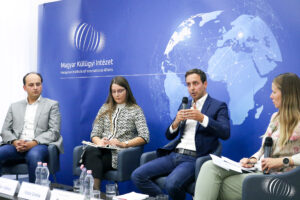

As the introduction of the event, Anna Orosz drew attention to the visit of Prime Minister Viktor Orbán to North Macedonia and the Macedonian–Hungarian government summit in Ohrid that served as apropos for the roundtable discussion. Cintia Viola pointed out that the negotiations at the Macedonian–Hungarian summit were organized around three topics, namely 1) effective management of migration; 2) deepening of economic cooperation and 3) the promotion of regional stability. The expert emphasized that while the accession talks with Albania could actually start in mid-October, North Macedonia would still be stuck in the parking lot, the main reason of which is the unsettled relationship with its neighbours. Cintia Viola underlined: “North Macedonia’s European integration path is currently crossed by several obstacles. In order for Skopje to be able to start accession negotiations, it is necessary to reach some kind of compromise with Bulgaria, however, the constitutional amendment according to the French proposal does not necessarily mean the final lifting of the Bulgarian veto”.
Ábel Bagdy underlined 4iG’s aspiration to become the strongest market player in the telecommunications sector in the Western Balkans. Since the company is already present in Albania and Montenegro, moving towards North Macedonia was a logical step in line with 4iG’s strategy. The North Macedonian market has two operators, alongside the Deutsche Telekom, the Austro–Mexican A1 dominates the market. 4iG is able to build upon the appropriate infrastructure and, thanks to the good cooperation with the North Macedonian authorities, can also buy frequencies, so the company is expected to be able to become a strong third market player. Ábel Bagdy added, “The Western Balkan countries need huge improvements in the field of digital infrastructure. When we talk about the region, innovation and research and development are not necessarily our first associations, even though they are very much needed. If a player with strong capital and who has already demonstrated performance in the region enters this market, it is in everyone’s interest.”
Gábor Miklós emphasized that North Macedonia, with its population of two million, would not be necessarily considered as an important ally of Hungary in the Western Balkans, however, its geographical location makes it of strategic importance – as it is at the cross-section of Pan-European transport corridors. The Corridors VIII and X meet in Skopje: while the former is far from completed, even though there are also Bulgarian and Italian interests behind it, Corridor X is ready – this route is also a Hungarian interest due to commercial traffic. From a Hungarian perspective, the development of (rail) transport infrastructure in North Macedonia could be a priority area, primarily in order to eliminate the “blind spots” in foreign trade. The expert put it this way: “If now, under the Hungarian EU Presidency, it is not possible to promote the accession process of the Western Balkans, then the next Presidency Trio will not be interested in it again.”