
Munich Security Conference 2026: The West Looks Inward

Perspective – Written by Bailey Schwab, Visiting Fellow
The PDF version is available here!
Introduction
The 2026 Munich Security Conference, held from February 13 to February 15, saw world leaders and important figures share varying perspectives about how the west should reorient its security policies, as well as the transatlantic alliance itself, for a changing world order. The themes and questions of the conference were: What is the essence of the western alliance? How has post-Cold War liberal internationalism affected transatlantic security? And is the so-called rules-based order over and, if so, what replaces it?
This HIIA Perspective will analyze the main viewpoints shared by the most senior figures who attended and spoke at the conference on the development of transatlantic relations, as well as global security in a changing world order. We will first provide an overview of the main speeches. Then, the piece will argue that fundamental disagreements remain pertaining to what the future of European security, and the nature of America’s underwriting of it, will and should look like.
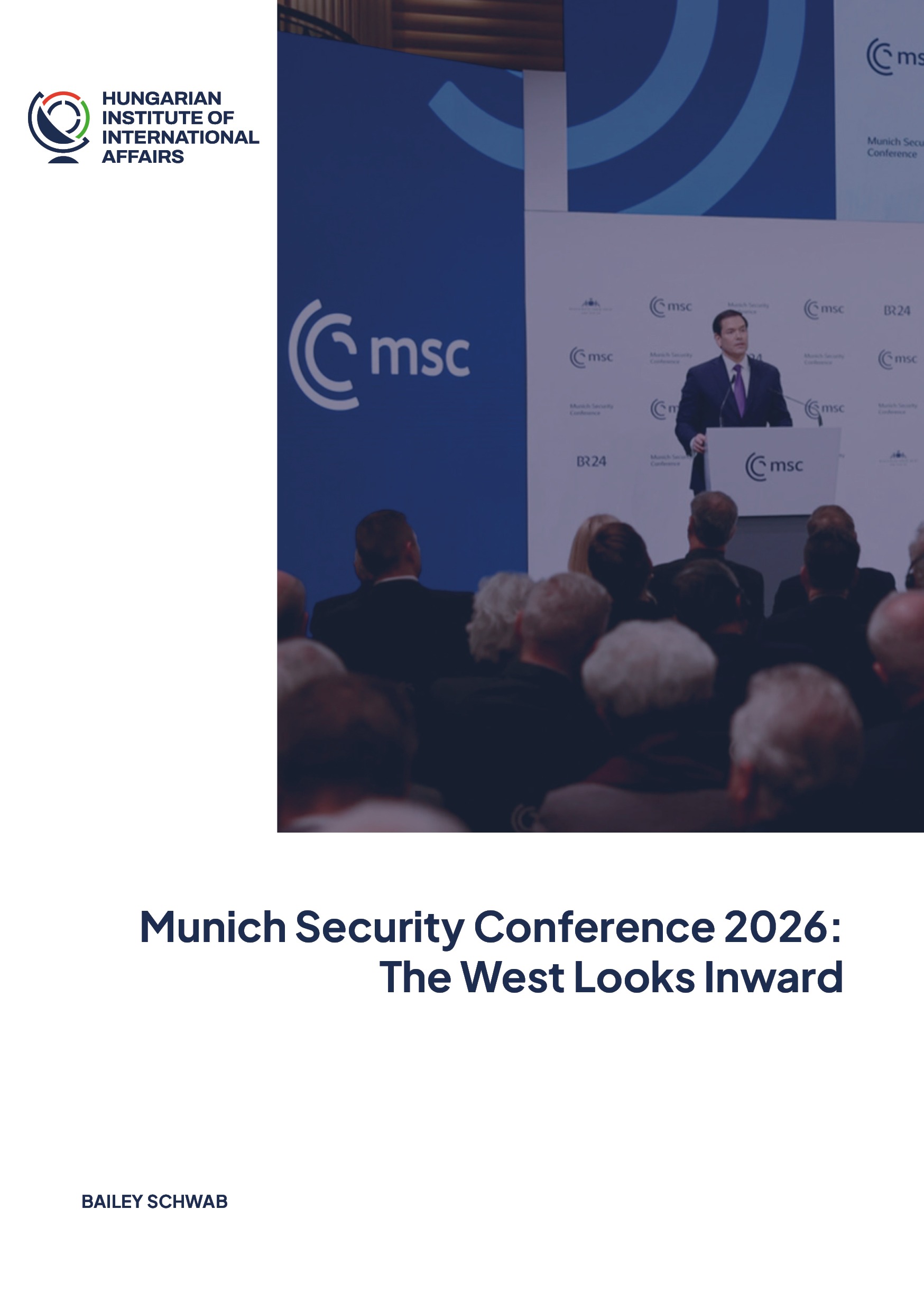
U.S. Secretary of State Marco Rubio
The end of history and the rules-based order are redundant, overused terms that conveyed—and still convey—a fundamental miscalculation about how American power in the post-Cold War era should have been applied. Thinking in these terms, Rubio asserted, “we embraced a dogmatic vision of free and unfettered trade, even as some nations protected their economies and subsidized their companies to systematically undercut ours, resulting in large parts of our societies being deindustrialized, shipping millions of working and middle-class jobs overseas, and handing control of our critical supply chains to both adversaries and rivals.”
Another key point of Rubio’s speech was that over the course of the post-Cold War liberal order, sovereignty has been undermined, both in the United States and Europe, as borders were opened to unprecedented waves of mass migration and sovereignty was outsourced to international institutions. Rubio stated that the U.S. and Europe must work together to take back control of their industries, supply chains, and national borders as these are fundamental acts of national sovereignty. “Failure to do so,” Rubio said, “is not just an abdication of our most basic duties owed to our people. It is an urgent threat to the fabric of our societies and the survival of our civilization itself.
The global order can no longer be placed above the vital interests of “our people and our nations.” By this, Rubio stated that there is no need to fully abandon the system of international cooperation, “or dismantle the global institutions of the old order that together we built.” Rubio called for these to be reformed and rebuilt. Rubio lambasted the United Nations for not being able to solve the war in Gaza or in Ukraine and instead praised American leadership in pursuing meaningful dialogue and peaceful agreements. The U.S. and Europe share a civilization. In turn, the United States wants to see Europe strong and able to defend this civilization. “What we want,” Rubio stated, “is a reinvigorated alliance that recognizes that what has ailed our societies is not just a set of bad policies but a malaise of hopelessness and complacency.” Following the Munich Security Conference, Rubio came to visit Bratislava and Budapest and reaffirmed the strong relationship built between the leaderships of Hungary and Slovakia and the United States, under Donald Trump.
U.S. Under-Secretary of State Elbridge Colby
The U.S. is advocating for a NATO 3.0. This would be something akin to NATO 1.0 which would require allies to step up and assume primary responsibility for their conventional defense. This is to come with a more sustainable model for rational defense of Europe with NATO taking primary responsibility for its conventional defense. A day before the conference, at the NATO Defense Ministerial, Colby stated that the US is adapting to the changing times and seeks a “return to and validation of its foundational purposes.” This purpose, Colby said, was to provide a strong, credible, and equitable defense of the North Atlantic area. At Munich, Colby declared that NATO was stronger than ever now that allies were made to step up in the provision of their own defense thanks to President Donald Trump.
German Chancellor Friedrich Merz
Merz argued that the post-WWII rules-based order “no longer exists” in the face of resurgent great-power competition. He argued the era of automatic confidence in Western institutions and transatlantic security has ended, and that Europe must rethink its security strategy and assert its freedom. That means, Merz stated, bolstering Europe’s own military, political, economic, and technological muscle rather than relying on a U.S. leadership that cannot go it alone anymore. Merz also pushed back on U.S. culture-war rhetoric imported to Europe, defended free trade and climate cooperation, and framed support for Ukraine as essential to defending freedom. One point of note is that while discussions with Macron on a European nuclear deterrent were flagged, there was no unified E3 type statement regarding a new shared perspective on nuclear policy, as some expected.
U.K. Prime Minister Keir Starmer
Starmer’s remarks emphasized the urgency of strengthening NATO and European defense cooperation. Recognizing that peace in Europe can no longer be taken for granted, he said all signs point to intensified Russian aggression and “the solidity of peace” weakening. He rejected inward-looking security policies, saying the UK must work closely with Europe on defense, technology, and security. Moreover, Starmer presented the Brexit era isolationism sentiment to be over. He stated that there is no British security without European security and vice versa which, he claimed, was the lesson of history. He thus signaled willingness to deepen selective economic alignment with the EU and reiterated the UK’s nuclear deterrent’s role within shared security.
French President Emmanuel Macron
Macron framed Europe as a geopolitical actor that must design its own security architecture independently of external powers, even as it seeks strong alliances. He said that Europe must draft the parameters of a future security framework suited to its geography and interests, including contemplating a “holistic” European nuclear deterrence developed with partners like Germany. Echoing Merz, he argued that Europe may have to be ready to coexist with an aggressive Russia and negotiate from strength, not weakness. Interestingly, just as Rubio did not mention the word “Ukraine” once, and Colby did not mention “Taiwan” aside from when asked by Ravi Agrawal, Macron did not say “NATO.”
EU High Representative Kaja Kallas
Kallas used her MSC platform to rebut narratives claiming Europe is in decline or facing “civilizational erasure.” She insisted Europe is strong, desirable (for example, she said many Canadians favorably view joining the EU), and dynamic with global interest in membership and strong societal values. Pushing back against U.S. criticism, such as from the U.S. National Security Strategy which described Europe as facing “civilizational erasure” and the State Department’s Strategic Plan FY2026-2030 which stated as a strategic goal the rebuilding of civilizational ties between the U.S. and Europe, she said Europe must reclaim its agency in a rougher world, strengthen defense capacity, and not allow Russia to gain at the negotiating table. She also pointed to expanding EU security partnerships beyond the Atlantic.
President of the European Commission Ursula von der Leyen
Von der Leyen’s speech stressed that Europe must deepen so-called “strategic autonomy” across defense, economy, technology, energy, and more, not as a rejection of the transatlantic bond, but to make that bond stronger. Interestingly, during a late-night event at the conference, representatives from Google reassured European audiences regarding their tech sovereignty. Google employees told the audience that they can let them use their products without the American government spying on them or triggering the kill switch. For example, when the head of the ICC was sanctioned by Trump, soon after Google and Microsoft disabled his accounts. Clearly, tech sovereignty, especially within the context of the Digital Services Act, is another pressing issue for Europeans. Furthermore, Von der Leyen argued the EU must operationalize its mutual defense clause and accelerate decision-making on security matters, including by partnering with third countries like the UK within emerging frameworks of cooperation.
Ukrainian President Volodymyr Zelensky
As expected, Zelensky came to the conference demanding more money and effort from his patrons. He stressed that territorial concessions will not bring peace and warned that giving up Ukrainian land would resemble the appeasement of 1938 since, Zelensky argued, it would not stop aggression but encourage it. While he asserted the need for unity among western allies, he used the opportunity to once again attack those leaders who have pursued peace and dialogue to try bringing about an end to the war.
Chinese Foreign Minister Wang Yi
Wang Yi’s speech stressed the need for multilateralism and a reformed global governance system. Yi emphasized sovereignty, equality, international law, and respect for how countries wish to develop. He cast China as a force for peace and a partner to Europe in a multipolar world order. Yi presented China’s rise as something that could contribute to global stability and, therefore, China was not a threat to the world. Lastly, he called on countries to work together to avoid the “law of the jungle” and unilateralism which can lead to conflict. Both Europe and China, Yi said, have shared interests in avoiding conflict and building a more equitable global order, framing cooperation as essential if the world is to avert deeper splits and instability.
Identity Crisis: The State of the Transatlantic Alliance
Overall, after the conference one comes away with a convoluted image of where the transatlantic alliance is headed. From Rubio’s statements indicating that the pillar institutions of the rules-based order, such as the United Nations, are not working as intended and need to be reformed to Merz declaring that the old order was dead, to Rubio not mentioning Russia in his speech, to Kallas declaring Russia was Europe’s existential threat, there are significant discrepancies between how the U.S. views the world and how the Europeans do. Although there are overlaps, namely in how everybody now seems to agree that the so-called “liberal international order” was, in many ways, a mirage, nobody agrees on what should replace it.
In essence, what MSC 2026 showed is that the U.S.-led western alliance is going through a cultural moment defined by a quasi-identity crisis. The fundamentals of what the west means are no longer agreed upon. Not only do such fundamental disagreements remain pertaining to more abstract and politicized matters, such as whether liberal democracy in the west has been a success or failure or what we mean by civilizational ties between the U.S. and the EU, but about global security policy, such as: how to end the war in Ukraine, whether it is in Europe’s interests for the war in Ukraine to be brought to an end through diplomacy or a grand defeat of Russia, whether U.S. foreign policy in the post-Cold War era was the cause of the rules-based order’s collapse or whether it is the primary force of its repair, and how to deal with Washington if it decided to take Greenland by force.
To conclude, the MSC did not provide definitive answers to these pressing security concerns. What is certain, however, is that the road ahead will be bumpy. World order, by which we mean the arrangement of power and authority at any given time in the international system, is always in a state of transition from the moment it is first established and appears rock solid. If the transatlantic alliance is to remain in the coming world order, there is still a lot of work to be done.