
BRICS Watch 2026/1

The PDF version is available here!
The Future of BRICS in the Global South after Operation Absolute Resolve
Zsolt Reile, Senior Research Fellow, HIIA
Bailey Schwab, Visiting Fellow, HIIA
Péter Pál Kránitz, Senior Research Fellow, HIIA
The capture of Venezuelan president Nicolás Maduro by U.S. military forces on Venezuelan soil on January 3, 2026, marked a dramatic inflection point in contemporary international affairs. The Trump administration’s action not only signaled an aggressive reassertion of American power in the Western Hemisphere but also reverberated across the global system, unsettling allies and provoking widespread condemnation within international institutions such as the United Nations, even as Washington simultaneously withdrew from several of those same bodies. This episode, remarkable both for its legal ambiguity and geopolitical audacity, exemplifies a broader shift in U.S. foreign policy toward unilateralism and coercive dominance.
Such actions have significant implications for the so-called “Global South,” a term used to refer to economically developing countries located in Africa, Asia, Latin America, and the Caribbean. These regions have experienced shared histories of colonialism, economic dependency, and outright subjugation by their more economically and militarily advanced northern counterparts, such as the former European nations—once the loci of great empires—and the “empire that dare not speak its name,” otherwise known as the United States of America.[1] More than just a geographical concept, however, the notion of the Global South has been used to encapsulate a collective experience many nations have undergone, and perceive themselves to be currently experiencing, of exploitation by stronger powers. While exposing BRICS’ limited capacity to deter coercion, the recent episode in Venezuela may accelerate shelter-seeking behavior, deepen intra-BRICS security cooperation, and reshape patterns of South–South engagement in an increasingly polarized global order.
The Global South under the Trump Doctrine
Operation Absolute Resolve has led to much criticism that the Trump administration has not only violated international law but executed yet another example of neo-imperialism. This is because military intervention was used by a hegemonic state to alter the internal politics of a country that the hegemonic state—the United States—considered to have been acting in ways contrary to its interests.[2] Trump primarily justified the use of force and the extraction of Maduro, which followed a huge military buildup in the Caribbean, by accusing Maduro of running a communist narco-state that permitted so-called “narco-terrorists” (a newly invented legal concept similar to the notion of “enemy combatant” during the War on Terror) to transport drugs to the United States. Further, Trump pledged that now that Maduro had been removed from Venezuela, the country with the world’s largest oil reserves, American companies would control these reserves to increase its oil output—many analysts claim this was the primary motivation for the attack.[3] Notwithstanding the validity of the Trump administration’s accusations, legal arguments, and the rapidity with which Venezuela’s oil reserves can begin to support significant production, Operation Absolute Resolve sends an important message to the Global South.
The message is that while many in the Global South, such as Venezuela, have recently turned to other great powers like China to source investment opportunities, spheres of influence still matter, and more powerful states will use force if they perceive their sphere of influence to be undermined by recalcitrant actors. In this case, Latin America will always be seen as America’s backyard by U.S. officials. Since the 1823 Monroe Doctrine, the United States has not tolerated any interference by great powers—back then, European powers, now China and Russia—in the affairs of these countries, where their influence could grow and consequently undermine America’s. China has become ever more integrated in the Western Hemisphere in recent years. For example, in 2025, it joined the Andean Community as an observer, and a significant portion of Venezuela’s heavy crude is shipped to China to service the former’s sovereign debt.[4] Nonetheless, in the era of great power competition between the United States and China, the desire of Global South countries to develop in their own way no longer seems to hold weight—if it ever did—in the formulation of U.S. foreign policy. Although the countries of the Global South have undertaken processes to de-risk from American power, such as pursuing de-dollarization, the United States will not take these measures lightly. In this new epoch, and as the action against Venezuela shows, Thucydides’ words ring truer than ever: “The strong do what they have to do and the weak accept what they have to accept.”
The Future of BRICS in the Global South
At the same time, the seizure of Venezuela’s leader carried a secondary, more subtle message aimed at BRICS, an organization that increasingly presents itself as a political and economic counterweight on behalf of the Global South. Venezuela, itself an aspiring BRICS applicant, was left effectively unprotected, highlighting the bloc’s inability to prevent or meaningfully respond to coercive action against its prospective members. BRICS is not a military alliance and lacks the capacity to project collective force in Latin America or elsewhere. The room for maneuver of its members, some of the largest economies and militaries in the world, in responding to the U.S. operation in Venezuela, was therefore limited to mere diplomatic and rhetorical condemnation based on international norms and laws. This situation has severely undermined the credibility of BRICS as an effective protector of the interests of the Global South.
Operation Absolute Resolve has thus rearranged the balance of power, especially in the Western Hemisphere, and may significantly constrain South–South and East–South economic and political cooperation in the future. From now on, Latin American, Caribbean, and—in light of previous threats of U.S. intervention in Nigeria—even African states will have to shape their sovereign foreign policy within abstract constraints, weighing every potential move through the prism of the threat of U.S. retaliation. This may be particularly true of relations with China, but it may also manifest itself in the formation of trade networks and energy policy, as well as in multilateral diplomacy and their engagement with BRICS and what it represents, from de-dollarization to a new architecture of multilateralism.
Yet paradoxically, the very aggression that exposed BRICS’ limitations may also enhance its appeal. For many countries in the Global South, unilateral resistance to a hegemonic power such as the United States is not a viable option, and the Venezuelan episode may accelerate processes of strategic shelter-seeking. Even in the absence of a formal military alliance, BRICS provides a platform through which bilateral and multilateral security relationships can deepen over time. Recent developments point in this direction: Shortly after the Venezuela intervention, several BRICS members—including China, Russia, and Iran—conducted joint naval exercises off the coast of South Africa. Although planned prior to the crisis, the timing of these drills has symbolic significance, suggesting that certain BRICS members are increasingly contemplating closer military cooperation. Brazil’s role as an observer, rather than an active participant, further indicates a cautious but growing interest in expanding naval and strategic capabilities. Taken together, these dynamics suggest that U.S. coercive actions in the Global South may simultaneously reinforce American dominance in the short term while incentivizing longer-term efforts to construct alternative power configurations beyond the U.S.-led order.
Endnotes
[1] Niall Ferguson, “The Empire That Dare Not Speak Its Name,” The Times, April 13, 2003, https://www.thetimes.com/world/us-world/article/niall-ferguson-the-empire-that-dare-not-speak-its-name-wmjksp3cbfl.
[2] Charles A. Kupchan, “Venezuela and Beyond: Trump’s ‘America First’ Rhetoric Makes a Neo-Imperialist Streak,” Council on Foreign Relations, January 7, 2026, https://www.cfr.org/expert-brief/venezuela-and-beyond-trumps-america-first-rhetoric-masks-neo-imperialist-streak.
[3] Brad W. Setser, “Increasing Venezuela’s Oil Output Will Take Several Years—and Billions of Dollars,” Council on Foreign Relations, January 8, 2026, https://www.cfr.org/expert-brief/increasing-venezuelas-oil-output-will-take-several-years-and-billions-dollars.
[4] Benedicte Bull, “Chinese Impact on Development in Venezuela: The Dynamics of Structural Stagnation,” New Political Economy (2025), 1–20, https://doi.org/10.1080/13563467.2025.2531004.
Strategic Hedging in the Foreign Policy of GCC States
László Csicsmann, Senior Research Fellow, HIIA
In July 2025, the United States withheld the sale of an additional 500,000 Nvidia chips to the United Arab Emirates (UAE) out of fear that they might end up in the hands of Russia or China.[1] This is not the first time that the Arab oil monarchies of the Persian Gulf—the member states of the Gulf Cooperation Council (GCC)—have found themselves caught in the middle of a U.S.–China trade war. Among the GCC states, Saudi Arabia and the UAE can be considered emerging middle powers thanks to their strategic location near the Strait of Hormuz, their wealth in fossil fuels, and the sovereign wealth funds created from revenues, and these states thus play influential roles in the global economy and in international politics.[2] Today, the GCC countries symbolize renewable energy, technological development, and the industrial and military applications of artificial intelligence. Middle powers generally play a key role in shaping the functioning of regional security architectures.
This paper aims to briefly outline the balancing, maneuvering foreign policy of these two Arab oil monarchies in the Persian Gulf: the United Arab Emirates and Saudi Arabia. Both states aim to pursue an independent foreign policy line, rejecting alignment with any bloc and avoiding a choice between the United States and China as their main external partners.[3] For both countries, the United States provides advanced military infrastructure, and in security matters, they are primarily tied to Western systems, while China remains their largest trading partner. As the Saudi investment minister put it: “I don’t see our relationship with the U.S. [and] with China as being mutually exclusive.”[4]
According to international relations literature, middle powers traditionally have two foreign policy options.[5] The bandwagoning strategy involves a weaker state allying with and cooperating a stronger state in exchange for military protection and economic opportunities. This choice is typically driven by the consideration that the weaker state cannot afford the costs of arming itself against the stronger, revisionist state. The second strategy is balancing, in which a state either forms alliances to prevent the rise of a stronger challenger or arms itself to create a counterweight.
In the 1990s, a third strategy emerged in IR literature, drawn from the business world: strategic hedging. Strategic hedging is a complex foreign policy strategy that combines elements of the previous two approaches. Its main aim is to reduce risk amid unpredictable global political shifts while simultaneously maximizing benefits. Theoretical literature considers it a transitional strategy that eventually ends up leaning toward either the global actor supporting the status quo or the revisionist state. The behavior was first identified among Southeast Asian states in China’s geostrategic environment and later observed in other middle powers, such as India.[6] Recent studies regard it as a form of neutrality in a rapidly changing international environment.[7] This is the strategy that best describes the positions of both the UAE and Saudi Arabia in the international system. It should also be noted that these two states consider each other competitors in the Gulf region, as they both position themselves as middle powers.
Multilateral Diplomacy (BRICS, SCO Membership)
Saudi Arabia and the UAE are dialogue partners in the Shanghai Cooperation Organization (SCO) and, in 2024, were among six states invited to join the BRICS group. The UAE accepted membership, whereas Saudi Arabia did not, which explicitly signals Riyadh’s careful hedging policy between the United States and China. To this day, Saudi Arabia has not formally responded to the BRICS invitation, for several reasons.[8] First, Iran received an invitation for full membership alongside Saudi Arabia, which is problematic in two ways. On the one hand, longstanding tensions and geopolitical rivalry between Iran and Saudi Arabia persist, despite the two countries restoring diplomatic relations in 2023 under China’s mediation. On the other hand, Saudi officials view Iran’s BRICS invitation as a symbolic display of the organization’s anti-Western orientation. Additionally, Saudi Arabia positions itself as a regional leader, and Riyadh sees it as undesirable to be treated as an equal partner with rivals such as the UAE, Egypt, or Iran. The Saudi crown prince has been absent from all major summits but ensured the country is represented at various lower-level forums and committees. On several occasions, Saudi Arabia was presented as a full member, which later had to be corrected. Its approach reinforces Saudi Arabia’s position in the multipolar world and, unintentionally, significantly weakens BRICS cohesion.
By contrast, the UAE became a full member of BRICS on January 1, 2024. Membership does not replace its partnership with the United States but serves a complementary function.[9] For Abu Dhabi, it is crucial to secure the markets and technologies needed for its technological development. BRICS membership provides a platform for the UAE to make its voice heard in shaping international rules and strengthens its regional role. The UAE also participates in minilateral arrangements such as I2U2 (India, Israel, UAE, United States), primarily aimed at technological cooperation. This framework underpins India’s announcement of an India–Middle East–Europe Economic Corridor (IMEC), which Washington explicitly views as an alternative to China’s Belt and Road Initiative, at the G20 summit in September 2023. For the UAE, however, the emphasis is on the complementary, not substitutive, nature of this approach.
Both states are dialogue partners in the SCO, yet neither attended the September 2025 summit in Tianjin, China, heralded as the dawn of a multipolar world. This was likely due to pressure from the Trump administration. Washington has no objection to the two states selling oil to China but prefers that the resulting revenues be spent in the United States. Most of Trump’s recent Middle East visit revolved around these business-related arrangements, aimed primarily at distancing regional states from China. In the days preceding the Tianjin summit, from August 28–31, the seventh China–Arab States Expo was held in China, attended by all Arab states.[10]
For the United States, the sale of the advanced technology mentioned in the introduction represents a red line, as Washington seeks guarantees that high-performance supercomputers and semiconductors will not fall into Chinese or Russian hands. Despite the UAE joining the Abraham Accords in 2020, the United States has withheld certain fighter jets and advanced drones from the country.
Divergent Views on the Russia–Ukraine War
In February 2022, the Biden administration strongly urged GCC states to join sanctions against Russia and condemn Moscow as an aggressor at the United Nations Emergency Special Session on Ukraine. Both Saudi Arabia and the UAE chose to maintain relations, largely abstaining from these votes, while continuing to regard Russia as an important partner.[11] Both countries’ leadership signaled their active or positively neutral stance on the Russia–Ukraine war, a policy reminiscent of the Cold War period. Saudi Arabia and the UAE cooperate with Russia within OPEC+ to regulate production quotas and thus world oil prices. Trump has repeatedly urged members to increase production to lower global prices, potentially impacting Moscow’s revenues. In 2025, this led to tensions between Saudi Arabia and Russia over production levels: Riyadh sought to increase output, while Moscow pushed for cuts to raise global prices.[12]
Both states have also played mediation roles in the war, successfully brokering prisoner exchange agreements on multiple occasions.[13] In February 2025, Riyadh hosted a high-level U.S.–Russia preparatory meeting aimed at laying the groundwork for ending the Russia–Ukraine war. This reflects the middle-power status that both the UAE and Saudi Arabia occupy within the multipolar international system.
Conclusion
Both the UAE and Saudi Arabia turn to the United States for security guarantees, while their trade relationships have “Asianized.” Under their strategic hedging approach, they aim to cooperate simultaneously with both China and the United States, leveraging potential political and economic benefits. Israel’s attack on Qatar in September 2025 raises questions regarding U.S. security guarantees. This compels both states to continuously recalibrate their foreign policy, given the significant risks in a shifting international order. Part of this strategy is reflected in the recent Saudi–Pakistan defense pact,[14] which could be to China’s advantage in the region in the field of defense cooperation.
Endnotes
[1] MEE staff, “US Officials Do Not Want to Sell Advanced AI Chips to Company Run by UAE Spy Chief: Report,” Middle East Eye, July 17, 2025, https://www.middleeasteye.net/news/us-officials-do-not-want-sell-advanced-ai-chips-company-run-uae-spy-chief-report.
[2] John Calabrese, “The Gulf States’ Middle Power Ascent,” The National Interest, August 1, 2025, https://nationalinterest.org/blog/middle-east-watch/the-gulf-states-middle-power-ascent.
[3] Karen E. Young, “How Saudi Arabia Sees the World,” Foreign Affairs, November 1, 2022, https://www.foreignaffairs.com/saudi-arabia/how-saudi-arabia-sees-world.
[4] Christopher S. Chivvis et al., “Saudi Arabia in the Emerging World Order,” Carnegie Endowment for International Peace, November 6, 2023, https://carnegieendowment.org/research/2023/11/saudi-arabia-in-the-emerging-world-order.
[5] Iván Gonzalez-Pujol, “Theorising the Hedging Strategy: National Interests, Objectives, and Mixed Foreign Policy Instruments,” All Azimuth 13, no. 2 (2024): 193–214, https://doi.org/10.20991/allazimuth.1480020.
[6] Cheng-Chwee Kuik, “Getting Hedging Right: A Small-State Perspective,” China International Strategy Review 3 (2021): 200–315, https://doi.org/10.1007/s42533-021-00089-5.
[7] Fabio Figiaconi, “Choosing Not to Choose: Hedging as a Category of Neutrality,” European Journal of International Security (2025): 1–20, https://doi.org/10.1017/eis.2025.10009.
[8] Oliver Stuenkel and Margot Treadwell, “Why is Saudi Arabia Hedging Its BRICS Invite?,” Carnegie Endowment for International Peace, November 21, 2024, https://carnegieendowment.org/emissary/2024/11/brics-saudi-arabia-hedging-why.
[9] Alexandre Kateb, “BRICS+ and the Arab Gulf: The Perks of Membership,” Carnegie Endowment for International Peace, January 4, 2024, https://carnegieendowment.org/sada/2024/01/brics-and-the-arab-gulf-the-perks-of-membership.
[10] Xinhua, “7th China–Arab States Expo with Record Participation,” The State Council of the People’s Republic of China, August 28, 2025, https://english.www.gov.cn/news/202508/28/content_WS68b021c0c6d0868f4e8f522d.html.
[11] Rachid Chaker, “The Russo-Ukrainian War as Seen from the Arab World,” Network for Strategic Analysis, May 13, 2025, https://ras-nsa.ca/the-russo-ukrainian-war-as-seen-from-the-arab-world/.
[12] Ahmad Ghaddar et al., “Behind OPEC+ Oil Output Hike, Saudi-Russian Tensions Simmer,” Reuters, June 2, 2025, https://www.reuters.com/business/energy/behind-opec-oil-output-hike-saudi-russian-tensions-simmer-2025-06-02/.
[13] Samuel Ramani, “The GCC States Flex Their Diplomatic Muscles over Ukraine,” Gulf International Forum, accessed January 10, 2026, https://gulfif.org/the-gcc-states-flex-their-diplomatic-muscles-over-ukraine/.
[14] Eleonora Ardemagni, “The Saudi-Pakistan Defense Pact Highlights the Gulf’s Evolving Strategic Calculus,” Atlantic Council, September 26, 2025, https://www.atlanticcouncil.org/blogs/menasource/the-saudi-pakistan-defense-pact-highlights-the-gulfs-evolving-strategic-calculus/.
Anti-Colonialism, South–South Sovereignty, and the BRICS Project
Péter Pál Kránitz, Senior Research Fellow, HIIA
Eric Zalcman, Fellow, Brazil and Southern Cone, McLarty Associates
“A new wave of decolonization is rising,” claimed Russian President Vladimir Putin at the Valdai Discussion Club in September 2025. Within BRICS, the narrative of non-Westernism serves as a master discourse that frames the bloc as an advocate for a more inclusive and sovereign global order. Russia and China actively leverage a key side discourse, anti-colonialism—through military, economic, and infrastructure engagements—to position themselves as partners countering Western dominance. By contrast, India and Brazil emphasize sovereignty and South–South cooperation but avoid confrontative anti-Western rhetoric, reflecting historical experiences and economic interdependence. Overall, BRICS balances symbolic anti-colonial solidarity with pragmatic considerations, revealing a bloc that mobilizes identity and autonomy rhetorically while acting cautiously in practice, especially when it comes to defying American hegemony in the Western Hemisphere.
Anti-Colonialism and BRICS
BRICS is a loose coalition of countries from all over the world, pursuing strong economic cooperation and less coherent political coordination. It lacks a clearly defined political identity or shared values, such as the European Union’s “Europeanness” or “European values.” However, there are some focal points of the ideological struggle within the organization that may be identified as master narratives of an evolving ad hoc BRICS identity policy. One such narrative, a cluster of political identity discourses, is the notion of non-Westernism that portrays BRICS as “not Anti-Western, but non-Western.”[1] It is the idea that BRICS and its members strive for an inclusive and just multilateral system in the evolving multipolar world order as an alternative to the hegemony of existing Western-based and Western-oriented international structures. Most recently, it was highlighted by Chinese President Xi Jinping at the August 2025 summit of the Shanghai Cooperation Organization and by Russian President Vladimir Putin at the Valdai Discussion Club in September.[2] Even if some members attempt to water down this narrative to avoid being seen as too confrontative to the West, and the United States in particular—as Indian Prime Minister Narendra Modi does—each and every BRICS member state is pursuing a discursive agenda on greater sovereignty for the “Global East and South” against the historic dominion of the West.[3]
One key side discourse of this master narrative is anti-colonialism, a rhetoric with the ability to foster mass political mobilization against colonial rule and even the post-colonial influence of Britain, France, the United States, and other powers with imperial history in the formal colonies—some 85 percent of our world, from Africa all through Asia and the Americas.[4] This rhetoric is a powerful discursive tool in the hands of political actors that strive to challenge existing and traditional power relations in the Global East and South. As President Putin proclaimed at Valdai, “A new wave of decolonization is rising now, as former colonies are acquiring, in addition to statehood, also political, economic, cultural and world outlook sovereignty.”[5] Anti-colonial rhetoric is not new to Russian political discourse. Moscow has long exploited the powerful sentiments of decolonialization and anti-colonialization in its fields of influence beyond the post-Soviet space, most notably in the Middle East and Africa. Although Russian infiltration into the Dark Continent dates back to Soviet, and even imperial times, this historic struggle has recently achieved significant success in part precisely thanks to the power of the reinvented anti-colonialism of multipolarity.[6] While the French army has been forced out of Mali, Burkina Faso, Niger, and the Central African Republic since 2020, Russian mercenary groups—most notably the Wagner Group, now the Africa Corps—have been invited, and with them significant Russian capital and investments have also come, including joint ventures for gold refineries and nuclear reactors in Niger and Burkina Faso.
China, too, exploits the political capital of anti-colonialism. It grounds its relations with the Global South in narratives drawn from its own experience of imperial subjugation and its support for decolonial movements. From Africa through Asia, along the Belt and Road Initiative, China seeks to position itself as a non-Western alternative to former colonial powers. A case study on Laos showed that the publicity of the Belt and Road Initiative’s development strives to portray Chinese investments policies as antithetical to Western conditionality.[7] An analogous strategy is employed in Africa, where both the political elite and society welcome the anti-colonial and non-Western mindset of China. As a result, the Chinese have emerged as the most favored external influence by Africans, ahead of the United States, UN agencies, the African Union, former colonial powers, and Russia.[8]
Unlike the Cold War era, where anti-colonial revolts were organic and driven by nationalism, the new wave of decolonialization is driven by, to a large extent, outside players exploiting anti-colonial rhetoric to advance their own geopolitical agendas.[9] Although Russian and Chinese anti-colonial narratives might attract many partners in the Global East and South, it would not be nearly as successful had it not been in the context of multipolarity and the emergence of East-based multilateral institutions, such as BRICS and its New Development Bank. BRICS is a manifesto of the non-Western offer, promising a more inclusive and sovereigntist international system that has not yet been polluted by the asymmetry of Atlantic institutions such as the World Health Organization, the World Trade Organization since 2016, or, more traditionally, the International Monetary Fund and the World Bank, which have long been portrayed through the world as neocolonialist powerhouses.[10]
South–South Sovereignty
Anti-colonialism is deeply rooted in the political discourse of most BRICS candidates—Nigeria, Uganda, Bolivia, Cuba, Malaysia, and Thailand—and some of its core members—one example is South Africa, where unresolved social conflicts stemming from the history of British rule and apartheid still shape political thinking and rhetoric. Although India and Brazil also share the legacy of the colonial yoke, historical experiences and the geopolitical landscape of South Asia and South America differs significantly from that of Russia, China or South Africa: Structural dependencies severely restrict Brazil’s room for geopolitical maneuver and related discourse, while India strives to counterbalance regional Chinese political-economic hegemony by maintaining pragmatic relations with the East and West, North and South. These two BRICS member states, therefore, pursue a significantly different approach to the discourse on “non-Westernism” by highlighting pragmatic sovereigntism, an expanded South–South and East–South cooperation instead of historic grievances and confrontative anti-colonialism.
South–South sovereignty was reflected in the July 2025 joint communique of Indian Prime Minister Narendra Modi and Brazilian President Lula da Silva, in which they recalled “their countries’ historic struggle of overcoming of colonialism and affirmation of sovereignty” but restrained from displaying confrontative rhetoric when it called for “building a fairer international order,” highlighting their commitment to both the G20 and BRICS.[11] As Modi has warned, BRICS must avoid becoming an anti-Western group as it grows, while extending the non-Western offer to the Global East and South.[12] In Brazil and India, therefore, non-Westernism takes the shape of theorizing and legitimizing a just and inclusive multilateral institutional cooperation of sovereign and equal partners.
The assertiveness of the second Trump administration, its gunboat diplomacy, and the revival of the Monroe Doctrine, however, seem to shift sovereigntist discourses in Brazil under Lula da Silva towards more confrontative rhetoric that resembles anti-colonial, or rather, anti-neocolonial discourse. Take, for example, this year’s Independence Day in Brazil, which seemed to celebrate emancipation not from Portugal’s long-faded empire, but from the dominant intrusions of the United States. Tanks and military bands gave way to banners proclaiming a “Sovereign Brazil,” while cabinet ministers donned blue MAGA-like baseball caps stamped with the slogan “Brazil is for Brazilians.”[13] Amid Washington’s punitive tariffs on Brazilian exports in retaliation for domestic technology regulation and the criminal prosecutions of former President Jair Bolsonaro, incumbent President Lula’s turn to sovereignty discourse was emblematic.
This political-discursive shift, however, was not without precedent. Brazil’s independence was negotiated largely peacefully, its metropole quickly outpaced, and its post-independence identity rarely defined in opposition to Portugal. Instead, the most enduring scars on Brazil’s democratic movement derive from the Cold War era, when U.S. involvement in supporting a military dictatorship coincided with the imprisonment, torture, and inadvertent nurturing of much of Brazil’s progressive political class—including Presidents Lula and Dilma Rousseff. Along with an espionage scandal in 2013, the reemergence of American interference under U.S. President Donald Trump—through politically-driven tariffs, sanctions on justices, and threats of military action—has reanimated this historical grievance. Further, it provided Lula with a para-colonial frame, that of a superpower’s aggressive interference in the internal affairs of a Global South nation, used to drive both domestic popularity and international solidarity.
Sovereigntist and anti-colonial discourse and its associated political maneuvers, however, is bound by severe constraints once it is targeted at the largest military power on the globe, the United States, especially when the sovereignist challenger is located on the American continent. After hosting the annual BRICS summit in July 2025, Lula convened an emergency virtual meeting in September to respond to what he called a wave of “tariff blackmail,” which had by then extended to India over its continued purchase of Russian oil. The Brazilian president, bolstered by the messages of his counterparts, urged BRICS to act as a counterweight to Washington’s unilateralism “being normalized as an instrument to conquer markets and interfere in domestic affairs.”[14] Although the September videoconference, which Indian Prime Minister Narendra Modi skipped to avoid the ire of the Trump administration amid fresh tariffs, amplified denunciations of U.S. policy, it was followed by member states parting ways to pursue their own bilateral approach with Washington.
When BRICS defines programs that run explicitly against U.S. preferences, it is structurally confined to cluster them in the monetary and financial sphere. By contrast, the bloc simultaneously sustains major ties to the Atlantic order, especially the European Union. Thus, “anti-colonial” operates primarily as an aesthetic and idiom in the invocation of sovereignty-laden rhetoric of decoupling from the United States, even when faced with attacks on all fronts. Amid tariffs on Brazil and India, aid suspension and genocidal slander targeting South Africa, and a wholesale confrontation with China, BRICS nevertheless appears paralyzed in efforts to emancipate from Washington, both collectively and individually. Brazilian and Indian dependence on the goodwill of the United States is the catalyst of their sovereigntist non-Westernism, and the lack of bold anti-colonial rhetoric in the publicity of their South–South cooperation.
From Confrontation to Calculation
Although it would be misguided to interpret the competition between BRICS and G7 economies for economic and political influence in what is called the Global East and South as a clash of anti-colonialism and neocolonialism, it is true that many developing countries in Africa and Asia, which have suffered decades or even centuries of Western colonial rule, now turn to BRICS in the hope of a more just and inclusive form of multilateralism—like the financial assistance of the New Development Bank, which does not impose conditionalities on partner governments like the IMF does with fiscal austerity or monetary reforms. BRICS countries like Russia and China consciously exploit the anti-colonial sentiments of post-colonial countries for their own benefits and convert this political capital into economic influence and geopolitical might.
The anti-colonial rhetoric, however, may backfire. Over the course of time, Chinese and Russian investments in the Global East and South, which were the very manifestations of the non-Western offer, might in the end be perceived as neocolonial infiltration. This is already causing significant problems for China in Africa, where private military and security companies securing BRI development projects are emerging as increasingly frequent targets of the violence of local paramilitary groups that view Chinese influence as a colonial power grab.[15] Russia’s place in Africa is also unstable. Like in Syria in 2024, regime change in any of its now seemingly stable partner countries could undermine Moscow’s position in the Sahel and beyond.
BRICS may speak in one non-Western register about autonomy, but it acts in many. It is constrained by divergent historical memories, including the presence of imperial pasts and aspirations among its members, interdependence with Western markets, and a risk calculus sharpened by U.S. offensives. The result is a BRICS that can symbolically align against American dominance and intrusion yet has—even in the ripest of moments—dropped the mask of its revolutionary identity to reveal the pale face of pragmatism.
Endnotes
[1] Shen Shiwei, “Opinion: Why the ‘Non-West But Not Anti-West’ BRICS Mechanism Matters in a Multipolar World?,” Eurasia Magazine, July 7, 2025, https://eurasiamagazine.com/opinion-why-the-non-west-but-not-anti-west-brics-mechanism-matters-in-a-multipolar-world; Zhao Long et al., “Decoding Greater BRICS Cooperation: A Non-Western Path to a Shared Development Community,” Shanghai Institutes for International Studies, Vol. 43, March 2025, https://www.siis.org.cn/SIISReport/16672.jhtml.
[2] “Full Text of Xi Jinping’s Speech at 25th Meeting of Council of Heads of State of SCO,” The State Council of the People’s Republic of China, September 1, 2025, https://english.www.gov.cn/news/202509/01/content_WS68b57f75c6d0868f4e8f53c3.html; “Valdai Discussion Club Meeting,” President of Russia, October 2, 2025, http://en.kremlin.ru/events/president/news/page/17.
[3] “Brics Must Avoid Being an Anti-West Group as It Grows, Says PM Modi,” Business Standard, October 24, 2024, https://www.business-standard.com/external-affairs-defence-security/news/brics-must-avoid-being-an-anti-west-group-as-it-grows-says-pm-modi-124102400534_1.html.
[4] Adria K. Lawrence, Imperial Rule and the Politics of Nationalism: Anti-Colonial Protest in the French Empire (Cambridge University Press, 2013); Stella M. Nkomo, “A Postcolonial and Anti-Colonial Reading of ‘African’ Leadership and Management in Organization Studies: Tensions, Contradictions and Possibilities,” Organization 18, no. 3 (2011): 365–386, https://doi.org/10.1177/1350508411398731; Peer Vries, “‘Europe in the World, 1500–2000,” in Global Economic History, eds. Tirthankar Roy and Giorgio Riello (Bloomsbury, 2018), 299–318.
[5] “Valdai Discussion Club Meeting.”
[6] Benjamin R. Young, “Russia Is Riding an Anti-Colonial Wave Across Africa,” Foreign Policy, September 12, 2024, https://foreignpolicy.com/2024/09/12/anti-colonialism-movement-global-south-russia-africa/.
[7] Rebecka Rosengren, “In the Shadow of China: A Qualitative Analysis of China’s Belt and Road Initiative in Laos Through a Neo-Colonial Lens,” (thesis, Uppsala University, 2024), https://www.diva-portal.org/smash/get/diva2:1866783/FULLTEXT01.pdf.
[8] Carrozza Ilaria, “Legitimizing China’s Growing Engagement in African Security: Change within Continuity of Official Discourse,” The China Quarterly 248, no. 1 (2021) 1174–1199, https://doi.org/10.1017/S0305741021000242; Folashadé Soulé et al., “Exploring the Role of Narratives in China–Africa Relations,” Africa Policy Research Institute, 2024, https://doi.org/10.59184/sa.044.
[9] Young, “Russia Is Riding.”
[10] Joyce Chen, “Neocolonialism and the IMF,” Harvard Political Review, October 21, 2021, https://harvardpolitics.com/neocolonialism-imf/.
[11] “Joint Statement: India and Brazil – Two Great Nations with Higher Purposes,” Government of India, July 9, 2025, https://www.pib.gov.in/PressReleasePage.aspx?PRID=2143277®=3&lang=2.
[12] “Brics Must Avoid.”
[13] Júlia Dias Carneiro and Scott Detrow, “Protests Mark Brazil’s Independence Day as Former President’s Coup Trial Wraps,” National Public Radio, September 7, 2025, https://www.npr.org/2025/09/07/nx-s1-5529395/.
[14] “BRICS Leaders Denounce Protectionism, Tariff ‘Blackmail,’” France 24, September 8, 2025, https://www.france24.com/en/live-news/20250908-brics-leaders-denounce-protectionism-tariff-blackmail.
[15] Sergey Sukhankin and Peace Ajirotutu, “Guns For Hire: Private Security and Mercenary Industries in China and Russia,” The Jamestown Foundation, February 3, 2025, https://jamestown.substack.com/p/guns-for-hire-private-security-and.
Why Does Unity Remain Elusive? The Next Decade of BRICS
Ruslan Bortnik, Senior Research Fellow, HIIA
The 17th BRICS summit confirmed that the association continues to balance between the diverse national interests of countries and situationally coinciding geopolitical and geo-economic common goals. The “bricks” of this international organization are still ambitiously scattered across the building site, but although there is the general desire to create a prestigious and prosperous “house”—better than that of prosperous neighbors—the builders are critically short of funding and materials for such a large-scale project. For the key founding countries, BRICS remains a project of the future, within the framework of which they are not yet able to realize their strategic interests in the field of security and the economy and are not ready to invest critical resources in its development. Transforming this club of countries of the Global South, many of which are cut off from the U.S. and European trading system or at risk of losing access to it, will require exceptional circumstances, but these conditions may now be emerging.
Today, the BRICS countries represent almost half of the world’s population, 36 percent of the planet’s territory and a quarter of the world’s economic output.[1] However, BRICS has not yet dared to finally cross the threshold separating it from becoming a full-fledged international organization with clearly stated strategic goals, similar to the European Union, NATO, or even the semi-formal G7 or AUKUS. And the 17th BRICS summit held on July 6–7, 2025 in Rio de Janeiro, Brazil, once again demonstrated this. BRICS sees itself as a platform for cooperation between the countries of the Global South as opposed to the West and the Group of Seven (G7), which unites the leading Western economic powers. The main question is whether the enlarged BRICS, with very different political systems and priorities, will be able to act as a sufficiently unified force for tangible global influence.
Presidents to Ministers: Who Represented Who at the Summit?
On the one hand, for the first time, the summit was attended not only by the founders of the bloc—Brazil, Russia, India, China and South Africa—but also by new members who joined after a major expansion in 2024 (Egypt, Ethiopia, Iran, the United Arab Emirates) as well as Indonesia, which joined on January 6, 2025.[2] On the other hand, several key heads of state were absent from the summit. Chinese President Xi Jinping skipped the summit and sent Prime Minister Li Qiang instead to head the country’s delegation.[3] The Russian delegation, as was the case at the Johannesburg Summit in 2023, was headed by Foreign Minister Sergei Lavrov, while President Vladimir Putin took part in the summit via videoconference. The formal reason for his absence was the International Criminal Court arrest warrant: Brazil, being a party to the Rome Statute, would be de jure obliged to fulfill the requirement to arrest the president of the Russian Federation in the event of his presence. The leaders of Egypt, Saudi Arabia, and Iran did not come to the summit either. Their decisions were influenced by the aggravated conflicts in the Middle East.
These notable absences immediately called into question the unity and influence of the group, making the summit less representative; it became a marker that even the key states do not yet consider BRICS a place where the most important problems of international political and economic relations are resolved. As a result, the summit was led by Brazilian President Luiz Inácio Lula da Silva, who holds the rotating BRICS presidency and served as the host of the Rio summit, Indian Prime Minister Narendra Modi, South African President Cyril Ramaphosa, Indonesian President Prabowo Subianto, and United Arab Emirates President Mohammed bin Zayed Al Nahyan.
Inside the Rio Declaration
At the BRICS summit, the leaders of 11 major emerging economies signed a joint declaration entitled, “Strengthening Global South Cooperation for More Inclusive and Sustainable Governance.”[4] The 31-page declaration reaffirmed the general course of the BRICS members to reform global institutions like the United Nations, International Monetary Fund, and the World Bank, as well as the need to further develop cooperation in the areas of healthcare, climate change, artificial intelligence, and logistics. The importance of promoting settlements in national currencies, developing the BRICS Pay platform and strengthening the New Development Bank (NDB) was also confirmed. A separate block was devoted to the regulation of AI and data protection with an emphasis on the preparation of a mandatory legal framework. In the energy sector, reducing dependence on the dollar was discussed, with an emphasis on the development of domestic supply chains against the backdrop of sanctions against Russia and Iran. The declaration also fixed the strategic goal of the bloc’s technological autonomy and the creation of an integrated internal market.
The main target of criticism from the BRICS participants at the summit was the new tariff policy of the administration of U.S. President Donald Trump and the broader issue of Western dominance in the world economy and politics. Some participants expressed “serious concerns” about “unilateral tariff and non-tariff measures that distort trade” and “affect prospects for economic development.”[5] In particular, China and other countries of the Global South sharply condemned U.S. tariff policy, to which Trump responded by threatening to introduce additional customs duties on “any country aligning themselves with the anti-American policies of BRICS” with no exceptions.
As if reacting to this, on July 30, Trump signed an executive order introducing an additional 40 percent tariff on all goods from Brazil starting on August 1.[6] Together with the standard 10 percent duty, the new tariff increases total volume of tariffs on Brazilian imports to 50 percent. The White House said that the reason was the policy of Brazil: The U.S. administration does not agree with what Brazilian President Luiz Inácio Lula da Silva is doing regarding former Brazilian President Jair Bolsonaro, who is being prosecuted for an “attempted coup d’état.” At the same time, Trump threatened India with duties of 25 percent and “punitive” tariffs for membership in BRICS and trade with Russia[7]—by August 6, these tariffs had been doubled to 50 percent starting on August 27.[8] The United States makes it clear that it is ready to impose additional economic restrictions on countries that seem to it geopolitically recalcitrant—even in the absence of a direct trade conflict. Moreover, the United States still considers BRICS a threat, despite the low stage of development and obvious difficulties with institutionalization.
Against this background, the BRICS leaders once again stressed the need to build a fairer and more parity system of global governance that would take into account the interests of developing countries. But the declaration is generally cautious in the wording of the declaration regarding Western countries and Israel. The document nowhere directly mentioned the United States or specific Western countries, although it contains veiled criticism of American policies, clearly hinting at Washington’s recent moves.[9] In addition, in the section on international security, the declaration calls for the resolution of conflicts and condemns the recent bombing of targets in Iran. An important point: Although many BRICS countries are often perceived as a counterweight to the West, their economies are still closely tied to the United States.
Figure 1. The Dependence of BRICS Countries on Trade with the United States.
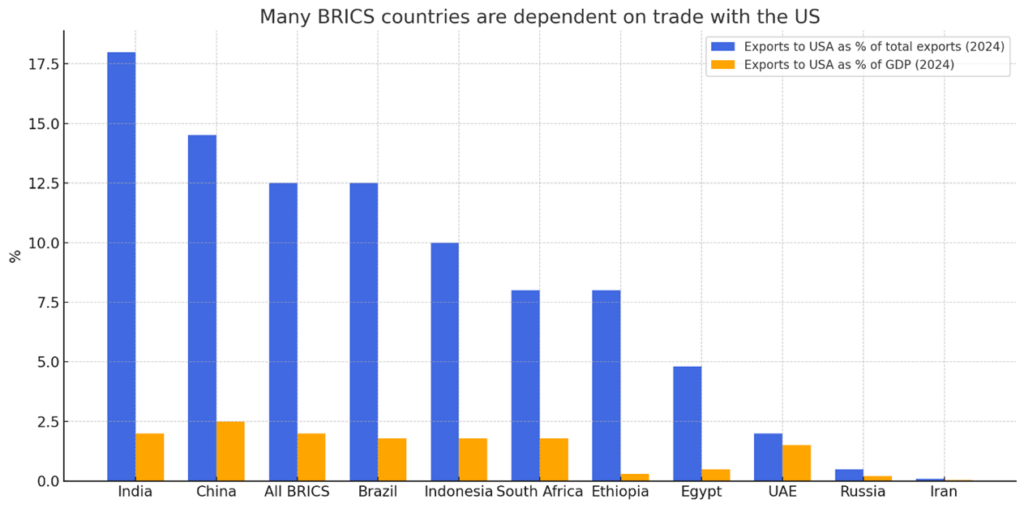
Calculated with IMF data.
Lingering Challenges and Shifting Priorities
Differences remain on issues of expansion and institutionalization: India and Brazil are in no hurry to admit new members, fearing the loss of their influence and the rise of China, while Beijing and Moscow see expansion as a way to increase the global weight of BRICS. Unlike in 2024, when the largest expansion of BRICS was observed, no final decision was made in Rio on the admission of new members: The issue of Saudi Arabia’s accession was postponed to the 2026 summit, and a working group was created to develop criteria and procedures for expansion for the future. India and Brazil are trying to balance between BRICS and the United States and the EU and are not ready for an open confrontation with the West, while Russia and Iran are taking a tougher anti-Western stance. Competition between China and India remains also, exacerbated by border disputes and the struggle for influence in the Global South: New Delhi fears Beijing’s excessive strengthening within the bloc and through its expansion. The economic models of the participants also differ significantly: China and Russia rely on state control and commodity markets, while India, Brazil and South Africa are focused on liberal market approaches and attracting Western investment. Countries in the Middle East and North Africa—particularly Egypt, the UAE, and Saudi Arabia—are heavily dependent on Western markets, technology, and military support, while Russia and Iran are in direct confrontation with the West and are promoting alternative arrangements.
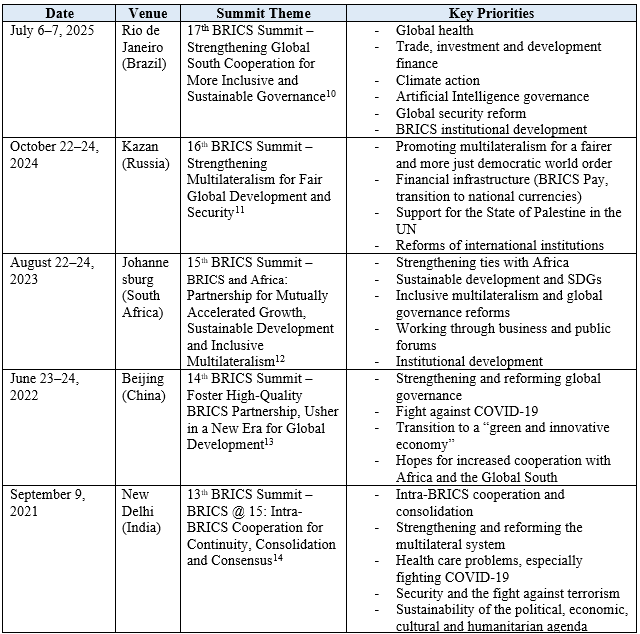
Still, even over the past five years, the agenda of the BRICS summits has undergone a noticeable evolution: While the focus in 2021 and 2022 was on combating the COVID-19 pandemic, overcoming the economic consequences of the crisis, and countering terrorism, starting in 2023, the focus shifted to broader long-term sustainable development issues, the reform of global institutions, and the promotion of multipolarity. In 2024, the tasks of institutional strengthening of the bloc, the development of its own financial and energy infrastructure, settlements in national currencies, the protection of state sovereignty, and joint actions in the security sector came to the fore.
By 2025, BRICS is trying to seize the initiative from the weakened Western liberal forces through so-called “inclusive globalization” in key areas of the global agenda—the fight against climate change, the regulation of artificial intelligence, the protection of free international trade and the building of new rules of global governance. At the same time, the association remains the main political center, mildly opposed and alternatively opposed Western countries, but avoids radical confrontation, seeking to gain a foothold as a supporting block of the Global South and one of the architects of a multipolar world. But the organization lacks its own financial infrastructure—banking and payment systems, an independent currency, etc.—as well as a security and governance circuit.
Table 1. The Agendas of the BRICS Summits, 2021–2025.
What’s Next for BRICS?
In general, the BRICS countries are still balancing on the brink of further institutional transformation and gradual fading and disappearance due to the exhaustion of a common agenda, which is aggravated by the harsh reactions of the United States to any form of geopolitical opposition. There is huge political, economic, and military potential, but there is a lack of synchronization of goals and sufficient trust. The residual historical conflicts between the BRICS countries may also hinder joint development to an extent. However, the historical confrontation between leading European states—especially France, Britain, and Germany—which lasted for centuries and resulted in two world wars and several smaller conflicts, did not become a barrier to the formation of NATO, the EU, or other forms of regional solidarity.
A significant problem within BRICS remains the lack of a clear leader ready to take on the burden of guaranteeing the security of the members of the organization and economic development. China could potentially become such a leader after achieving unconditional economic and technological leadership in the world and parity in nuclear weapons with the United States and the Russian Federation, and so could India if its economic development continues. We may, however, be entering a decade that the United States looks set to not leave to its geopolitical rivals. Moreover, if individual countries such as China, Brazil, or Russia manage to agree with the United States on their own issues, solving their key problems of bilateral relations with the United States, then the importance and necessity of the BRICS structure as an alternative platform would significantly decrease.
BRICS retains the role of a kind of club of countries cast out by the West that is trying to formulate an independent agenda and claim a leading role on the global stage. As it grows in influence, the main question is whether the bloc will be able to act as a sufficiently unified force as it continues to balance the diverse national interests of members and situationally coinciding geopolitical and geo-economic common goals. It’s obvious that the members are not yet able to realize their strategic interests in the field of security and the economy and are not ready to invest critical resources in its development, so BRICS remains a project of the future for the time being. Still, the group has huge political, economic, and military potential, and its future is promising so long as it can build sufficient unity.
Endnotes
[1] “Brazil Hosts BRICS Summit; Russia’s Putin, China’s Xi Skip Rio Trip,” Al Jazeera, July 6, 2025, https://www.aljazeera.com/news/2025/7/6/brazil-hosts-brics-summit-russias-putin-chinas-xi-skip-rio-trip.
[2] “Brazil Hosts BRICS Summit.”
[3] “BRICS Summit Rio De Janeiro 2025: A New Impetus for Multipolarity?,” Diplomat Magazine, July 13, 2025, https://diplomatmagazine.eu/2025/07/13/brics-summit-rio-de-janeiro-2025-a-new-impetus-for-multipolarity/.
[4] “BRICS Summit Signs Historic Commitment in Rio for More Inclusive and Sustainable Governance,” BRICS Brasil 2025, July 6, 2025, https://brics.br/en/news/brics-summit-signs-historic-commitment-in-rio-for-more-inclusive-and-sustainable-governance.
[5] Kira Krasovskaya, “Страны БРИКС раскритиковали таможенные пошлины Трампа” [BRICS Countries Criticize Trump’s Customs Duties], Deutsche Welle, July 7, 2025, https://www.dw.com/ru/strany-briks-raskritikovali-tamozennye-posliny-trampa/a-73178815.
[6] “Fact Sheet: President Donald J. Trump Addresses Threats to the United States from the Government of Brazil,” The White House, July 30, 2025, https://www.whitehouse.gov/fact-sheets/2025/07/fact-sheet-president-donald-j-trump-addresses-threats-to-the-united-states-from-the-government-of-brazil/.
[7] Victor Reklaitis, “Trump to Penalize India for Buying Russian Oil. Here’s How Much It Purchases.,” MarketWatch, July 30, 2025, https://www.marketwatch.com/story/trump-to-penalize-india-for-buying-russian-oil-heres-how-much-it-purchases-17bf8097.
[8] Nikhil Inamdar, “India Has 20 Days to Avoid 50% Trump Tariffs – What Are Its Options?,” British Broadcasting Corporation, August 7, 2025, https://www.bbc.com/news/articles/c1w83j35jjjo.
[9] Valentina Sader and Ignacio Albe, “What Really Came Out of This Year’s BRICS Summit?,” Atlantic Council, July 8, 2025, https://www.atlanticcouncil.org/blogs/new-atlanticist/what-really-came-out-of-this-years-brics-summit/.
[10] BRICS Brasil 2025, “BRICS Summit Signs Historic Commitment.”
[11] “16th BRICS Summit Kazan Declaration 2024,” BRICS Think Tank Council, October 2024, https://bricsthinktankscouncil.org/knowledge-base/16th-brics-summit-kazan-declaration-2024/.
[12] “BRICS Johannesburg II Declaration (XV Summit, 2023),” Glostat, October 22, 2025, https://www.glostat.com/documents-international-organizations/brics-johannesburg-declaration-xv-summit-2023/
[13] “14th BRICS Summit Beijing Declaration (2022),” BRICS Think Tank Council, June 2022, https://bricsthinktankscouncil.org/knowledge-base/14th-brics-summit-beijing-declaration-2022/.
[14] “13th BRICS Declaration_New Dehli (2021),” BRICS Think Tank Council, September 2021, https://bricsthinktankscouncil.org/knowledge-base/13th-brics-declaration_new-dehli-2021/.