
BRICS versus Trump: Maneuvering in the Multipolar World Order

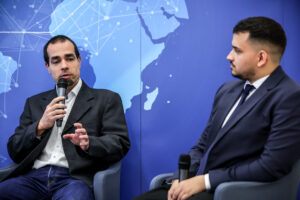
On June 24, 2025, the Hungarian Institute of International Affairs held a roundtable discussion titled “BRICS versus Trump: Maneuvering in the Multipolar World Order”. The discussion featured Ádám Csenger of the Oeconomus Economic Research Foundation, alongside Ramachandra Byrappa and Zsolt Reile, Senior Research Fellows at the Hungarian Institute of International Affairs. The event was moderated by Dániel Lévai, Research Fellow at HIIA.
The session began by addressing the fundamental question: What is BRICS? While the speakers agreed that BRICS does not function as a formal institution, they described it as a loose grouping of countries dissatisfied with the Western-dominated world order. Ádám Csenger characterized BRICS as a symbolic alternative, lacking a unified structure or secretariat. Zsolt Reile emphasized that these are “aspiring nations” seeking a fairer share of the global economy, particularly with support from China. Ramachandra Byrappa framed BRICS as a lobbying force aimed primarily at reforming the United Nations.




Much of the conversation centered on the strategic implications of BRICS and its potential impact on the global order. Csenger noted that while BRICS countries have benefited from globalization, they now seek either to reform or replace existing power structures. He cited U.S. concerns about de-dollarization, who warned against the emergence of a BRICS currency. Byrappa pointed out that de-dollarization is occurring more in favor of the euro, and that India, for example, has no real structural interest in pushing a BRICS currency.
The discussion also touched on the foreign policy outlook of key BRICS members. The panelists agreed that many BRICS nations, including Brazil and Saudi Arabia, are pursuing a balancing act between maintaining ties with the West while engaging China. Ramachandra Byrappa noted that Brazilian President Lula da Silva, a social democrat who advocates for fairness and regional integration, stands in stark contrast to Trump’s aggressive and intrusive foreign policy style. While Trump has taken a confrontational approach in places like Canada and Panama, Lula seeks closer cooperation across the Americas, making him a potential obstacle to Trump’s influence in the region.
On the Middle East, the panelists noted that BRICS has not spoken with one voice regarding the recent 12-day conflict between Israel and Iran. While Russia condemned Israel’s actions, it also acknowledged the presence of a large Russian population in Israel. Iran, meanwhile, expected stronger support from Russia, but practical considerations, like the cost of closing the Strait of Hormuz, have limited escalation.
Looking ahead to the upcoming BRICS summit in Rio de Janeiro, Brazil, the experts anticipated a focus on social and environmental priorities, such as poverty reduction and rainforest protection. Unlike the more politically charged 2024 summit in Kazan, the Brazil summit is expected to emphasize development topics, steering away from contentious geopolitical debates. Overall, the panelists concluded that while BRICS positions itself as a challenge to Western dominance, its internal fragmentation will continue to limit its global impact.
Overall, the experts concluded that although BRICS is positioning itself as a challenger to Western hegemony, its internal divisions continue to limit its global influence.