
Attack on Venezuela and the Removal of Maduro from Power: The Trump Doctrine in Action

Perspective – Written by Bailey Schwab
The full analysis is available here.
On January 3, 2026, the United States launched military strikes against Venezuela and removed its leader, Nicholas Maduro, from power. Operation Absolute Resolve, the attack’s codename, involved 150 aircraft, bombers, and fighters from the U.S. Navy, Air Force, and Marine Corps launching strikes from over twenty different bases on land and sea across the western hemisphere. Chairman of the Joint Chiefs of Staff, General Dan Caine, announced in the press conference that the operation included the use of F-22’s, F-35’s, F-18’s, Apache helicopters, and B-1 bombers, as well numerous remotely piloted drones. CBS News reported that it was the U.S. Army’s elite unit, Delta Force, that was responsible for the capture and extradition of Maduro to the United States.
This bold and successful strike against the Venezuelan regime did not occur in a vacuum. It was the logical conclusion of the Trump administration’s comprehensive shift in approach to dealing with the western hemisphere. It represents yet another, but much more explicit, assertion of power in that region. And, as Donald Trump argued out in the press conference after the operation, it was consistent with fundamental principles of U.S. foreign policy established two centuries ago. The Trump Doctrine both repudiates what the administration considers to be redundant frameworks employed by his predecessors in their execution of U.S. foreign policy as well as declaring its consistency to age-old wisdom and doctrine about how the U.S. should act in the world which recent administrations have neglected. While Trump legitimised the use of force against the Venezuelan communist regime by asserting its leader to be a narco-terrorist, overseeing drug-running groups such as Cartel de los Soles which have been recently named as ‘foreign terrorist organisations’ that are bringing drugs into the United States and killing its people as a consequence, this does not fully explain the reasons Trump authorised the strike.
To better explain the operation, a deeper delve into the guiding principles of Trump’s foreign policy are needed. While every major principle will be dealt with in a subsequent report, there is one in particular that must be dealt with. Namely, the reinvigoration and reassertion of U.S. power in the western hemisphere as part of a broader concerted and global effort to maintain American global leadership in the face of great power competition and encroachments in strategically significant regions by those powers, particularly China.
The Trump Corollary to the Monroe Doctrine
In 1823, President James Monroe outlined America’s unwillingness to accept European conquest in the western hemisphere. This came to be known as the Monroe Doctrine. Under the Trump Doctrine, the western hemisphere is still America’s backyard. Just like the Roosevelt Corollary to the Monroe Doctrine which stated the U.S. could intervene in the affairs of Latin American countries if they engaged in activity that undermined American interests, the Trump 2.0 administration’s 2025 National Security Strategy asserted what it called a Trump Corollary to the Monroe Doctrine which aims to ‘restore American pre-eminence in the Western Hemisphere, and to protect our homeland and our access to key geographies throughout the region.’ Previous national defence and security strategies all proclaimed the western hemisphere to be the most important concern for American security. However, in terms of prioritisation of resources and military presence, the hemisphere ranked much lower than other regions, such as the Middle East or Europe. This has changed under Trump.
Recent deployments to Latin America throughout 2025, and particularly the Caribbean area, have included large ships with great firepower; a surge in the number of military personnel which have continued growing throughout the year, stationed in places such as Puerto Rico and Guantanamo Bay in Cuba; ten F-35s deployed to Puerto Rico in September, consisting of pilots and hundreds of ground support personnel; around 150 special operation troops aboard the afloat staging base, MV Ocean Trader; and the aircraft carrier USS Gerald Ford which has aboard 4,500 sailors and the three destroyers escorting the carrier holding 320 sailors.
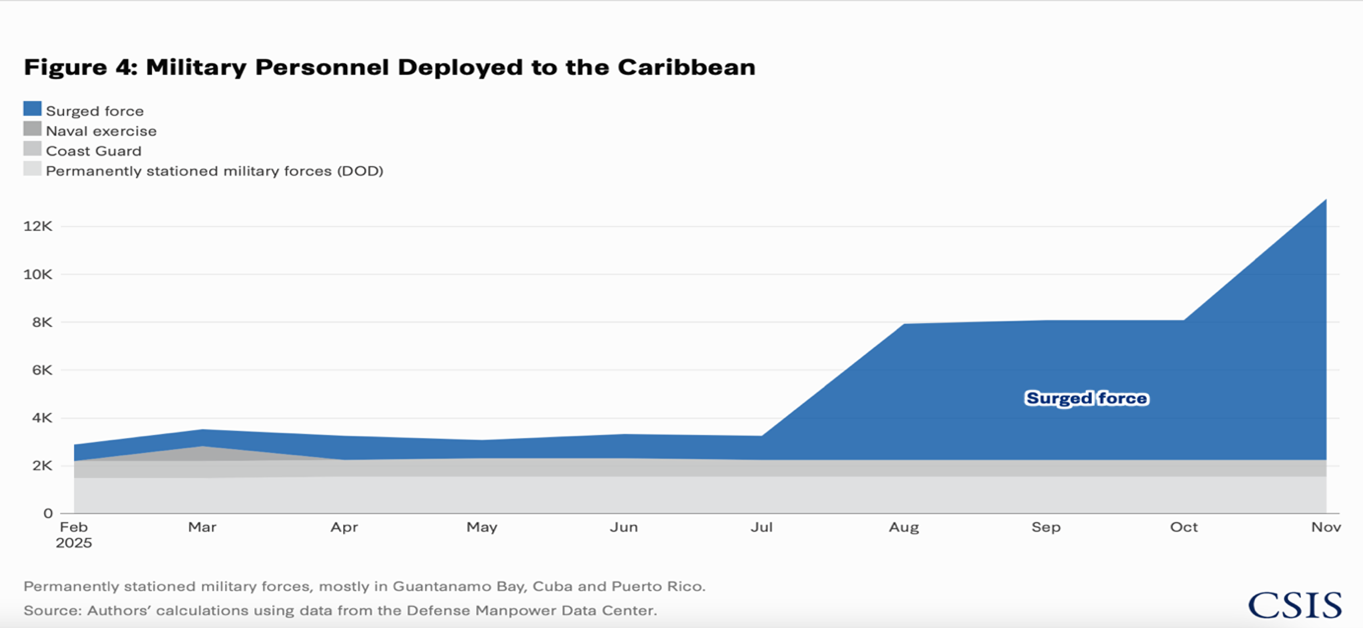
Evidently, the Trump administration’s approach to the hemisphere is informed by a reinvigoration of previous American security and military doctrine toward the Americas, which is itself motivated by three priorities: to target drug smugglers, primarily through lethal force and to legitimise this method through new legal concepts; to ensure access to critical and strategic resources, such as oil and rare earths, as well as preventing hostile foreign powers from making inroads into the hemisphere; and to strengthen the U.S. border to prevent mass migration which is seen as a primary threat to American civilisation.
On the tackling of drug smuggling, in November 2025, Secretary of War Pete Hegseth announced Operation Southern Spear, led by the Joint Task Force Southern Spear and U.S. Southern Command, which aimed to “defend our Homeland, remove narco-terrorists from our Hemisphere, and secure our Homeland from the drugs that are killing our people.” A few days prior to this announcement, the U.S. had sent it largest aircraft carrier, the USS Gerald Ford, to Caribbean waters. The deployment of the USS Gerald Ford was seen to enhance Washington’s ability to target drug smugglers which the administration has now labelled as ‘narco-terrorists’ and ‘foreign terrorist organisations.’ These newly employed legal terms, similar to ‘enemy combatant’ during the George W. Bush administration’s War on Terror to justify the torture of detainees, are being used by the Trump administration to pre-emptively kill anyone suspected of transporting illicit narcotics; which has been controversial domestically. It is clear that the Trump administration is serious about reasserting American power in the region.
Another critical priority of the administration in the hemisphere is securing access to strategic resources. In turn, the administration has been concerned about China embodying itself in Latin America’s institutional architecture. For example, in 2025 the Andean Community admitted China as an observer which has further contributed to consolidating China’s position as a key partner in Latin America in what its inhabitants see as the search for autonomy and development. The Andean bloc has abundant lithium, copper, and agricultural exports which fits into Beijing’s approach to development in the developing world. Such a framework allows China to pursue its supply chains ambitions and promoting its image as a partner in sustainable development. Furthermore, Beijing’s presence in Latin America has also seen it try to cultivate military ties with regional partners through arms sales, officer exchanges, training programmes, and joint exercises.
These developments are direct threats to American dominance over the western hemisphere that the Trump Doctrine is trying to reassert. Ceding the hemisphere to any foreign power would repudiate America’s longest standing doctrine that stated any intervention from foreign powers in the western hemisphere would be considered an act of war against the United States. This is compounded by the fact that Latin America has the world’s largest oil reserves, 31% of the world’s fresh water, over 50% of the world’s soybeans, 60% of the world’s lithium, and is abundant in gold, copper, and silver. As a result, the November 2025 National Security Strategy declared that after years of neglect, the United States ‘will deny non-Hemispheric competitors the ability to position forces or other threatening capabilities, or to own or control strategically vital assets, in our Hemisphere.’
Lastly, is the protection of the southern border; not only from drugs but from mass migration (which sometimes do go hand in hand). In the Heritage Foundation’s ‘Project 2025’ report, many of the authors of which Trump nominated to fill key governmental positions and thus described by critics as “the right-wing wish list for Trump’s second term,” it reasserted the need to strengthen border protection operations as a matter of national security. Border protection, the authors argued, “requires sustained attention and effort by all elements of the executive branch.” This has involved a strategic manoeuvring of America’s bureaucracy. For example, aligning the Department of War and the Department of Homeland Security to improve American infrastructure and border security. Moreover, Trump has employed emergency powers to deploy troops to the border and he has invoked the 18th century Alien Enemies Act to justify deportations of migrants.
Operation Absolute Resolve
After Trump bombed Iran’s nuclear facility in June 2025, Vice President J.D. Vance outlined his definition of the Trump Doctrine thusly: “What I call the Trump Doctrine is quite simple: Number one, you articulate a clear American interest and that’s, in this case, that Iran can’t have a nuclear weapon…Number two, you try to aggressively diplomatically solve that problem. And number three, when you can’t solve it diplomatically, you use overwhelming military power to solve it and then you get the hell out of there before it ever becomes a protracted conflict.” Rarely in American history do administrations publicly declare their presidential doctrine by name. When they do, it is to outline a set of criteria to legitimise the use of force within a broader communicatory effort to convey a repudiation of what they purport to be redundant practices and frameworks employed by their predecessors to deal with a specific issue.
Within this broader context, then, this high-risk attack on Venezuela and the removal of Maduro does three things. Only time will tell whether or not they will be successful in the long-term. Firstly, it decisively reasserts American military primacy in the Western Hemisphere. Operation Absolute Resolve demonstrated that the United States retains the capability and political will to conduct large-scale, multi-domain operations in its near abroad with speed, precision, and overwhelming force. By integrating fifth-generation aircraft, strategic bombers, special operations forces, and forward-deployed naval assets, the operation served as a live demonstration of U.S. escalation dominance. The message was not only directed at Caracas, but at any regional and/or extra-hemispheric power considering testing American resolve. In this sense, Venezuela became the proving ground for the Trump Corollary to the Monroe Doctrine: a doctrine no longer merely declaratory but enforced through action.
Secondly, the operation functioned as a strategic denial mechanism against Chinese (and, to a lesser extent, Russian and Iranian) influence in Latin America. Maduro’s Venezuela had increasingly aligned itself with Beijing through energy agreements, infrastructure projects, arms purchases, and debt arrangements that effectively mortgaged future Venezuelan resources. Removing the regime disrupted a key node in China’s Western Hemisphere strategy and signalled that Washington is no longer willing to tolerate adversarial powers embedding themselves in strategically vital states through economic statecraft alone. This is in accordance with the principles of the Monroe Doctrine, the seminal statement of U.S. foreign policy. From this perspective, the attack should be understood less as a counter-narcotics operation and more as a move within the broader framework of great power competition. Further, as one aimed at preventing the consolidation of a hostile, China-aligned bloc in the Caribbean basin.
Thirdly, the operation sought to redefine the legal and normative boundaries of U.S. action in the hemisphere. By framing Maduro simultaneously as a narco-terrorist, a foreign terrorist leader, and the head of a criminal enterprise responsible for American deaths, the Trump administration fused counterterrorism, counter-narcotics, and national defence into a single operational justification. This fusion is central to the Trump Doctrine. It collapses the distinction between war and law enforcement, external threats, and internal security, and in doing so lowers the political and legal threshold for the use of force. The operation thus sets a precedent: future interventions in the hemisphere may be justified not as regime change per se, but as homeland defence operations conducted beyond U.S. borders.
Conclusion
Taken together, these three effects illustrate why the strike against Venezuela cannot be understood as an isolated episode. It represented the culmination of a deliberate reorientation of U.S. strategy toward the Western Hemisphere into one that treats the region not as a peripheral concern, but as a central theatre in the contest for global power. Whether this approach ultimately produces stability, prosperity, or renewed cycles of intervention and resistance remains an open question. What is clear, however, is that under Trump, the Monroe Doctrine has been revived not as history, but as policy. And it is being enforced not by rhetoric, but by force.