
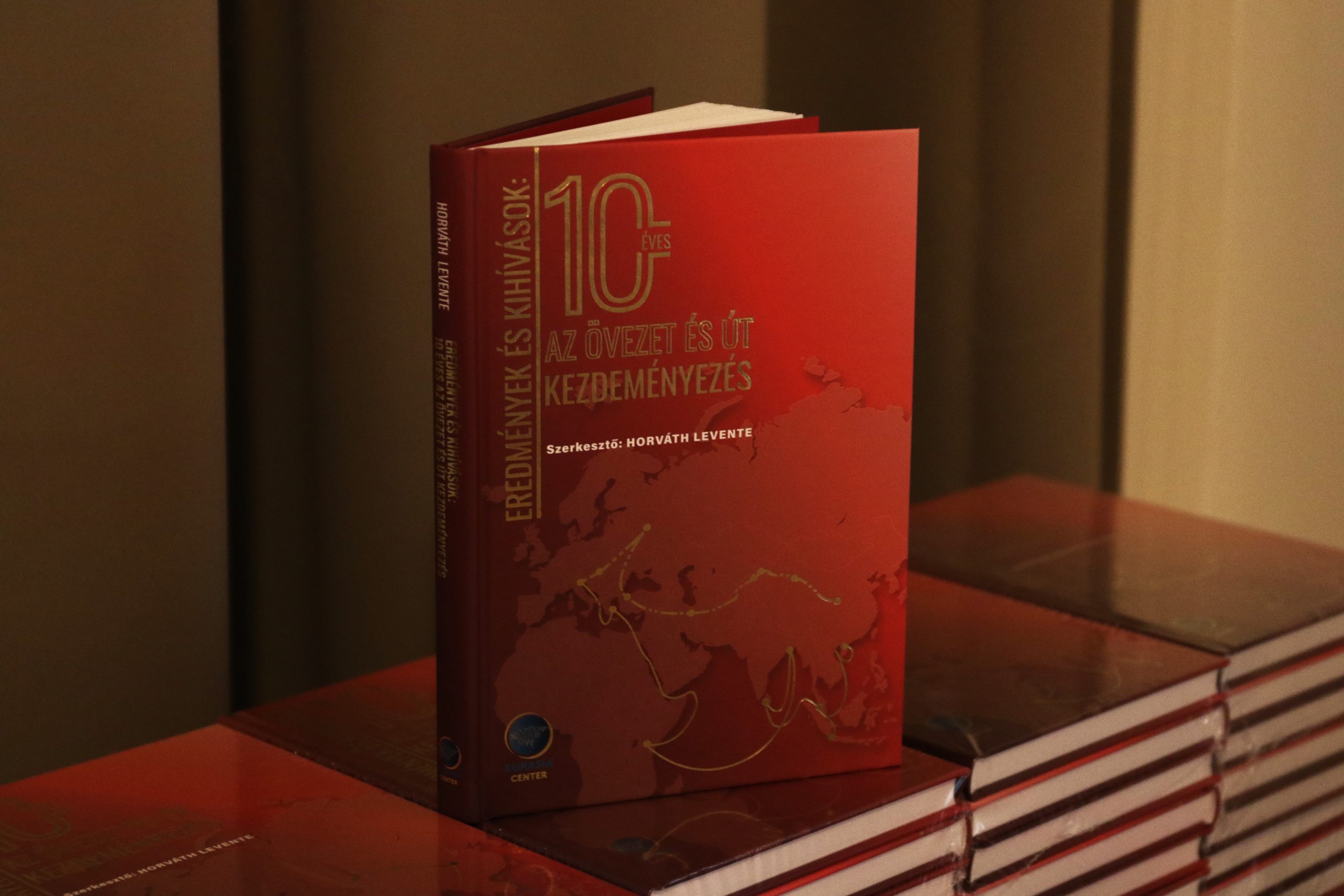
China has launched its grand strategy, the Belt and Road Initiative (BRI) 10 years ago. On the occasion of the anniversary, a roundtable discussion was held on the 26th of September by the Hungarian Institute of International Affairs (HIIA) with the participation of leading China experts. The participants of the event were Sándor Kusai, lecturer at Pázmány Péter Catholic University, Viktor Friedmann, head of the Department for International Studies at the Budapest Metropolitan University, and Viktor Eszterhai, Research Director of HIIA. The discussion was moderated by Gergely Salát, senior researcher at HIIA.
How to define the Belt and Road Initiative? was the first question of the discussion. The experts agreed that over the past ten years, the initiative has gradually evolved into a strategy, but it originally started out as a vision and a domestic political slogan. The following question concerned which China-led projects have been implemented within the framework of the Belt and Road Initiative. “It’s difficult to tell, because almost anything can be attached to the BRI” – said Mr. Friedmann, adding that the initiative has been particularly successful in Southeast Asia, where significant infrastructure investments have been made. According to Mr. Eszterhai, the Chinese initiative has achieved results where it provides an alternative to Western sources.
The conflict between the West and China was a central issue of the discussion. According to Mr. Kusai, the goal of the Belt and Road Initiative is to ensure that “not all roads lead to Rome, but new roads should also lead to Beijing.” This raised the question of whether China can offer a fairer model than the current world economic system, or if it is simply trying to shift the system’s center of gravity within the classic “core-periphery ” structure. Mr. Eszterhai stated that a main principle of the BRI is to provide a “Win-Win” situation for both parties to benefit from the cooperation. “But the point is, which one of the parties gains a bigger win” – Mr. Eszterhai added. In this regard, Mr. Kusai pointed out that the center-periphery structure of the system has been the reality for the past centuries. Thus, it is a utopian idea, that either China or any other player could offer an alternative.
Where does Hungary fit into this system? Does the emerging multipolar world order present opportunities or challenges? According to Mr. Eszterhai, Hungary should not overestimate the opportunities offered by the Belt and Road Initiative, but it should be looked at as an alternative source from Budapest. “However, the question arises of how much room a country has for foreign policy maneuvering, and one must be aware of the cost if certain doors close” – responded Mr. Friedmann. He emphasized the risks inherent in competing with great powers. Responding to Hungary’s position, Mr. Kusai stated that although Hungary’s room for maneuver is narrowing in the changing world order, it would be a mistake to decouple from China. In recent times, countries like Finland and Singapore have undertaken mediator roles between major power blocs, successfully taking advantage of the arising opportunities.